
I. The Savior Seen Through the Words of the Prophet
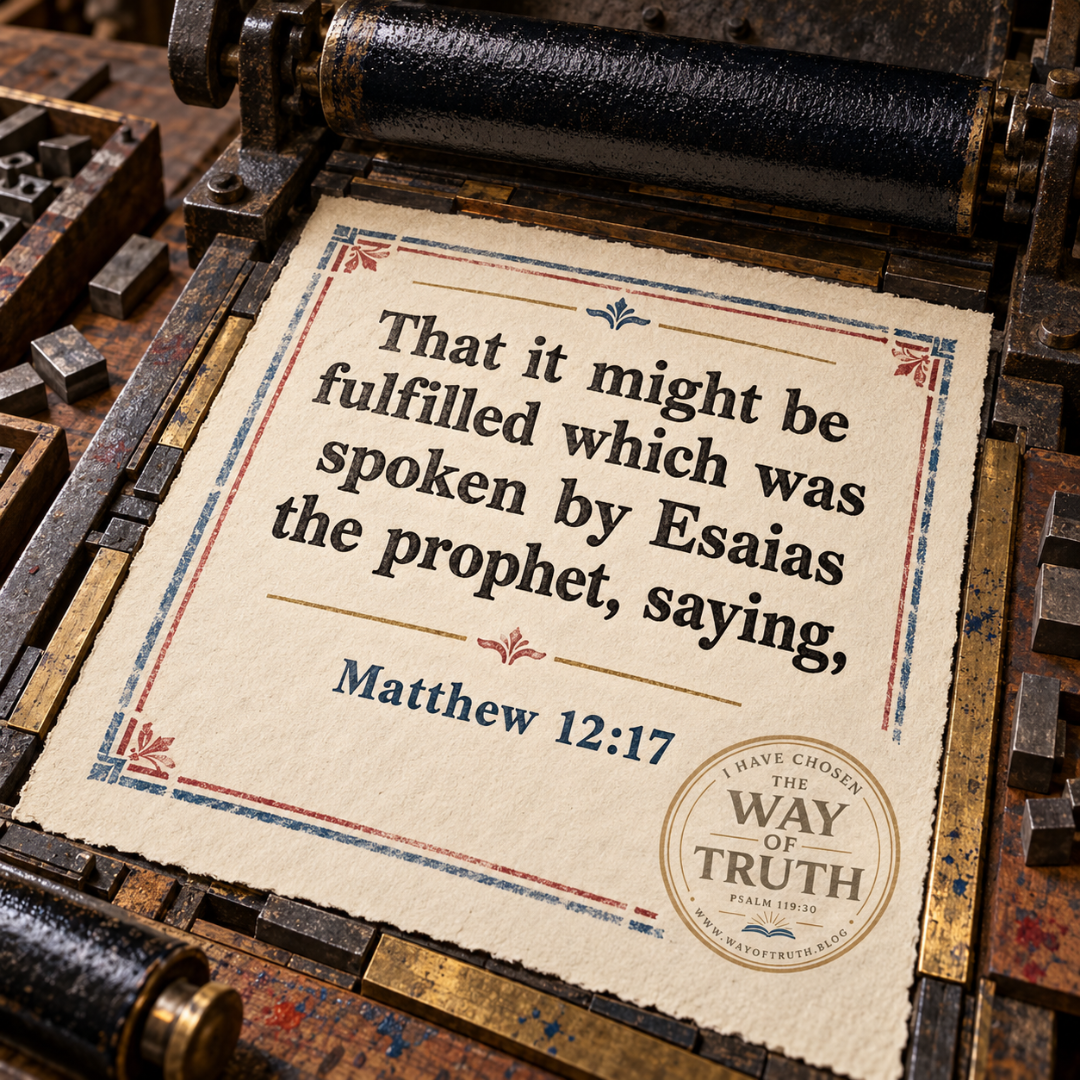
Matthew 12:17 is one of those verses we might be tempted to hurry past. It doesn’t contain a miracle, a command, a promise, or even the prophecy itself. It’s essentially an introduction to the quotation that follows. But Matthew didn’t put it here merely to connect two paragraphs.
After describing what Jesus did, Matthew pauses and tells us how we should understand what Jesus did. The events unfolding before the crowds weren’t random episodes in the life of an unusually compassionate teacher. They belonged to something God had revealed centuries earlier through Isaiah. Matthew wants us to see Jesus through the lens of Scripture.
A. “That It Might Be Fulfilled”
The word “fulfilled” is enormously important in Matthew’s Gospel. Repeatedly, Matthew draws a line from the Old Testament promise and the person and ministry of Jesus Christ. Events that might otherwise seem ordinary suddenly take on much greater significance because Scripture had already prepared the reader to recognize them.
That’s exactly what happens here. The Pharisees had gone out and “held a council against him, how they might destroy him” (Matthew 12:14). Jesus knew what they were planning, withdrew from the area, continued healing those who followed Him, and then “charged them that they should not make him known” (Matthew 12:16).
Someone watching only the surface of events might wonder why the Messiah would behave this way. Why withdraw? Why avoid confrontation? Why tell people not to publicize His miracles? Matthew answers by referring to Isaiah. “That it might be fulfilled which was spoken by Esaias the prophet.”
The quietness of Jesus’ ministry at this moment wasn’t evidence that He lacked authority. It was evidence that He was precisely the kind of Messiah God had promised. The verses immediately following Matthew 12:17 quote Isaiah’s description of God’s Servant. Among other things, Matthew will tell us: “He shall not strive, nor cry; neither shall any man hear his voice in the streets” (Matthew 12:19). Jesus wasn’t failing to behave like the Messiah. Human expectations about the Messiah were failing to account for what Scripture had actually said.
B. God Had Already Described His Servant
Matthew identifies the source plainly: “Esaias the prophet.” Isaiah had written centuries before the earthly ministry of Christ. Yet Matthew shows that Isaiah’s prophecy found its fulfillment in the life and ministry of Jesus. That says something important about biblical prophecy.
Prophecy isn’t merely fortune-telling dressed in religious language. Biblical prophecy reveals God’s purposes in history. Sometimes it predicts specific events. Sometimes it paints a larger portrait of the person or work God will eventually reveal. In Isaiah 42, God describes His chosen Servant, His character, His mission, and the way He’ll carry it out.
Then Jesus comes. Matthew looks at Him and says, in effect, This is the One Isaiah was talking about. Matthew is showing that Christ fits the prophetic portrait. His gentleness, restraint, ministry, and mission all fit. And as the Gospel continues, even His rejection, suffering, death, and ultimate triumph will fit the larger testimony of Scripture. God wasn’t improvising.
C. Scripture Tells Us What Events Mean
There’s another lesson tucked into Matthew’s method. Matthew doesn’t merely report what happened. He interprets what happened by appealing to God’s Word. We naturally interpret events through our expectations. The disciples sometimes did it. The crowds did it. The Pharisees certainly did it. Everyone could see the same Jesus while reaching very different conclusions about Him. Matthew brings us back to the proper standard. What has God said?
If our expectations of Christ conflict with Scripture, Scripture wins. That sounds obvious until Jesus doesn’t behave as we expect Him to. Some wanted a Messiah who would immediately confront Rome. Others were fascinated by miracles. Religious leaders expected Him to conform to their understanding of the Sabbath. Crowds could easily become excited about His power without understanding His mission. But God had already told Israel something about His Servant.
So, Matthew doesn’t ask us to decide what sort of Messiah we would prefer. He tells us to recognize the Messiah God actually promised. That principle extends far beyond this passage. Christianity isn’t built by imagining the God we would like to exist and then giving Him biblical vocabulary. We begin with revelation. God tells us who He is, who Christ is, and what salvation is. Our task is to believe Him.
D. God Spoke Through the Prophet
Matthew’s wording also quietly reinforces the nature of Scripture. The prophecy was “spoken by Esaias the prophet.” Isaiah was a real man speaking within a real historical setting. Yet Matthew treats his words as part of God’s unfolding revelation, carrying significance that reached far beyond Isaiah’s own lifetime.
This reflects the Bible’s own understanding of inspiration. God didn’t override the personalities, vocabulary, history, or circumstances of biblical writers. He spoke through them. Peter would later explain: “For the prophecy came not in old time by the will of man: but holy men of God spake as they were moved by the Holy Ghost” (2 Peter 1:21).
Matthew therefore doesn’t treat Isaiah as an interesting ancient religious thinker whose ideas happened to resemble Jesus. Isaiah was a prophet. God had spoken. And God had now acted consistently with what He had revealed.
That connection between promise and fulfillment is one reason biblical prophecy contributes to our confidence in Scripture. The Bible tells one unfolding redemptive story across centuries, authors, kingdoms, cultures, and circumstances, yet its central movement converges upon Jesus Christ.
E. Fulfillment Is More Than Hunting for Predictions
There’s a careless way to approach prophecy that this verse doesn’t encourage. We shouldn’t treat the Bible as though every Old Testament sentence were a secret code predicting some later event. Context matters. Isaiah 42 had meaning to Isaiah’s original audience. The passage belongs within Isaiah’s larger presentation of the Servant of the LORD and God’s redemptive purpose. Matthew isn’t ignoring that context. He’s showing where that prophetic portrait ultimately leads.
This also answers a common skeptical objection. Critics sometimes suggest that New Testament writers simply searched the Old Testament for vague phrases that they could attach to Jesus afterward. But Matthew’s argument is much richer than that.
The prophecy he’s about to quote describes the character and mission of God’s Servant. Matthew has just shown Jesus behaving exactly in keeping with that description. The connection isn’t manufactured from a stray phrase. It arises from the larger portrait. And that portrait will continue to unfold.
F. More Than Merely a Servant
The language Matthew is about to quote from Isaiah identifies Christ as God’s “servant.” Some groups have used biblical descriptions of Jesus as a servant to argue that He must therefore be merely a created or inferior being. That doesn’t follow. Being a servant describes Christ’s role in carrying out the Father’s saving purpose. It doesn’t settle the question of His divine nature.
The same Gospel has already called Him “Emmanuel, which being interpreted is, God with us” (Matthew 1:23). Matthew will later record His disciples worshipping Him and will conclude with the risen Christ claiming: “All power is given unto me in heaven and in earth” (Matthew 28:18). Scripture must interpret Scripture.
The wonder of Christ’s servanthood isn’t that He was merely a servant. It’s that the glorious Son willingly took the servant’s place to accomplish the Father’s will. And Matthew 12:17 prepares us to look more closely at that Servant.
II. Learning to See God’s Work Through God’s Word
Matthew 12:17 gives us a valuable habit for Christian living: learn to interpret reality through Scripture instead of forcing Scripture through our expectations.
A. Let God’s Word Correct Our Expectations
People around Jesus saw the same events but interpreted them differently. The Pharisees saw a threat. The crowds saw a miracle worker. Matthew saw prophecy being fulfilled. The difference was Scripture.
We face a similar danger whenever we build expectations about God from culture, tradition, emotion, popular teaching, or our own preferences and then become disappointed when God doesn’t behave according to the script we’ve written for Him.
Sometimes we need to exchange the question, “Why isn’t God doing what I expected?” for the more important question, “What has God actually promised?” He never promised that obedience will make life easy. He promised that His grace will be sufficient. He hasn’t promised that faithfulness will always receive applause. He promised that our labor in Him isn’t in vain. He hasn’t promised to explain every providence immediately. He’s given us enough truth to trust His character while we wait.
Scripture steadies us because it moves our confidence away from our interpretation of circumstances and anchors it in what God has actually said.
B. Don’t Force Every Circumstance into Prophecy
There’s an opposite error worth avoiding. Matthew could say, under divine inspiration, that an event fulfilled Isaiah. We should be much more cautious before making similar claims ourselves. Not every unexpected news story fulfills a biblical prophecy. Not every personal setback is a coded biblical prediction. And not every headline needs to be squeezed into Revelation.
We should read prophecy seriously, but also humbly. The goal isn’t to make ourselves experts at identifying secret connections. It’s to see more clearly the faithfulness of the God who keeps His Word.
C. Make Scripture Central to the Church’s View of Christ
Christ must be presented as Scripture presents Him. The Church doesn’t have permission to reinvent Jesus for each generation. We shouldn’t reshape Him into a political mascot, motivational coach, social reformer, therapeutic counselor, prosperity dispenser, or vague symbol of kindness. Jesus is better than every reduced version of Him.
The Church’s calling is to open the Scriptures and proclaim the real Christ: promised by the prophets, revealed in the Gospels, crucified for sinners, risen from the dead, reigning as Lord, and coming again.
That also shapes evangelism. We aren’t asking people merely to adopt Christian values. We’re calling them to the Christ whom God has revealed. And when we tell others about Him, we can do so with confidence. Christianity didn’t appear out of nowhere. The gospel stands within God’s long-revealed plan of redemption. The Christ we proclaim is the Savior to whom the Scriptures point.
That should lead us not only to confidence, but worship. The God who promised is the God who fulfilled. The God who spoke through Isaiah is the God who sent His Son. And the more clearly we see that, the more reasonable the response becomes: Trust Him. Obey Him. Praise Him. Make Him known.
III. The Promised Savior Has Come for Sinners
Matthew’s words about fulfilled prophecy ultimately point us beyond prophecy itself. God didn’t reveal the coming Servant merely so future generations could admire the accuracy of prediction. He was announcing a Savior. And we need one.
Scripture says: “For all have sinned, and come short of the glory of God” (Romans 3:23). Our deepest problem isn’t that we need better circumstances or a little spiritual improvement. We’ve sinned against a holy God, and sin brings judgment: “For the wages of sin is death” (Romans 6:23). But the God who promised salvation acted to provide it.
Jesus Christ came according to God’s redemptive purpose. He lived without sin, willingly gave Himself upon the cross, and bore the judgment sinners deserve. Scripture declares: “Christ died for our sins according to the scriptures; And that he was buried, and that he rose again the third day according to the scriptures” (1 Corinthians 15:3–4). Notice those beautiful words: “according to the scriptures.” The cross wasn’t God’s emergency response when everything else went wrong. Christ’s death and resurrection belonged to the saving purpose God had revealed beforehand.
That salvation is offered to you. You can’t earn forgiveness by becoming religious enough, moral enough, or sincere enough. Turn from your sin and place your trust in Jesus Christ. Rest your hope in who He is and what He has accomplished, not in what you can accomplish for yourself.
The Savior promised in Scripture has come. The Savior who died has risen. And the Savior who fulfilled God’s Word is completely worthy of your trust. Come to Christ in repentance and faith, receive the forgiveness and eternal life He freely gives, and live for the glory of the God who always keeps His Word.
IV. Reflection and Response
- When circumstances don’t match what I expected God to do, do I allow Scripture to correct my expectations, or do I begin questioning God because He hasn’t followed my plan?
- Are there ideas I hold about Jesus that come more from culture, tradition, politics, or personal preference than from Scripture itself?
- How does Matthew’s connection between Isaiah and Christ strengthen my confidence that God’s redemptive plan is purposeful and trustworthy?
- Am I careful to handle biblical prophecy according to its context, or am I tempted to force current events or personal circumstances into passages that don’t actually address them?
- Since God has faithfully revealed and fulfilled His saving purpose in Christ, how can I glorify Him more fully and help someone else see that Jesus is the promised Savior?