
I. The Frightening Progression of a Hardened Heart
A. The Response to Undeniable Mercy
Jesus had entered the synagogue, where a man had a withered hand. The Pharisees had asked whether it was lawful to heal on the Sabbath, not because they sincerely wanted an answer, but “that they might accuse him” (Matthew 12:10). Jesus exposed the weakness in their reasoning, reminded them of the value of human life, and declared, “Wherefore it is lawful to do well on the sabbath days” (Matthew 12:12). Then He healed the man: “Then saith he to the man, Stretch forth thine hand. And he stretched it forth; and it was restored whole, like as the other” (Matthew 12:13).
Nothing about that miracle was morally questionable. A damaged hand was made whole. A suffering man was helped. No one was harmed. No legitimate command of God was violated.
But then the Pharisees began planning how to kill Jesus. Their opposition was no longer simply an honest disagreement about how to interpret the Sabbath. Jesus had answered their challenge, exposed their inconsistency, and demonstrated His authority through an unmistakable act of mercy. Yet the evidence didn’t soften them. It intensified their hostility.
Sometimes we imagine that unbelief exists primarily because people haven’t received enough evidence. Certainly, honest questions deserve honest answers, and Scripture never condemns sincere investigation. But Matthew shows us another possibility. Evidence doesn’t automatically produce faith when the heart is determined to resist the conclusion toward which the evidence points.
The problem here wasn’t insufficient information. It was unwillingness to yield.
B. Leaving Rather Than Yielding
Matthew tells us that “the Pharisees went out.” Jesus had publicly confronted their interpretation of the Sabbath, and the miracle had vindicated His teaching. They now had a choice. They could reconsider. They could humble themselves. They could admit that their understanding had become distorted. They could ask whether the One standing before them might possess an authority greater than they’d recognized. Instead, they left.
Matthew doesn’t tell us that they went outside to pray, search the Scriptures, reconsider the evidence, or speak privately with Jesus. They withdrew so they could organize opposition against Him. Correction had become confrontation. Conviction had become resentment. And resentment was moving toward violence.
There’s an important distinction here. Being wrong isn’t the same thing as being hardened. Every believer misunderstands things at times. We all need correction. The danger begins when protecting our position becomes more important than knowing the truth. A teachable person can say, “I was wrong.” A hardened person starts looking for ways to silence whatever proves them wrong.
C. Opposition Becomes Deliberate
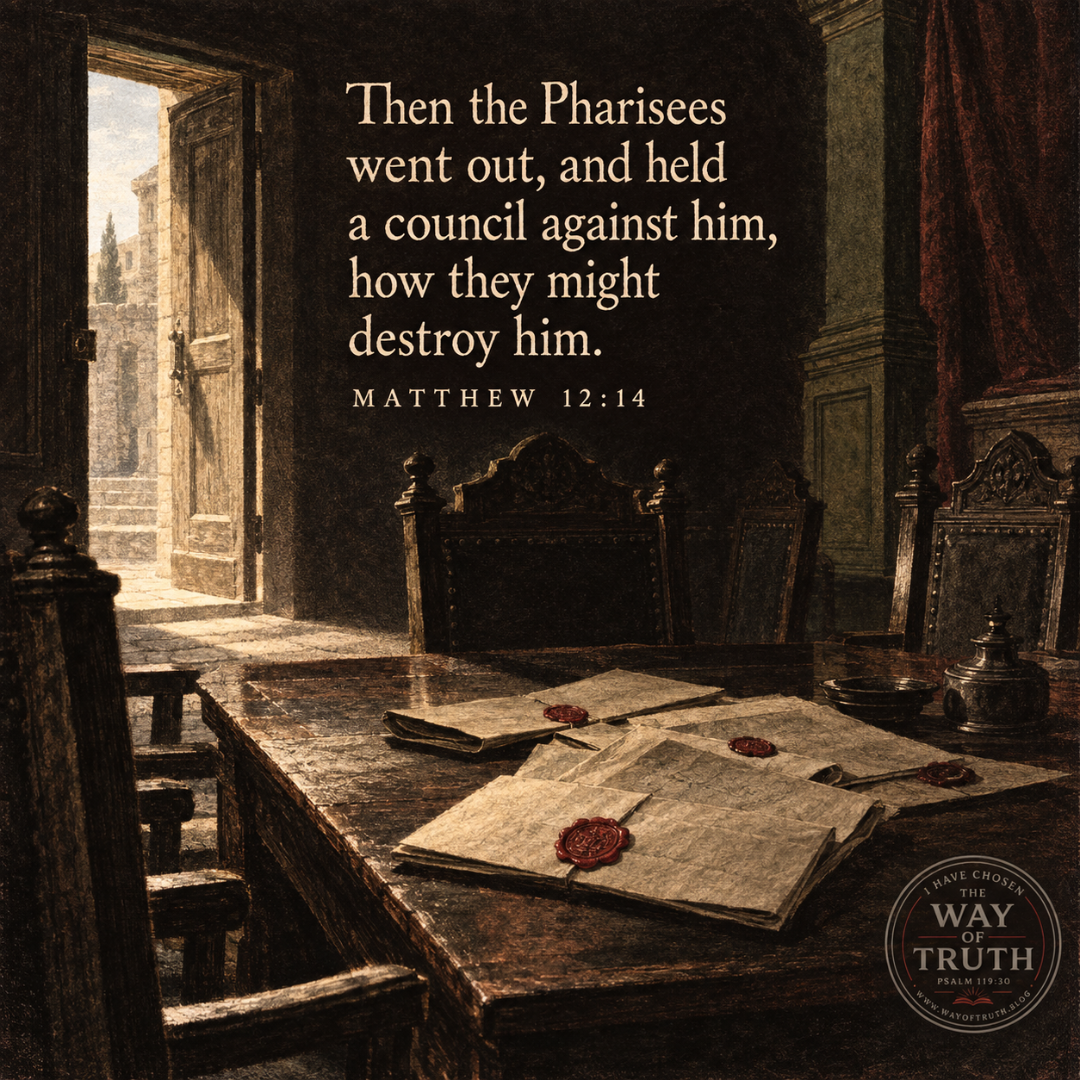
The Pharisees “held a council against him.” This was no momentary outburst of frustration. Matthew presents intentional action. They discussed what to do about Jesus.
Mark adds another remarkable detail: “And the Pharisees went forth, and straightway took counsel with the Herodians against him, how they might destroy him” (Mark 3:6). The Pharisees and Herodians were hardly natural allies. The Pharisees were deeply concerned with Jewish religious identity and tradition, while the Herodians were associated with the political order surrounding Herod’s dynasty. Yet hostility toward Jesus could bring otherwise unlikely partners together.
That pattern appears repeatedly in human history. People who disagree about almost everything can suddenly discover common ground when confronted by something they both want removed.
Luke describes the emotional condition accompanying the conspiracy: “And they were filled with madness; and communed one with another what they might do to Jesus” (Luke 6:11). These accounts don’t contradict one another. Matthew emphasizes the deliberate plot. Mark identifies additional participants. Luke describes the furious state of those involved. Together they give us a fuller picture of the same disturbing development.
Their religion had reached a terrible inversion. They had objected to Jesus making a man’s hand whole on the Sabbath, and now they were planning to take a man’s life. They were disturbed by an act of mercy while contemplating murder. Something had gone terribly wrong.
D. The Conflict Escalates
Matthew doesn’t soften their intention. They were discussing “how they might destroy him.” They wanted Jesus dead.
The conflict that’s been developing throughout Matthew has now reached a new stage. Earlier opponents questioned Jesus. Then they accused Him. They criticized His disciples. They challenged His conduct. But here the opposition becomes explicitly lethal. The shadow of the cross is becoming longer.
But we should carefully distinguish two truths that Scripture holds together. These men were morally responsible for their hostility. God’s sovereign purpose didn’t excuse their actions or lessen their guilt. At the same time, their conspiracy couldn’t overturn God’s redemptive purpose. Later, Peter would say concerning Christ: “Him, being delivered by the determinate counsel and foreknowledge of God, ye have taken, and by wicked hands have crucified and slain” (Acts 2:23).
Notice how naturally Scripture places divine purpose and human responsibility beside each other. Christ’s death wasn’t an accident that caught God by surprise. Yet those who crucified Him acted wickedly and remained responsible for what they did.
Matthew 12:14 gives us an early glimpse of that road toward Calvary. Men begin plotting destruction. God will bring redemption. That doesn’t make their sin good. It displays the astonishing sovereignty and wisdom of God, who can accomplish His righteous purposes even through actions for which sinful people remain fully accountable.
E. When Religion Becomes Resistance to God
This verse also answers an important modern objection. People sometimes point to religious hypocrisy, cruelty, or violence and conclude that religion itself must therefore be false or harmful. Scripture is far less defensive about religious corruption than we might expect. The Bible openly exposes it.
The Bible doesn’t pretend that outward religion automatically produces righteousness. In fact, some of Jesus’ strongest confrontations were directed toward people who possessed extensive biblical knowledge yet resisted the God whose Word they claimed to defend.
The problem wasn’t that the Pharisees cared too much about God’s truth. Their problem was that human interpretations, pride, status, and resistance to Christ had displaced submission to God’s truth.
Christianity therefore doesn’t teach, “Religious people are good.” It teaches that sinners need redemption, including very religious sinners. A person can know biblical terminology, defend moral standards, attend worship, hold respected positions, and still resist God when He confronts the heart. Religious activity can’t substitute for repentance.
F. Taking Counsel Against the Lord
Matthew doesn’t explicitly quote Psalm 2 here, so we shouldn’t claim that Matthew identifies this particular meeting as a direct fulfillment of that psalm. Still, within the wider biblical story the similarity is difficult to miss: “The kings of the earth set themselves, and the rulers take counsel together, against the LORD, and against his anointed” (Psalm 2:2).
Human beings repeatedly imagine that God’s authority can be resisted successfully if enough power, influence, planning, or political cooperation is assembled against Him. Psalm 2 answers that illusion. God isn’t threatened.
Matthew 12:14 begins with men holding a council against Jesus. The Gospel will eventually lead us to the crucifixion, where Christ’s enemies appear to have achieved their goal. But Matthew doesn’t end at a tomb. The resurrection overturns the apparent victory of Christ’s enemies. The One whom men sought to destroy can’t finally be defeated.
That gives this dark little verse a larger setting. The conspiracy and hostility are real. The cross will be real. But so will the empty tomb.
II. What This Warning Means for Us
A. Guard Against the Need to Always Be Right
Most of us will never sit in a council plotting someone’s death. Matthew 12:14 nevertheless exposes a heart-pattern that can appear in much smaller and more respectable forms.
What happens when God’s Word corrects us? That’s the practical question.
We may discover that a position we defended strongly isn’t as biblical as we thought. Someone may point out an inconsistency in our behavior. Scripture may challenge something we’ve justified for years. A sermon may hit an uncomfortable nerve. Another believer may lovingly tell us something we’d rather not hear.
At that moment, we can examine ourselves honestly, or we can become defensive. The Pharisees chose defense over repentance. Their example reminds us that spiritual maturity isn’t demonstrated by never being wrong. It’s demonstrated partly by what we do when the truth shows us that we’re wrong.
A humble Christian doesn’t have to win every argument. We should want truth to win. Sometimes that means admitting, “I need to rethink this.” There’s no shame in being corrected by the Word of God. The shame would be recognizing what Scripture says and refusing to yield because our pride has too much invested in our previous position.
B. Don’t Confuse Zeal with Faithfulness
The Pharisees were serious people. They cared about religious questions. They debated matters of law. They were concerned about Sabbath observance. And they were preparing to kill the Lord of the Sabbath.
Religious intensity, by itself, proves very little. We can be passionate and wrong. We can be sincere and stubborn. We can defend a biblical principle in an unbiblical spirit.
This matters especially in an age when outrage travels quickly. Christians can become so consumed with exposing error, defeating opponents, winning debates, and defending causes that we forget the character Christ calls us to display.
Of course, truth, doctrine, and moral clarity matter. Jesus Himself confronted error plainly. But biblical faithfulness can’t be measured merely by how forcefully we oppose something. The Pharisees were forceful. What they lacked was humble submission to God. Before becoming outraged over someone else’s error, it is worth asking whether the Word of God is also exposing something in us.
C. Beware of Making an Enemy Out of Whoever Challenges You
Jesus hadn’t harmed the Pharisees. He had challenged them. Yet because His teaching threatened their conclusions and increasingly exposed their spiritual blindness, they began treating Him as someone who had to be eliminated.
Our reactions will usually be far less severe, but the same temptation can appear whenever correction feels threatening. We may stop listening to someone because they challenged us. We might question their motives, avoid them, speak badly about them, or begin interpreting everything they do in the least charitable way possible.
Matthew 12:14 warns us where unchecked resentment can lead. When someone’s truthful words irritate us, our first question shouldn’t automatically be, “What’s wrong with them?” Sometimes the better question is, “Lord, is there something here that I need to hear?”
That doesn’t mean every critic is correct. Jesus never teaches us to surrender discernment. But discernment should examine the criticism, not merely resent the critic.
D. Churches Must Never Protect Tradition at the Expense of Truth
The Pharisees were defending a religious system they believed needed protection from Jesus. Yet the tragedy was staggering: they were defending their understanding of God against God the Son standing before them.
Churches can fall into a lesser version of the same error when traditions become untouchable simply because “we’ve always done it this way.” Traditions aren’t automatically bad. Some are wise and valuable. But every tradition must remain subordinate to Scripture.
Our preferred style, denominational habits, political instincts, personal theological systems, and favorite teachers aren’t Scripture. The Church must continually allow the Word of God to examine everything else. Unity built around Christ and truth is precious. Unity built around protecting cherished assumptions from biblical examination is fragile and dangerous.
E. Respond to Opposition Like Christ, Not Like His Enemies
Believers will sometimes encounter people who strongly oppose Christian conviction. Some may mock the faith. Others may misrepresent it. In some places Christians experience genuine persecution.
Matthew 12:14 doesn’t give us permission to answer hostility with hostility. The behavior of Christ’s enemies must not become the behavior of Christ’s followers. We’re called to speak truth, defend the faith, oppose evil, and remain faithful to Scripture. But we do those things as people who belong to the crucified and risen Christ.
We don’t need to destroy everyone who disagrees with us. We want them saved. The Pharisees looked at Jesus and asked, in effect, “How can we get rid of Him?” Christians should look at those who oppose Jesus and ask, “How can we faithfully show them who He really is?” The person arguing against Christianity today may, by God’s grace, become the person proclaiming Christ tomorrow. Saul of Tarsus should keep us from writing people off too quickly.
So, we defend the truth without abandoning love. We refuse to compromise Christ’s message, but we also refuse to forget why that message is being proclaimed. We want sinners reconciled to God.
F. Let Christ’s Mercy Magnify God’s Glory
The contrast between verses 13 and 14 is almost painful. Jesus restores. His enemies plot destruction. He gives wholeness. They plan death. That contrast points us toward the character of Christ.
When we see Him showing mercy to the man with the withered hand, we’re seeing something true about the heart of our Savior. And when we later see Him walking toward Jerusalem despite knowing what His enemies intend, we see even more clearly the depth of His obedience and love. The proper response isn’t merely to shake our heads at the Pharisees. It’s to worship Christ. And that worship should overflow into witness.
Our world still contains people who misunderstand Jesus, resist His authority, or know His name only through caricatures. We have the privilege of telling them about the Christ Scripture actually reveals: holy without cruelty, authoritative without selfishness, courageous without arrogance, compassionate without compromising truth, and merciful toward sinners who could never save themselves.
The darkness of Matthew 12:14 makes the goodness of Christ shine even more clearly.
III. The One They Sought to Destroy Came to Give Life
It would be easy to stand at a safe distance from the Pharisees and say, “How could anyone see what Jesus did and still reject Him?” But Scripture doesn’t allow us to make sin merely somebody else’s problem.
The Pharisees’ hostility was an extreme expression of something that exists in every fallen human heart: resistance to God’s rightful authority. We may not plot Christ’s death, but whenever we insist upon ruling our lives apart from Him, we’re saying that we would rather have life without His rule. That’s sin. And sin carries a terrible consequence: “For the wages of sin is death; but the gift of God is eternal life through Jesus Christ our Lord” (Romans 6:23).
The remarkable news of Christianity is that the Jesus whom sinners rejected didn’t abandon them. The opposition described in Matthew 12:14 would eventually lead toward the cross. Jesus knew where His mission was taking Him. He went willingly. There He bore the judgment our sins deserve. Scripture summarizes the heart of the gospel simply: “Christ died for our sins according to the scriptures; And that he was buried, and that he rose again the third day according to the scriptures” (1 Corinthians 15:3–4).
Jesus wasn’t merely the victim of a human conspiracy. He willingly gave Himself for sinners. His enemies meant His death for destruction, but God accomplished through the cross the sacrifice by which guilty people could be forgiven.
And death didn’t have the final word. Jesus rose. The One whom men sought to destroy conquered death itself.
That means Christianity isn’t an invitation to become more religious, polish up your behavior, or try harder to earn God’s approval. The Pharisees were already intensely religious. You need something religion alone can’t provide. You need forgiveness, reconciliation with God, and a new life. And those gifts are found in Jesus Christ.
Turn from your sin and come to Him in faith. Don’t stand outside with those trying to keep Christ at a distance. Don’t allow pride, past mistakes, questions, religious disappointment, or fear of what others may think to become excuses for continuing to resist Him. Look honestly at Jesus. The One opposed by sinful men became the Savior of sinful men.
Trust Him. Receive the forgiveness He purchased through His blood. Rest your hope in His finished work rather than your own goodness. Follow Him as Lord and let the life He gives become a life lived for His glory.
The Pharisees asked how they might destroy Jesus. The far better question is this: What will you do with Him?
IV. Reflection and Response
- How do I normally respond when Scripture, a sermon, or another believer exposes something in my thinking or behavior that needs correction? Do I become defensive, or am I willing to be taught?
- Is there any tradition, opinion, personal preference, or theological assumption that I’ve allowed to become so important that I resist examining it honestly in the light of Scripture?
- When people disagree with or oppose my Christian convictions, do I primarily view them as enemies to defeat, or as people who need the truth and grace of Christ?
- How does the contrast between Christ’s mercy in Matthew 12:13 and the Pharisees’ hostility in Matthew 12:14 deepen my worship and gratitude toward Him? How can I glorify Him in response?
- Who in my life may misunderstand, resist, or simply not know Jesus, and what gracious opportunity might God give me to faithfully share the gospel with that person?