
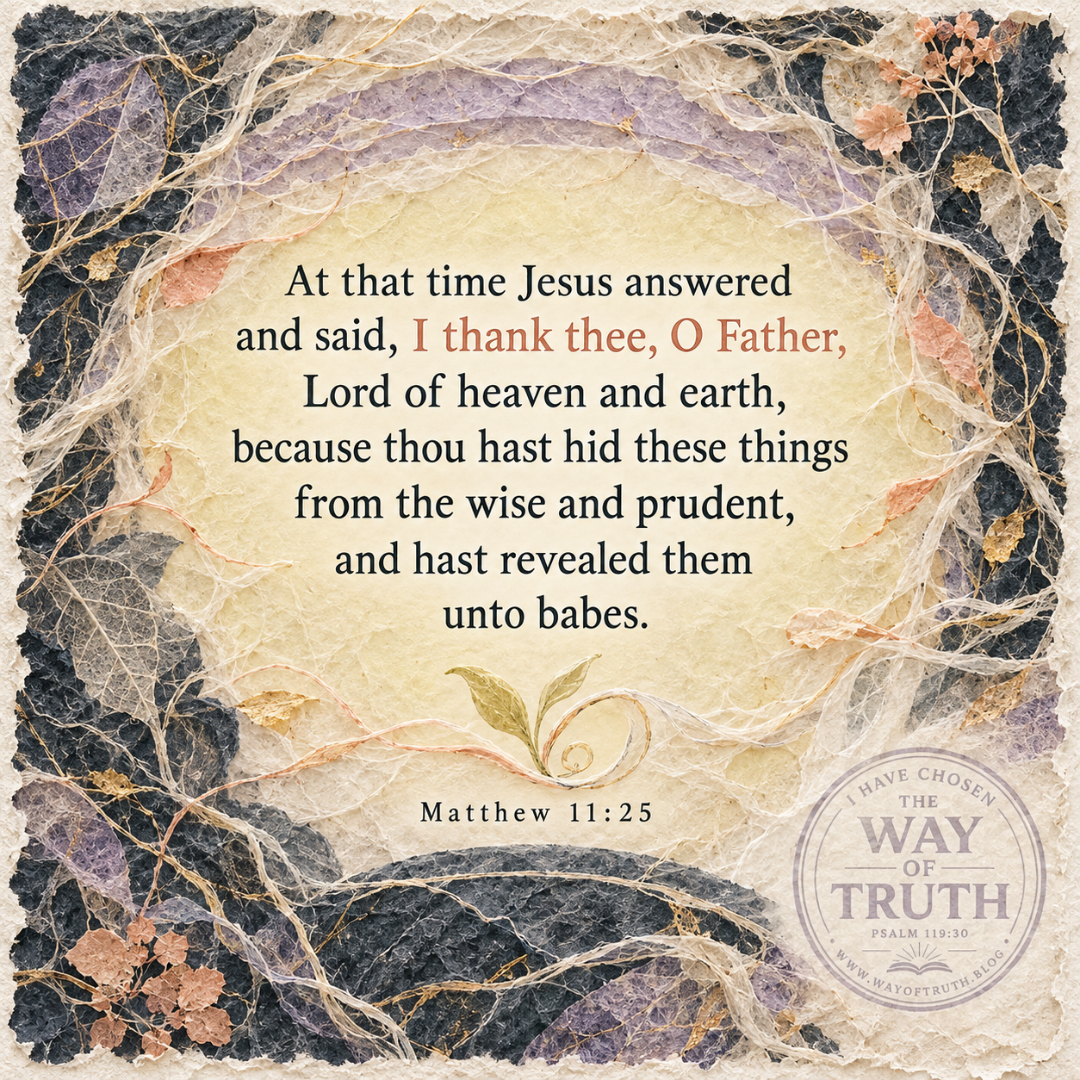
Matthew 11:25 begins with words we can easily hurry past: “At that time.” They matter because Jesus isn’t speaking in isolation. His prayer comes directly out of what has just happened.
In the preceding verses, Jesus pronounced solemn judgment upon Chorazin, Bethsaida, and Capernaum. These towns had witnessed His mighty works, yet they refused to repent. Capernaum had received extraordinary spiritual privilege. Christ had taught there. He’d performed miracles there. The evidence hadn’t been hidden away in some distant corner. Yet greater exposure to truth hadn’t produced greater faith.
Then comes a striking change in tone. Jesus turns from addressing unbelieving cities to addressing His Father: “I thank thee, O Father, Lord of heaven and earth.”
The unbelief around Him doesn’t cause Jesus to question the Father’s wisdom, goodness, or rule. He praises Him. That’s worth sitting with for a moment.
Christ has encountered rejection. People who should have recognized Him have failed to do so. Towns blessed with remarkable opportunities have remained stubbornly unmoved. Yet Jesus doesn’t respond as though God’s purposes have somehow gone off course. He looks upward and acknowledges the Father as “Lord of heaven and earth.” Nothing about the rejection of Christ threatens God’s throne.
The title Jesus uses is sweeping. The Father isn’t merely Lord of the people who believe, nor Lord only of Israel, nor Lord only of religious matters. He’s “Lord of heaven and earth.” Everything belongs beneath His authority.
Human unbelief is serious, but it’s not sovereign.
When Seeing Isn’t the Same as Understanding
Jesus continues: “because thou hast hid these things from the wise and prudent.”
At first hearing, that can sound troubling. Does God oppose wisdom? Does Christianity celebrate ignorance? Does God deliberately keep sincere people from discovering the truth? The surrounding passage keeps us from reading Jesus that way.
The people of these cities weren’t deprived of evidence. Quite the opposite. Jesus had just said that mighty works had been done among them. They’d seen what previous generations had never seen. Their blindness wasn’t caused by a lack of evidence or opportunity. They saw the works. What they failed to perceive was what those works revealed about Jesus.
A person may encounter biblical truth without submitting to it. Someone may know Christian vocabulary, understand theological arguments, possess several excellent study Bibles, listen to hundreds of sermons, and still never bow before Christ. Information can reach the mind while the heart remains stubbornly closed. That was the tragedy of Capernaum.
Jesus isn’t condemning intelligence when He speaks of “the wise and prudent.” Scripture repeatedly praises genuine wisdom. The problem isn’t knowing too much. The problem is becoming so confident in our own judgment that we refuse to be taught by God.
There’s a kind of wisdom that kneels, and there’s a kind of wisdom that can’t imagine needing to kneel. The second kind is spiritually dangerous. Paul later describes something similar: “For after that in the wisdom of God the world by wisdom knew not God” (1 Corinthians 1:21).
Human reasoning is a gift from God, but reasoning can’t sit as judge over its Creator. Our minds are meant to receive truth from God, not summon God to the witness stand and demand that He justify Himself according to whatever standards we’ve invented.
The issue in Matthew 11:25 is therefore not education versus ignorance. It’s self-sufficiency versus dependence.
The Surprising People Who Receive the Truth
Jesus contrasts the wise and prudent with another group: “and hast revealed them unto babes.” “Babes” doesn’t mean that Christians should be gullible, immature, careless thinkers, or uninterested in learning. Jesus isn’t establishing ignorance as a spiritual virtue. The picture is one of dependence.
A little child doesn’t arrive with impressive credentials. A child has nothing with which to bargain. Children receive because they’re dependent upon another to give. That makes the image perfectly suited to the grace of God.
The deepest truths of the kingdom aren’t trophies awarded to those clever enough to discover God by their own intellectual achievement. They’re truths God graciously makes known. Psalm 119:130 expresses the same principle beautifully: “The entrance of thy words giveth light; it giveth understanding unto the simple.” Notice where the light comes from. It enters from outside us.
Christian faith doesn’t begin with humanity climbing upward until we finally reach God. It begins with God making Himself known. Creation reveals His power. Scripture reveals His truth. Most gloriously, the Son reveals the Father. In the next verses Jesus will say: “Neither knoweth any man the Father, save the Son, and he to whomsoever the Son will reveal him” (Matthew 11:27).
True knowledge of God is revelation before it’s discovery. We know because God has spoken. We see because God gives light. And we come to the Father because the Son makes Him known. That leaves no room for spiritual boasting.
Grace That Humbles Human Pride
There’s something deeply humbling about Jesus’ words. We naturally like to imagine that spiritual insight says something flattering about us. Perhaps we noticed what others overlooked. Perhaps we reasoned more carefully. Perhaps we were morally sensitive enough to recognize what others rejected. Matthew 11:25 removes the pedestal.
If you recognize Jesus for who He is, you have something to be grateful for, not something to brag about. Truth is received as grace.
That doesn’t mean thinking is unimportant. Christianity has nothing to fear from careful reasoning, honest investigation, historical inquiry, or serious study. Jesus Himself reasoned from Scripture, answered objections, exposed faulty arguments, and expected His hearers to understand what God had spoken. But intellectual ability alone can’t produce spiritual sight.
A brilliant person can be blind to obvious truth because pride stands in the way. A person with very little education can see Christ clearly because they receive God’s Word with humble faith.
Education is valuable. Humility is indispensable. And having both is better than pretending we must choose between them.
Does God Hide the Truth from People?
The most difficult words in the verse remain: “thou hast hid these things.” Jesus doesn’t merely say that the wise failed to understand. He attributes both hiding and revealing to the Father. We shouldn’t soften His words until they say less than Jesus intended. God is sovereign over revelation. Yet neither should we pull this one statement away from everything surrounding it.
Matthew has just told us that Chorazin, Bethsaida, and Capernaum witnessed Christ’s works and “repented not” (Matthew 11:20). Their judgment is connected with their response to genuine light. They’re not portrayed as innocent people desperately seeking God while He maliciously conceals Himself from them. They had light. They rejected it. Their problem wasn’t lack of evidence but refusal to respond rightly to what had been given.
Scripture repeatedly presents this sobering pattern. Pride doesn’t move a person toward clearer spiritual vision. Persistent rejection of truth hardens rather than enlightens. God is under no obligation to grant ever-increasing light to those who proudly refuse what He’s already given. Revelation itself remains an act of grace. No sinner can demand that God make Himself known on the sinner’s terms.
This keeps two biblical truths together: human beings are genuinely responsible for rejecting God’s revelation, and God remains sovereign in making saving truth known. Neither truth needs to be weakened to protect the other.
Divine Sovereignty and Human Response
Matthew 11:25–27 has understandably played a part in long-running Christian discussions about God’s sovereignty in salvation. Some interpreters, particularly within the Reformed tradition, emphasize the Father’s sovereign choice in hiding and revealing, especially because verse 26 continues: “Even so, Father: for so it seemed good in thy sight.”
From that perspective, the passage strongly emphasizes God’s initiative. Saving knowledge doesn’t arise from human intelligence, willpower, or merit. God graciously reveals the Son according to His sovereign pleasure.
Other interpreters, including many in the Arminian tradition, place greater emphasis on the contrast between the proud and the humble. They understand the hiding partly in terms of God’s judicial response to unbelief: those who proudly reject the light are left in their blindness, while those who humbly receive God’s truth are given greater understanding.
There’s truth being protected on both sides, but the immediate context helps us avoid forcing the passage to answer more questions than Jesus is addressing here. The verse unmistakably teaches divine initiative. The Father reveals. Spiritual understanding is a gift, not a human achievement. Verse 26 makes God’s sovereign pleasure impossible to ignore.
At the same time, Matthew has just emphasized human responsibility. The cities are condemned because they “repented not.” They witnessed Christ’s works and remained unbelieving. And only a few verses later Jesus will openly invite sinners: “Come unto me, all ye that labour and are heavy laden, and I will give you rest” (Matthew 11:28). The strongest contextual reading therefore holds these truths together rather than making one cancel the other.
God graciously makes truth known. Human beings are responsible for their response to the truth He gives. Pride blinds; humble dependence receives. No one earns revelation through humility, yet no one can blame God for unbelief while stubbornly rejecting the light placed before them.
Matthew 11:25 doesn’t provide a complete explanation of every question surrounding election, grace, free will, or human inability. But it does give us something more immediately practical: we’ll never understand the kingdom rightly while approaching God as though He must pass our scrutiny. We come as dependent receivers.
Christianity Isn’t a Religion of Secret Knowledge
There’s another misunderstanding worth clearing away. The language of something being “revealed” can be abused by religious movements that claim to possess secret spiritual knowledge unavailable to ordinary Christians. Cult leaders sometimes gain influence by suggesting that the Bible’s real meaning can only be understood through their organization, prophet, special revelation, or private interpretive key. Matthew 11:25 teaches nothing of the kind.
Jesus was publicly teaching. His works were publicly performed. His message would eventually be proclaimed throughout the nations. The apostles would later preach Christ openly and preserve their testimony in Scripture.
The truth isn’t hidden because it requires initiation into an elite religious club. Ironically, Jesus says almost the opposite. The supposedly impressive can miss what the humble receive. God’s kingdom isn’t unlocked by intellectual prestige, secret ceremonies, mystical passwords, or loyalty to a self-appointed spiritual guru. It’s received through Christ.
The Bible’s message can be profound enough to occupy the greatest minds for a lifetime while remaining plain enough for a child to trust the Savior. That combination is rather beautiful.
The Great Reversal of the Kingdom
Matthew frequently shows us that God’s kingdom overturns normal human expectations. The powerful aren’t necessarily the blessed. The religiously privileged aren’t automatically believing. The intellectually admired aren’t guaranteed spiritual sight. And the seemingly insignificant aren’t overlooked by God.
Here the contrast is between “the wise and prudent” and “babes.” The world tends to admire independence. God’s kingdom begins with dependence. The world celebrates the person who seems to have everything figured out. Jesus blesses those willing to admit that they need revelation from God. The world says, “Trust yourself.” Scripture says, in effect, “You need light from above.”
That’s not an attack on human dignity. It’s an honest diagnosis of human limitation and sin. A creature should depend upon the Creator. A sinner should depend upon grace. And a disciple should remain teachable before the Lord. We never graduate from that posture.
Receiving Truth with Open Hands
Matthew 11:25 gives us several deeply practical lessons for everyday Christian life.
First, it should make us grateful for every measure of spiritual understanding God has given us. When Scripture becomes clear, when we begin to grasp the greatness of Christ, when a passage convicts us, when the gospel becomes precious rather than merely familiar, our first response shouldn’t be self-congratulation. It should be thanksgiving. We can pray, “Father, thank You for showing me this.”
That simple habit changes the way we approach Bible study. Instead of opening Scripture merely as analysts collecting information, we open it as dependent children asking the Author to teach us.
There is nothing wrong with commentaries, study tools, theology books, or careful research. They can be tremendous gifts. But none of them eliminates our dependence upon God. A shelf full of books can’t manufacture humility.
Second, this verse warns us about spiritual pride. Pride is particularly dangerous when attached to biblical knowledge because it can disguise itself as maturity. We may know the correct terminology, understand difficult doctrines, identify bad arguments, and spot theological errors in other people while becoming increasingly difficult for God to correct through His Word.
Sometimes we become so accustomed to evaluating sermons, teachers, churches, denominations, and theological positions that we quietly begin evaluating Scripture from the same chair. God’s Word belongs above us, not beneath our red pen.
We should certainly test human teaching by Scripture. But when Scripture itself confronts us, our task isn’t to grade it but to believe and obey.
Third, Matthew 11:25 encourages Christians who may feel intellectually unimpressive. You don’t need an advanced degree to know God. You don’t need to speak the language of a seminary classroom to love Christ, understand the gospel, pray faithfully, obey Scripture, or serve His Church.
Some believers unnecessarily intimidate themselves because other Christians seem more educated, articulate, or theologically sophisticated. Learning is good, and we should grow in our understanding whenever God gives us the opportunity. But our standing before God doesn’t depend upon winning a theology quiz.
The Lord isn’t impressed by vocabulary. He desires truth in the inward parts.
At the same time, educated Christians shouldn’t apologize for serious study. The solution to intellectual pride isn’t intellectual laziness. It’s humility. Study deeply, think carefully, examine arguments honestly, and then lay everything you know at Christ’s feet.
Fourth, this verse should influence the life of the local church. A healthy church must never become a place where ordinary believers feel that serious biblical truth belongs only to professionals. Pastors and teachers should explain Scripture clearly, not use complexity to impress people. Mature believers should help younger believers grow rather than making them feel small for asking basic questions.
There’s something deeply fitting about a church where an experienced Bible teacher and a newly converted believer can sit beneath the same Word and both say, “Lord, teach me.” Christian unity grows more easily in that soil.
Fifth, Matthew 11:25 should shape the way we share the gospel. We can reason with people. We can answer objections. We can present historical evidence. We can explain why Christianity is intellectually credible. Those efforts matter. But arguments alone can’t create spiritual life. That realization keeps evangelism from becoming either arrogant or hopeless.
We don’t need to manipulate anyone into believing. We don’t need the perfect comeback to every objection. We faithfully proclaim Christ, answer questions as wisely as we can, pray for those who hear, and depend upon God to open hearts to the truth. That should make us diligent without making us frantic.
Finally, the verse asks something very personal of us: Am I still teachable? It’s possible to follow Christ for years and slowly become harder to correct. We develop settled opinions. We become attached to familiar interpretations. We start defending positions simply because they’re ours. But the posture of the “babe” never becomes obsolete. The mature Christian isn’t someone who no longer needs to learn, but someone who increasingly understands how much they need the Lord.
So, we come again to Scripture with open hands. “Father, show me what’s true.” “Correct what I’ve misunderstood.” “Expose what pride has hidden from me.” “Help me receive Your Word rather than merely analyze it.”
There’s great freedom in approaching God that way. We don’t have to pretend we already know everything. We have a Father who delights to reveal truth.
The Savior Who Makes the Father Known
Perhaps you’re reading Jesus’ words and realizing that Christianity has mostly been information to you. You know some Bible stories. Maybe you grew up around church. Perhaps you believe that God exists and even admire Jesus. But knowing facts about Christ isn’t the same as belonging to Him.
Matthew 11:25 reminds us that our deepest need isn’t simply more information. We need God to open our eyes to the truth about Himself and about us.
The Bible tells us plainly why we need Him. We’ve sinned against the God who made us. Scripture says: “For all have sinned, and come short of the glory of God” (Romans 3:23).
Sin is more than making mistakes. It’s our rebellion against God’s rightful rule. We’ve broken His commands, loved ourselves more than our Creator, and failed to give Him the obedience and worship He deserves.
Sin carries a terrible penalty: “For the wages of sin is death” (Romans 6:23). We can’t erase that guilt by becoming more religious, more moral, more educated, or more sincere. We need someone to save us. That’s why the good news centers upon Jesus Christ.
The eternal Son of God became man, lived without sin, and willingly gave Himself upon the cross. He bore the judgment sinners deserve. He died, was buried, and rose bodily from the grave, defeating death and demonstrating His victory over sin.
Salvation isn’t something we achieve. It’s something Christ accomplished and sinners receive.
God now calls you to turn from sin and trust in His Son. Jesus doesn’t tell weary sinners to become impressive enough for Him. Just a few verses after Matthew 11:25, He says: “Come unto me, all ye that labour and are heavy laden, and I will give you rest” (Matthew 11:28).
That invitation is wonderfully personal. Come unto me. Not merely to Christianity as a cultural identity. Not merely to church attendance. Not merely to improved behavior.
Come to Christ.
Bring Him your guilt rather than trying to hide it. Bring Him your questions rather than pretending you have none. Bring Him your sin rather than insisting that you’ll clean yourself up first. Turn to Him in repentance and faith.
Those who trust Christ receive forgiveness, reconciliation with God, new life, and the promise of eternal salvation. None of it is earned by being clever enough, good enough, religious enough, or spiritually impressive enough. It’s grace.
If you’ve never trusted Christ, don’t let pride keep you standing at a distance from the One who came to save sinners. Come humbly. Come honestly. Come believing His promise.
The Father reveals the glory of His Son, and the Son invites sinners to come. Trust Him. Then spend the life He gives you learning, worshiping, obeying, and gladly living for His glory.
Reflection and Response
- When I read Scripture, do I approach it primarily to confirm what I already believe, or am I genuinely willing for God to correct and teach me?
- Are there areas where biblical knowledge, experience, education, or familiarity with Christianity have made me spiritually self-confident rather than more dependent upon God?
- How does Jesus’ praise of the Father after the unbelief of Chorazin, Bethsaida, and Capernaum strengthen my confidence in God’s sovereignty when people reject the gospel?
- Do I treat spiritual understanding as something I’ve achieved, or as a gift from God that should produce gratitude, humility, obedience, and patience toward others?
- Who in my life needs to hear about Christ, and how can I faithfully share the gospel while depending upon God rather than my own ability to persuade?