
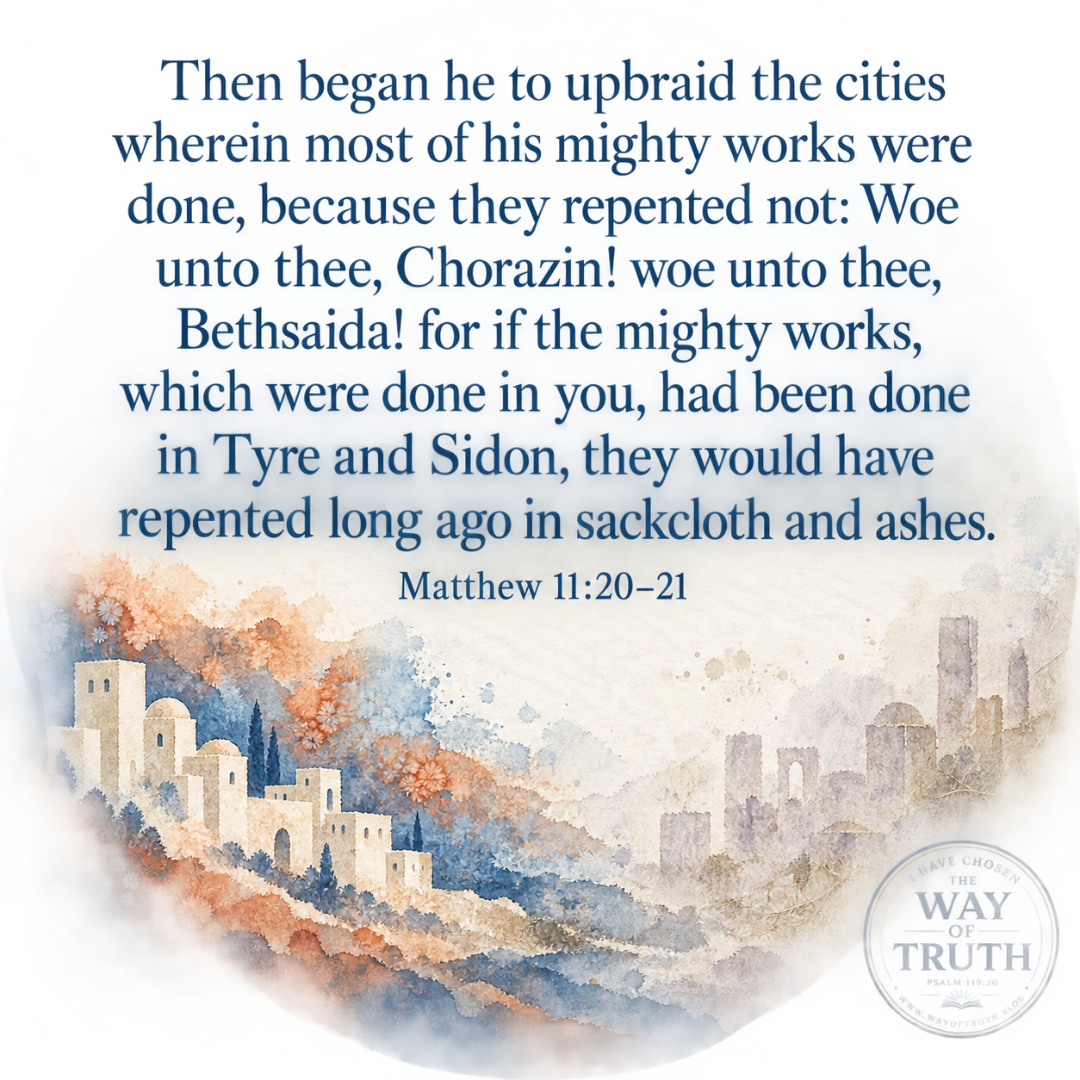
A person can welcome relief without welcoming the authority of the One who gives it. That possibility makes this passage unsettling. Jesus had done mighty works among these communities, yet the response those works called for hadn’t followed.
Matthew tells us exactly why Jesus rebuked them: “because they repented not.”
The preceding verses exposed a generation determined to find fault with both John’s restraint and Jesus’ fellowship with sinners. Now the focus moves from their criticisms to their responsibility. Whatever explanations they offered for rejecting God’s messengers, they remained unwilling to turn to God.
Earlier in the chapter, Jesus pointed John’s messengers to His works as evidence of His identity and mission (Matthew 11:4–5). Here those same works become evidence of neglected opportunity. They revealed the Messiah’s compassion and authority. Receiving their benefits while resisting His message was a deeply inadequate response.
This passage presses a particular question upon us: What happens when the mercy we recognize never becomes a reason to repent?
A Rebuke with a Stated Reason
To “upbraid” means to reproach or rebuke. Jesus openly confronted these cities over their failure to respond. The wording presents a settled assessment of their conduct, rather than an outburst of wounded pride.
Notice what Matthew doesn’t say. He doesn’t say that the cities failed to appreciate an impressive display, organize a celebration, or improve Jesus’ reputation. Their failure was spiritual and moral: they hadn’t repented.
Repentance involves a changed judgment about our sin and our relationship to God, expressed in turning toward Him. It includes sorrow for wrongdoing, but sorrow alone can simply mean regretting consequences. Repentance acknowledges God’s right to correct us and gives up the effort to defend what He condemns.
Matthew has already joined repentance with visible fruit in John’s preaching (Matthew 3:8), and Jesus began His public proclamation with the call to repent because the kingdom of heaven was at hand (Matthew 4:17). His mighty works belonged within that message. Healing and deliverance were genuine acts of compassion, and they also testified that His claim upon the hearers deserved their response.
The cities are addressed collectively. Jesus identifies their prevailing unrepentance; He isn’t requiring us to conclude that every resident responded identically. Bethsaida itself was the hometown of Philip, Andrew, and Peter (John 1:44). A community’s dominant response doesn’t erase the individuals within it.
Nor does Matthew describe every miracle performed in these places. We should resist filling those gaps with imagined scenes. The Gospels openly acknowledge that they give a selection of Jesus’ works rather than an exhaustive record (John 20:30–31). An unrecorded episode isn’t a contradiction. Here Matthew supplies a summary of ministry whose full details he doesn’t narrate.
The Cities They Would Never Have Chosen as Examples
“Woe unto thee, Chorazin! woe unto thee, Bethsaida!”
“Woe” announces calamity and judgment. Its solemn force won’t fit a picture of Jesus as a teacher who merely affirms whatever people already believe. His compassion includes telling the truth about the danger of remaining in sin.
Tyre and Sidon make the warning especially searching. These Gentile cities appear in the Old Testament under prophetic rebuke and judgment (Isaiah 23; Ezekiel 26–28). They were hardly obvious models of a right response to God.
Yet Jesus says that, had His mighty works been done there, “they would have repented long ago in sackcloth and ashes.”
The comparison overturns religious complacency. Communities enjoying the Messiah’s ministry had responded worse than these notorious cities would have responded under the stated circumstances. Their privileged position supplied no shelter from Christ’s assessment.
Sackcloth and ashes were outward expressions of mourning and humiliation. Jonah 3 gives a familiar example: the people of Nineveh expressed their repentance through fasting and sackcloth, and the king sat in ashes. Crucially, God saw their turning from evil (Jonah 3:10). The clothing and ashes expressed the response; they didn’t purchase mercy.
Jesus isn’t prescribing a costume for Christian repentance. He describes a response that would have been openly recognizable. Tyre and Sidon would have humbled themselves. Chorazin and Bethsaida had remained unmoved.
There’s also a sharp rebuke in “long ago.” What these Galilean communities continued to resist, the others would already have done. Repeated opportunity hadn’t produced the response it warranted.
What Christ Knows and What He Hasn’t Explained
Jesus’ statement raises a serious question: How can He say what people would have done in circumstances they never experienced?
He speaks with certainty. The natural reading is that His comparison is true, not that He invents an impossible response merely to make His audience feel ashamed. It reveals knowledge beyond ordinary human observation, consistent with Scripture’s presentation of the Son as knowing human hearts (John 2:24–25). The passage alone doesn’t supply a complete account of divine knowledge, but it does show that Christ’s knowledge isn’t confined to events that actually happened.
Christians differ over how this relates to grace and human choice. Calvinist interpreters commonly distinguish outward exposure to miracles from God’s inward work that brings a sinner to repentance. On that reading, Jesus’ statement doesn’t imply that signs, by themselves, overcome sinful resistance. Arminian interpreters commonly emphasize that people can resist God’s gracious work and that the cities are responsible for refusing the call before them.
Each concern points toward something we should preserve: repentance is never a human achievement independent of God’s grace, and these cities are genuinely accountable for their refusal. But these two verses don’t describe the precise inward working of grace in either group. They therefore can’t, by themselves, settle the wider disagreement.
The strongest conclusion from the wording is more specific: Jesus truthfully identifies how Tyre and Sidon would have responded, and He holds Chorazin and Bethsaida responsible for failing to repent despite His mighty works. Any theological explanation must preserve both claims.
Another question follows: Why didn’t God give Tyre and Sidon those same works?
The passage doesn’t tell us. We should admit that instead of inventing a hidden explanation. Scripture does’t promise identical historical opportunities to every community. Neither does this passage portray Tyre and Sidon as innocent: the prophetic writings address their actual wrongdoing. In the following verse, Jesus explicitly distinguishes their judgment from that of the Galilean cities (Matthew 11:22). His assessment takes their different circumstances seriously.
That doesn’t answer every question about God’s ordering of history. But it does prevent us from treating His judgment as careless about those differences.
The passage also challenges the assumption that sufficiently impressive evidence automatically produces repentance. Evidence matters: Jesus appeals to real works. Yet acknowledging evidence and submitting to its implications are distinguishable responses. This’s no excuse for dismissing every honest question as rebellion. Jesus’ verdict concerns these communities, whose opportunities and hearts He knew.
Let the Word Reach the Place We Protect
For us, the first practical response is to let Christ’s stated concern govern our self-examination. He names unrepentance. We should therefore ask about the sins we excuse, rather than merely checking whether we remain interested in spiritual things.
We may read Scripture regularly and still protect one habit from its authority. Perhaps we defend rude speech because we’re tired. Perhaps we call dishonesty “keeping things simple,” or treat resentment as a justified reward for having been hurt. The details differ, but the question is concrete: Where have I understood what obedience requires and continued to argue for an exception?
Begin there. Name the sin plainly before God. If you’ve wronged someone, acknowledge the wrong without making the apology a defense of yourself. If a practice repeatedly draws you into sin, take a practical step to interrupt it. Ask a trustworthy believer for help where needed. Such actions don’t buy forgiveness; they give expression to a heart that’s ceasing to make peace with sin.
We should also examine what we seek from Christ. The passage describes communities among whom His mighty works had occurred, yet repentance hadn’t followed. That warns us against wanting His help while refusing His rule. It’s right to pray about illness, employment, family strain, and daily needs. But our prayers should make room for His correction, too. We can’t faithfully ask Him to put our circumstances right while insisting that He leave our conduct alone.
This matters in the gathered church. A congregation can celebrate answered prayer, rejoice in good attendance, and teach sound doctrine while tolerating conduct that contradicts its confession. The proper response is honest examination. Do leaders receive correction? Are harmful patterns confronted with fairness? Can members confess a struggle and receive patient help? A church that speaks often about repentance should make it possible to practice repentance without pretending that mature believers have outgrown the need.
That kind of honesty serves unity. Many church conflicts deepen because each person can identify the other person’s fault with remarkable precision while describing their own fault as unfortunate circumstances. A willingness to confess our actual contribution can interrupt that pattern. Reconciliation still requires truth, appropriate boundaries, and accountability. Repentance doesn’t mean concealing abuse or pressuring someone to restore trust before there’s evidence of change.
The comparison with Tyre and Sidon also corrects our approach to mission. We should be cautious about deciding which people are likely to respond to the gospel. Religious familiarity doesn’t guarantee receptiveness, and a troubling background doesn’t place someone beyond Christ’s saving mercy. We proclaim His death and resurrection because people need Him, without requiring them to appear deserving first.
There’s encouragement here for tender consciences as well. Jesus rebukes settled unrepentance; He doesn’t say that every struggle, recurring temptation, or imperfect step proves a person has rejected Him. Someone grieving over sin and seeking His help shouldn’t confuse that struggle with a determination to remain unchanged. The appropriate response to conviction is to come honestly to Christ, not to wait until you can present Him with a flawless record.
In worship, then, let’s praise God for mercy that tells us the truth. His holiness makes sin serious; His kindness calls us to turn from it. Romans 2:4 connects God’s goodness with repentance. We honor Him when gratitude moves beyond appreciation of His gifts and becomes willing obedience.
There’s Still Mercy for the Person Who Turns
If this passage has unsettled you, you don’t need to pretend otherwise. Perhaps you’ve known Christian teaching for years without personally trusting Christ. Perhaps you’ve begun to recognize that enjoying the comfort of religious language is different from being reconciled to God. You can bring that recognition honestly to the Savior.
The need goes deeper than a few neglected duties. We’ve sinned against the God who made us, choosing our own desires over His rightful authority. Sin brings guilt, death, and judgment. We can’t erase that guilt by becoming more religious or promising never to fail again.
But the One who pronounced these woes also went to the cross for sinners. Jesus Christ, the sinless Son of God, willingly gave His life as the sacrifice for sin. He bore the judgment sinners deserve, and His resurrection declares His victory over death. The risen Savior is able to forgive, reconcile us to God, and give eternal life (Romans 3:23–26; 1 Corinthians 15:3–4).
The call to repent is therefore an invitation to abandon both our sin and our attempts to save ourselves. Turn to Christ in faith. Repentance doesn’t mean repairing your whole life before He’ll receive you. It means coming without defending your sin, while trusting His mercy and the sufficiency of His finished work.
You don’t need to produce a particular intensity of emotion or recite a perfect prayer. Speak honestly to Him. Acknowledge your guilt and entrust yourself to the Savior who died and rose again. Forgiveness and eternal salvation are gifts of His grace, received through faith; new obedience grows from the new life He gives (Ephesians 2:8–10).
Later in this same chapter, Jesus says, “Come unto me, all ye that labour and are heavy laden, and I will give you rest” (Matthew 11:28). The warning and the welcome come from the same Lord.
Receive His warning seriously and receive His welcome personally. Trust in Christ and begin living for the glory of the One who saves.
Where Will We Yield to Him?
- Where have I recognized God’s truth but continued to defend a specific sin or delay a clear act of obedience?
- Do my prayers show a willingness to receive Christ’s correction as well as His help?
- What would sincere repentance look like in one relationship or habit?
- How can our church encourage honest confession, fair accountability, and patient restoration?
- Have I personally trusted Christ for forgiveness, and how should His mercy shape my worship and witness today?