
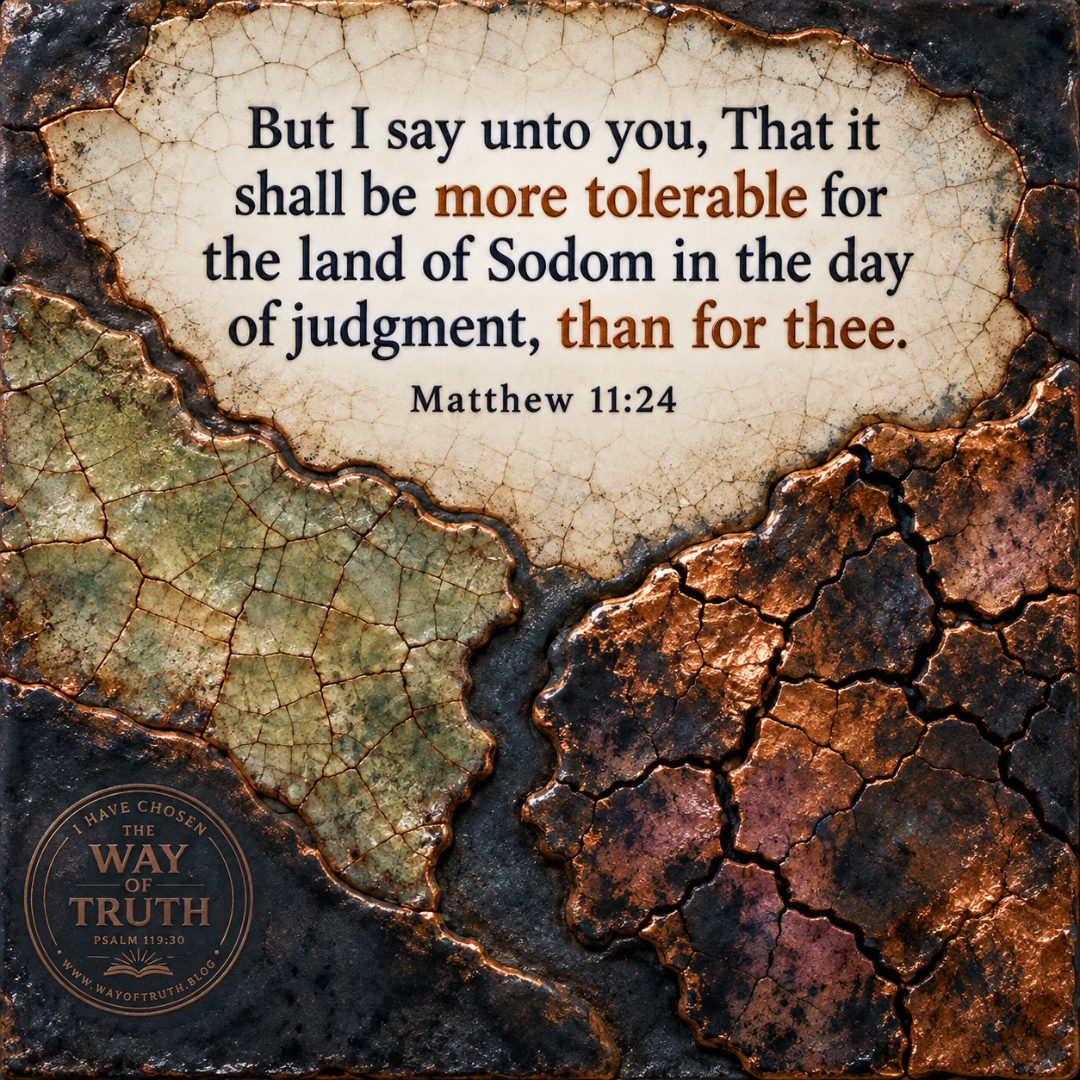
Matthew 11:24 completes one of the strongest warnings Jesus gives during His Galilean ministry. In the preceding verses, He rebuked the cities where most of His mighty works were performed because they didn’t repent. Chorazin and Bethsaida were compared unfavorably with Tyre and Sidon. Then Capernaum, a city unusually privileged by Christ’s presence and miracles, was compared with Sodom.
Verse 23 introduced that startling comparison. Verse 24 tells us why it matters.
“But I say unto you.”
There’s authority in those words. Jesus isn’t offering a theological theory or speculating about what judgment might look like. He speaks as One who knows the verdict because judgment belongs to Him. Elsewhere He declares that the Father “hath committed all judgment unto the Son” (John 5:22).
That gives this warning an unusual weight.
Christ knows what Capernaum saw. He knows what Sodom did. He knows what each city would have done under circumstances it never actually experienced. And He knows precisely how those differences will matter when judgment comes.
Human courts work with incomplete evidence. Witnesses forget. Motives can be difficult to establish. Circumstances are sometimes misunderstood. God suffers from none of those limitations.
Nothing relevant will be missing from His judgment.
Nothing will be exaggerated.
Nothing will be overlooked.
No one will need to tell God, “You don’t know the whole story.”
He does.
That’s sobering for the sinner, but it’s also reassuring for anyone who’s ever wondered whether God can truly judge the world fairly. Jesus answers that concern before we even voice it. The Judge knows infinitely more than we do, and His verdict will reflect perfect knowledge.
“More Tolerable” and the Precision of Divine Justice
Jesus says that it will be “more tolerable for the land of Sodom” than for Capernaum.
Those two words, more tolerable, deserve careful attention.
They show that while all unforgiven sin places a person under divine judgment, Scripture doesn’t present every judgment as identical in severity. Jesus plainly speaks of one judgment being more tolerable than another.
This fits what He teaches elsewhere. In Luke 12:47–48, Christ describes servants receiving differing punishment according to what they knew and how they responded. Greater knowledge brings greater accountability.
That doesn’t mean anyone deserves salvation because they knew less. Sodom was hardly innocent. Genesis 19 presents its wickedness without apology, and later Scripture repeatedly remembers Sodom as an example of rebellion and judgment.
Jesus isn’t rehabilitating Sodom’s reputation. He’s exposing Capernaum’s responsibility.
Capernaum had received something Sodom never had: extraordinary exposure to the earthly ministry of the Son of God. Christ had taught there. His miracles had been performed there. Evidence of the kingdom had appeared before their eyes.
Yet they didn’t repent.
The shocking comparison therefore says something profound about divine justice. God doesn’t judge merely by lining up outward actions and counting them. He knows the truth a person received, the opportunities that person possessed, and the response that followed.
His judgment is neither arbitrary nor crude. It’s exact.
This also corrects one of our common mistakes when thinking about sin. We naturally compare ourselves with people whose behavior seems worse than ours. Capernaum could certainly have looked at Sodom and felt morally superior.
Jesus effectively says, That comparison won’t help you.
The important question isn’t merely, “Have I behaved better than someone else?”
It’s, “What have I done with the truth God has placed before me?”
A Day That Can’t Be Avoided
Jesus locates this reckoning “in the day of judgment.”
Christianity doesn’t describe history as an endless cycle in which good and evil simply continue forever. Scripture points toward a definite conclusion. Human history is moving toward a day when God will judge.
Jesus speaks of that day as reality, not metaphor.
That challenges the modern instinct to treat judgment as an embarrassing leftover from a harsher age. Some people prefer a God who comforts but never condemns, loves but never judges, welcomes but never holds anyone accountable.
That may sound pleasant, but it’s not the God Jesus reveals.
The same Christ who receives children, touches lepers, forgives sinners, weeps at Lazarus’s tomb, and invites the weary to come unto Him also warns repeatedly of judgment.
We don’t honor Jesus by accepting His comforting words while quietly editing out His warnings.
Nor is divine judgment contrary to divine love. A God who never judges evil would ultimately treat cruelty, oppression, deception, abuse, hatred, and rebellion as matters of no final consequence. Scripture presents something far better. God is patient and merciful, but He’s also righteous. Evil won’t receive the last word.
Abraham asked in Genesis 18:25: “Shall not the Judge of all the earth do right?”
Matthew 11:24 answers: yes. Perfectly.
Judgment According to Truth Received
There’s another remarkable feature in Christ’s words. Jesus says Sodom’s judgment will be more tolerable even though Capernaum’s outward reputation was undoubtedly better.
That turns ordinary human evaluation upside down.
We tend to notice visible wickedness. God also sees rejected light.
This doesn’t excuse ignorance or make unbelief harmless. Scripture teaches that all people remain accountable to their Creator. But Jesus unmistakably establishes a relationship between revelation, opportunity, and responsibility.
That principle runs throughout Scripture.
Paul writes that God “will render to every man according to his deeds” (Romans 2:6). Jesus teaches that “unto whomsoever much is given, of him shall be much required” (Luke 12:48).
Matthew 11:24 gives that principle flesh and blood. Capernaum had been given much. Much was therefore required.
For those of us with easy access to Scripture, churches, preaching, Christian books, Bible apps, sermons, podcasts, and generations of Christian teaching, that should make us thoughtful. We can accumulate biblical information while remaining remarkably skilled at keeping God at arm’s length.
A shelf full of Bibles can’t repent for us. Knowing Christian vocabulary can’t believe for us. Growing up around Christianity can’t reconcile us to God.
The issue isn’t proximity to truth but our response to it.
The Comparison with Sodom Isn’t an Exaggeration
Some readers may wonder whether Jesus is simply using dramatic language to frighten His audience. The context doesn’t support that reading.
Christ gives parallel comparisons involving Chorazin, Bethsaida, Tyre, Sidon, Capernaum, and Sodom. He speaks deliberately about what would have happened under different circumstances and then connects those circumstances with the coming judgment.
His warning depends upon the comparison being meaningful.
Nor does the passage suggest that Jesus is unfairly condemning Capernaum for failing to meet an impossible standard. Their responsibility arose precisely because God had graciously given them abundant evidence. Their problem wasn’t lack of opportunity. Their problem was refusal to respond rightly to the opportunity they had.
Some modern views of God assume that meaningful judgment is incompatible with love. Jesus allows no such division. The One giving this warning is the same Savior who will shortly say: “Come unto me, all ye that labour and are heavy laden, and I will give you rest” (Matthew 11:28). That invitation comes only four verses later.
The Judge is also the Savior.
That’s one of the great tensions of the gospel, and Scripture doesn’t ask us to solve it by weakening either side. God’s holiness is real. His judgment is real. His mercy is real. His invitation is real. The proper response isn’t to argue one attribute of God against another. It’s simply to come to Christ.
Living Now in Light of That Day
Matthew 11:24 isn’t given merely to satisfy our curiosity about different levels of judgment. Jesus intends His warning to produce a response. For believers, that begins with humility.
We’ve received extraordinary spiritual privileges. Many of us possess our own copies of Scripture, perhaps several. We can hear faithful preaching almost instantly. We can study biblical languages, commentaries, historical background, and theology without leaving our homes. Believers in earlier centuries could scarcely have imagined such access. But access itself isn’t maturity.
A person can know how to find Habakkuk faster than everyone else in the Bible study and still resist what God says once they get there.
The appropriate response to greater light is greater faithfulness.
That means allowing Scripture to correct us rather than merely collecting information from it. When God’s Word exposes pride, bitterness, dishonesty, impurity, selfishness, unforgiveness, or complacency, our responsibility isn’t to develop a more sophisticated explanation for why our situation is different. We should immediately repent.
That posture should also shape the life of the church. A congregation should never confuse years of biblical teaching with guaranteed spiritual health. Sound teaching is a tremendous gift, but the proper fruit of sound teaching is transformed lives.
Where Christ has given much, His people should desire to honor Him much.
Our worship should be shaped by gratitude rather than entitlement. Our obedience should flow from love rather than mere habit. Our churches should be places where Scripture isn’t simply admired but obeyed.
And our awareness of judgment should deepen our concern for those who don’t know Christ. Jesus doesn’t speak about judgment so Christians can congratulate themselves for escaping it. Quite the opposite. If judgment is real, gospel proclamation becomes urgent.
People around us aren’t merely neighbors, coworkers, relatives, customers, classmates, or strangers in the grocery-store checkout line. They’re eternal souls who need Christ.
That doesn’t mean we must force a gospel conversation into every interaction. Wisdom matters. Kindness matters. Listening matters. But Christians should never become so comfortable in the world that we forget what Scripture says about its spiritual condition.
There’s no room here for smugness. If we’re saved, we’re saved by grace. We didn’t outsmart judgment. We didn’t outperform someone else. We didn’t become good enough to deserve mercy.
Christ bore our sin. That reality should make the church both serious about truth and gentle with sinners.
We can speak about judgment without enjoying the thought of anyone facing it. We can warn without becoming harsh. We can maintain biblical convictions without behaving as though grace belongs to us more naturally than it could belong to someone else.
After all, the gospel we offer others is the same gospel we desperately needed ourselves.
Matthew 11:24 also encourages believers who struggle with the apparent unfairness of life. We see people harmed without justice. We see lies prosper. We see evil sometimes rewarded and faithfulness sometimes ignored.
This verse reminds us that no account remains permanently unsettled. God knows every circumstance. He understands every motive. He’s forgotten nothing. The final judgment will contain no mistaken verdicts and no miscarriages of justice.
For the believer, that truth allows us to release vengeance into God’s hands and continue walking faithfully. We don’t need to settle every score. The Judge of all the earth will do right.
And because that day is coming, we should use the days before it well: glorifying God, obeying His Word, loving His people, sharing Christ, and refusing to waste the spiritual privileges He’s graciously given us.
Mercy Before the Verdict
Perhaps this verse makes you uncomfortable. It should. Jesus intends His warning to awaken us rather than entertain us. But notice something wonderfully important: Jesus warned Capernaum about judgment before it had arrived. The warning itself was mercy.
And if you’re reading Christ’s words today, the door of mercy remains open to you as well.
Scripture teaches that our deepest problem is sin. We haven’t merely made occasional mistakes. We’ve sinned against the God who created us. “For all have sinned, and come short of the glory of God” (Romans 3:23).
Sin brings judgment because God is holy and just. “The wages of sin is death” (Romans 6:23). No amount of moral comparison can remove our guilt. Being better behaved than someone else can’t reconcile us to God. Neither church attendance, religious upbringing, good intentions, baptism, generosity, nor biblical knowledge can erase sin.
But God hasn’t left sinners without hope.
Jesus Christ, the eternal Son of God, came into the world and lived without sin. On the cross He willingly gave Himself for sinners, bearing the penalty we deserve. Scripture says that Christ “died for our sins according to the scriptures; And that he was buried, and that he rose again the third day according to the scriptures” (1 Corinthians 15:3–4).
The One who warns us about the coming judgment is also the One who died to save us from condemnation.
Christ rose bodily from the grave, defeating death and demonstrating that His saving work was complete. Salvation is therefore not something we earn. It’s received through repentance and faith.
Repentance means turning from sin toward God. Faith means trusting Christ rather than yourself, your morality, your religion, or anything else to make you right with God.
If you’ve heard the gospel many times but never personally trusted Christ, don’t mistake familiarity for faith. Capernaum reminds us how dangerous that can be.
Come to Christ.
You don’t need to clean yourself up first. You don’t need an impressive spiritual record. You need the Savior.
Confess your sin before God. Believe that Jesus Christ died and rose again. Entrust yourself to Him. His promise is gracious and sure: “For whosoever shall call upon the name of the Lord shall be saved” (Romans 10:13).
The day of judgment is real. But today, Christ still calls sinners to mercy.
Trust Him, receive His forgiveness, walk in the new life He gives, and spend the life He has graciously given you for His glory.
Questions Before the Day Comes
- When God’s Word exposes something in my life that needs to change, do I respond with repentance or begin looking for reasons the warning applies more readily to someone else?
- Have years of exposure to Scripture produced deeper obedience, humility, and love for Christ, or have I begun treating spiritual privilege as something ordinary?
- How does knowing that God judges with complete knowledge and perfect justice help me entrust unresolved wrongs and injustices to Him?
- If I genuinely believe that a day of judgment is coming, how should that truth affect the way I speak about Christ to people who don’t yet know Him?
- What opportunity has God given me to glorify Him with the truth, grace, time, knowledge, and spiritual privileges He’s placed in my hands?