
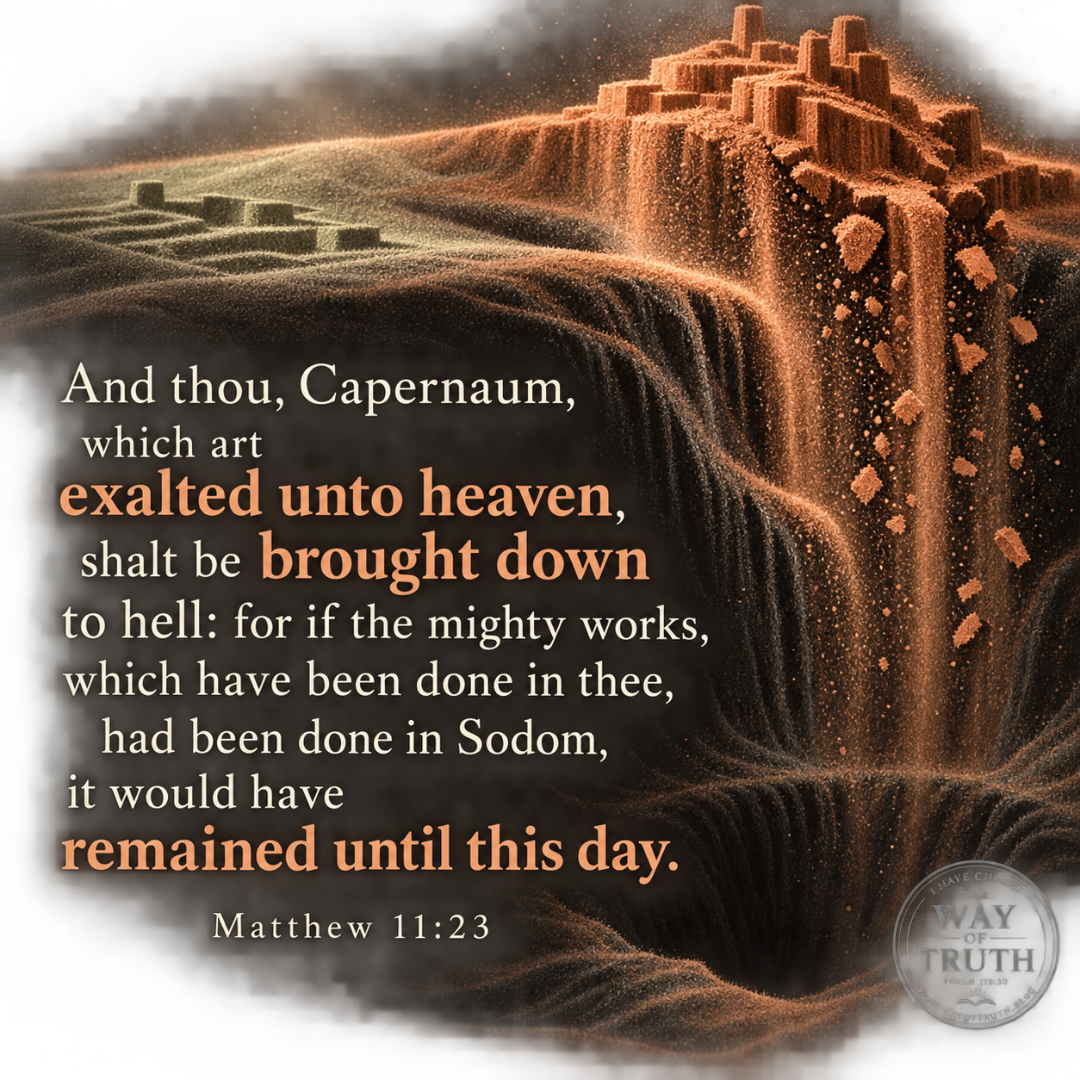
Capernaum had a distinction few places could claim: Jesus had lived there.
Matthew 4:13 tells us that, after leaving Nazareth, He came and dwelt in Capernaum. This was a place where His ministry unfolded at close range. Matthew records the healing of a centurion’s servant there, followed by the healing of Peter’s mother-in-law and many others (Matthew 8:5–17). The city’s privilege was concrete. Its people had encountered the works of the Messiah in their own community.
Yet Jesus addresses Capernaum with one of the most sobering declarations in this chapter.
The preceding verses have named Chorazin and Bethsaida and compared their response with what Tyre and Sidon would have done. Now the warning reaches the city so closely associated with Jesus Himself. The movement is personal and pointed: even this place can’t shelter behind its connection to Him.
Matthew 11:20 supplies the reason for the entire rebuke: these cities had not repented. Verse 23 adds a devastating reversal. Capernaum’s extraordinary elevation would give way to an extraordinary fall.
We shouldn’t imagine that every inhabitant rejected Christ. The centurion’s faith already prevents that conclusion. Jesus addresses the city according to its prevailing response. Nor does Matthew record the residents explicitly claiming that their city was spiritually secure. That danger is an implication of the contrast Jesus draws: their honored position offered no protection while they refused Him.
What Had Lifted Capernaum So High?
“Which art exalted unto heaven” describes remarkable elevation. It doesn’t mean that the inhabitants had already entered heaven or received salvation.
The explanation follows within the verse itself: mighty works had been done there. In this context, Capernaum’s height is best understood primarily in terms of its extraordinary privilege through Christ’s presence and ministry. Pride may have accompanied that privilege, but Jesus doesn’t require us to invent a speech in which the city boasted of its greatness.
This matters because it locates the city’s failure precisely. Capernaum was brought low despite having received something genuinely good. The ministry of Jesus was no illusion, and His miracles were no empty spectacle. The failure lay in the response.
There’s a recognizable biblical pattern here. In Jeremiah 7, people treated the presence of the temple as reassurance while continuing in disobedience. God confronted their confidence in a holy place when their lives contradicted His commands. Capernaum’s circumstances were different, but the underlying mistake was similar: a real connection with God’s work could erroneously be treated as security apart from submission to God.
A place can be honored by what God does there without everyone in it being reconciled to Him.
The Depth Beneath the Height
“Shalt be brought down to hell” overturns the city’s exaltation. The wording is decisive. Capernaum won’t preserve its standing by appealing to the wonders it witnessed.
The Greek word translated “hell” here is Hades, a term for the realm of the dead.1 In this sentence, the descent from heaven to Hades expresses a catastrophic reversal from privilege to abasement under judgment. The word should be explained in its setting rather than treated as though every biblical use of “hell” carries precisely the same emphasis.
The language recalls Isaiah 14:13–15, where the king of Babylon’s lofty ambitions are answered by descent to the depths. Of course, Jesus isn’t identifying Capernaum with every detail of that prophecy. He uses a familiar biblical contrast: apparent height can’t prevent God from bringing the proud and unresponsive low.
Does this reduce the warning to the eventual decline of a town? No. The next verse explicitly speaks of the day of judgment. The city’s downfall belongs within a warning whose reach extends beyond civic prosperity and earthly history.
Neither should we make this single expression carry a complete account of punishment after death. It doesn’t settle every question about the condition of the dead or the nature and duration of final punishment. Those matters require the wider witness of Scripture. What it plainly establishes is that nearness to Christ’s ministry doesn’t exempt persistent unbelief from His judgment.
The City Whose History Could Have Been Different
The comparison with Sodom makes the warning sharper still.
Genesis 13:13 describes Sodom’s inhabitants as exceedingly wicked before the Lord. Genesis 19 records the city’s violent corruption and destruction. Jesus doesn’t soften that history. His comparison depends upon Sodom being a recognized example of grave wickedness and divine judgment.
Yet He says that if His mighty works had been done there, “it would have remained until this day.”
Notice the exact claim. Jesus speaks directly of the city’s continued existence. In the context established by verses 20–21, the natural implication is that its response would have included repentance sufficient for the threatened destruction to be averted. We shouldn’t extrapolate that into a statement that every resident would necessarily have received eternal salvation.
Jonah 3 provides a useful comparison. Nineveh’s response to God’s warning was followed by the withholding of the announced disaster. A city being spared within history and every individual receiving eternal life aren’t interchangeable claims.
The force of Jesus’ words is startling. The city remembered for destruction would have remained, while the city privileged by His presence would be brought down. Capernaum’s respectable position couldn’t make its refusal harmless.
Jesus also speaks with certainty about events that never occurred. He doesn’t say that Sodom might possibly have responded. This fits the wider chapter’s presentation of His unique knowledge and authority, particularly His relationship with the Father in Matthew 11:27. His judgment reaches beyond appearances and beyond the limits of human reconstruction.
Questions We Should Ask Without Forcing an Answer
A thoughtful reader may ask, “If Sodom would have responded, why weren’t those miracles given to it?”
The verse doesn’t explain why God distributed opportunities as He did. We should acknowledge that honestly. Genesis presents Sodom as guilty of actual evil, not as condemned merely for lacking experiences granted centuries later to Capernaum. Jesus’ comparison adds that Capernaum’s response to greater revelation was profoundly culpable. It doesn’t say that Sodom had been innocent.
Calvinist readers commonly understand the statement within God’s sovereign government of both circumstances and grace. Arminian readers commonly emphasize the meaningful response people can make to divine revelation and their responsibility for resisting it. Both can affirm the claim Jesus actually makes. The sentence doesn’t describe the inward operation of grace, explain election, or define the relationship between God’s rule and human freedom.
The strongest reading here is therefore the one that preserves the stated comparison without making it settle that larger debate: Christ truly knows how Sodom would have responded under the specified circumstances, and Capernaum’s actual refusal deserves judgment. Treating His words as an empty exaggeration weakens the reason He gives for the warning; treating them as a complete explanation of salvation asks them to supply information they don’t contain.
Nor does the passage promise Sodom a second opportunity after death. Its conditional statement concerns what would have happened in its earlier history. It doesn’t announce what will happen to its inhabitants later.
Jesus treats Sodom’s destruction as a real event, consistent with Genesis. That continuity matters within Scripture’s testimony, though this verse isn’t an independent archaeological demonstration. Its purpose is to expose Capernaum’s danger, not to answer every historical question a modern reader might raise.
Let Christ Address the Places We Feel Safest
Capernaum invites us to examine the places where familiarity has made us feel beyond challenge.
For some of us, that may be our Christian upbringing. For others, it may be years of ministry, careful doctrinal convictions, or belonging to a faithful congregation. These can be substantial blessings. We ought to thank God for them. The danger comes when we quietly make them answer a question only our relationship with Christ can answer: Have we received Him in repentance and faith?
A person can remember when a church building was constructed, explain its doctrinal statement, and know where every spare chair is kept, yet still resist the Lord proclaimed there. Familiarity makes us useful in many ways, but it can’t reconcile us to God.
This deserves a particular place in our private reading of Scripture. When a familiar passage appears, we can move immediately to remembering what it means for someone else. A teacher thinks of a lesson. A writer thinks of a paragraph. A parent thinks of a child who needs to hear it. Those uses may be appropriate, but we also need to let the Word address us before we pass it along.
Try pausing before preparing an explanation. Ask, “Lord, what am I assuming about my standing before You? Am I willing for this passage to expose that assumption?” Then consider whether your confidence rests in Christ’s promise or in your proximity to Christian activity. The distinction may be uncomfortable, but it’s merciful to have false security uncovered while we can still respond.
Congregations need the same honesty. A church may have a rich history of faithful preaching and sacrificial service. That history deserves gratitude, but it can’t guarantee present faithfulness. Remembering what God did among us should lead us to seek His will now. We should ask whether our current worship, teaching, and decisions actually honor the Lord whose past blessings we celebrate.
That includes the way we speak about our congregation. If our strongest claims are always about our reputation, our longevity, or how much better we are than another church, Capernaum gives us reason to pause. Christian unity grows when believers recognize their common dependence upon Christ. We can hold firm convictions while remembering that our standing before God rests in Christ, not in the church we attend..
The comparison with Sodom should also change whom we consider worth approaching with the gospel. Jesus’ words expose how unreliable human expectations can be. We may assume that a person with an openly troubled history will never listen while someone comfortable around Christian language needs little attention. Neither assumption is safe. We should offer patient, clear witness to both.
This isn’t a promise that every unlikely hearer will respond. It’s a reason to stop allowing reputation to decide who receives our time. Pray for the person you’ve quietly written off. Explain the gospel to the religious acquaintance whose personal trust in Christ you’ve simply assumed.
Finally, worship should direct our attention toward the greatness of the Savior Himself. Capernaum’s highest honor was that He had come among them. Our hope likewise rests in Him. We glorify God when we treasure His Son, receive His Word, and follow His commands with grateful dependence. For believers, this warning need not produce an endless search for something wrong with every assurance. It calls us to place our assurance where it belongs: in the crucified and risen Christ, whose promises are trustworthy.
You Can Come Closer Than Familiarity
Perhaps Christianity has been part of your surroundings for so long that you’ve rarely considered whether you’ve personally come to Christ. You know the account of His birth, recognize the songs, and understand what Christians believe about the cross. Yet knowing the account and trusting the Savior are different things. You can bring that question honestly before Him today.
Our deepest need is forgiveness. We’ve sinned against the holy God who made us, in our actions, words, desires, and failures to do what’s right. Sin deserves His judgment. Its wages are death, and Scripture warns of eternal punishment for those who remain unreconciled to God (Romans 6:23; Matthew 25:46). Religious surroundings can’t remove that guilt.
But Jesus Christ came to save sinners. The Son of God lived without sin and willingly offered Himself on the cross, bearing the judgment sinners deserve. His death was the sufficient sacrifice for sin. He was buried and rose bodily on the third day, victorious over sin and death (1 Corinthians 15:3–4). He’s alive and able to save those who come to God through Him.
His call is personal: repent and believe. Turn from your sin and from the belief that your background, efforts, or reputation can make you right with God. Entrust yourself to Jesus Christ and His finished work. You don’t need to improve your history before asking for His mercy.
Salvation is God’s gift, received through faith, not a reward for religious achievement (Ephesians 2:8–10). In Christ there’s forgiveness, reconciliation with God, new life, and eternal salvation. The life He gives begins to bear fruit in willing obedience.
Come to Him with the truth about yourself. Trust the Savior who died and rose again, receive His promised mercy, and live for the glory of the Lord who welcomes sinners.
Let the Warning Search Our Confidence
- What part of my religious background or activity am I tempted to treat as proof that I’m right with God?
- When I read familiar Scripture, do I allow it to address me personally before applying it to someone else?
- How can our congregation give thanks for its history while examining its present faithfulness to Christ?
- Whose reputation has led me to assume that sharing the gospel with them would be pointless?
- What gives me confidence before God, and how does resting in Christ lead me toward obedience and worship?
- Bible Hub, “Strong’s Greek: 86. ᾅδης (hadés)—Hades, the Realm of the Dead,” accessed 19 September 2026, https://biblehub.com/greek/86.htm. ↩︎
[…] Verse 23 introduced that startling comparison. Verse 24 tells us why it matters. […]