
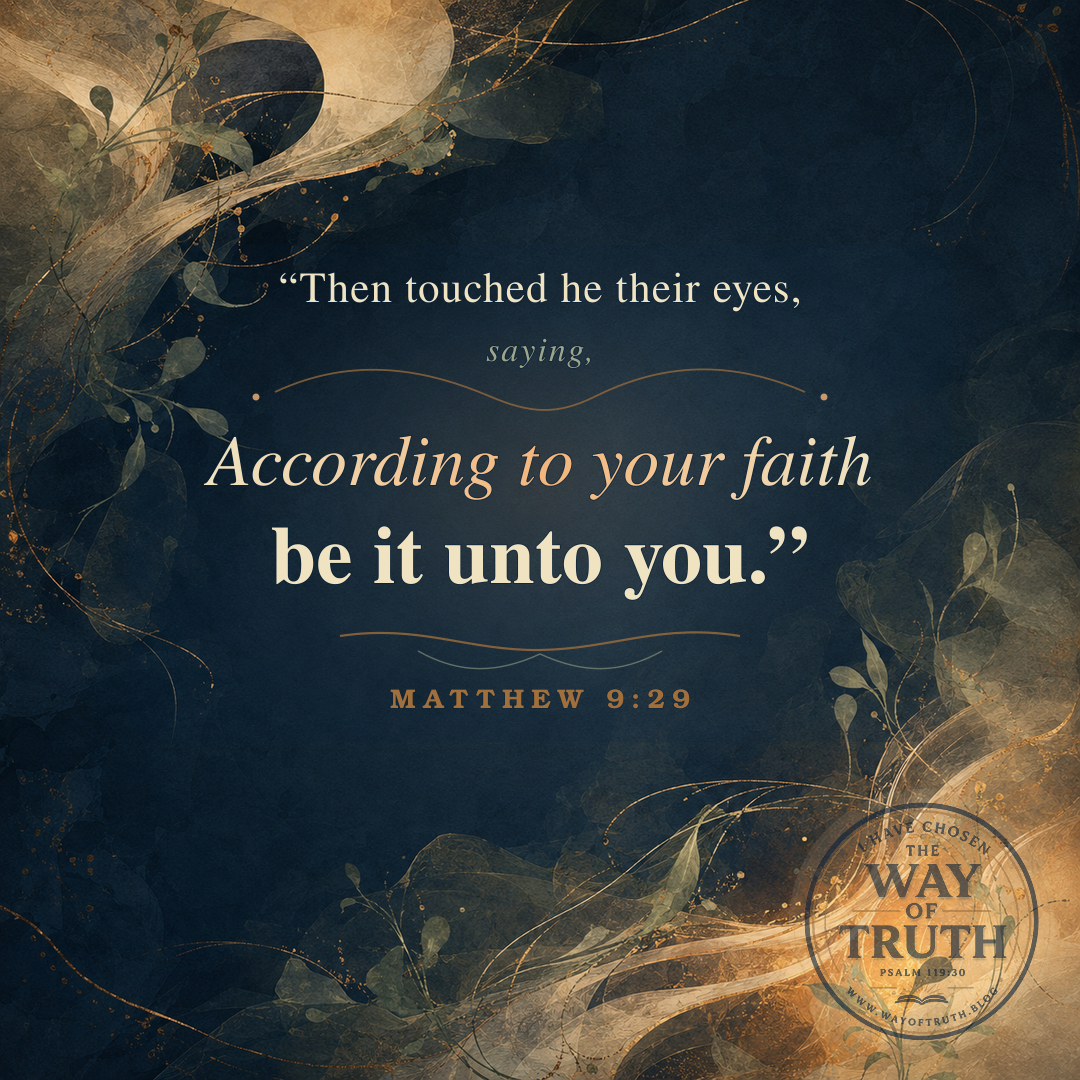
The word “Then” connects this verse directly to the conversation inside the house. The two blind men had followed Jesus while crying, “Thou Son of David, have mercy on us” (Matthew 9:27). Once they came to Him, Jesus asked, “Believe ye that I am able to do this?” They answered, “Yea, Lord” (Matthew 9:28).
Now Christ responds to their confession. He doesn’t ask another question, demand a longer explanation, or send them away to prove themselves. He touches their eyes and speaks.
This moves the account beyond the themes emphasized in the previous two verses. Verse 27 showed whom they pursued and why they cried for mercy. Verse 28 brought their belief in Christ’s ability into the open. Verse 29 reveals what Jesus did with that faith. Their confidence in Him wasn’t left hanging in the air as a religious sentiment. Christ answered it with personal compassion and effective authority.
Matthew’s language remains remarkably restrained. There’s no dramatic buildup, secret ritual, or attempt to make the scene more spectacular than it was. Jesus touches. Jesus speaks. The eyes that couldn’t see are about to open.
A Touch They Could Feel
“Then touched he their eyes.”
Jesus didn’t need physical contact in order to heal. Earlier in Matthew, He healed the centurion’s servant from a distance. His power wasn’t limited by location, procedure, or method. Here, however, He chose to place His hands upon the very part of their bodies that had failed them.
Matthew doesn’t explain why Jesus used touch, so we shouldn’t pretend to know more than the text tells us. Still, the form of His compassion is worth noticing. These men couldn’t see His expression or watch His hand move toward them. But they could feel His presence. The touch assured them that the One they’d followed was now personally attending to their need.
Christ never treated suffering people as inconveniences, curiosities, or illustrations with legs. He dealt with them as people. His touch was neither careless nor theatrical. It was compassionate and deliberate.
Nothing in the verse suggests that some mystical force resided in the physical movement itself. The touch wasn’t magic. Jesus used no charm, formula, sacred object, or hidden knowledge. Ancient religion often tried to manipulate supernatural powers through the correct ritual. Jesus does nothing of the kind. He acts from His own authority.
His methods throughout Matthew 8–9 vary for a reason. Sometimes He touches. Sometimes He speaks. Sometimes He heals from a distance. He casts out devils with His word, calms a storm by command, forgives sins, and raises a dead girl by taking her hand. The variety keeps us from turning one method into a religious formula. The power was never in the procedure. It was always in Christ.
When Christ Took Their Confession Seriously
Jesus said, “According to your faith be it unto you.”
This statement reaches back to their answer in verse 28. Jesus had asked whether they believed He was able to restore their sight. They had replied, “Yea, Lord.” His words in verse 29 mean that their request would now be answered in keeping with the trust they’d expressed.
“According to your faith” doesn’t mean “in proportion to the amount of faith you have.” Jesus wasn’t assigning them thirty percent vision because they possessed thirty percent faith. The next verse says plainly, “And their eyes were opened” (Matthew 9:30). Their restoration was complete.
Nor does the statement mean that faith itself contained healing power. The men didn’t heal themselves by believing intensely enough. Faith was their trust in Christ; Christ was the One who opened their eyes. Their faith received what His authority supplied.
That distinction matters. Biblical faith isn’t a mental force that reshapes reality. It doesn’t make us little creators who can speak desired outcomes into existence. These men believed a particular truth about a particular person: Jesus was able to do what they couldn’t do for themselves.
Christ’s declaration may therefore be understood as, “Let what you have trusted Me to do now be done for you.” He took their confession seriously. They’d placed the full weight of their hope upon His ability, and He showed that their confidence in Him wasn’t misplaced.
Faith contributed no merit to the miracle. The men came seeking mercy, not collecting wages. Yet their faith was real, personal, and necessary within this encounter. They didn’t merely believe that miracles were possible in theory. They believed that Jesus Himself was able to act for them.
Faith Received What Only Christ Could Give
This verse holds divine power and human response together without confusing them. Jesus supplied the healing; the men trusted Him. Christ’s authority didn’t make their faith meaningless, and their faith didn’t reduce His healing to a human achievement.
We shouldn’t force the verse into debates that it wasn’t written to settle. Matthew’s describing the healing of two blind men, not giving a complete explanation of every relationship between faith, healing, prayer, and salvation. The surrounding narrative places sensible limits on what we may conclude.
Just a few verses earlier, Jesus raised a dead girl. She couldn’t exercise faith, ask for help, or make a confession. In other passages, Christ heals people because others bring them to Him. At times, He acts despite confusion and weak understanding. Therefore, Matthew 9:29 can’t honestly be turned into a universal rule that God performs every miracle only when the sufferer reaches the required level of faith.
That distortion has wounded many people. When healing doesn’t come, they’re told that they must not have believed strongly enough. Yet this passage gives no one permission to examine another sufferer’s heart, assign a faith score, and blame the person for remaining ill. We’re not spiritual quality-control inspectors.
The verse also doesn’t teach that bodily suffering is imaginary. Jesus touched real eyes and healed a real physical condition. The men’s blindness was neither an illusion nor merely a negative thought. Scripture treats both the suffering and the healing as genuine.
Faith is important, but faith must never be separated from its object. A small faith resting upon the almighty Christ is better than enormous confidence placed in a false promise. The decisive question isn’t whether we can manufacture enough certainty. It’s whether the One in whom we trust is faithful.
The Promised Light Entered the House
This private healing belongs to Matthew’s larger presentation of Jesus as Israel’s promised Messiah and authoritative King, a central purpose running throughout the Gospel of Matthew.
The Old Testament had connected the opening of blind eyes with the saving work of God. Psalm 146:8 declares, “The LORD openeth the eyes of the blind.” Isaiah looked ahead to a day of divine restoration: “Then the eyes of the blind shall be opened, and the ears of the deaf shall be unstopped” (Isaiah 35:5).
Matthew doesn’t stop in the middle of the story to announce a formal fulfillment. He doesn’t need to. The deed speaks plainly. The men had called Jesus the “Son of David,” and the Son of David performed the works associated with God’s promised kingdom.
This doesn’t mean that the kingdom had reached its final completion. Blindness, disease, sorrow, and death remained in the world. Even those whom Jesus healed would eventually experience physical death. These miracles were signs of the King’s identity and previews of the restoration He’ll ultimately bring.
For a brief moment inside an ordinary house, the promised future broke into the present. Sightless eyes opened beneath the hand of the Messiah. The miracle revealed both His compassion toward the suffering and His authority over the brokenness sin has brought into creation.
A Historical Claim That Can’ Be Dismissed by Assumption
Some readers reject this account simply because miracles don’t fit a worldview in which nature is all that exists. But that objection assumes the conclusion before examining the claim. If God exists, and if Jesus is the Messiah presented throughout the Gospel, then a supernatural healing isn’t irrational. It’s exactly the kind of sign we’d expect to accompany His identity and mission.
Matthew presents the event as history, not as a symbolic tale about gaining insight. He identifies the men’s condition, records their pursuit of Jesus, preserves His question and their response, describes His touch and declaration, and then reports the result. The sequence is concrete and public enough to carry consequences beyond the room.
The account’s brevity doesn’t by itself prove that the miracle occurred, but neither does it give the skeptic grounds to dismiss it. Matthew writes without the exaggerated atmosphere commonly associated with legend. Jesus doesn’t struggle against an equal power or perform for applause. He simply exercises authority.
Christian faith is therefore not blind faith in the modern sense of belief without evidence. Ironically, the blind men saw something about Jesus that many sighted people missed. They recognized His messianic identity, sought His mercy, confessed His ability, and entrusted themselves to Him. Their physical eyes hadn’t yet opened, but their confidence had already found the right object.
Living Under the Hand of the Able Christ
The first application is simple but searching: faith must remain focused on Christ.
It’s easy to become preoccupied with the condition of our own faith. We wonder whether it’s strong enough, steady enough, sincere enough, or impressive enough. Self-examination has its place, but endless inspection of our faith can quietly turn our attention away from the Savior. The men didn’t enter the house talking about how remarkable their believing was. They came because they believed Jesus was able.
When your faith feels weak, don’t try to strengthen it by staring harder at yourself. Return to what Scripture reveals about Christ. Remember His authority, compassion, cross, resurrection, promises, and faithfulness. Faith grows by knowing Him more truly, not by congratulating itself.
This passage also teaches us to bring our needs to Christ plainly. The men knew exactly what they lacked. They didn’t hide their blindness behind polished religious language. We can come to the Lord with the same honesty. We can tell Him where we hurt, what we fear, what we can’t repair, and what we long for Him to do.
At the same time, trusting Christ’s ability isn’t the same as claiming authority over His will. Jesus can heal every sickness, resolve every crisis, and remove every burden. But He hasn’t promised to do everything we request in the manner or timing we prefer. Faith trusts not only His power but also His wisdom. Mature faith can ask boldly while still saying, “Thy will be done” (Matthew 26:42).
That keeps prayer from becoming either timid resignation or presumptuous demand. We don’t pray as though Christ were powerless. We also don’t speak as though He were under our command. We bring our desires to the King and leave the outcome in His hands.
The Church must become a place where suffering people are helped to look toward Christ rather than being graded according to appearances. Some believers speak confidently while trembling inside. Others have deep faith but struggle to put it into polished words. We should pray for one another, bear one another’s burdens, and resist the temptation to explain every unanswered prayer as someone else’s spiritual failure.
Jesus’ touch also challenges the way we serve. Although we can’t reproduce His divine healing authority, we can reflect His personal compassion. Ministry should never reduce people to cases, projects, attendance figures, or problems to solve. Christ attended to the men in a way they could understand and receive. Likewise, we should listen carefully, communicate clearly, and treat people with dignity. Sometimes faithful ministry begins by slowing down long enough to notice the person standing directly in front of us.
The verse also speaks to the Church’s unity. Christians may disagree over how particular gifts operate today or how to understand certain answers to prayer. Those discussions matter, but they must not draw attention away from the truth all believers confess: Jesus Christ is Lord, His authority is complete, and every good gift comes from Him. We gather around the Giver, not around our preferred explanation of the gift.
Finally, this miracle should move us toward worship and witness. The eyes were opened by Christ, not by human skill, persuasion, or religious performance. In the same way, the Church’s mission must direct attention to Him. We proclaim the gospel because people need more than inspiration, self-improvement, or temporary relief. They need the Savior who alone can forgive sin, give spiritual life, and bring His people safely into His everlasting kingdom.
The Deeper Sight Every Heart Needs
Perhaps you understand the blind men’s desperation, even if your own need isn’t physical blindness. You may see the world around you clearly while remaining uncertain about God, forgiveness, or where you stand before Him. This passage invites you to look beyond the miracle and consider the person who performed it.
Our deepest problem is sin. We’ve disobeyed God, rejected His rightful authority, and fallen short of His holiness. Sin isn’t merely a collection of unfortunate mistakes. It’s guilt before the God who created us. Scripture says, “For the wages of sin is death” (Romans 6:23). Physical death is part of that judgment, but sin also leaves us separated from God and unable to rescue ourselves.
No amount of positive thinking, religious activity, moral effort, or sincere intention can erase that guilt. We need mercy, just as surely as the two blind men did.
The good news is that the Son of David came to provide more than temporary relief. Jesus Christ, the sinless Son of God, willingly died upon the cross in the place of sinners. He bore the judgment we deserved and paid the penalty we could never pay. Scripture declares “that Christ died for our sins according to the scriptures; And that he was buried, and that he rose again the third day according to the scriptures” (1 Corinthians 15:3–4).
His resurrection was God’s public declaration that death had been defeated and Christ’s saving work was sufficient. Jesus lives, and He offers forgiveness, reconciliation with God, new life, and eternal salvation to all who come to Him.
Faith doesn’t purchase these gifts. It receives them. You’re not saved because your faith is unusually strong, but because the Savior in whom you trust is fully sufficient. Turn from your sin and place your confidence in Jesus Christ. Don’t merely agree that He can save people in general. Entrust yourself personally to Him.
The Christ who touched sightless eyes still receives those who come seeking mercy. Call upon Him as Lord. Believe the gospel, rest in His finished work, and follow Him. He’ll forgive every sinner who comes to Him in repentance and faith, give that person new life, and keep all who belong to Him. Trust Him today and live for the glory of the One who alone can bring us out of darkness and into everlasting light.
Questions for Reflection and Response
- Am I placing my confidence in Christ Himself, or have I become preoccupied with the supposed strength or weakness of my faith?
- Is there a need I’ve been hiding, minimizing, or trying to carry alone instead of bringing it honestly before the Lord?
- Do my prayers combine confidence in Christ’s ability with humble submission to His wisdom and will?
- Have I ever judged a suffering believer by assuming that an unanswered prayer revealed deficient faith? How should this passage correct my attitude?
- How can I reflect Christ’s personal compassion this week by giving thoughtful, dignified attention to someone who’s hurting?