
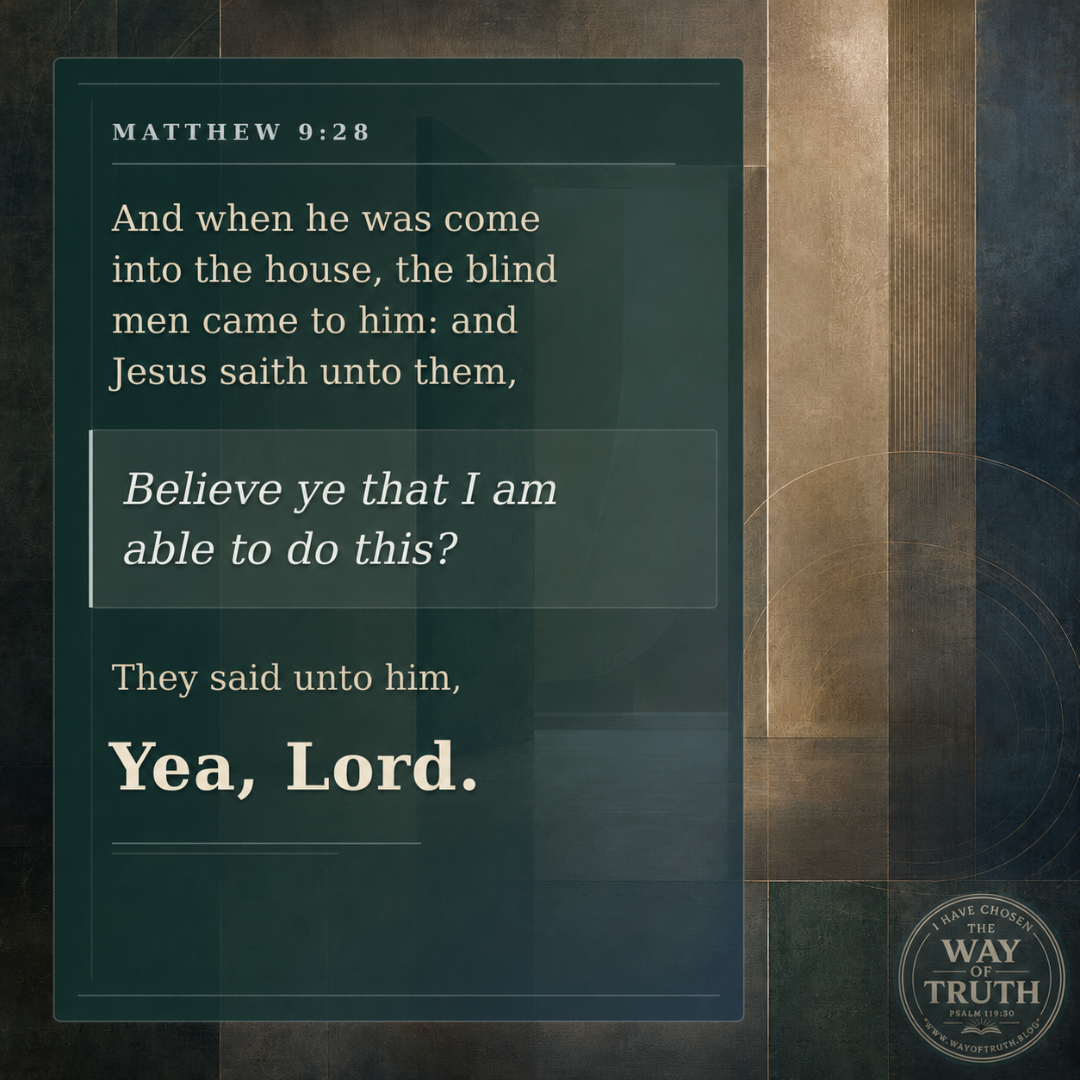
Matthew 9:27 showed two blind men following Jesus and calling upon Him for mercy. Verse 28 carries the account forward. The setting changes. Jesus enters a house, the men come to Him, and their public appeal becomes a direct conversation with Christ.
Matthew doesn’t tell us whose house it was, how far the men had followed, or who else was present. Those details may interest us, but they’re not the point. The Holy Spirit directs our attention to a question and an answer. Jesus brings the matter down to this: “Believe ye that I am able to do this?”
Their earlier words had expressed what they wanted from Christ. His question now brings into the open what they believed about Christ.
That distinction matters. A person may want God’s help without having settled what they believe about God. They may pray because they’re frightened, desperate, or out of options. None of those conditions are wrong. Desperation often strips away our illusion of control. Yet Jesus does more here than receive a request. He places Himself before these men as the decisive issue. Before the miracle occurs, they must answer a question about Him.
Why Jesus Asked What He Already Knew
Jesus wasn’t gathering information He lacked. Earlier in the same chapter, Matthew wrote, “And Jesus knowing their thoughts said, Wherefore think ye evil in your hearts?” (Matthew 9:4). The Lord who knew the hidden reasoning of the scribes didn’t need two blind men to update Him on the condition of their hearts.
Throughout Scripture, God sometimes asks questions to reveal people, not to educate Himself. When the Lord called to Adam, “Where art thou?” (Genesis 3:9), He wasn’t searching Eden for a missing man. The question required Adam to come out of hiding and face the truth of his condition. In much the same way, Christ’s question gives these men an opportunity to state plainly the confidence already implied by their appeal.
This also answers a skeptical reading of the verse. Someone might say that Jesus asked because He was uncertain whether the men possessed enough faith for Him to act. But the immediate context doesn’t present Christ as anxious about whether their confidence could supply something missing in Him. The question concerns His ability, not theirs: “Believe ye that I am able to do this?”
Their faith didn’t provide Christ with power. His power gave their faith a worthy object.
The Center of the Question: “I Am Able”
Jesus didn’t ask, “Do you believe that healing is possible?” He didn’t ask whether they believed strongly in miracles, maintained a positive attitude, or could picture themselves seeing. He asked whether they believed that He was able.
Biblical faith is never made powerful merely by being intense. Sincerity can’t make an unreliable object reliable, and strong belief can’t turn falsehood into truth. The value of faith depends upon the One in whom it rests. These men weren’t told to believe in their own ability to believe. They were called to place their confidence in Christ.
The words “to do this” also keep the question concrete. Jesus wasn’t asking for vague religious optimism. The men had brought a particular human impossibility before Him, and He asked whether they believed it lay within His power.
Within the larger witness of Scripture, the wording is striking. When Peter later participated in the healing of a lame man, he rejected the idea that the miracle came through human ability: “why look ye so earnestly on us, as though by our own power or holiness we had made this man to walk?” (Acts 3:12). Peter directed attention away from himself and toward Jesus. Here, however, Jesus doesn’t say, “Do you believe God may use Me?” He asks, “Believe ye that I am able.”
This single verse isn’t intended to carry the whole biblical doctrine of Christ’s deity by itself. Still, it fits naturally within Matthew’s growing portrait of Jesus. He forgives sins, knows hidden thoughts, commands the wind and sea, casts out devils, raises the dead, and now places His own ability at the center of the question. Scripture doesn’t present Him as a spiritual coach helping people unlock their inner potential. Nor does it present Him as a created religious guide who merely points toward a power greater than Himself. He acts with the authority of the promised Savior.
Isaiah had looked ahead to the saving work of God and declared, “Then the eyes of the blind shall be opened, and the ears of the deaf shall be unstopped” (Isaiah 35:5). Matthew’s account belongs within that larger biblical hope. The promised day of salvation wasn’t arriving as an idea, philosophy, or religious program. It was arriving in the person of Jesus Christ.
“Yea, Lord”: Brief Words with Definite Meaning
The men answered, “Yea, Lord.” Their reply is short, but it’s not vague.
“Yea” gives Christ a definite answer. They don’t evade His question, soften their claim, or offer a speech about how difficult faith can be. “Lord” acknowledges the authority of the One standing before them. They believe that Jesus Himself can do what no ordinary man can do.
We should be careful not to force more into their two words than Matthew tells us. The verse doesn’t give us a complete account of everything these men understood about Christ, and we shouldn’t turn their reply into a fully developed creed. At the same time, we shouldn’t empty it of meaning. Their answer is personal, direct, and centered on Jesus.
The question and answer are both plural. Christ addresses the two men together, and they answer Him together. Their shared confession is fitting, but neither man could answer by appealing to the other’s confidence. They came with one need and gave one answer, yet each stood personally before the same Lord.
That speaks to an important biblical balance. Faith is personal, but it’s not meant to remain isolated. The Church confesses one Lord, proclaims one gospel, and worships with one voice. Still, no one is saved because a parent believed, a spouse prayed, or a church confessed the truth on their behalf. Others may bring us the Word, pray for us, and point us toward Christ, but each of us must answer Him personally.
Christ’s Ability Isn’t Our Authority
Jesus’ question teaches confidence in His power, but it doesn’t hand human beings control over that power. “I am able” doesn’t mean, “You may now decide everything I must do.”
The distinction between God’s ability and His will is essential. Before Nebuchadnezzar, Shadrach, Meshach, and Abednego declared, “our God whom we serve is able to deliver us” (Daniel 3:17). Then they added, “But if not” (Daniel 3:18). They didn’t doubt God’s power. They simply refused to assume that faith gave them the right to write the outcome. Whether God delivered them from the furnace or received them through death, they wouldn’t worship the king’s image.
The blind men were healed, as the next verse records. That’s what Jesus chose to do in this particular encounter. But Matthew 9:28 shouldn’t be turned into a promise that every illness will be removed, every hardship will end quickly, or every prayer will be answered in precisely the form requested. Faith doesn’t place Christ under our authority. It bows to His.
This exposes the error in teachings that treat faith as a force, positive confession as a mechanism, or healing as something believers can demand if they speak with enough certainty. The text doesn’t tell the men that their minds create reality. It points them away from themselves: “Believe ye that I am able.”
Nor does the verse justify blaming a suffering person for not having enough faith. Scripture records faithful servants who remained sick, endured weakness, and died without receiving every earthly deliverance they desired. The question before us isn’t whether we can manufacture enough certainty to obligate God. It’s whether we recognize the sufficiency of Christ while submitting to His wisdom.
Faith honors Him by trusting the promises He’s actually made. Presumption dishonors Him by putting words in His mouth and then accusing Him when He doesn’t perform them.
A Simple Report, not a Religious Legend
Matthew relates the exchange with restraint. Jesus enters the house. The men come to Him. He asks a question, and they answer. The account proceeds as part of a connected series of events rather than as a detached tale designed merely to celebrate wonder.
That simplicity doesn’t, by itself, prove that the event occurred. Yet neither may a skeptic dismiss it simply because it includes a miracle. To declare beforehand that miracles can’t happen isn’t neutral historical reasoning. It’s a philosophical assumption that excludes God before the evidence is considered. If the God who created sight exists, there’s nothing logically incoherent about His restoring it.
The fact that Matthew preserves an exchange another Gospel may not record is no contradiction. Omission isn’t denial. Each Gospel writer selected and arranged true events for particular purposes. Here Matthew shows us something spiritually precise: before Jesus opens the men’s eyes, He draws from their lips a confession of His ability.
The Question That Still Searches the Church
Christ’s question was spoken to two particular men in a particular house, so we shouldn’t pretend that every sentence addressed to them is an identical personal promise to us. Yet the truth revealed by the question reaches every generation: faith must rest in the ability and authority of Jesus Christ.
That truth searches us because Christians can confess great things about Jesus while living as though everything finally depends upon us. We say He’s Lord, then carry our burdens as if He were absent. We affirm that He’s able to save, then quietly decide that a certain person is beyond the reach of grace. We declare that He can keep His people, then treat every uncertain tomorrow as though panic were a form of preparation. Worry can feel productive because it keeps the mind busy, but it’s never added one ounce to Christ’s strength.
In prayer, this verse teaches us to begin with who Christ is. We may bring specific needs boldly and honestly. The men did. But our confidence isn’t in the emotional force of our words, the length of our prayers, or our ability to achieve a perfectly calm state of mind. We come because Christ is able. Then we leave the manner, timing, and outcome in His wise hands.
That’s not weak praying. It’s reverent praying. There’s a world of difference between saying, “Lord, I doubt Thy power,” and saying, “Lord, I know Thou art able, and I trust Thy decision.” The first questions His sufficiency. The second rests in both His power and His wisdom.
Perhaps your answer isn’t as steady as “Yea, Lord.” Scripture gives honest language for that struggle too: “Lord, I believe; help thou mine unbelief” (Mark 9:24). Christ isn’t honored by counterfeit certainty. You don’t have to hide your fears. Bring them into the light of His Word. Ask Him to correct what’s false, strengthen what’s weak, and anchor your confidence more firmly in who He is.
The words “Yea, Lord” also press beyond a moment of crisis. Calling Jesus “Lord” means that His authority reaches our ordinary choices. We can’t meaningfully confess His power while treating His commands as optional suggestions. If He’s able to save us, He’s also worthy to rule us. Faith listens when He speaks, repents when His Word exposes sin, forgives when He commands forgiveness, and obeys even when obedience costs something.
For the Church, the men’s united reply offers a simple picture of shared confession. Christian unity isn’t produced by pretending doctrine doesn’t matter. It grows as believers bow together before the same Lord. Our backgrounds, personalities, preferences, and earthly loyalties may differ, but the Church has one answer at its center: “Yea, Lord.” Worship should magnify His sufficiency. Preaching should make His truth clear. Fellowship should help weary believers keep looking to Him rather than turning faith into a contest.
This verse should also shape how a congregation treats suffering people. Christ’s question must never become a weapon placed in our hands so that we can interrogate the sick, shame the discouraged, or explain every unanswered prayer by accusing someone of unbelief. Jesus drew these men toward Himself. Our ministry should do the same. We can pray with confidence, care with patience, bear burdens without offering shallow explanations, and trust Christ even when His providence remains difficult to understand.
His ability also gives courage for mission. We don’t know whom God will save, so we have no right to declare anyone unreachable. The hardest heart isn’t stronger than Christ. The deepest guilt isn’t beyond the cleansing power of His blood. The Church proclaims the gospel because salvation belongs to the Lord, not because we possess clever words or flawless methods. We speak faithfully, love people genuinely, and depend upon Christ to do what we can’t.
The goal isn’t to make faith look impressive. It’s to show that Jesus is worthy of faith. When He receives the glory, our weakness no longer has to pretend to be strength.
The Savior Who’s Able to Save Completely
Perhaps you have come to Christ’s words carrying a need that feels immediate and overwhelming. He cares about the real burdens of human life. Yet beneath every temporary need lies a deeper one that none of us can repair: our sin has separated us from God.
The Bible says, “For all have sinned, and come short of the glory of God” (Romans 3:23). Sin is more than making a few regrettable choices. It’s our rebellion against the God who made us, our refusal of His rightful rule, and our failure to love Him and others as we should. Because God is holy and just, sin carries a real penalty: “For the wages of sin is death” (Romans 6:23). We can’t cancel that guilt through good intentions, religious activity, or comparison with people who seem worse than we are.
Here’s the good news: the Jesus who asked, “Believe ye that I am able?” is able to meet our greatest need. Scripture says, “Wherefore he is able also to save them to the uttermost that come unto God by him” (Hebrews 7:25). He can save completely because He did what sinners could never do for themselves.
Jesus Christ, the sinless Son of God, willingly took the place of sinners upon the cross. He bore the judgment our sins deserved and shed His blood to provide forgiveness. The gospel declares “that Christ died for our sins according to the scriptures; And that he was buried, and that he rose again the third day according to the scriptures” (1 Corinthians 15:3-4). His resurrection wasn’t merely a comforting ending to a tragic story. It was His victory over sin and death, the public confirmation that the crucified Savior lives and reigns.
Saving faith is more than agreeing that Jesus possesses power. It’s personally turning from sin and entrusting yourself to Him as Lord and Savior. Scripture describes the proper response as “repentance toward God, and faith toward our Lord Jesus Christ” (Acts 20:21). Repentance doesn’t mean cleaning yourself up before you come. It means abandoning the defense of your sin and turning toward the One who alone can forgive and change you.
You may feel that your guilt is too great, your life too damaged, or your heart too far gone. Those fears don’t measure the Savior’s ability. Christ is able to forgive, able to make you new, able to reconcile you to God, and able to give eternal life. His promise rests on His finished work, not your worthiness.
Come to Him honestly. Confess your sin. Believe that He died and rose again. Entrust yourself to Him, not merely for help with one crisis, but for the salvation and lordship of your whole life. He receives all who truly come to God through Him. Trust Christ today, then live as one who belongs to Him, for the glory of the Savior who’s able to save completely.
Reflection and Response
- When I pray, is my confidence centered on Christ’s ability, or on the strength and certainty I can produce within myself?
- Where do I need to distinguish between trusting that Christ is able and presuming that He must follow the outcome I’ve chosen?
- Does my daily obedience agree with my confession, “Yea, Lord,” or am I calling Jesus Lord while resisting something He has clearly commanded?
- How can my church help suffering people look toward Christ without turning faith into a test, competition, or reason for blame?
- Whom have I quietly considered beyond the reach of God’s saving grace, and how should Christ’s ability change the way I pray and witness?