
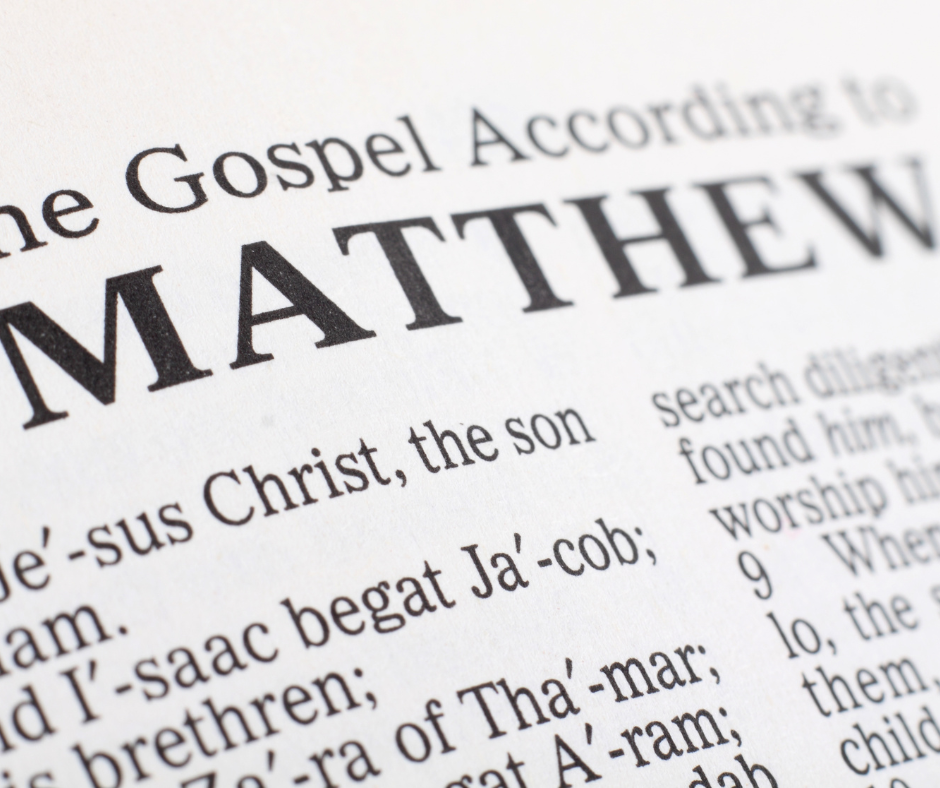
The Gospel of Matthew stands at the threshold of the New Testament as the Spirit-inspired bridge between the long expectations of the Old Testament and their fulfillment in Jesus Christ. No other Gospel so deliberately anchors its narrative in the soil of Israel’s Scripture, history, and covenant identity. Matthew writes with the conviction that the promises made to Abraham, the prophecies sung by David, and the hopes proclaimed by the prophets find their realization in the Messiah who has come. The first Gospel therefore introduces not only the story of Jesus, but the dawn of the long-awaited kingdom of God.
Matthew writes with an intentional, purposeful order, presenting Jesus as the true Son of David and Son of Abraham, the rightful heir to Israel’s throne and the fulfillment of God’s redemptive plan. The opening genealogy does more than trace lineage; it situates Jesus within the unfolding story of grace that stretches from the patriarchs to the exile and into the renewed hopes of the post-exilic community. From its first sentence, the Gospel declares that the Messiah has arrived, and with Him the covenant purposes of God are moving toward their consummation.
I. Authorship, Setting, and Audience
The early Church unanimously attributed this Gospel to Matthew, also known as Levi, a former tax collector called by Christ to discipleship (Matthew 9:9). His background provides a unique vantage point: trained in record-keeping and writing, familiar with Roman administration yet immersed in Jewish tradition, Matthew was ideally equipped to present a carefully structured, Scripture-saturated testimony to Jesus’ identity. His transformation from a despised publican into an apostle of Christ mirrors the larger work of grace evident throughout the Gospel.
Matthew likely wrote for a predominantly Jewish audience living in the first century, perhaps within the broader region of Syria or Palestine, where Jewish-Christian communities were forming in the decades after the resurrection. His Gospel assumes extensive knowledge of the Old Testament and Jewish customs, weaving the fulfillment of prophecy into the narrative with deliberate clarity. Yet Matthew does not write exclusively for Israel; he presents a Messiah whose mission extends to all nations, culminating in the Great Commission that frames the worldwide mission of the Church.
The historical setting reflects a period of transition. Israel was under Roman occupation, longing for deliverance, divided by competing religious factions, and marked by both spiritual expectation and spiritual decline. Within this environment, Matthew reveals Jesus not as the political liberator many expected, but as the true King whose authority transcends every earthly power and whose reign begins not with conquest but with redemption.
II. Structure and Literary Craftsmanship
The Gospel’s structure reflects Matthew’s careful organization. While the narrative flows naturally, Matthew shapes his material into a distinct pattern, alternating between narrative scenes and major teaching discourses. Many interpreters have noted the presence of five major discourses—such as the Sermon on the Mount (chapters 5–7), the Parables of the Kingdom (chapter 13), and the Olivet Discourse (chapters 24–25)—which together form a deliberate literary architecture. Whether or not Matthew intended a symbolic parallel to the five books of Moses, the structure reinforces Jesus’ authority as teacher and reveals His kingdom’s ethical, theological, and eschatological dimensions.
Matthew’s narrative is also characterized by its purposeful use of fulfillment citations. The recurring phrase “that it might be fulfilled which was spoken by the prophet” serves as a thematic thread, guiding the reader through the tapestry of redemptive history. From the virgin birth (1:23) to the ministry in Galilee (4:14–16) and beyond, Matthew shows that Jesus’ life is the embodiment of divine promise. His Gospel is not biography for its own sake but revelation that discloses the work of God unfolding in time.
The Gospel also places significant emphasis on discipleship. Matthew records moments of teaching, correction, commissioning, and testing, portraying Jesus as the authoritative interpreter of the Law who forms a new covenant people grounded in obedience, faith, and righteousness from the heart. This theme will reappear throughout the narrative as Jesus calls His followers to walk in the narrow way, take up the cross, and trust in His presence until the end of the age.
III. Narrative Movement and Major Motifs
Matthew’s Gospel unfolds with a balance of historical narrative and theological emphasis. The opening chapters present the infancy narrative, situating Jesus within Israel’s story and revealing Him as the true Immanuel, “God with us.” His baptism inaugurates His public ministry, His temptation reveals His sinless obedience, and His preaching announces the arrival of the kingdom.
Throughout the Gospel, Matthew presents Jesus as a King, yet a King whose authority is unlike any other. He rules through truth, mercy, healing, and divine sonship. His miracles display His power over sickness, demons, nature, and death. His teaching reveals the ethical character of His kingdom, calling His disciples to a righteousness that exceeds that of the scribes and Pharisees. The growing conflict with the religious establishment underscores the profound contrast between human tradition and divine revelation.
As the narrative moves toward Jerusalem, the tension intensifies. Matthew records Jesus’ royal entry, His cleansing of the temple, and His profound prophetic discourses concerning judgment and the end of the age. The passion narrative forms the climactic center of the Gospel’s saving message: the King is rejected, condemned, crucified, and buried. Yet Matthew’s account does not end in darkness. The resurrection morning reveals the triumph of the true Son of David, now risen with all authority in heaven and earth and commissioning His disciples to carry His message to the nations.
IV. Historical Reliability and Canonical Significance
The Gospel of Matthew bears the unmistakable marks of historical truth. Its geographical details, cultural textures, and depictions of first-century Jewish life align with what is known through archaeology and ancient sources. Matthew’s use of Old Testament Scripture reflects a deep understanding of the Hebrew text and its fulfillment in the Messiah. Furthermore, the Gospel’s early acceptance by the Church, widespread use in worship, and consistent citation by the earliest Christian writers attest to its authenticity and apostolic origin.
Within the canon, Matthew occupies a foundational role. Positioned at the beginning of the New Testament, it introduces the reader to the person of Jesus, the shape of His kingdom, and the call to discipleship that defines Christian identity. It secures the continuity between the old and new covenants, showing that the gospel is not a new religion but the consummation of everything God has been doing since the beginning.
V. Conclusion
The Gospel of Matthew invites the reader to behold Jesus as the promised Messiah, the authoritative Teacher, the compassionate Shepherd, and the risen King. It reveals that God has kept His covenant promises and that the kingdom of heaven has drawn near. Matthew writes not merely to inform but to summon: to call disciples into the life of faith, obedience, and mission shaped by the presence of the One who promises, “Lo, I am with you alway, even unto the end of the world.”
As the gateway to the New Testament, Matthew provides the theological foundation upon which the rest of apostolic teaching stands. To study this Gospel is to enter the world where prophecy becomes fulfillment, promise becomes reality, and the long-awaited King stands revealed in the fullness of His glory.