
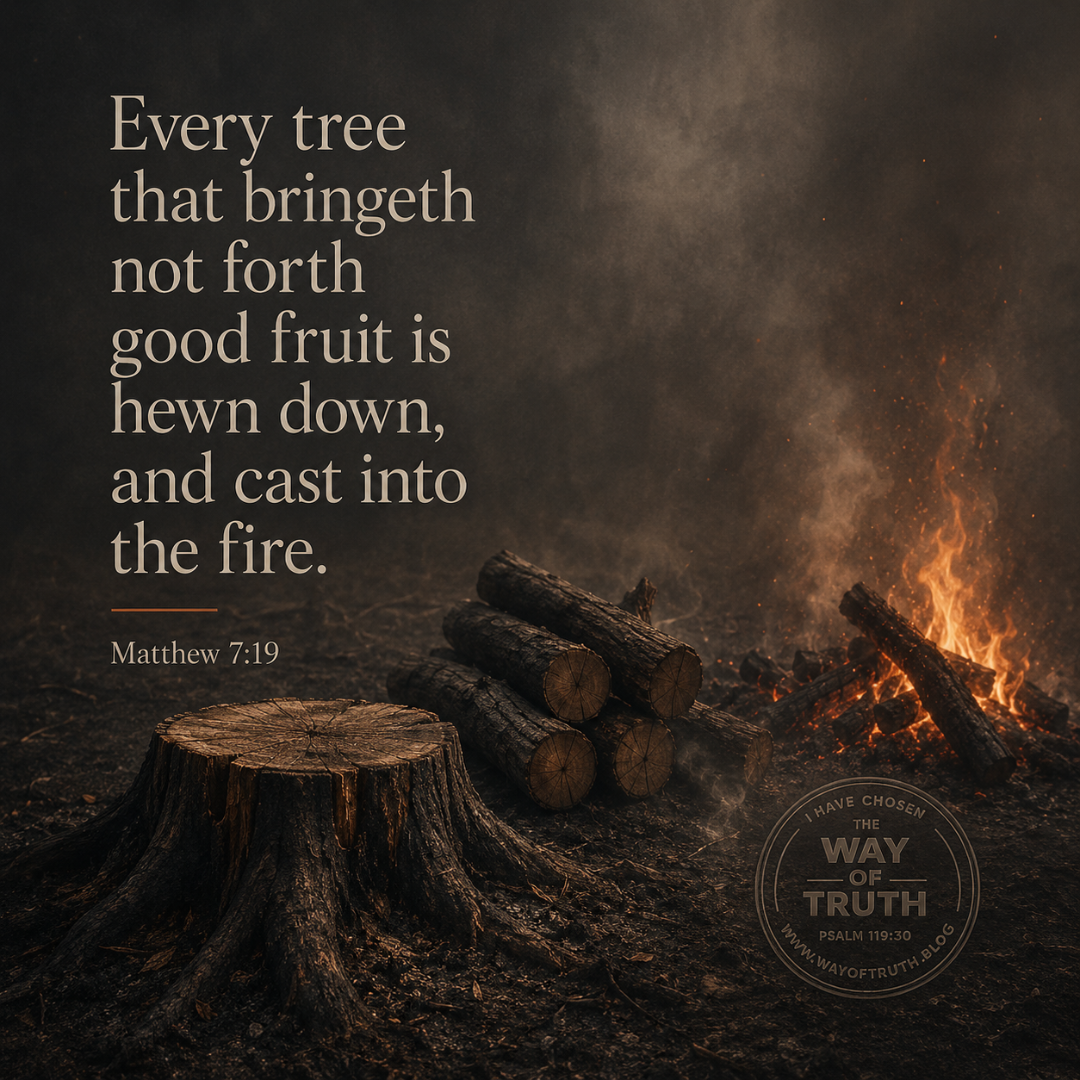
Matthew 7:19 comes in the middle of Jesus’ warning about false prophets. He has already said, “Ye shall know them by their fruits” (Matthew 7:16), and He has explained that a good tree brings forth good fruit while a corrupt tree brings forth evil fruit. Now He presses the warning further. Fruit doesn’t merely reveal the tree; it also exposes the tree to judgment.
“Every tree that bringeth not forth good fruit” isn’t describing a struggling believer who grieves over sin, repents, and desires to walk with God. Jesus is speaking of a tree whose settled pattern is fruitlessness or corruption. The issue isn’t whether a person has moments of weakness, seasons of immaturity, or areas needing growth. Every honest Christian knows that sanctification isn’t instant perfection. The issue is whether there’s any real evidence of spiritual life at all.
The word “every” gives the warning weight. Jesus leaves no protected category for religious people, gifted speakers, admired leaders, impressive personalities, or outwardly moral individuals. A tree may stand for a while. It may have leaves. It may look sturdy from a distance. It may even provide shade. But if it doesn’t bring forth good fruit, the final outcome is certain: it “is hewn down, and cast into the fire.”
This builds naturally on the previous verses. In Matthew 7:15, Jesus warns of false prophets who come “in sheep’s clothing,” while inwardly they are “ravening wolves.” In Matthew 7:16–18, He teaches that their fruit will reveal them. In Matthew 7:19, He shows that exposure isn’t the end of the matter. God doesn’t merely identify falsehood; He judges it.
The image of being “hewn down” is sobering. The axe doesn’t trim a few branches. It cuts the tree down. This points to final judgment, not temporary discipline. The fire isn’t a mild inconvenience. It’s an image of divine wrath against all that remains barren, corrupt, and opposed to God.
Scripture uses similar language elsewhere. John the Baptist warned, “And now also the axe is laid unto the root of the trees: therefore every tree which bringeth not forth good fruit is hewn down, and cast into the fire” (Matthew 3:10). That connection matters. Jesus isn’t introducing a strange or isolated thought. He’s continuing the biblical witness that outward religion without repentance is dangerous. The Lord is patient, but His patience must never be mistaken for indifference.
This verse also fits within the broader unity of Scripture. From Genesis onward, God distinguishes between what has life and what only has appearance. Cain brought an offering, but his heart wasn’t right before God. Israel often maintained religious ceremonies while turning away from the Lord. The prophets repeatedly warned that sacrifices, songs, and assemblies couldn’t cover hearts full of rebellion. In the New Testament, Jesus confronts the same problem among those who honor God with their lips while their hearts are far from Him.
That makes Matthew 7:19 deeply relevant to modern religion. A person may know Christian vocabulary, attend church, speak of values, post Bible verses, and still remain spiritually dead. That’s not said with cruelty. It’s said because Jesus loves us enough to tell the truth before judgment arrives. A doctor who refuses to diagnose a deadly condition may sound pleasant, but they’re not being kind. Jesus is perfectly compassionate, and His compassion never requires Him to pretend that sin is harmless.
Some skeptics object that this kind of language makes Christianity harsh or fear-based. But the warning is morally coherent. A holy God would’t be righteous if He treated evil, deception, hypocrisy, and rebellion as trivial. If human courts are expected to care about justice, surely the Judge of all the earth must do right. The fire of judgment isn’t an overreaction. It’s the final answer of God’s holiness against what refuses His grace and corrupts His truth.
At the same time, this verse must not be twisted into salvation by works. Jesus isn’t teaching that good fruit earns acceptance with God. Rather, good fruit reveals the life that God has given. The fruit is evidence, not the root. A living tree bears fruit because it’s alive. In the same way, those who truly belong to Christ will bear the fruit of repentance, faith, love, humility, obedience, and perseverance. Not flawlessly. Not mechanically. Not so that they can boast. But genuinely, because grace changes people.
Cultic and legalistic distortions often use verses like this to frighten people into submission to a human system. They may say, in effect, “Produce what we demand, obey our leaders, follow our rules, or God will cast you away.” That misses the heart of the passage. Jesus isn’t placing people under man-made control. He’s warning against false prophets and calling His hearers to discernment before God. The question isn’t whether a person conforms to a religious organization’s demands. The question is whether there’s fruit that comes from true life in God.
Another distortion moves in the opposite direction. Some reduce the verse to a vague call to be “nice” or “productive.” But Jesus isn’t giving a motivational speech about personal improvement. He’s speaking of eternal realities. A tree without good fruit faces judgment. That’s far more serious than failing to reach one’s potential. This is about standing before God.
The passage also challenges modern philosophies that treat moral judgment as merely personal opinion. Jesus speaks with divine authority. He doesn’t say, “Some trees may not fit your preferences.” He says that every tree not bringing forth good fruit will be cut down and cast into the fire. In a world that often wants spirituality without accountability, Jesus gives us truth with edges. The edges are sharp because the matter is serious.
And yet, there’s mercy even in the warning. The tree is still standing when the warning is given. The hearer is still being called. The Lord isn’t announcing this after the axe has already fallen. He’s speaking now, while there’s still time to repent, believe, and come to Him.
Holy Fear Without Spiritual Despair
Matthew 7:19 should make the church sober, but it shouldn’t make believers hopeless. There’s a difference between holy self-examination and spiritual panic. Jesus gives this warning not so His people will live in constant despair, but so that no one will be deceived by empty appearances.
For the individual believer, this verse invites honest reflection. We should be willing to ask, “Is there real fruit in my life?” Not, “Am I impressive?” Not, “Do others think I’m spiritual?” Not even, “Do I know the right answers?” The better question is whether Christ’s life is producing visible evidence in us. Do we repent when convicted? Do we desire holiness? Are we growing in love for God and neighbor? Are we becoming more truthful, humble, patient, forgiving, and obedient? Are we grieved by sin, or have we made peace with it?
Those questions aren’t meant to crush the conscience. A believer who mourns sin, runs to Christ, and longs to bear fruit should not read Matthew 7:19 as though Jesus is eager to destroy him. The Lord doesn’t despise weak faith. He doesn’t break the bruised reed. But He does expose false confidence. He warns those who are content with leaves while lacking life.
This is especially important in church life. Congregations can be tempted to evaluate people by visible success, charm, gifting, numbers, polish, or influence. But Jesus teaches us to look deeper. The church must care about doctrine, character, humility, repentance, and obedience. A gifted teacher with corrupt fruit isn’t a blessing to be celebrated; they’re a danger to be discerned. A ministry that grows in size while growing careless with truth isn’t healthy simply because it looks outwardly successful. Even weeds can grow quickly, and nobody brags about a lawn flourishing with crabgrass.
The church should apply this passage with both courage and humility. Courage, because false teaching and corrupt leadership must not be ignored. Humility, because discernment can easily turn into pride if we forget our own dependence on grace. We’re not fruit inspectors standing above everyone else with clipboards and smug expressions. We’re servants under the authority of Christ, called to examine all things by Scripture, including ourselves.
This verse also speaks to the worship of the church. True worship isn’t performance without surrender. It’s not music without reverence, prayers without repentance, or preaching without truth. God is glorified when His people worship Him in sincerity, through Christ, according to His Word. If worship leaves sin unchallenged, Christ unexalted, and Scripture sidelined, something’s wrong at the root. The Lord deserves more than religious activity with no spiritual fruit.
Matthew 7:19 also presses the church toward mission. If judgment is real, evangelism isn’t optional in the Christian life. It’s love in motion. We proclaim the gospel because people need more than encouragement, therapy, community, or moral advice. They need salvation. They need forgiveness. They need new birth. They need Christ.
This should shape how believers speak to the lost. We don’t need to be harsh to be honest. We don’t need to soften Jesus’ warning until it becomes meaningless. The truth is serious: every fruitless tree will be cut down and cast into the fire. But the invitation is also real: Christ saves sinners. He doesn’t merely tell bad trees to try harder. He gives new life. He makes men and women new creatures. He produces fruit by His Spirit in those who belong to Him.
For personal obedience, this passage calls us to stop excusing fruitlessness. It’s easy to say, “That’s just my personality,” when the issue is really pride, bitterness, laziness, selfishness, or unbelief. It’s easy to hide behind busyness and call it faithfulness. It’s easy to confuse religious opinions with spiritual maturity. But Jesus brings the matter back to fruit. Not noise. Not leaves. Not reputation. Fruit.
That fruit begins with abiding in Christ. Jesus later says, “I am the vine, ye are the branches” (John 15:5). A branch doesn’t produce fruit by gritting its teeth and trying to look botanical. It bears fruit by remaining connected to the vine. In the same way, believers bear fruit through dependence on Christ, obedience to His Word, prayer, repentance, and the work of the Holy Spirit.
This gives hope to the Christian who feels small and weak. Good fruit isn’t always dramatic. Sometimes it looks like apologizing when pride wants to defend itself. Sometimes it looks like refusing bitterness when resentment feels justified. Sometimes it looks like telling the truth when lying would be easier. Sometimes it looks like praying again after a dry season, opening Scripture again after distraction, or speaking of Christ when silence would feel safer.
The point isn’t that every believer must produce the same amount of visible fruit at every moment. Trees don’t all mature at the same pace, and seasons differ. But where there is life, there will be fruit. Where there is no fruit at all, Jesus says we must not comfort ourselves with appearances.
This verse should move us to glorify God because He’s both holy and merciful. His holiness means He won’t ignore evil. His mercy means He warns before judgment. His grace means He can take sinners who deserve fire and make them fruitful in Christ. That’s not spiritual self-improvement. It’s resurrection life working in ordinary people.
So let this verse do its proper work. Let it sober the careless. Let it awaken the deceived. Let it humble the proud. Let it strengthen the church’s discernment. Let it stir believers to proclaim the gospel. And let it send every honest soul back to Christ, because He alone can make the tree good.
The Good News for Fruitless Souls
If this warning unsettles you, don’t rush past it. Jesus meant for His words to be felt. “Every tree that bringeth not forth good fruit is hewn down, and cast into the fire” isn’t a small statement. It tells us that God’s judgment is real, and that outward religion can’t save a fruitless soul.
The truth is that all of us, by nature, are sinners before God. We haven’t loved Him with all our heart. We haven’t obeyed Him as we should. We’ve sinned in thought, word, desire, and action. Even our best efforts can’t erase guilt. Scripture says, “For all have sinned, and come short of the glory of God” (Romans 3:23). The penalty for sin isn’t merely a difficult life or a guilty conscience. “For the wages of sin is death” (Romans 6:23).
That’s why we need more than advice. A bad tree can’t save itself by decorating its branches. We need redemption from outside ourselves. We need the mercy of God in Jesus Christ.
The good news is that God sent His Son to save sinners. Jesus Christ lived without sin. He perfectly pleased the Father. He died on the cross, bearing the judgment that sinners deserve. He shed His blood as the atoning sacrifice for sin. He was buried, and He rose again the third day in victory over sin and death. Because He lives, salvation is offered freely to all who come to Him.
The call of the gospel isn’t “try harder and hope for the best.” It’s to repent and believe on the Lord Jesus Christ. Turn from sin and false confidence. Stop trusting your morality, your religious background, your church attendance, your sincerity, or your good intentions. Trust Christ Himself. He alone forgives. He alone cleanses. He alone gives new life.
And when Christ saves, He doesn’t merely spare sinners from judgment. He changes them. He gives a new heart. He produces fruit that could never grow from the old nature. Forgiveness, peace with God, eternal life, and a transformed life are found in Him.
So come to Christ. Come honestly. Come with your sin, your guilt, your barrenness, and your need. He’s not a weak Savior. He’s mighty to save. Trust Him, follow Him, and live for the glory of God, who gives life where judgment was deserved.
Reflection and Response
- Where am I most tempted to confuse outward religious appearance with genuine spiritual fruit?
- Does my life show the fruit of repentance, faith, love, humility, and obedience, even if imperfectly?
- How can I practice discernment in the church without becoming proud, suspicious, or harsh?
- In what specific area is God calling me to seek fruit that glorifies Him rather than merely maintaining appearances?
- Who needs to hear the gospel from me with both honesty about judgment and warmth about the saving grace of Christ?