
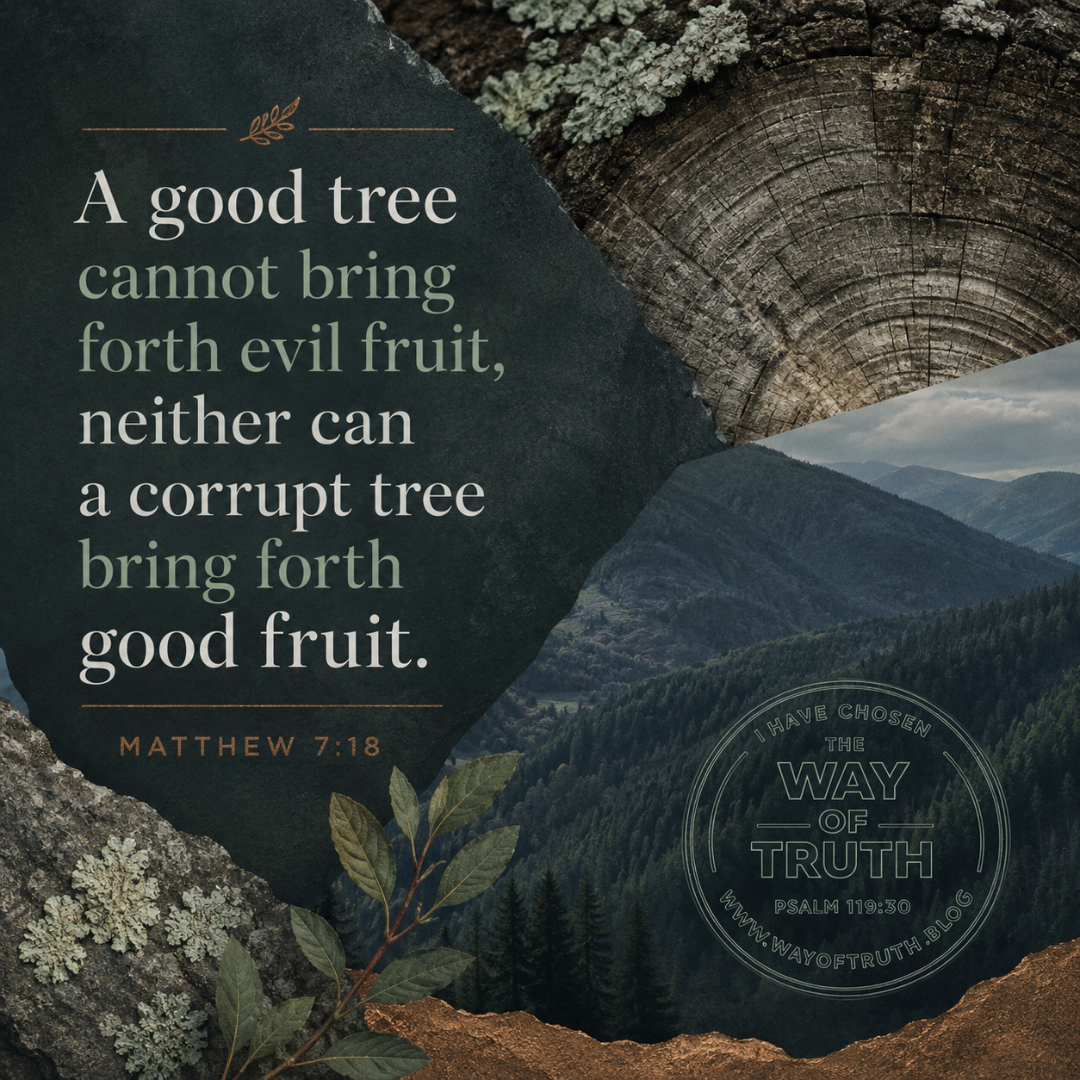
Matthew 7:18 continues the picture Jesus has already placed before us. He has warned His disciples about false prophets, described them as wolves in sheep’s clothing, and taught that trees are known by their fruit. Now He sharpens the point by telling us, “A good tree cannot bring forth evil fruit, neither can a corrupt tree bring forth good fruit.”
Jesus isn’t saying that believers never sin, or that unbelievers never do anything externally kind, useful, or admirable. The Bible is honest about both. Believers still stumble. Unbelievers can still show natural affection, civic virtue, generosity, and moral concern because they’re made in the image of God. But Jesus is speaking about the settled spiritual nature of a life and the kind of fruit that flows from it.
A good tree, by its nature, doesn’t produce evil fruit. A corrupt tree, by its nature, doesn’t produce good fruit. The fruit reveals the root because the fruit comes from the root.
This verse builds directly on Matthew 7:15–17, but it adds something stronger than observation. Verse 16 says, “Ye shall know them by their fruits.” Verse 17 says every tree brings forth fruit according to its nature. Verse 18 presses the matter further: a tree can’t consistently produce fruit contrary to what it is. In plain terms, spiritual life has moral direction. Spiritual corruption also has moral direction.
That matters because false teaching often asks us to separate a person’s message from the life and spirit that message produces. Jesus does’t let us do that. Doctrine and fruit are connected. A teacher may use religious words, quote Bible verses, smile warmly, and sound very spiritual, but if the teaching leads away from Christ, repentance, holiness, the authority of Scripture, and humble obedience, the problem isn’t cosmetic. The tree itself is corrupt.
This also fits the wider testimony of Scripture. James asks, “Doth a fountain send forth at the same place sweet water and bitter?” (James 3:11). Paul teaches that “the fruit of the Spirit is love, joy, peace, longsuffering, gentleness, goodness, faith” (Galatians 5:22). John writes, “He that doeth righteousness is righteous, even as he is righteous” (1 John 3:7). Scripture repeatedly teaches that inward reality eventually becomes outward evidence.
This isn’t salvation by fruit. It’s salvation revealed by fruit. We’re saved by grace through faith, not by works. Yet true grace doesn’t leave a person spiritually unchanged. A painted dead branch is still a dead branch. It may look improved for a little while, but it still can’t grow living fruit. Only life can produce life.
This verse also answers a common modern objection: “Isn’t it judgmental to evaluate spiritual fruit?” It can be, if we evaluate with pride, harshness, gossip, or suspicion. But Jesus isn’t commanding sinful fault-finding. He’s teaching sober discernment. There’s a difference between condemning someone’s soul as though we were God and recognizing spiritual danger because Christ told us to pay attention.
Some groups twist this kind of passage into perfectionism, as if a real believer must never struggle, never fail, and never need confession. That can’t be right, because Scripture also says, “If we say that we have no sin, we deceive ourselves” (1 John 1:8). Others twist it in the opposite direction, claiming that a person can belong to Christ while producing no evidence of spiritual life at all. That also can’t be right, because Jesus says the tree and the fruit are inseparable.
The safest reading is the one that lets the verse speak plainly: the nature of the tree determines the nature of the fruit. A heart made alive by God will bear fruit consistent with His work. A corrupt spiritual source can’t produce the fruit of true godliness, no matter how polished the leaves may look.
And yes, leaves can be impressive. But leaves don’t make jam. Fruit matters.
Let the Fruit Drive Us Back to the Root
Matthew 7:18 calls the church to clear-eyed discernment, but it also calls every believer to humble self-examination. The point isn’t merely, “Look out for bad trees over there.” The passage also presses us to ask, “What kind of fruit is growing in me?”
That question should lead us into honesty. When impatience, pride, bitterness, lust, envy, dishonesty, or lovelessness keeps showing up, we shouldn’t simply trim the visible branches and pretend the root is healthy. We need to bring the matter before the Lord. Sometimes we want God to improve the fruit while we quietly protect the root problem. We ask Him to make us kinder without surrendering our resentment. We ask Him to make us pure without fleeing temptation. We ask Him to make us peaceful while feeding fear all day long. That’s not how spiritual fruit grows.
The believer’s hope isn’t self-repair. Our hope is Christ. He gives life. He changes hearts. He sends His Spirit to produce what we can’t manufacture. Christian growth isn’t spiritual decoration. It’s living union with Christ bearing visible fruit over time.
This matters in the life of the church. Churches aren’t called to chase whatever looks successful, popular, emotionally powerful, or culturally impressive. A ministry may have crowds, money, energy, branding, and online influence, yet still produce fruit that’s shallow, man-centered, Scripture-light, and repentance-free. On the other hand, a faithful church may look ordinary, but its people are learning to love Christ, confess sin, bear burdens, forgive one another, serve quietly, worship sincerely, and proclaim the gospel clearly. That’s good fruit.
This passage also helps protect church unity. False unity says, “Ignore the fruit so nobody feels uncomfortable.” Biblical unity says, “Let’s stay close to Christ, submit to His Word, and lovingly guard one another from what harms the flock.” The church doesn’t honor God by pretending poison is nourishment. At the same time, the church must not become suspicious, harsh, or eager to label people. Discernment without love becomes pride. Love without discernment becomes carelessness. Jesus calls us to both truth and tenderness.
Personally, this verse invites us to slow down and notice what our lives are producing. What comes out when we’re tired? What grows when nobody’s watching? What appears in our words when we’re frustrated? What kind of influence do we leave behind in our home, workplace, church, and friendships? Do people around us see more of Christ’s patience, mercy, holiness, courage, and truth? Or do they mainly experience our irritation, self-protection, and need to be right?
Those questions aren’t meant to crush us. They’re meant to drive us to God. The Lord is glorified when His people stop pretending and start abiding. Jesus later says, “He that abideth in me, and I in him, the same bringeth forth much fruit” (John 15:5). Fruitfulness begins with nearness to Christ.
This also shapes our mission. If corrupt trees can’t bring forth good fruit, then the world doesn’t merely need moral advice. People don’t simply need religious polish, better habits, or inspirational slogans. They need new life. That means the church must proclaim the gospel, not merely promote values. We call sinners to Christ because only Christ can make the tree good.
And for believers, this is deeply encouraging. The Lord isn’t asking us to staple spiritual fruit onto dead wood. He’s calling us to walk with Him, depend on Him, confess sin quickly, obey His Word, and trust His Spirit to bear fruit that glorifies God. Even slow growth is still growth. A small piece of real fruit is better than a whole basket of plastic fruit. Plastic fruit may last longer on the table, but nobody is strengthened by it.
So, bring the root to the Lord. Ask Him to search you. Ask Him to deepen repentance, strengthen faith, purify motives, and make your life fruitful for His glory. The goal isn’t to look spiritually impressive. The goal is to belong wholly to Christ, bear fruit that pleases the Father, and become a clearer witness to the gospel in a world that desperately needs life.
Only Christ Can Make the Tree Good
If this verse has made you wonder what kind of tree you are before God, don’t turn away from that question. It may be one of the kindest questions the Lord could press upon your heart.
Jesus says, “A good tree cannot bring forth evil fruit, neither can a corrupt tree bring forth good fruit.” That means our deepest problem isn’t merely that we’ve done some wrong things. Our problem is deeper than behavior. Sin has corrupted the heart. We’ve disobeyed God, rejected His authority, loved darkness, excused ourselves, and fallen short of His glory. The Bible says, “For all have sinned, and come short of the glory of God” (Romans 3:23).
The penalty for sin is death and judgment. We can’t erase our guilt by trying harder. We can’t make ourselves spiritually alive by improving our outward appearance. A corrupt tree can’t turn itself into a good tree.
But God, in mercy, sent His Son. Jesus Christ lived without sin. He bore the penalty sinners deserve when He died on the cross. “Christ died for our sins according to the scriptures” (1 Corinthians 15:3). He was buried, and He rose again the third day, victorious over sin and death. He doesn’t merely offer moral improvement. He offers forgiveness, cleansing, reconciliation with God, and new life.
That is why the gospel is such good news. Christ can do what we can’t. He can forgive the guilty. He can cleanse the defiled. He can make alive those who are dead in sin. He can change the root so that good fruit begins to grow.
The call isn’t to pretend you’re better than you are. The call is to repent and believe on the Lord Jesus Christ. Turn from sin. Stop trusting yourself. Come to Christ by faith. He’s a gracious Savior, not a reluctant one.
Trust Him today. Receive His mercy. Follow Him as Lord. And by His grace, live for the glory of the One who alone can make the corrupt new, the barren fruitful, and the guilty forgiven.
Reflection and Response
- What kind of fruit is most consistently growing in my words, choices, relationships, and private thoughts?
- Where have I been trying to manage outward behavior while avoiding a deeper root issue before the Lord?
- How can I practice discernment in a way that protects truth without becoming proud, harsh, or suspicious?
- Does my life help others see the beauty, holiness, mercy, and truth of Christ more clearly?
- Who needs to hear the gospel from me, not merely moral encouragement, but the good news that Christ gives new life?