
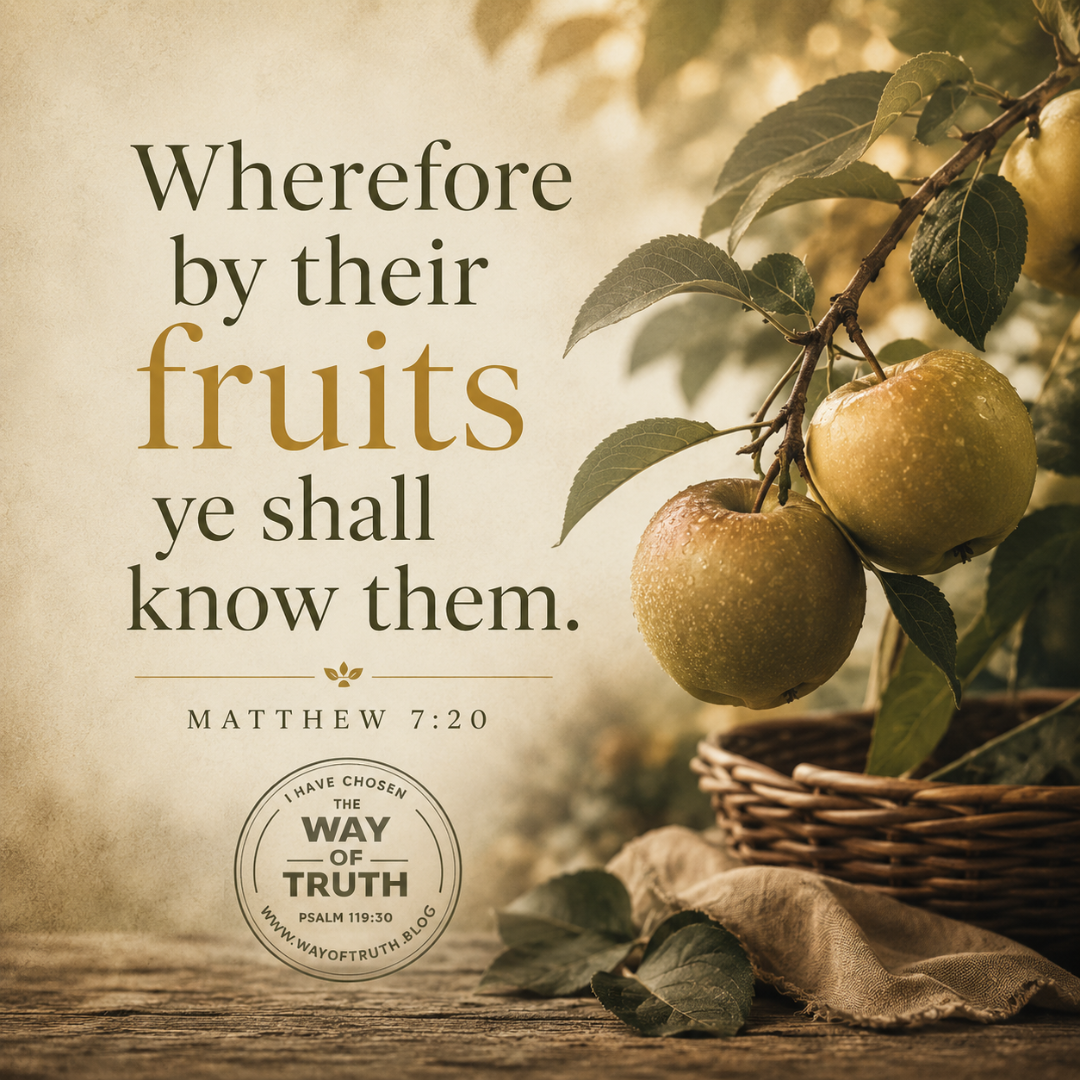
Matthew 7:20 is short, but it carries the weight of the whole warning that came before it. Jesus has been speaking about false prophets, warning His hearers that they may come “in sheep’s clothing,” while inwardly being “ravening wolves” (Matthew 7:15). Then He gives the repeated test: fruit reveals the tree. Grapes don’t grow on thorns. Figs don’t grow on thistles. A good tree brings forth good fruit, and a corrupt tree brings forth evil fruit. Fruitless trees face judgment. Then comes this verse: “Wherefore by their fruits ye shall know them.”
The word “wherefore” matters. Jesus is drawing the conclusion. Since outward appearance can deceive, spiritual claims can sound convincing, and false prophets may look harmless, Christ commands His people to look at fruit. Not gossip. Not suspicion. Not personality preferences. Not whether someone has a polished public image. Fruit.
This verse teaches that spiritual discernment isn’t optional for believers. Jesus doesn’t say, “You might know them,” or “You can never really tell.” He says, “ye shall know them.” That doesn’t mean believers become all-knowing judges of the heart. Only God sees the heart perfectly. As 1 Samuel 16:7 says, “for man looketh on the outward appearance, but the LORD looketh on the heart.” Yet Jesus teaches that a person’s doctrine, conduct, influence, humility, repentance, and spiritual direction eventually reveal something real.
This is important because many people misuse this passage in two opposite ways. Some use it harshly, as though every failure proves someone is false. That’s not what Jesus is teaching. Peter denied Christ, David sinned grievously, and many true believers have stumbled badly. Scripture doesn’t teach that genuine believers never struggle. But others misuse the passage softly, as though we’re never allowed to evaluate spiritual fruit at all. That also contradicts Jesus. A refusal to discern isn’t humility; it may be disobedience feigning kindness.
The passage also answers a modern objection: “Isn’t this judgmental?” Jesus has already warned against hypocritical judgment earlier in Matthew 7, but He now commands righteous discernment. The difference isn’t whether we evaluate, but how and why. Proud judgment condemns others while excusing self. Biblical discernment humbly tests what’s true, good, and faithful to God.
Against false religion, cultic manipulation, and shallow spirituality, Jesus gives His people a simple but searching test. Do the fruits point to Christ, holiness, truth, repentance, love, obedience, and faithfulness to Scripture? Or do they point to pride, deception, greed, immorality, confusion, fear, self-exaltation, and spiritual harm?
This verse fits the whole Bible’s witness. The prophets were tested by whether they spoke truth from God. Israel was warned not to follow signs and wonders if the message led them away from the LORD. Deuteronomy 13:3 says, “for the LORD your God proveth you, to know whether ye love the LORD your God with all your heart and with all your soul.” In the New Testament, believers are told, “Beloved, believe not every spirit, but try the spirits whether they are of God” (1 John 4:1). Scripture isn’t naïve about religious deception. It teaches us to be loving, but not gullible. Gentle, but not blind.
Jesus’ words are morally coherent because He doesn’t ask us to judge by worldly standards. He doesn’t tell us to measure people by charisma, wealth, platform, education, emotional intensity, or popularity. He tells us to look at fruit. That’s profoundly fair. Fruit isn’t a momentary impression. It’s what grows over time from the life and teaching of a person.
And yes, sometimes fruit takes patience to see. You usually can’t identify a tree’s harvest by staring at it for five seconds in February. In the same way, we shouldn’t rush to conclusions based on one moment, one rumor, or one awkward sentence. But over time, fruit speaks.
Recognizing the Produce of a Life
Jesus’ words are intensely practical for individual believers and for the Church. If false prophets can look like sheep, then the Church must learn to look beyond appearances. That doesn’t mean we become suspicious of everyone who teaches, leads, writes, preaches, counsels, sings, or influences. Suspicion isn’t a spiritual gift. But discernment is a spiritual responsibility.
For the individual believer, Matthew 7:20 calls us to examine what we allow to shape us. Not every voice with Bible words is biblical. Not every emotional message is faithful. Not every confident teacher is sound. Not every ministry with a crowd is healthy. The question isn’t simply, “Did this move me?” but “Is this true? Does it honor Christ? Does it lead me toward obedience? Does it deepen reverence for God? Does it make sin look deadly and grace look precious? Does it make Scripture clearer or does it quietly replace Scripture with personality, pressure, or novelty?”
This matters because teaching produces fruit in hearers. Bad teaching rarely remains an idea on a shelf. It shapes worship, prayer, marriage, parenting, church life, conscience, evangelism, and how people view God. If teaching steadily produces pride, harshness, fear, greed, sensuality, spiritual confusion, or contempt for Scripture, Jesus tells us not to ignore the fruit.
At the same time, this verse should make us humble before we apply it to others. We should ask, “What fruit is being produced in me?” Am I growing in repentance, love, patience, truthfulness, self-control, courage, and tenderness toward the Lord? Am I becoming easier to correct, or more defensive? Am I quicker to forgive, or quicker to keep score? Am I more eager to glorify God, or more eager to be noticed?
Fruit grows from life. A Christian doesn’t manufacture spiritual fruit by sheer willpower, as if sanctification were a weekend craft project with glue sticks and good intentions. The fruit of godliness comes from union with Christ, dependence on the Holy Spirit, and obedience to the Word. Jesus later says in John 15:5, “for without me ye can do nothing.” That keeps us from pride when fruit appears and from hopelessness when we see remaining weakness.
For churches, this verse is especially important. The Church must not evaluate leaders merely by gifting. A man may be eloquent and still dangerous. A teacher may be popular and still unfaithful. A ministry may be energetic and still unhealthy. Churches should ask: Does this leadership produce reverence for God, submission to Scripture, clarity about the gospel, care for souls, holiness, humility, and love? Are people being shepherded toward Christ, or gathered around a personality?
This also applies to unity in the Church. True unity isn’t built by ignoring fruit. It’s built around truth and love. When a church refuses to discern, wolves aren’t corrected, sheep are harmed, and the name of Christ is dishonored. But when discernment is practiced humbly, patiently, and biblically, the Church is protected and God is glorified.
Matthew 7:20 also calls us to gospel mission. A watching world often sees the fruit before it understands the doctrine. That doesn’t mean good works replace gospel proclamation. They can’t. Sinners need the message of Christ crucified and risen. But the life of the Church should adorn the gospel it proclaims. Titus 2:10 speaks of believers living so as to “adorn the doctrine of God our Saviour in all things.” When believers walk in integrity, compassion, courage, purity, and truth, they don’t save anyone by their fruit, but they bear witness to the Savior who changed them.
So, we should pray for fruit that glorifies God. Fruit in our homes. Fruit in our speech. Fruit in our work. Fruit in our worship. Fruit in our churches. Fruit in our private lives where no one applauds. Fruit in our witness to the lost. Not performative fruit. Not plastic fruit that looks shiny but has no life in it. Real fruit: the kind that comes from abiding in Christ.
This passage also helps us resist two common errors in our day. One error says, “Doctrine doesn’t matter; only love matters.” But Jesus is warning about false prophets, which means truth matters deeply. The other error says, “Doctrine matters, but character is secondary.” Jesus rejects that too. Truth and fruit belong together. Sound doctrine should produce holy fruit, and holy fruit must grow from the truth of God.
The believer’s response should be both sober and hopeful. Sober, because Jesus says people can be known by their fruits. Hopeful, because Christ doesn’t merely expose bad fruit; He gives new life. He changes people from the root upward. He makes truth beautiful in the lives of His people. And He sends those people into the world to proclaim His gospel, not only with words spoken clearly, but with lives that make those words harder to dismiss.
Hope for Fruitless Sinners
If this verse unsettles you, don’t rush past that feeling. Jesus’ words are meant to make us think honestly. “Wherefore by their fruits ye shall know them.” That means our lives aren’t spiritually weightless. What we love, follow, excuse, practice, and produce says something real about us.
The Bible teaches that all of us are sinners. Romans 3:23 says, “For all have sinned, and come short of the glory of God.” Sin isn’t only the obvious evil we do in public. It’s also the pride, unbelief, selfishness, lust, bitterness, deceit, and rebellion that grow from within. Before a holy God, none of us can save ourselves by trying to look more fruitful than we really are.
And sin has a penalty. Romans 6:23 says, “For the wages of sin is death.” That’s why Jesus’ warning about fruit matters. A life apart from God doesn’t end in peace, no matter how religious or respectable it may appear. We need more than improvement. We need rescue.
The good news is that Jesus Christ came to save sinners. He lived without sin. He died on the cross as the sacrifice for sin. He rose again in victory over death. 1 Corinthians 15:3–4 says, “Christ died for our sins according to the scriptures; And that he was buried, and that he rose again the third day according to the scriptures.” He did what we could never do. He bore the judgment sinners deserve and offers forgiveness, new life, and eternal salvation to all who come to Him.
The call of the gospel isn’t “try harder until God accepts you.” It’s repent and believe on Christ. Turn from sin and trust the Savior. Acts 16:31 says, “Believe on the Lord Jesus Christ, and thou shalt be saved.”
If you don’t yet know Christ, come to Him honestly. Bring your sin, your false fruit, your empty religion, your private guilt, your fear, and your need. He’s not a Savior for people who have already made themselves clean. He’s the Savior who cleanses sinners and gives life where there was none.
Trust Him. Follow Him. And by His grace, live for the glory of God.
Reflection and Response
- What kind of fruit is my life steadily producing, especially in the places where few people see me?
- Am I evaluating spiritual teaching by Scripture and Godly fruit, or am I too easily impressed by personality, emotion, popularity, or confidence?
- How can I practice discernment without becoming proud, suspicious, or harsh?
- What fruit would most clearly glorify God in my home, church, work, and witness this week?
- Who in my life needs to hear the gospel of Christ, and how can my words and conduct help point them to Him?
[…] warning about fruit. Jesus has just said, “Wherefore by their fruits ye shall know them” (Matthew 7:20). Now He applies that truth to religious profession itself. It’s possible to have leaves without […]