
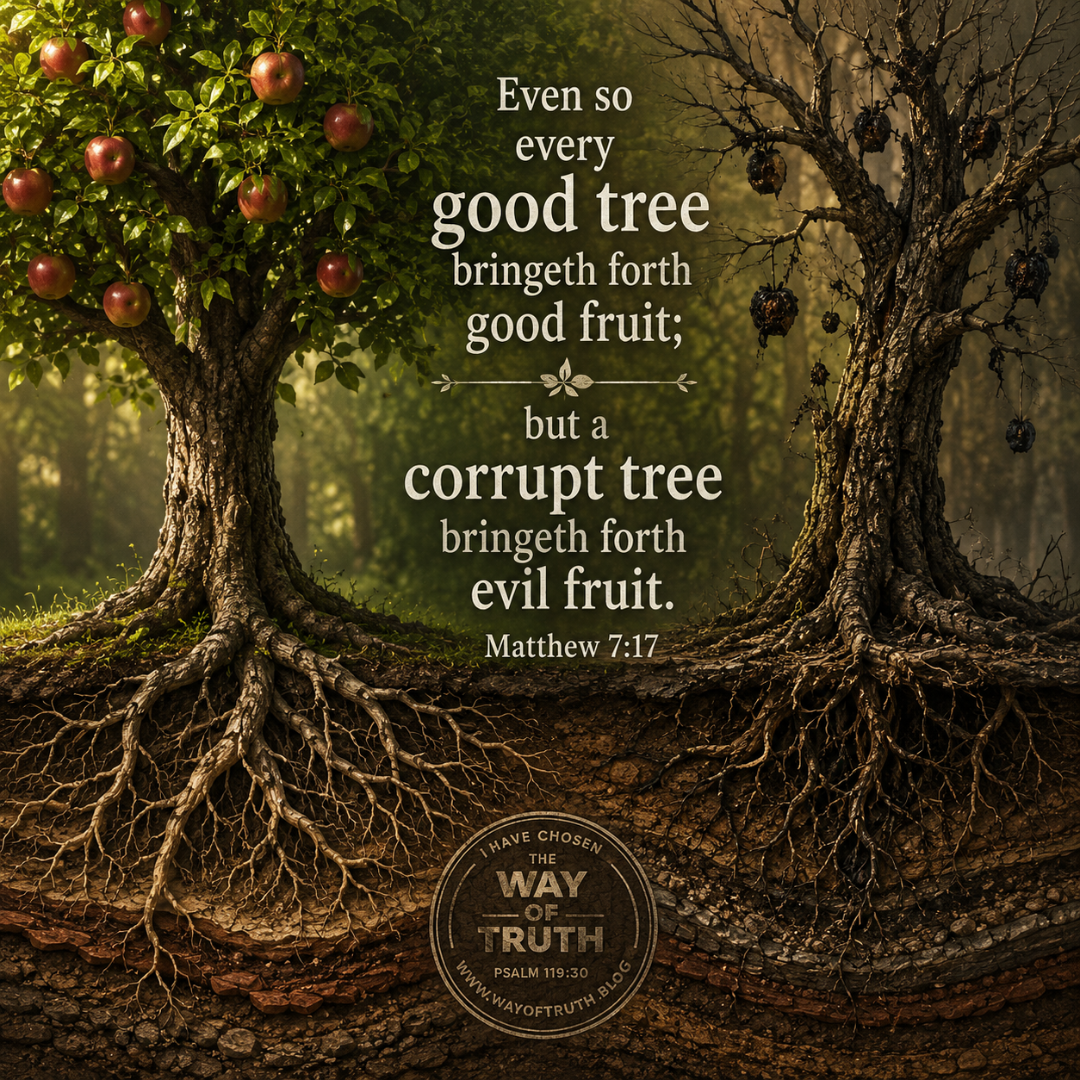
Jesus continues the warning He began in Matthew 7:15: “Beware of false prophets.” In verse 16, He gave the test: “Ye shall know them by their fruits.” Now, in Matthew 7:17, He explains why that test works. Fruit isn’t random. Grapes don’t accidentally grow from thornbushes. Figs don’t suddenly appear on thistles. And good spiritual fruit doesn’t come from a corrupt spiritual source.
The point is simple, but it reaches deep: what a person produces reveals what they are.
Jesus says, “Even so every good tree bringeth forth good fruit.” A good tree produces good fruit because its life, nature, and root are sound. In the same way, a true servant of God will not be perfect, but the general direction and effect of their life and teaching will be good. Their doctrine will honor God’s Word. Their message will exalt Christ. Their influence will call people toward repentance, faith, holiness, humility, love, and obedience.
Then Jesus gives the opposite: “but a corrupt tree bringeth forth evil fruit.” A corrupt tree may still look impressive from a distance. It may have leaves. It may stand tall. It may even provide shade. But if the root is diseased, the fruit will eventually expose it. False teachers may sound compassionate, confident, intellectual, spiritual, or even biblical. But their teaching and influence will eventually reveal corruption. They may minimize sin, deny judgment, flatter human pride, distort the gospel, undermine the authority of Scripture, or draw attention to themselves rather than to Christ.
This doesn’t mean believers should become suspicious of everyone. Jesus isn’t calling His people to become spiritual fruit inspectors with a clipboard and a frown. Some Christians already have the frown part down, but that’s not the goal. He’s calling us to wise, humble, Scripture-shaped discernment.
This verse also fits the broader message of Scripture. In Psalm 1:3, the blessed man is pictured as “a tree planted by the rivers of water, that bringeth forth his fruit in his season.” In John 15:5, Jesus says, “I am the vine, ye are the branches.” True fruit comes from abiding in Him. Galatians 5:22–23 describes “the fruit of the Spirit” as love, joy, peace, longsuffering, gentleness, goodness, faith, meekness, and temperance. Scripture consistently teaches that inward spiritual reality produces outward evidence.
This also guards us from two errors.
First, it guards us from the error of judging by appearance alone. A person may seem gifted, popular, moving, or persuasive, but none of those things prove faithfulness. A large platform isn’t the same thing as good fruit. Smooth speech isn’t the same thing as truth.
Second, it guards us from the error of claiming that fruit doesn’t matter. Some may twist grace into the idea that a person can belong to Christ while remaining unchanged in heart, doctrine, and life. But Jesus doesn’t separate root from fruit. We’re not saved by our fruit, but true salvation doesn’t leave the tree corrupt. The gospel changes the root, and over time, that new life bears fruit.
Skeptics may object that Christians use “fruit” language to judge people unfairly. And sadly, some have done that. But Jesus isn’t giving permission for harsh, shallow, or self-righteous judgment. He’s giving a moral and spiritual test rooted in reality. Ideas have consequences. Teaching shapes lives. A message that leads people away from truth, holiness, repentance, and Christ isn’t harmless just because it sounds kind or religious.
Cultic and heretical groups often misuse this kind of passage by pointing to outward morality, organizational growth, or emotional devotion as proof that their movement is true. But Jesus isn’t merely asking, “Are people busy?” or “Are they sincere?” or “Does the group look successful?” He’s asking whether the fruit is truly good according to God’s Word. Evil fruit can wear religious clothing. True fruit must be measured by Scripture, not by numbers, feelings, charisma, or human approval.
The authority of this verse rests in the moral clarity of Christ Himself. He sees beneath appearances. He knows the root. And He lovingly teaches His people not to be carried away by leaves when there is no godly fruit.
Testing the Fruit
Matthew 7:17 calls believers to slow down and look carefully. Not cynically, not proudly, but carefully. Jesus knows we’re easily impressed by the wrong things. We can be drawn to confidence, eloquence, humor, intelligence, beauty, success, and emotional intensity. None of those things are necessarily wrong. But none of them prove spiritual health.
A gifted teacher may still be a corrupt tree. A plainspoken believer may bear far more good fruit than someone with polish and applause. In the kingdom of God, faithfulness matters more than flash.
For the individual believer, this verse begins with self-examination. Before we apply it to every preacher, author, influencer, or church leader we know, we should first ask: What kind of fruit is growing in my own life? Are my words producing peace or stirring needless conflict? Does my private life match my public faith? Am I growing in humility, repentance, love, holiness, patience, and obedience? Do I respond to correction with teachability, or do I defend myself like a lawyer who knows their client is guilty?
This kind of examination shouldn’t drive believers into despair. Christians still struggle with sin. Fruit grows gradually. A young apple tree doesn’t bear an abundance of apples overnight. The issue isn’t whether we’re perfect, but whether God’s grace is truly at work in us. If we belong to Christ, there should be evidence of His life in us, sometimes small, sometimes slow, but real.
This verse also applies to the church’s worship and teaching. Churches must care about doctrine because doctrine bears fruit. What a church teaches about God, sin, Christ, salvation, Scripture, holiness, and eternity will shape the people who sit under that teaching. If the pulpit avoids repentance, softens sin, entertains unbelief, or replaces Christ with self-improvement, the fruit will eventually show. People may become religious consumers rather than worshipers. They may learn to feel affirmed without being transformed. They may become skilled at church language while remaining strangers to godly sorrow, obedience, and gospel joy.
The church is also called to protect its unity. But true unity isn’t built by ignoring rotten fruit. Biblical unity grows around truth. When leaders and members humbly submit to Scripture, confess sin, forgive one another, pursue holiness, and keep Christ central, the church becomes a place where good fruit can grow. That doesn’t mean the church will be flawless. Every local church is still made up of sinners. But where Christ is honored, His Word is obeyed, and the Spirit is at work, there will be fruit that glorifies God.
This passage also strengthens the church’s mission. The world doesn’t merely need religious activity. It needs the gospel of Jesus Christ. When believers bear good fruit, they adorn the truth they proclaim. Our conduct shouldn’t contradict the gospel. A bitter, proud, dishonest, or loveless life makes our witness harder to hear. A humble, truthful, compassionate, holy life doesn’t save anyone, but it can make the beauty of Christ more visible.
So, we should pray for fruit. Not artificial, plastic fruit arranged for display, but real fruit from a heart changed by grace. We should ask the Lord to make us people whose lives help others see that His Word is true, His ways are good, and His Son is worthy.
And when we see bad fruit in ourselves, we shouldn’t merely tape good behavior onto a corrupt branch. We should go to the root. We should confess sin honestly, return to Christ, submit again to His Word, and ask Him to renew us by His grace. The Christian life isn’t behavior management with religious decorations. It’s life from Christ bearing fruit for God.
Above all, Matthew 7:17 calls us to live for God’s glory. Good fruit isn’t ultimately about making us look spiritually impressive. It’s about showing the goodness of the God who saved us. Jesus said in Matthew 5:16, “Let your light so shine before men, that they may see your good works, and glorify your Father which is in heaven.” That’s the aim: not applause for the tree, but glory to the Gardener.
Christ Changes the Root
Maybe this verse has exposed something uncomfortable in you. Maybe you see fruit in your life that you can’t explain away. Maybe there’s pride, bitterness, lust, dishonesty, greed, unbelief, or a long habit of looking religious while staying far from God. If so, this passage isn’t inviting you to pretend the fruit is better than it is. It’s inviting you to come honestly to the Savior who can change the root.
The Bible teaches that our deepest problem isn’t merely that we sometimes do bad things. Our problem is sin. We’ve sinned against a holy God. Romans 3:23 says, “For all have sinned, and come short of the glory of God.” Sin isn’t a small thing. It separates us from God, corrupts our desires, and places us under judgment. Romans 6:23 says, “For the wages of sin is death.”
That’s why we need more than advice, religion, effort, or a better public image. A corrupt tree can’t heal itself by trying harder to look healthy. We need redemption, forgiveness, and a new life.
This is the good news: God sent His Son, Jesus Christ, to save sinners. Jesus lived without sin. He perfectly pleased the Father. Then He died on the cross as the sacrifice for sin, bearing the judgment sinners deserve. He rose again from the dead, victorious over sin and death. As 1 Corinthians 15:3–4 says, “Christ died for our sins according to the scriptures; And that he was buried, and that he rose again the third day according to the scriptures.”
Jesus doesn’t merely improve people outwardly. He saves, forgives, cleanses, and makes new. He gives life where there was death. He gives righteousness where there was guilt. He gives hope where there was condemnation.
The call of the gospel is to repent and believe. Turn from sin and self-rule. Stop trusting your morality, sincerity, religious background, or good intentions. Trust Jesus Christ. He’s able to forgive fully, save completely, and begin in you a new life that bears fruit for God.
Come to Him honestly. You don’t have to decorate the tree before bringing it to the Savior. Bring Him the whole truth. Bring Him the sin, the guilt, the emptiness, the fear, the false fruit, the hidden rot. He’s gracious to save all who come to Him by faith.
Trust in Christ, receive His mercy, and live for the glory of the God who makes corrupt sinners into fruitful servants of His grace.
Reflection and Response
- What kind of fruit is most consistently growing from my words, habits, relationships, and private life?
- Am I more easily impressed by outward appearance, confidence, popularity, or success than by faithfulness to Scripture and Christlike character?
- Where do I need to stop managing outward behavior and instead bring the root issue honestly before the Lord?
- How can my life more clearly glorify God by displaying the fruit of repentance, faith, humility, love, and obedience?
- Who in my life needs to hear the gospel, and how can I bear faithful witness to Christ in both my words and conduct?