
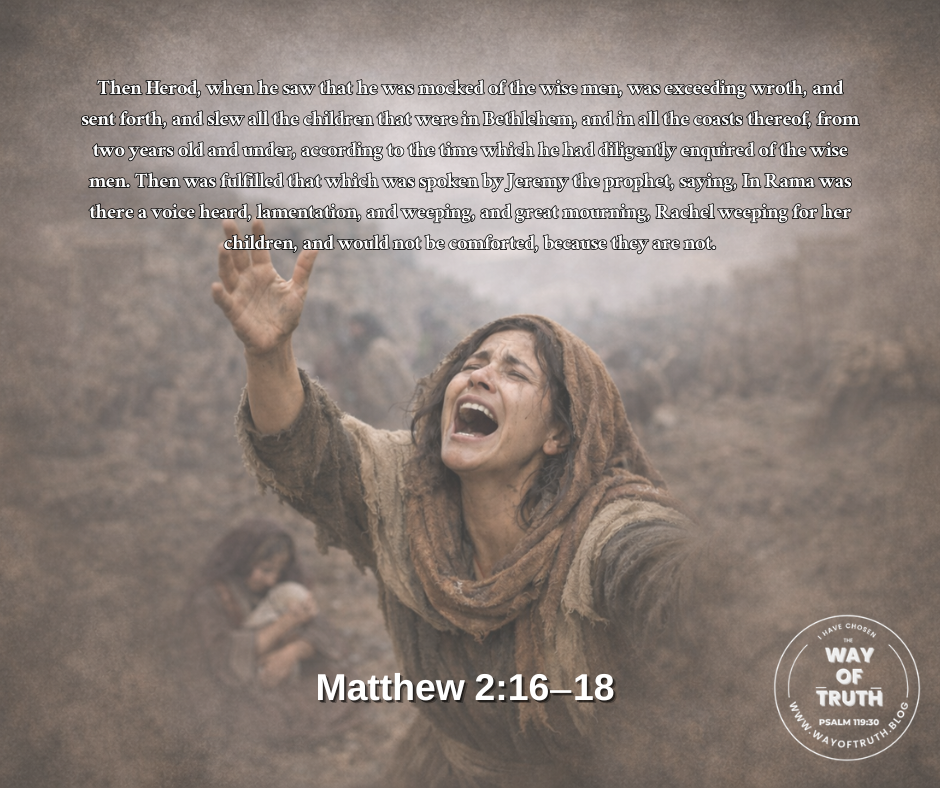
Matthew doesn’t soften the horror of this passage. Herod realizes he’s been outmaneuvered and responds with rage. “Exceeding wroth.” The language is blunt because the act is brutal. He sends soldiers to Bethlehem and its surrounding region and orders the slaughter of male children two years old and under.
The detail about age aligns with Herod’s earlier careful inquiry. His fear has matured into violence. The threatened throne lashes out at innocence.
It’s tempting to rush past this text. We prefer nativity scenes with soft lighting. But Matthew won’t allow us to sentimentalize the arrival of Christ. The coming of the true King provokes hostility. The kingdom of darkness does not yield quietly.
Then Matthew does something striking. He connects this tragedy to the words of the prophet Jeremiah. “In Rama was there a voice heard… Rachel weeping for her children.” In Jeremiah’s context, Rachel symbolizes Israel grieving the exile, the loss of her sons carried away.
Matthew sees in Bethlehem’s mourning a continuation of Israel’s sorrow. Yet Jeremiah’s prophecy doesn’t end with despair. In its original setting, it moves toward hope, restoration, and covenant renewal. Matthew doesn’t quote that entire promise, but he invokes it. Sorrow is real. Yet it exists within a larger redemptive frame.
Skeptics sometimes question the historical reliability of this event because it’s not widely recorded outside Scripture. Yet Herod’s known cruelty is well documented. The scale of Bethlehem was small; the atrocity, though horrific, would not necessarily attract imperial record. Matthew’s account fits the character of Herod and the political climate of the time.
More importantly, the text confronts us with theological realism. The birth of the Savior doesn’t prevent immediate suffering. It exposes it. The presence of evil doesn’t contradict God’s sovereignty; it reveals the depth of what Christ has come to confront.
Matthew 2:16–18 isn’t an interruption of the Christmas story. It’s part of it.
Faith in the Midst of Unanswered Tears
This passage forces us to wrestle with grief.
Rachel’s weeping is described as inconsolable. “Would not be comforted.” Scripture doesn’t rebuke that mourning but acknowledges it. There are losses in this world that feel irreparable. The Bible doesn’t minimize them with clichés.
For believers, this text dismantles shallow optimism. Following Christ doesn’t insulate us from pain. In fact, the presence of Christ can intensify opposition. The world that rejected Him then still resists Him now.
Yet sorrow isn’t the final word. Jeremiah’s larger context speaks of restoration and hope. Matthew’s inclusion of the prophecy implies that this grief, though real, doesn’t derail God’s purposes. Herod rages. Mothers weep. But the promised Son lives. Redemption advances.
For the Church, this passage calls for compassionate realism. We can’t preach Christ in a way that denies suffering. We must weep with those who weep. At the same time, we must anchor hope in God’s sovereign plan. The cross itself will embody this paradox: the worst evil becoming the means of salvation.
On a personal level, this text invites honest faith. When tragedy strikes, do we assume God has lost control? Or do we cling to the larger story? The slaughter in Bethlehem didn’t nullify the promise. It intensified the need for it.
There’s also a sobering contrast here. Herod’s fear of losing power leads to destruction. Sin, left unchecked, always harms others. The refusal to bow before Christ never remains private. It spills outward.
For believers today, the call is twofold. Grieve honestly. Trust deeply. The Christian hope doesn’t deny tears; it promises their eventual end.
The Savior Born into Sorrow
Matthew 2:16–18 reminds us that Jesus entered a broken world.
He wasn’t born into ease. His earliest days were marked by threat and tragedy. The grief of Bethlehem foreshadows the grief of Calvary. The world that resisted Him at birth would crucify Him as a man.
Why did He come into such a world? Because the world needed saving.
Sin has ravaged humanity. Violence, injustice, and death are not accidents; they’re the fruit of rebellion against God. The penalty for sin is death, and no human system can fully repair what sin has fractured.
But God didn’t abandon His creation. He sent His Son. Jesus would grow, live without sin, and ultimately bear sin’s penalty on the cross. He would absorb the wrath sin deserves. He would rise again, conquering death and securing eternal life.
The sorrow of Bethlehem points forward to a greater sorrow at Golgotha, where the innocent Son would die so that sinners might live.
If you don’t already know Jesus Christ as your Lord and Savior, understand that He entered our grief to redeem it. He calls you to repentance and faith. Turn from sin. Trust in the Savior who suffered and rose again. In Him there is forgiveness and the promise of a day when mourning will cease.
And if you belong to Christ, let this passage strengthen your hope. Tears are real, but they’re not ultimate. The King who survived Herod’s rage will one day wipe away every tear.
Reflection and Response
- How does this passage reshape your understanding of the “Christmas story”?
- What does Rachel’s weeping teach us about honest grief?
- Why does the presence of suffering not disprove God’s sovereignty?
- How does this text deepen your appreciation for Christ’s mission?
- Where do you need to trust God’s larger redemptive plan amid personal sorrow?