
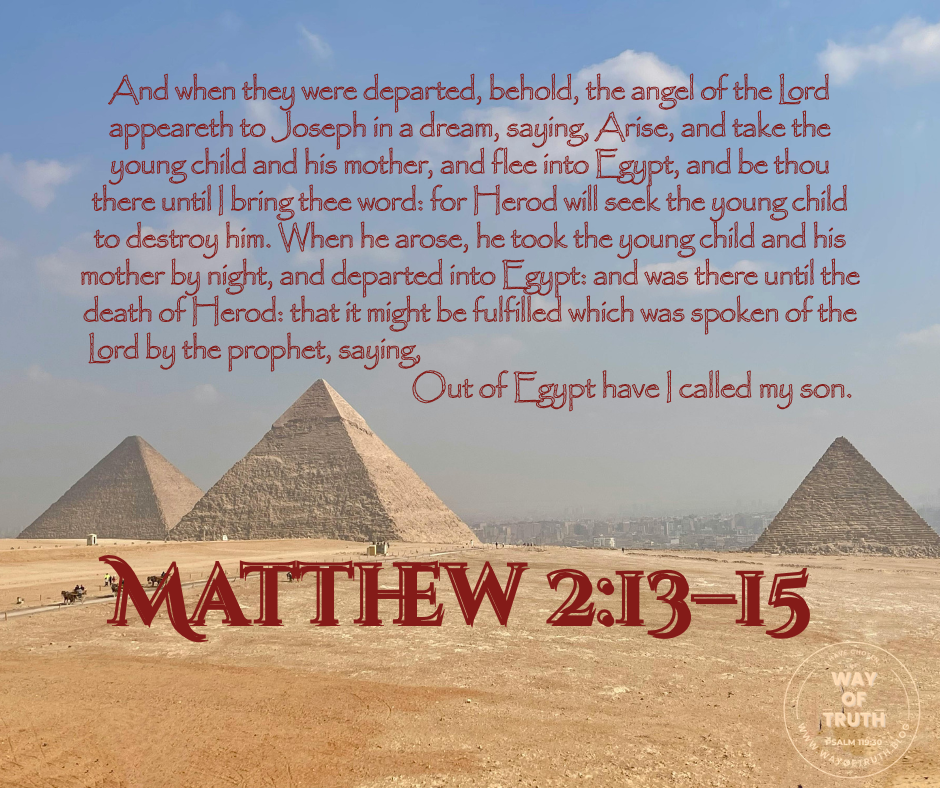
In Matthew 2:13-15, danger closes in. Matthew’s “behold” signals urgency. An angel appears to Joseph again. The message is clear and direct: Arise. Take the young child and his mother. Flee.
There’s no embellishment or theological explanation in the moment. Just obedience required. Herod will seek the child “to destroy him.” The threat is personal. The King has been born, and the counterfeit king responds with violence.
Joseph’s response is as striking as it is brief. “When he arose, he took the young child and his mother by night.” Immediate action. No recorded hesitation or complaint. Just quiet obedience under pressure.
Notice the order of words. “The young child and his mother.” Matthew consistently centers the child. Even in danger, the focus remains on Him.
Egypt isn’t a random destination. It’s historically loaded. Israel once went down into Egypt in famine. They were later brought out in deliverance. Now the true Son goes down into Egypt, not in defeat, but in preservation. Matthew tells us explicitly that this fulfills Scripture: “Out of Egypt have I called my son.”
The quotation comes from Hosea, where Israel is called God’s son. Matthew sees in Jesus the true and faithful Son, recapitulating Israel’s story but succeeding where Israel failed. This isn’t forced symbolism; it’s covenant continuity. The Messiah embodies His people’s history.
Skeptics sometimes object that Matthew “reuses” Old Testament texts creatively. But Matthew doesn’t invent fulfillment. He reads Scripture canonically. God’s redemptive patterns culminate in Christ. The Son who comes out of Egypt isn’t merely echoing history; He’s completing it.
Matthew 2:13–15 presents a sobering truth: the Savior enters a world that resists Him, yet God sovereignly preserves His redemptive plan.
Obedience in the Night
This passage challenges comfortable assumptions about God’s protection.
The angel doesn’t remove the threat. He redirects the family. Protection comes through obedience, not exemption from hardship. The Messiah’s early life includes displacement, danger, and exile. If we imagine that following God guarantees ease, this passage gently corrects us.
Joseph obeys “by night.” That detail carries weight. Obedience isn’t postponed until morning. When God speaks clearly, delay becomes disobedience. Faith sometimes requires action before full understanding.
For believers today, there’s deep comfort here. God’s not surprised by hostility. He’s not scrambling to adjust His plan. He sees the threat before it materializes fully. He warns. He guides. He preserves.
At the same time, this passage confronts triumphalism. The Son of God begins His earthly life as a refugee. He’s carried into a foreign land for safety. Christianity doesn’t begin in political dominance, but in vulnerability under God’s sovereign care.
For the Church, this text offers both realism and hope. Faithfulness may bring opposition. Yet opposition doesn’t cancel God’s purposes. Herod seeks to destroy. God preserves. The line of promise remains intact.
On a personal level, consider how you respond when obedience disrupts your plans. Joseph’s life is repeatedly rearranged by divine instruction. Marriage plans altered. Travel forced. Stability interrupted. Yet he continues to trust.
There’s also a beautiful theological thread here. Israel was called God’s son yet often failed in obedience. Jesus, the true Son, retraces Israel’s steps and fulfills the covenant faithfully. Where humanity faltered, Christ stands firm.
That truth anchors our hope. Our salvation doesn’t rest on our flawless obedience, but on His.
The True Son Who Saves
Matthew 2:13–15 reveals something profound about Jesus. He’s not merely protected for survival; He’s preserved for salvation.
The child carried into Egypt would one day carry a cross. He was spared from Herod’s violence so that He might willingly lay down His life at the appointed time. God’s protection here serves a larger purpose: redemption.
Humanity’s problem is deeper than political tyranny. It’s sin. We’re separated from God, guilty before Him, unable to rescue ourselves. The penalty for sin is death. No escape route of our own making can change that.
But God sent His Son. Jesus lived without sin, fully obedient where Israel and all humanity failed. He bore sin’s penalty on the cross. He rose again, conquering death and securing eternal life for all who trust Him.
The One called out of Egypt is the faithful Son. He accomplishes what we cannot. The gospel calls us to repentance and faith, to trust not in our own record but in His.
If you don’t already know Jesus Christ as your Lord and Savior, consider what it means that God preserved Him through danger for your salvation. His life wasn’t accidental. His mission was deliberate. He invites you to turn from sin and trust Him.
And if you belong to Christ, rest in the faithfulness of the true Son. The God who preserved His redemptive plan then is the same God who guards His people now.
Reflection and Response
- What does Joseph’s immediate obedience teach you about responding to God’s direction?
- How does Jesus as the “true Son” deepen your understanding of salvation?
- In what ways has God redirected you for protection or growth?
- Why is hardship not evidence of God’s absence?
- How can your life reflect trust in God’s sovereign preservation?