
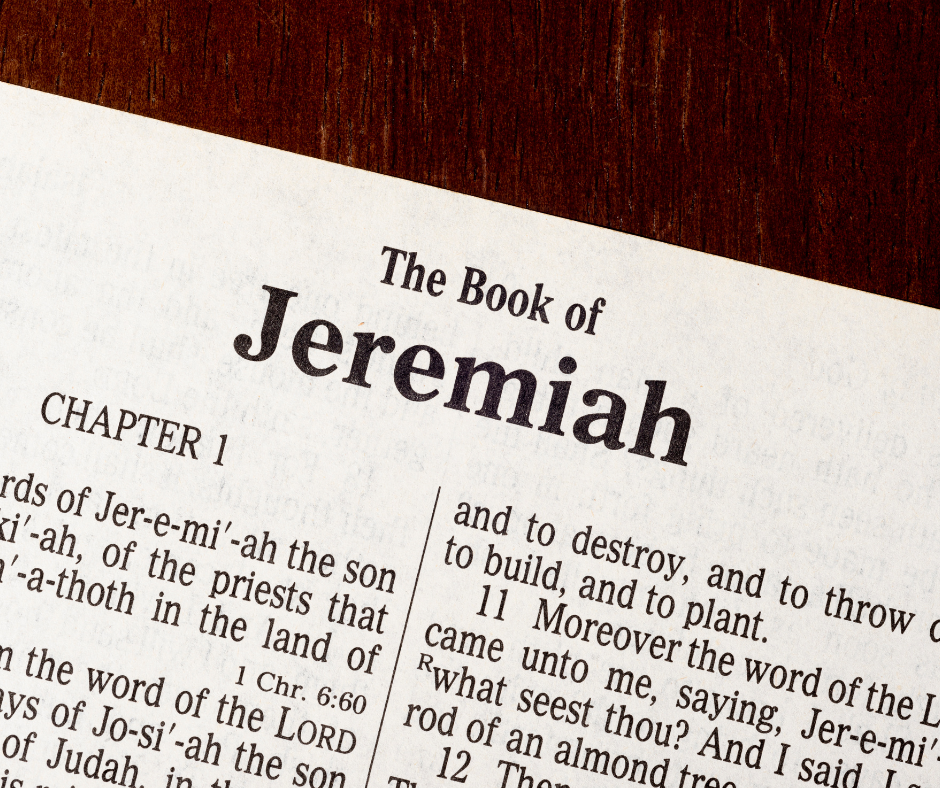
The book of Jeremiah is one of the most personal, powerful, and poignant works in all of Scripture. It reveals the heart of a prophet burdened by the Word of the Lord, a man who wept over his nation’s sin even as he faithfully proclaimed God’s coming judgment. More than any other prophet, Jeremiah embodies the anguish and compassion of God Himself: a holy God grieved by rebellion, yet unrelenting in His offer of mercy. Spanning the final decades before the Babylonian exile, Jeremiah chronicles the last warnings to Judah before the destruction of Jerusalem, while also shining with the promise of a new covenant that would one day restore God’s people from within.
I. Authorship and Historical Setting
Jeremiah, “the son of Hilkiah, of the priests that were in Anathoth” (1:1), was called to prophetic ministry around 627 B.C., during the thirteenth year of King Josiah’s reign. His ministry continued through the reigns of Jehoahaz, Jehoiakim, Jehoiachin, and Zedekiah, spanning more than forty years—from Josiah’s reforms to the fall of Jerusalem in 586 B.C.—and extending briefly into the period of exile in Egypt. Jeremiah lived through the collapse of the southern kingdom of Judah, witnessing both political turmoil and spiritual decay.
The book’s composition is attributed to Jeremiah himself, with the assistance of his scribe Baruch (36:4, 32). Together, they recorded prophecies, sermons, historical narratives, and laments as the Spirit of God directed. While some sections are not arranged chronologically, the thematic unity is unmistakable: the holiness of God, the faithlessness of His people, and the hope of future redemption.
II. The Man and His Ministry
Jeremiah was called as a young man, hesitant and fearful, yet divinely appointed to speak God’s words “to root out, and to pull down, and to destroy, and to throw down, to build, and to plant” (1:10). His ministry was marked by profound suffering. He was ridiculed (20:7–9), imprisoned (37:15), threatened with death (26:8–11), and eventually carried against his will into Egypt (43:6–7). Yet through it all, he remained faithful to his calling. Often called the weeping prophet, Jeremiah’s tears reflect God’s own sorrow over a people hardened in sin.
His life and message also stand as a mirror of Christ, who would later weep over Jerusalem (Luke 19:41) and face rejection for speaking truth. Jeremiah’s perseverance in suffering and his intercessory heart make him a model of prophetic faithfulness in the midst of widespread apostasy.
III. Structure and Content
The book of Jeremiah is a rich tapestry of prophecy, poetry, and narrative, unified by a single theme: the call to repentance in the face of coming judgment. Though not strictly chronological, it unfolds in distinct movements:
- The Call and Early Messages (Chapters 1–10):
- God commissions Jeremiah and warns Judah of imminent judgment for idolatry and hypocrisy.
- The prophet declares that external religion cannot substitute for true repentance and covenant loyalty.
- The National Sins and Coming Judgment (Chapters 11–29):
- Jeremiah exposes Judah’s spiritual adultery, false prophecy, and misplaced confidence in the Temple and political alliances.
- He predicts the Babylonian invasion and seventy years of captivity (25:11–12), calling submission to God’s chastening the only path to hope.
- The Book of Consolation (Chapters 30–33):
- Amid judgment, Jeremiah delivers one of Scripture’s brightest promises: restoration and the new covenant (31:31–34), in which God will write His law on the hearts of His people and forgive their sins forever.
- Historical Narratives and Final Days of Judah (Chapters 34–45):
- These chapters recount the siege of Jerusalem, Jeremiah’s imprisonment, the city’s fall, and the prophet’s fate among the remnant.
- The faithless leadership of Judah stands in sharp contrast to God’s enduring faithfulness.
- Oracles Against the Nations (Chapters 46–51):
- Jeremiah pronounces judgment on surrounding nations—Egypt, Philistia, Moab, Ammon, Babylon, and others—demonstrating God’s sovereignty over all kingdoms.
- The Fall of Jerusalem and Aftermath (Chapter 52):
- This chapter describes the city’s destruction and the exile, fulfilling Jeremiah’s prophecies in detail.
IV. Themes and Theology
At its heart, Jeremiah is a book about covenant faithfulness, God’s and man’s. Its central themes reveal both the gravity of sin and the greatness of grace:
- The Holiness and Justice of God: God’s judgment on Judah’s idolatry and moral corruption reveals His uncompromising holiness. Sin is not tolerated; it provokes the righteous wrath of God.
- The Call to Repentance: Repeatedly, God pleads with His people to return: “Return, O backsliding children, saith the LORD; for I am married unto you” (3:14).
- The Failure of False Religion: Jeremiah exposes empty ritual, corrupt priests, and deceitful prophets who offer peace without repentance.
- The Sovereignty of God over Nations: The rise and fall of empires—Assyria, Babylon, Egypt—unfold under the hand of the Lord of history.
- The Promise of the New Covenant: Jeremiah 31:31–34 stands at the theological center of the book and anticipates the gospel: a covenant of grace written on the heart, fulfilled in Christ’s blood (Luke 22:20; Hebrews 8:6–13).
- Hope Beyond Judgment: Though destruction is certain, restoration is promised. The God who uproots also plants (1:10). His purposes of judgment always serve His purposes of redemption.
V. Historical and Apologetic Considerations
Archaeological discoveries have repeatedly confirmed the historical accuracy of Jeremiah, including names of officials (e.g., Gemariah, Baruch, and Neriah) and the Babylonian conquest of 586 B.C. The book’s complex literary style—alternating between prose and poetry—reflects the prophet’s deep emotional and spiritual engagement with his message. Its preservation, including Jeremiah’s dictation to Baruch and the burning and rewriting of the scroll (Jer. 36), demonstrates both divine providence and human opposition to God’s truth.
VI. Christological Significance
Jeremiah foreshadows Christ in multiple ways. Both were called from the womb (Jeremiah 1:5; Luke 1:31), both were prophets rejected by their own people (Jeremiah 26:8–9; John 8:59), both lamented Jerusalem’s sin (Jeremiah 9:1; Luke 19:41), and both foretold the destruction of the Temple. The new covenant promised through Jeremiah finds its complete fulfillment in Christ’s redemptive work. In Him, God’s law is written on the heart, sins are forgiven, and the covenant relationship is eternally secured.
VII. Practical and Devotional Application
Jeremiah speaks to every generation that lives amid moral decline and spiritual apathy. It teaches that God’s truth cannot be compromised, that repentance is the only path to restoration, and that divine mercy endures even in judgment. For believers, Jeremiah’s courage, honesty, and compassion model faithful service in a hostile world. His message reminds us that God’s Word, though often unpopular, remains the only foundation for true hope.
VIII. Conclusion
The book of Jeremiah is both a lament and a love song: the lament of a prophet who saw his nation fall and the love song of a God who refused to abandon His people. It reveals that judgment and mercy are not opposites but two expressions of a holy God who desires repentance and redemption.
In the smoke of Jerusalem’s ruins, Jeremiah saw beyond the present to the promise of a new heart and a coming Redeemer. His message endures as a timeless call: to turn from sin, to trust in the Lord’s unfailing covenant, and to hope in the One who writes His law not on tablets of stone but upon the hearts of His people. Through the tears of Jeremiah shines the unquenchable light of divine grace, a grace fully revealed in Jesus Christ, the mediator of the new covenant.