
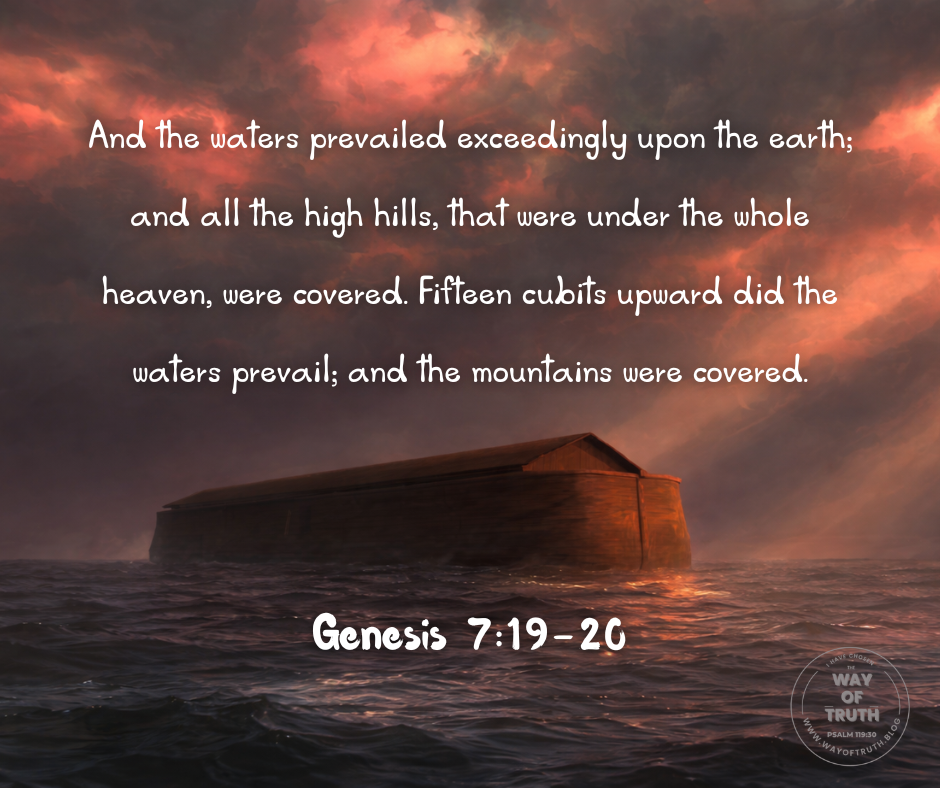
“And the waters prevailed exceedingly upon the earth; and all the high hills, that were under the whole heaven, were covered. Fifteen cubits upward did the waters prevail; and the mountains were covered” (Genesis 7:19-20).
There’s something deeply unsettling about these verses, and Scripture doesn’t try to soften that effect. Genesis 7:19–20 describes a moment when every familiar marker of stability disappears. The hills and mountains—symbols of permanence, safety, and endurance—are quietly overwhelmed. The text offers no drama, no cries, and no panic. It simply states what happened. The waters prevailed. Everything else gave way.
This restraint is intentional. God does not sensationalize judgment. He records it. And in doing so, He invites the reader not merely to observe, but to reflect.
We live in a world that’s constantly searching for higher ground. We look for security in planning, preparation, financial buffers, professional competence, health, or influence. None of these are inherently wrong, but Genesis reminds us that none of them are ultimate. There comes a point when what once felt solid no longer holds. The mountains are covered. What remains then is not ingenuity, but refuge.
The Illusion of Permanent Stability
Mountains have always represented what feels unmovable. They’re older than memory, indifferent to human ambition, and seemingly immune to sudden change. In the ancient world, they were places of refuge and awe. Yet Genesis tells us that even these were not high enough.
This confronts a quiet assumption many of us carry: that there will always be something left to stand on. We assume that if one support fails, another will remain. Scripture challenges that assumption without cruelty, but without compromise.
Genesis 7 does not say that the mountains eroded slowly over time. It says they were covered. The implication is sobering: when God’s judgment reaches its full measure, partial solutions vanish. There is no remaining elevation to reach and no final strategy to attempt.
This truth isn’t meant to produce fear, but honesty. Faith begins where self-reliance ends. If we believe we can ultimately secure ourselves, trust in God will remain theoretical. The Flood narrative presses the issue into the open. When no high ground remains, what—or whom—will you trust?
The Quiet Sufficiency of God’s Provision
While Genesis 7:19–20 focuses on the waters, it silently assumes something else: the ark still floats. Nothing is said about it in these verses, yet its presence is decisive. Everything outside it is overwhelmed; everything inside it is preserved.
This is one of Scripture’s most powerful devotional patterns. God’s provision often appears understated in the moment of greatest need. The ark doesn’t resist the waters. Rather, it’s carried by them. The same force that brings judgment also lifts the vessel of salvation.
That is not accidental. God doesn’t provide salvation that barely works. He provides refuge that holds.
For the believer, this is deeply reassuring. Faith isn’t about clinging desperately to God in moments of crisis, hoping He won’t let go. It’s about resting in what He has already provided. Noah and his family aren’t scrambling here. Their obedience is complete. Their safety is secure.
Many Christians struggle because they live as though preservation depends on constant effort. Genesis gently but firmly says otherwise. God sustains what He saves. The ark floats not because Noah keeps adjusting it, but because God carries it.
Learning to Trust Before the Waters Rise
One of the most searching aspects of this passage is its timing. By the time the mountains are covered, it’s too late to prepare. The moment for decision has already passed. The ark was built earlier. The invitation was given earlier. Faith was required earlier.
This teaches us something vital about spiritual formation. Trust isn’t forged in the crisis itself. It’s revealed there. Faithfulness cultivated in ordinary obedience prepares us for extraordinary moments.
That’s uncomfortable, because it removes excuses. We often tell ourselves we’ll trust God when circumstances demand it. Genesis suggests the opposite. The capacity to trust in crisis grows from obedience when no crisis is visible.
This doesn’t mean believers will be spared difficulty. Noah was carried through the Flood. Faith doesn’t prevent storms; it provides refuge within them. The question is not whether waters will rise, but whether we’re already resting in what God has given.
The Shape of Christian Hope
Genesis 7:19–20 also reshapes hope. Hope isn’t grounded in the belief that judgment will never come, but in the confidence that God’s mercy is greater. The Flood isn’t the final word of Scripture. It’s a foreshadowing.
Later, the Bible will speak of another judgment and another refuge. Jesus Christ will stand at the center of that story. Just as the ark bore Noah safely through the waters, Christ bears His people through judgment by taking it upon Himself.
The cross is where the waters truly prevailed. Judgment fell fully, not on the world in that moment, but on the Son of God. And just as the ark emerged after the Flood into a renewed world, Christ rose from the grave, inaugurating new creation.
This is why Christian hope is steady, not frantic. Believers don’t deny judgment, nor do they despair because of it. They trust the refuge God has provided. The same God who covered the mountains has also raised a Savior.
Living in Light of What Will Not Last
Genesis 7:19–20 invites a recalibration of priorities. What are you treating as immovable that Scripture says will pass away? Where are you quietly assuming permanence where God has warned of transience?
This passage encourages humility, gratitude, and clarity. It loosens our grip on what feels secure and strengthens our grip on what truly is. The goal is not to live anxiously, but attentively: to invest in what endures rather than what merely appears stable.
For believers, this means living with confidence rather than fear, generosity rather than hoarding, and obedience rather than delay. When no high ground remains, only God’s provision stands. And that’s more than enough.
If you’d like to explore this passage in greater depth, you’re warmly invited to read the full Bible study here: When the Waters Overcame the World: A Study of Genesis 7:19–20.