
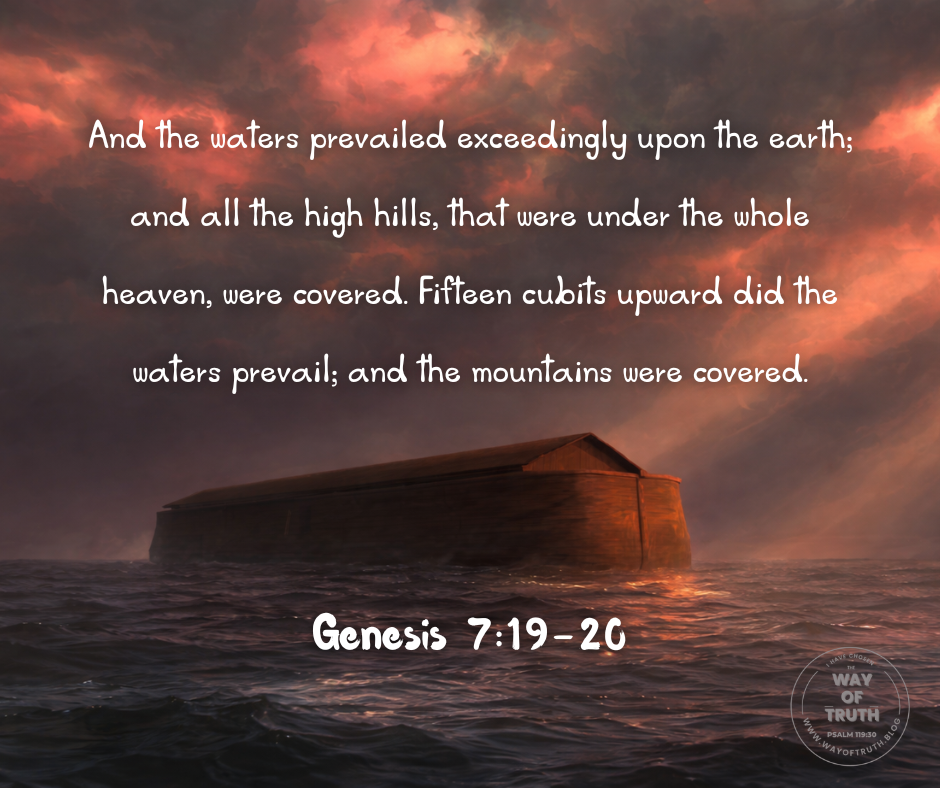
“And the waters prevailed exceedingly upon the earth; and all the high hills, that were under the whole heaven, were covered. Fifteen cubits upward did the waters prevail; and the mountains were covered” (Genesis 7:19-20).
I. The Climactic Expansion of Judgment
Genesis 7:19–20 stands at the narrative and theological crest of the Flood account. Earlier verses describe the onset of judgment, the opening of the fountains of the great deep, and the steady rising of the waters. Here, however, the text presses beyond local devastation to universal scope. These verses don’t introduce new action but intensify what has already begun. The language slows, heightens, and repeats, forcing the reader to confront the totality of what God is doing.
Within the broader structure of Genesis, this passage marks the undoing of the ordered world described in Genesis 1. Creation’s boundaries are overwhelmed, elevations lose their protective distinction, and nothing remains untouched. Literarily, the author employs cumulative emphasis to communicate completeness rather than spectacle. Redemptive history is advanced not by novelty but by escalation. The reader is meant to feel the weight of inevitability.
Culturally and historically, ancient readers would have understood mountains as symbols of permanence, stability, and cosmic order. By declaring that even “the high hills” are submerged, the text announces that no refuge remains outside God’s appointed means of salvation. The ark is not one option among many. It’s the only place of life when judgment reaches its full measure.
II. When Judgment Reaches Its Full Measure
The description of the Flood in Genesis 7:19–20 represents the narrative’s point of maximum expansion. The text does not introduce new events so much as it presses what has already been unfolding to its unavoidable conclusion. Every word functions to clarify scope, intensity, and finality. Moses, writing under divine inspiration, uses deliberate repetition, measured detail, and geographic language to ensure that the reader understands the Flood as comprehensive, controlled, and purposeful. The emphasis is not on chaos but on dominance, and not on spectacle but on certainty.
A. The Language of Overpowering Dominion
The clause “the waters prevailed exceedingly upon the earth” employs a verb that consistently conveys strength, victory, and superiority. This is not the language of passive accumulation but of active dominance. The waters are portrayed as winning, as overtaking everything in their path. Importantly, the subject is not the rain, nor the fountains of the deep, but “the waters” themselves, unified into a single, overwhelming force under God’s command.
The adverb “exceedingly” intensifies the action beyond what would already be expected. The waters did not merely prevail; they prevailed to the utmost degree. This linguistic choice closes the door on partial readings. The Flood is not presented as severe in some areas and moderate in others. It is uniformly dominant.
This clause also marks a reversal of Genesis 1. There, the waters retreat so that dry land may appear by divine word. Here, the waters advance until the earth itself is subdued. Creation’s order is not destroyed randomly; it is judicially undone. The earth that had become filled with violence (Genesis 6:11-12) is now filled with water instead.
This dominance also underscores God’s sovereignty. The waters do not escape His control. They prevail because He permits and directs them to do so. Judgment is not an accident of nature, but an expression of divine authority exercised with precision.
B. The Scope of Judgment Defined
The statement that “all the high hills, that were under the whole heaven, were covered” is among the most expansive geographical claims in Scripture. Every component of the phrase contributes to its force. “All” leaves no remainder. “High hills” removes the possibility that only low-lying areas were affected. “Under the whole heaven” expands the frame from regional to global without qualification.
From a literary standpoint, this phrasing anticipates and resists minimization. The author does not rely on a single universal term but layers universal descriptors together. This isn’t careless repetition but careful reinforcement. Ancient readers would have recognized this as a way of closing interpretive loopholes.
Hills and high places carried symbolic weight in the ancient world. They were associated with security, refuge, and even divine encounter. By declaring that these were submerged, the text communicates that no natural advantage provides safety when God’s judgment is fully expressed. Elevation offers no exemption.
Nothing in the Hebrew suggests metaphor or limitation. The phrase does not function idiomatically but descriptively. Attempts to reinterpret this as regional hyperbole must import assumptions foreign to the text. Within the narrative itself, there is no signal that the author intends anything less than comprehensive coverage.
This clause also advances the narrative logic. If all flesh outside the ark is to perish, then all possible refuges must be removed. The text ensures narrative coherence by eliminating any plausible escape apart from God’s provision.
C. Measured Judgment and Sufficient Provision
The specification that “fifteen cubits upward did the waters prevail” introduces a striking moment of precision into an otherwise sweeping description. This is not a poetic flourish but a functional measurement. A cubit was a common unit in the ancient world, roughly eighteen inches, and fifteen cubits corresponds to the clearance needed for the ark to float freely above submerged terrain.1[1]
This detail serves several purposes. First, it anchors the account in physical reality. Measurements imply observation, not myth. The Flood is described not as an abstract catastrophe but as an event with spatial dimensions.
Second, the measurement highlights divine sufficiency. The ark was built according to God’s instructions, and the waters rose precisely enough to fulfill their purpose without threatening the vessel of preservation. The same waters that destroy also sustain. There is no excess, no deficiency, and no danger to those inside God’s provision.
Third, the upward movement reinforces the earlier emphasis on “prevailing.” The waters do not merely spread outward; they rise vertically, overcoming even the highest points. This eliminates the possibility that the ark merely drifted horizontally among peaks. It was lifted decisively above them.
This measured judgment reflects God’s character. He is not reckless even when executing wrath. His actions are exact, purposeful, and governed by His word. Judgment and mercy are not competing impulses but coordinated expressions of His will.
D. Finality Without Sensationalism
The closing declaration, “and the mountains were covered,” repeats what has already been said but escalates it to its strongest possible form. Hills become mountains. What was implied is now stated plainly. The repetition is not redundant; it’s climactic.
Notably, the text offers no emotional commentary. There is no description of panic, no depiction of suffering, and no narrative embellishment. The restraint is deliberate. The author allows the sheer scope of the statement to carry its weight. This silence is itself a theological signal. Judgment does not require dramatization to be terrifying. Its finality is enough.
This line seals the fate of the old world. Once the mountains are submerged, the reader understands that the Flood has reached its full extent. Nothing remains above the waters except the ark. The story has moved from warning to execution to completion.
This restraint also protects the passage from mythologizing. Unlike other ancient flood accounts that revel in chaos or divine regret, Genesis presents judgment as controlled, sober, and morally grounded. God does not lose control of creation; He reasserts it.
The covering of the mountains confirms that the Flood is not merely destructive but definitive. The old order has passed away. What remains afloat is not humanity’s achievement but God’s grace, preserved exactly as He intended.
III. Universality, Evidence, and the Limits of Modern Skepticism
Genesis 7:19–20 confronts the reader with a claim that has long provoked resistance: the Flood was universal in scope, leaving no refuge outside God’s appointed means of salvation. Modern skepticism often shifts the discussion away from the text itself toward questions of geological plausibility and empirical verification. While those questions deserve thoughtful engagement, they’re frequently framed in ways that quietly predetermine the answer. A responsible apologetic must therefore do two things at once: take the biblical text seriously on its own terms and examine whether the skeptical claim that “there is no evidence for a global flood” is as straightforward or decisive as it is often presented.
A. The Skeptical Claim: “There Is No Evidence for a Global Flood”
The assertion that no evidence exists for a global flood is usually grounded in contemporary geological consensus, particularly uniformitarian assumptions that prioritize slow, gradual processes over catastrophic ones. Critics point to the absence of a single, neatly identifiable worldwide sedimentary layer, the apparent continuity of certain ecological systems, and the lack of unanimous agreement among geologists as evidence that Genesis must be describing either a local flood or a mythologized event.
However, this claim often overstates its case. It is more accurate to say that there is no evidence accepted within a strictly naturalistic interpretive framework for a global flood, not that there is no evidence at all. That distinction matters. Geological data do not interpret themselves. They are always read through methodological commitments about what kinds of causes are permissible. When catastrophic, divinely directed events are excluded a priori, the conclusion is already shaped before the evidence is examined.
Moreover, the geological record does contain features that catastrophic models argue are consistent with large-scale, rapid deposition: vast sedimentary layers spanning continents, extensive fossil graveyards, polystrate fossils, and large-scale erosional surfaces. These features are interpreted differently depending on one’s assumptions, but their existence complicates the claim that the evidence decisively rules out a global flood.
B. Textual Priority and the Question of Scope
From a biblical standpoint, Genesis 7:19–20 does not present universality as a secondary inference but as a primary claim. The repeated, cumulative language—“all the high hills,” “under the whole heaven,” “the mountains were covered”—functions to foreclose regional limitation. Any reading that reduces the Flood to a local event must explain why the text employs such unqualified language and why the narrative insists that all land-based life outside the ark perished.
Appeals to ancient Near Eastern hyperbole often fail to account for the internal coherence of the account. The universality of judgment matches the universality of corruption described in Genesis 6. The scope of destruction corresponds to the scope of salvation. The logic of the narrative holds together precisely because the Flood is total.
C. Historical Revelation Versus Modern Verification
A deeper issue beneath the skeptical objection is the expectation that past divine acts must be verifiable by modern scientific methods in order to be credible. Scripture, however, does not ground its authority in future corroboration. It presents the Flood as a historical act of God, known by revelation and preserved through inspired testimony. The biblical authors never attempt to prove the Flood by appeal to geology; they proclaim it as an event interpreted by God’s word.
This doesn’t mean faith is irrational or indifferent to evidence. It means that Scripture sets the terms of the discussion. The question is not whether modern science, operating within self-imposed constraints, can reconstruct a divinely governed catastrophe with certainty. The question is whether the God who created the world has the authority to judge it, and whether His Word is trustworthy when it testifies to that judgment.
Genesis 7:19–20 stands as a challenge to both ancient pride and modern confidence. It reminds the reader that the limits of our methods are not the limits of reality, and that God’s acts in history may exceed the categories by which later generations attempt to measure them.
IV. No Neutral Ground
Once the mountains are covered, Genesis 7:19-20 quietly but firmly eliminates every illusion of self-protection. The Flood narrative does not merely describe ancient judgment. It confronts every generation with enduring truths about God, humanity, and the nature of refuge. These verses shape how believers understand humility, obedience, mission, and corporate faithfulness in a world that still looks for safety apart from God.
A. The End of Self-Reliance
The covering of the mountains confronts one of humanity’s most persistent instincts: the belief that there is always some higher ground to reach, some advantage to secure, some strategy that will suffice if danger grows severe enough. Genesis 7:19–20 quietly dismantles that instinct. The highest elevations, the places that symbolize strength and permanence, disappear beneath the waters without protest or delay.
This calls for a sober reexamination of where trust truly rests. It’s easy to speak of dependence on God while quietly leaning on stability, resources, reputation, or preparedness. These things are not sinful in themselves, but the Flood narrative reminds us that none of them are ultimate. When judgment reaches its full measure, none of these can substitute for obedience and faith.
This passage invites humility rather than fear. God does not strip away false securities to leave His people exposed, but to reorient their confidence toward what actually holds. Noah didn’t survive because he anticipated every contingency. He survived because he trusted God’s word and entered the refuge God provided.
When pressure increases, when uncertainty grows, and when the future feels unstable, the instinct to grasp for control intensifies. Genesis 7:19–20 reminds us that faith is not proven when things are manageable, but when every imagined escape disappears. At that point, trust either deepens or collapses. Scripture presses us toward the former.
B. Obedience That Precedes Understanding
One of the quiet strengths of this passage is what it does not show. Noah is not reacting here. He is not scrambling as waters rise. By the time the mountains are covered, his obedience is already complete. The ark floats not because Noah adapts well under pressure, but because he obeyed long before the pressure arrived.
This has direct relevance for Christian discipleship. Scripture repeatedly teaches that obedience often precedes clarity. God does not always explain the full scope of what He is doing before He calls His people to act. Noah was told that judgment was coming, but the magnitude described in Genesis 7:19–20 far exceeds anything he could have fully imagined while building the ark.
For believers today, this challenges the desire to obey only once outcomes feel reasonable or understandable. Faithful obedience is often quiet, uncelebrated, and misunderstood until much later. It may even appear excessive or unnecessary at the time. Yet Genesis reminds us that delayed obedience cannot substitute for timely obedience.
This also encourages patience with God’s timing. The waters rise according to God’s schedule, not human urgency. Obedience is not validated by immediate results but by alignment with God’s word. When the Flood finally reaches its peak, it becomes clear that obedience done early is obedience that endures.
The Church must cultivate this long obedience together. Faithfulness formed slowly prepares believers to stand when events move quickly. Genesis 7:19–20 testifies that by the time crisis becomes obvious, preparation must already be complete.
C. A Community Shaped by Shared Refuge
Although Genesis 7:19–20 focuses on the waters rather than the ark, the implication is unmistakable: everything outside the ark is overwhelmed; everything inside it is preserved. Salvation in this passage is not individualized isolation but shared refuge. Noah’s obedience brings his household with him, and life is preserved within a divinely appointed community.
This has important implications for the Church. Christianity is not merely a collection of private faith decisions; it’s a people gathered into Christ. The Flood narrative reminds us that God’s means of preservation are corporate as well as personal. The ark holds many lives together, sustained by the same grace, protected by the same provision.
For local churches, this shapes how community is valued. Fellowship is not optional reinforcement for faith; it’s one of God’s ordinary means of sustaining it. Isolation weakens trust, while shared obedience strengthens it. In times of uncertainty, believers are meant to bear one another’s burdens, speak truth to one another, and remain anchored together in God’s promises.
This passage also guards against spiritual elitism. No one inside the ark survives because they are better swimmers, wiser planners, or more resilient. All survive for the same reason. The Church, rightly understood, is a community of shared dependence, not ranked achievement.
Genesis 7:19–20 quietly insists that God’s people endure judgment by remaining together within the refuge He provides.
D. Living with Urgency Without Panic
Finally, the totality of judgment described here instills urgency without hysteria. The text is calm even as it describes absolute devastation. There is no sensationalism, no frantic tone, and no emotional manipulation. That restraint itself instructs the believer.
Faithful urgency is grounded in truth, not fear. The Church is called to warn, to proclaim, and to invite, but not to panic or coerce. Genesis shows that God’s purposes unfold steadily and decisively. He does not rush, and He is not uncertain. That steadiness should shape the posture of those who serve Him.
This passage encourages believers to live attentively. Time is meaningful. Decisions matter. Yet anxiety does not produce faithfulness. Trust does. God’s timing prevailed, just as the waters did.
For Christians today, this balances mission and peace. The gospel must be proclaimed clearly and compassionately because judgment is real. At the same time, confidence rests in God’s sovereignty, not in human persuasion. Faithfulness means speaking truth, living distinctly, and trusting God with outcomes.
Genesis 7:19–20 leaves no room for complacency, but it also leaves no room for despair. God’s judgment is real, but so is His provision, and those who rest in it can live with sober confidence rather than fear.
V. The Refuge God Has Provided
Genesis 7:19–20 confronts us with a reality that Scripture never softens: judgment, when it comes, is complete. The waters rise until even the highest ground disappears. Yet the purpose of this passage is not merely to warn, but to point forward. The Flood account prepares us to understand a deeper truth woven throughout the Bible: that God does not announce judgment without also providing a refuge. What was true in Noah’s day reaches its fullest expression in Jesus Christ.
A. No Safe Ground Apart from God
If you don’t already know Jesus Christ as your Lord and Savior, this passage speaks honestly to the human condition. Genesis 7:19–20 strips away the assumption that people can ultimately protect themselves. The mountains, symbols of stability and permanence, vanish beneath the waters. Scripture is making a theological point that still holds: when God’s judgment reaches its full measure, there is no natural, moral, or intellectual high ground that can shield us.
The Bible consistently teaches that sin is not merely a collection of poor choices but a condition that places humanity at odds with a holy God. From the opening chapters of Genesis, corruption spreads until it touches everything. The Flood does not come because God is impatient or cruel, but because wickedness has become comprehensive. Judgment matches the scope of the problem.
This is uncomfortable, and Scripture does not pretend otherwise. Yet it is also clarifying. Many people live as though accountability can always be deferred or negotiated. Genesis tells us that there comes a point when warning gives way to reality. The waters rise, not because humanity failed to try harder, but because humanity could not fix what sin had undone.
The gospel begins here, not with comfort, but with truth. Until we understand that there is no refuge in ourselves, the offer of salvation will always seem unnecessary or excessive. Genesis insists that it is neither.
B. The Refuge Revealed
The Flood narrative does more than describe judgment; it reveals God’s consistent pattern of salvation. Before the waters rise, God provides the ark. Before destruction arrives, He gives instruction, warning, and time. Salvation is not improvised at the last moment; it’s prepared in advance according to God’s word.
This pattern reaches its fulfillment in Jesus Christ. Just as the ark was God’s appointed means of rescue, Christ is God’s appointed Savior. Scripture does not present Him as one option among many, but as the refuge God Himself has established. The New Testament makes this connection explicit, describing Christ as the one who bears judgment so that others may live.
The ark didn’t prevent the Flood. It carried people safely through it. In the same way, the gospel doesn’t deny judgment; it answers it. Jesus did not come merely to teach or inspire. He came to take upon Himself the penalty sin deserves. At the cross, judgment fell fully, not on the world in that moment, but on the Son of God who stood in the place of sinners.
This is why the resurrection matters. Christ did not remain under judgment. He rose, victorious over sin and death, confirming that the refuge God provided truly holds. Salvation is not theoretical. It is accomplished, sufficient, and secure for all who trust in Him.
C. The Call Issued
The gospel always invites response. In Noah’s day, the response was to enter the ark. In our day, the response is repentance and faith in Jesus Christ. Repentance means more than regret. It is a turning: a willingness to agree with God about sin and to turn away from it. Faith means trusting not in personal goodness or religious effort, but in what Christ has already done.
This call is deeply personal, but it’s not vague. Scripture doesn’t ask you to clean yourself up before coming to Christ. It asks you to come because you cannot. The door of the ark was not opened for the strong, the clever, or the deserving. It was opened for those who trusted God’s word enough to enter.
There is urgency here, but not manipulation. The Bible never urges panic, yet it never encourages delay. Opportunity exists because God is patient, but patience is not permission to ignore the invitation. The Flood came at the appointed time. The gospel warns that judgment will also come again, and Scripture is clear that Christ Himself will be the judge.
Still, the invitation stands. You’re not asked to climb higher or prove worthiness. You’re invited to trust. Faith rests, not because circumstances are safe, but because God is faithful.
D. The Promise Given
Those who were inside the ark were spared because the refuge was sufficient. That same assurance belongs to those who are in Christ. Salvation does not depend on holding on tightly enough, believing strongly enough, or living flawlessly enough. It depends on the One who holds you.
The gospel promises forgiveness, reconciliation with God, and new life, not because judgment is ignored, but because it has been satisfied. Christ’s sacrifice is complete. His resurrection is decisive. Those who trust in Him are not awaiting condemnation but redemption.
This promise reshapes how life is lived now. Fear gives way to confidence, not arrogance. Gratitude replaces self-reliance. Hope steadies the believer even in uncertainty. The same God who carried the ark through the waters carries His people through a broken world toward a renewed one.
The invitation remains open. Enter the refuge God has provided. If you already belong to Him, rest in the assurance that salvation is not fragile. The waters may rise, but the refuge holds, and it always will, for the glory of God and the joy of those He saves.
- The inference that the fifteen cubits of water ensured safe flotation for the ark arises from the text’s own data rather than from speculative engineering. Genesis 6:15 specifies the ark’s height as thirty cubits. A floating wooden vessel would not be fully submerged, and the statement that the waters rose fifteen cubits above the mountains indicates sufficient clearance for unobstructed flotation rather than peril. The measurement is narratively unnecessary unless it serves to reassure the reader that God’s provision was adequate and secure. The text does not offer technical detail, but the inference follows reasonably from the stated dimensions and the narrative logic of divine sufficiency. ↩︎