
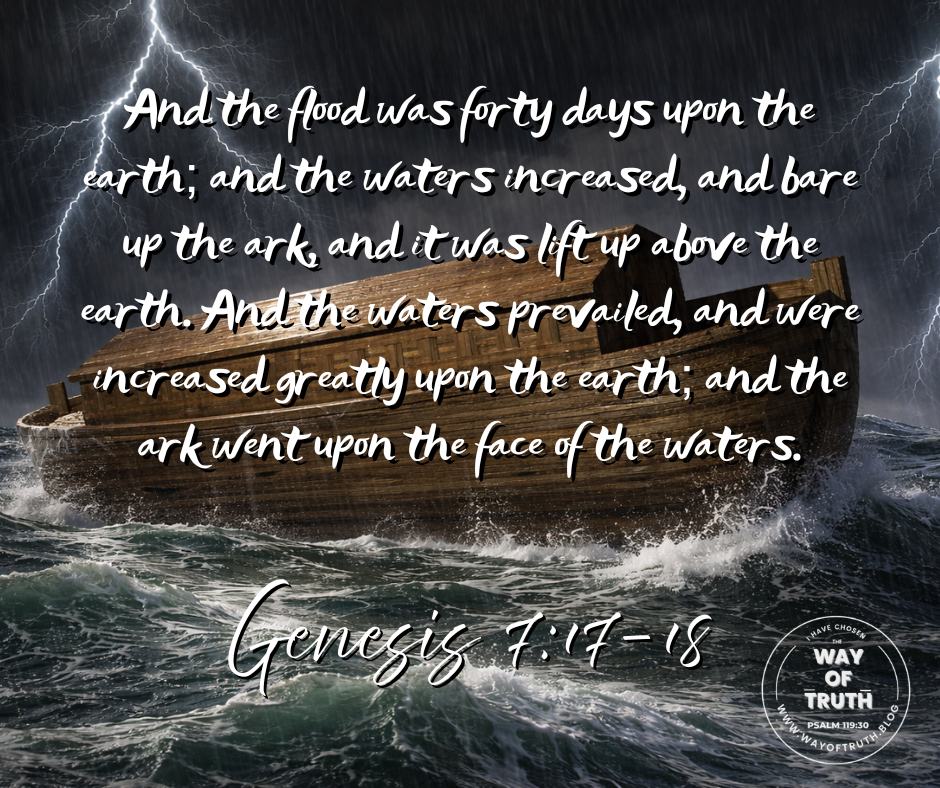
Genesis 7:17–18 records a quiet but decisive moment in the Flood narrative. There is no dialogue, no panic, and no commentary on emotions. The waters rise. The earth disappears. And the ark—built long before the first drop fell—is lifted. Scripture tells us simply: “the waters increased, and bare up the ark… and the ark went upon the face of the waters.” These verses invite us to consider what faith looks like when obedience is already behind us and circumstances move beyond our control.
This passage doesn’t ask us to do something new. It asks us to trust when the ground we relied on is no longer there.
When Faith Is No Longer Busy
For many believers, faith feels most comfortable when it’s active. We pray, plan, serve, repent, adjust, and respond. Much of the Christian life truly does involve obedience expressed through action. But Genesis 7:17–18 confronts us with a season where faithful action has reached its limit. Noah has obeyed. The ark is finished. The animals are inside. The door has been shut by God Himself. When the waters begin to rise, Noah does nothing at all.
That detail matters more than we often realize. The ark does not require steering. Noah is not called to reinforce its walls or redirect its path. The text emphasizes instead that the waters themselves “bare up the ark.” What destroys the world becomes the means by which God carries His people forward.
Many of us struggle precisely here. When life enters a season we cannot manage—illness, grief, prolonged uncertainty, cultural instability—we instinctively look for something to do. We search for leverage, control, or reassurance. Genesis 7 reminds us that there are moments when God’s will is not further effort but settled trust. Faith is sometimes expressed not by movement, but by remaining where God has already placed you.
Lifted, Not Escaping
The ark is not spared from the Flood. It is lifted by it. That distinction is crucial. Salvation in Scripture is often preservation through difficulty. The waters prevail over the earth, but they don’t prevail over those whom God has enclosed within His provision.
This challenges a subtle expectation many believers carry: that faith should keep life stable. Genesis 7 dismantles that assumption. The earth itself becomes unstable. What once felt solid disappears. Yet the ark remains secure, not because the world holds together, but because God does.
There’s comfort here for anyone whose sense of stability has been shaken. God does not promise that the structures we trust—health, routines, institutions, or cultural norms—will endure unchanged. He promises something better: that His care does not depend on those structures at all. When the ground gives way, God is not scrambling. He’s lifting.
The Quiet Separation
When the ark is lifted “above the earth,” a separation occurs that cannot be undone. Those inside and those outside now occupy different realities. Scripture describes this without triumph or gloating. There is no sense of celebration, only finality.
This guards us from misunderstanding salvation. To be preserved by God is not a reason for pride; it’s a reason for humility. Noah does not survive because he is clever or resilient. He survives because he trusted God’s word before the rain began. Even then, once the Flood starts, his survival rests entirely on grace.
That humility shapes how believers relate to the world. We’re called to live distinctly, but never dismissively. The ark floats because God holds it, not because of Noah’s craftsmanship. Remembering that keeps our witness marked by gratitude rather than superiority and compassion rather than distance.
A Word for the Waiting Heart
Genesis 7:17–18 speaks powerfully to seasons of waiting. The waters rise for forty days. The ark drifts. Nothing resolves quickly. Faith here is not dramatic. It’s quiet endurance under God’s care.
If you’re in a season where answers are slow and circumstances feel heavier than you expected, this passage offers steady reassurance. God does not abandon His people once obedience has been rendered. He does not require you to manage what only He can govern. The same Lord who called you to trust Him before the storm is the One who sustains you when the storm is fully upon you.
You may not feel lifted. You may feel suspended, uncertain, or even afraid. Genesis 7 reminds us that security does not always feel like movement upward. Sometimes it feels like being held when everything else is sinking.
A Gentle Warning and a Gracious Invitation
There is also a sober edge to this text. Once the ark is lifted, the opportunity to enter has passed. Scripture records this without alarmism, but also without apology. God’s patience is real, but it’s not endless. Judgment advances steadily, not suddenly.
That reality sharpens the invitation of the gospel. If you don’t yet know Jesus Christ as your Lord and Savior, Genesis 7 points you to a truth you can’t afford to ignore. Just as God provided an ark before the Flood, He has provided salvation in Christ before final judgment. Jesus lived the life we could not live, bore the judgment we deserved, and rose again so that all who trust in Him might be lifted beyond condemnation into new life.
Salvation is not earned by swimming harder or climbing to higher ground. Itss received by entering what God has already provided. Today, the invitation remains open. Grace is still offered. The door has not yet been shut.
Walking Forward
Genesis 7:17–18 teaches us how to live when faith is no longer busy, when stability disappears, and when trust must replace control. It calls us to rest in God’s provision, to live humbly as those preserved by grace, and to speak with urgency shaped by compassion.
If you’d like to explore this passage in greater depth, including its exegesis, theology, and apologetic implications, I invite you to read the full Bible study here: Lifted Above the Waters: A Study of Genesis 7:17–18.
May the God who lifts His people above the waters teach us to trust Him when the ground beneath us is gone.