
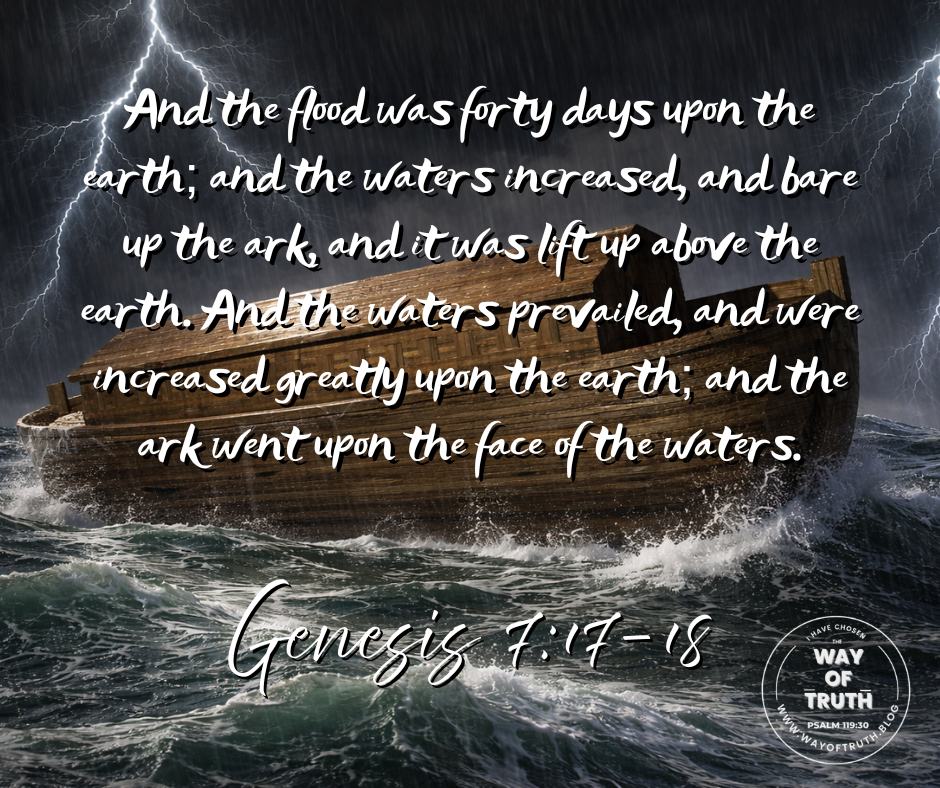
“And the flood was forty days upon the earth; and the waters increased, and bare up the ark, and it was lift up above the earth. And the waters prevailed, and were increased greatly upon the earth; and the ark went upon the face of the waters” (Genesis 7:17-18).
I. From Warning to Irreversible Reality
Genesis 7:17–18 marks a decisive narrative shift in the Flood account. What had long been announced through divine warning now becomes visible, unstoppable reality. Earlier verses emphasized preparation, obedience, and orderly entry into the ark. These verses emphasize motion, force, and dominance: the flood comes, the waters increase, and the ark is lifted.
The text is restrained and repetitive by design. The repetition of phrases such as “the waters increased” and “the waters prevailed” is not stylistic clumsiness but theological emphasis. The author wants the reader to feel the steady, inexorable rise of judgment. There’s no chaos in the narration, even though there’s devastation in the event. The Flood unfolds according to divine timing and control.
Within redemptive history, these verses represent the first global judgment executed directly by God upon a corrupt world, while simultaneously preserving a righteous remnant through grace. The ark is no longer merely a structure of obedience; it becomes the sole place of life in a world now dominated by death-bearing waters. The stage is set for later biblical patterns in which judgment and salvation proceed together, never in competition, always under God’s sovereign hand.
II. The Rising Waters and the Lifted Ark
Genesis 7:17–18 is deceptively simple. The verses contain no dialogue, no dramatic description of panic, and no explicit theological commentary. Yet their restrained language is precisely what gives them interpretive weight. The narrator slows the reader down and forces attention on movement, duration, and result. The Flood is no longer anticipated; it’s operative. These verses describe the mechanics of judgment and preservation as they unfold under divine sovereignty. Each clause adds pressure, height, and inevitability. What emerges is a theology of divine control expressed through physical process.
A. Duration, Deliberation, and Divine Restraint
The opening clause, “the flood was forty days upon the earth,” must be read in close coordination with Genesis 7:12, which states, “And the rain was upon the earth forty days and forty nights.” The narrator is not repeating himself carelessly; he’s clarifying the relationship between cause and effect. Verse 12 describes the source and duration of the judgmental waters—unceasing rain sent directly by God—while verse 17 describes the result of that sustained action: a Flood that does not merely begin but comes to rest upon the earth as a prevailing reality.
This distinction matters exegetically. The Flood is not defined solely by rainfall, nor is it exhausted by it. The rain of verse 12 initiates a process that culminates in the condition described in verse 17. The emphasis shifts from precipitation to domination. The waters now occupy the earth in a way that alters its very function as habitable space. By linking the same forty-day period to both rain and Flood, the text underscores intentional coordination. The judgment unfolds exactly as long as God determines, neither dissipating early nor extending indefinitely.
The forty-day duration therefore communicates deliberation rather than impulsiveness. The Flood is not portrayed as a sudden divine outburst, but as a sustained, purposeful act consistent with prior warning and long-suffering patience. God had announced judgment well in advance; when it arrives, it does so with controlled persistence. The rain does not fall for a symbolic moment but for a sufficient span to accomplish what God intends.
The phrase “upon the earth” further reinforces scope and effect. The waters do not merely strike the earth; they remain upon it, pressing down, reshaping it, and rendering it uninhabitable. This language subtly reverses the ordering work of Genesis 1, where God separated waters from land to produce life. Here, through sustained rain and rising depths, that separation is temporarily undone, not chaotically, but under divine command.
The forty-day period—viewed through the lens of both verses—prevents two interpretive extremes. It guards against the notion of arbitrary destruction, while also resisting the idea that judgment can be endured or waited out. The rain lasts long enough to make the Flood irreversible, yet precisely long enough to demonstrate divine restraint. God is neither rushed nor reactive. Even judgment unfolds according to measured time.
B. Passive Preservation and Active Judgment
The narrative focus shifts from time to motion: “the waters increased.” The verb emphasizes steady accumulation rather than sudden violence. The Flood rises by degrees, reinforcing the sense of inevitability. There is no moment in which the waters hesitate or reverse. Increase is their defining action.
Crucially, the same clause introduces preservation: the waters “bare up the ark.” The ark is grammatically passive. It doesn’t resist, steer, or maneuver. It’s carried. This isn’t a minor detail. The text deliberately avoids attributing survival to Noah’s skill or foresight at this stage. Obedience has already been rendered; now preservation is entirely God’s work.
The waters themselves become instruments of deliverance for those inside the ark. This creates a striking theological tension. The agent of judgment and the means of salvation are the same. The difference lies not in the water, but in location. Inside the ark, the waters lift. Outside, they destroy. The text offers no middle category.
This detail quietly dismantles any notion of human contribution to salvation once judgment is underway. Noah’s righteousness mattered in his response to God’s command, but it doesn’t translate into control over outcomes. The ark floats because God wills it to float. The language underscores dependence rather than heroism.
C. Separation, Elevation, and Finality
The statement that the ark “was lift up above the earth” marks a decisive spatial and theological transition. The ark is no longer merely resting on land; it’s removed from it entirely. Elevation here functions as separation. Those inside the ark are no longer sharing the same plane of existence as those outside.
This elevation is not gradual in emphasis, even if it’s gradual in process. Once the ark is above the earth, there is no suggestion of return. The narrative closes off alternatives. No secondary refuge appears. No additional instructions are given. The moment of separation is complete.
The phrase “above the earth” also carries symbolic resonance without becoming allegorical. Throughout Scripture, elevation often signifies protection or distinction, but here it’s grounded in physical reality. The ark is lifted because the earth itself is being judged. Safety is no longer found within the created order as it stands, but only within God’s appointed provision.
Importantly, the text doesn’t describe Noah reacting or interpreting the moment. The silence reinforces the finality. Judgment proceeds without commentary from its beneficiaries. Salvation does not require explanation to be effective.
D. Dominance without Disorder
The final clause intensifies the description: “the waters prevailed, and were increased greatly upon the earth.” The verb “prevailed” conveys dominance, strength, and victory. The waters are not merely present; they’re triumphant. Creation’s former stability is overwhelmed.
Yet this triumph is not chaotic. Immediately following, the text notes that “the ark went upon the face of the waters.” The verb “went” is notably calm. There is no imagery of violent tossing or near disaster. The ark moves steadily, upheld by the very forces that undo the world beneath it.
This juxtaposition is intentional. Total judgment doesn’t imply loss of control. God’s sovereignty is displayed not only in destruction but in stability amid destruction. The ark’s steady movement testifies to divine governance even as the earth itself is being undone.
Exegetically, this final image resolves the tension of the passage. Judgment has fully asserted itself. Preservation has fully taken effect. There is no suspense left, only progression toward God’s intended end. The narrative invites the reader to trust that when God judges, He does so completely, and when He saves, He does so securely.
III. Judgment, History, and Moral Coherence
Many skeptical objections to Genesis 7:17–18 have been addressed in earlier studies and need not be rehearsed in full here. We’ll briefly engage with the most common claims to clarify how this passage itself resists reduction.
One frequent objection asserts that the Flood narrative is merely a reworking of ancient myth rather than an account of historical judgment. Yet Genesis 7:17–18 undermines that claim through its deliberate sobriety and sequential precision. Unlike mythological flood traditions, which often feature capricious deities, exaggerated heroism, or arbitrary destruction, this text remains morally and narratively restrained. The rising waters are not the result of divine impulse or cosmic accident, but the culmination of a moral trajectory carefully established in Genesis 6. Judgment here is intelligible, proportionate, and grounded in ethical cause, not narrative spectacle.
A related objection portrays the Flood as an act of divine cruelty or excess. This reading fails to account for the passage’s emphasis on order and restraint. The Flood unfolds over a clearly defined period, proceeds according to previously announced terms, and preserves life in accordance with God’s prior covenantal commitment. Nothing in the text suggests delight in destruction or uncontrolled wrath. Instead, Genesis presents judgment as the sober execution of justice already explained and long delayed.
Modern efforts to recast the Flood as a symbolic depiction of humanity’s struggle with chaos similarly fall short. Such interpretations flatten the text’s moral seriousness and evacuate its warning function. Genesis 7:17–18 doesn’t read as allegory or abstraction. It reads as proclamation and is meant to be remembered, feared, and heeded. The passage stands as a reminder that divine patience, though real and generous, is neither endless nor indifferent to sustained rebellion.Top of Form
Bottom of Form
IV. Lifted by Grace
Genesis 7:17–18 doesn’t instruct us through commands or explanations. It teaches by placing us in the middle of an advancing reality. The waters rise. The ground disappears. The ark is lifted. No commentary is offered, yet the meaning presses in with quiet force. These verses invite reflection on what faith looks like once obedience has already been rendered and circumstances move beyond human influence. This passage shapes our posture before God, the shared life of the people of God, and the calling to bear witness in a world moving steadily toward judgment.
A. Learning Dependence When Control Is Removed
Once the Flood begins in earnest, Noah does nothing. He doesn’t steer the ark, reinforce its structure, or attempt to manage its course. The text repeatedly emphasizes that the waters carry the ark and that it moves upon the surface of forces it can’t resist or redirect. The moment for action has passed. What remains is trust.
This confronts a deeply rooted instinct in many believers: the assumption that faith must always feel active to be faithful. Genesis 7:17–18 presents a different picture. Obedience has already been completed. Now faith consists in remaining where God has placed us while events unfold beyond our control. That posture is often uncomfortable. When prayer has been offered and obedience rendered, the temptation is to search for new strategies or assurances. These verses suggest that there are seasons when God’s will is not further action, but quiet reliance.
Many of us recognize this tension in our own lives. Illness, loss, prolonged uncertainty, or cultural instability can create the sense that the ground beneath us is disappearing. Genesis 7 doesn’t promise that the waters will recede quickly, but it does show that God sustains His people through what overwhelms the world around them. Dependence here is not resignation; it’s alignment with reality. The ark survives not by resisting the Flood, but by being upheld within it.
B. Embracing Separation without Spiritual Pride
As the ark rises “above the earth,” a line is drawn that cannot be crossed. Those inside and those outside now occupy entirely different futures. This separation isn’t the result of last-minute effort or moral display; it flows from earlier response to God’s word. Yet once judgment advances, the distinction becomes unmistakable.
This has implications for how believers understand their own identity in the world. Scripture doesn’t frame this separation as a badge of honor. The narrative offers no celebration of survival and no language of triumph. The ark’s elevation is described plainly, almost quietly. The focus never shifts to Noah’s virtue or worthiness. Everything remains centered on God’s action.
That restraint matters. It protects God’s people from confusing deliverance with superiority. To be preserved is not to be elevated in self-regard, but to be placed entirely at the mercy of God’s provision. This perspective shapes how believers engage those outside the ark, so to speak. Separation does not eliminate compassion but deepens it. It reminds the Church that its safety rests on grace, not merit.
When this truth is held rightly, it produces humility rather than withdrawal. Believers can live distinctly without becoming dismissive, and faithfully without becoming proud. The ark floats not because of impressive craftsmanship on the part of Noah, but because God holds it.
C. Finding Stability When the World Is Unraveling
Genesis 7:17–18 portrays not merely judgment, but the undoing of what once seemed secure. The earth itself becomes unreliable. Boundaries established in creation give way. Yet amid this unraveling, the ark moves steadily across the waters. The contrast is intentional and instructive.
For believers, this challenges the expectation that faith should preserve familiar structures. Scripture doesn’t promise that cultural, moral, or institutional stability will endure. What it does promise is that God sustains His people when those structures fail. The ark is spared while the world collapses.
This perspective reshapes how loss is interpreted. When familiar supports erode, it’s tempting to read that erosion as evidence of divine absence. Genesis 7 offers a different lens. God’s purposes advance not despite upheaval, but often through it. The ark’s steady movement signals that divine control has not weakened simply because the environment has grown hostile.
This truth fosters resilience. Faith doesn’t depend on favorable conditions, but on God’s faithfulness. The waters may prevail, but they don’t prevail over what God has chosen to preserve.
D. Recovering Urgency without Alarmism
Finally, Genesis 7:17–18 restores a sober sense of urgency. Once the ark is lifted, the opportunity to enter is gone. The text offers no dramatic appeals or emotional pleas. Judgment advances steadily, not suddenly, and that steady advance is precisely what makes it final.
This matters for how the Church speaks about salvation. Urgency doesn’t require exaggeration. The Flood narrative doesn’t rely on shock value. Its power lies in its calm certainty. God warned long before the waters rose. When they came, they came exactly as He had said.
Believers are called to reflect that same clarity. The gospel doesn’t need distortion to be compelling. It needs faithfulness. Genesis 7 reminds us that patience has a limit, that delay is not denial, and that God’s word, once spoken, will not fail.
For those who belong to Christ, this should awaken responsibility rather than fear. While the door remains open, the call to speak, to love, and to bear witness remains urgent. The rising waters remind us that time matters, obedience matters, and grace, once refused long enough, inevitably gives way to judgment.
V. Lifted Above Judgment
Genesis 7:17–18 records rising waters and a lifted ark, but beneath the historical movement lies a gracious summons that reaches far beyond Noah’s generation. These verses don’t merely describe what happened; they confront us with what always happens when God’s patience gives way to judgment and mercy stands ready beforehand. The gospel doesn’t flatten this passage into abstraction, nor does it soften its seriousness. Instead, it draws the reader into its deepest reality: God judges sin with truth and gravity, and God provides salvation with clarity and sufficiency.
A. The Rising Waters and the Human Condition
If you don’t yet know Jesus Christ as your Lord and Savior, Genesis 7:17–18 begins by telling the truth about our condition before God. The Flood rises because the earth has become corrupt, violent, and resistant to God’s authority. The waters don’t appear as an overreaction, but as a response long delayed. This is essential to understand, because the gospel begins not with comfort but with honesty. Scripture insists that sin is not merely personal failure or social brokenness; it’s a settled posture of rebellion that separates humanity from the God who gives life.
The rising waters illustrate a reality that Scripture consistently affirms: judgment advances whether it’s acknowledged or ignored. No one outside the ark can stop it. No effort, ingenuity, or moral reform can outpace it once it has begun. This isn’t because God is harsh, but because sin corrodes what it touches and can’t coexist indefinitely with holiness.
The Flood narrative confronts modern instincts to minimize sin or treat it as manageable. Genesis 7 doesn’t allow that illusion. The waters rise steadily, not impulsively. In the same way, Scripture teaches that the consequences of sin are real, cumulative, and ultimately decisive. The gospel makes sense only when this truth is faced. Until we see why salvation is necessary, grace appears optional. Genesis 7 strips away that comfort and prepares the heart to hear good news that is truly good.
B. Salvation Comes from Outside Ourselves
If you’re listening carefully to Genesis 7:17–18, you’ll notice something striking: no one builds an ark once the Flood begins. Preparation happens beforehand. The ark exists not as a human solution devised under pressure, but as a provision given by God in advance of judgment. This pattern lies at the heart of the gospel.
In Scripture, salvation never originates from within human ability. Just as Noah could not construct an ark while the waters rose, humanity cannot rescue itself from sin once judgment is underway. The ark isn’t an extension of human strength; it’s an act of divine mercy. God provides what humanity cannot.
This points forward unmistakably to Jesus Christ. God didn’t wait for humanity to improve itself or seek rescue on its own terms. He sent His Son into the world as a finished provision, prepared before the full weight of judgment fell. Christ lived a sinless life, offered Himself as an atoning sacrifice, and rose again in victory over death. Salvation, like the ark, is entered by faith.
The gospel therefore calls you not to self-improvement, but to trust. To believe in Christ is to step into what God has already provided. It is to rest in a righteousness not your own and to be carried by grace rather than by merit. The ark floats because God designed it to. Christ saves because God sent Him to do so.
C. What It Means to Be Saved in Christ
Genesis tells us that the ark was “lift up above the earth.” That phrase captures the heart of salvation. Those inside the ark aren’t spared because judgment disappears, but because they are removed from its reach. The waters still prevail; the difference lies in where one stands.
In the same way, the gospel doesn’t deny judgment but provides rescue from it. To be saved in Christ is not to pretend that sin has no consequences, but to be placed where those consequences have already been borne. On the cross, Jesus absorbed the judgment sin deserved. In His resurrection, He emerged victorious, lifted beyond the power of death itself.
This changes how salvation is understood. Christianity isn’t a promise of moral insulation or a guarantee of earthly ease. It’s a promise of deliverance from ultimate judgment and restoration to God. Those who belong to Christ are “lifted” not by their faithfulness, but by His finished work.
Genesis 7 quietly insists that there is safety only in what God has appointed. The gospel echoes that insistence with urgency and hope. Christ doesn’t offer partial shelter or temporary relief. He offers complete salvation and eternal life. To be in Him is to be secure, even while the world around you remains unstable.
D. Enter While There’s Time
Genesis 7:17–18 also speaks with urgency, but not with panic. The ark is lifted, and once it is, entry is no longer possible. The text offers no dramatics, only finality. Judgment doesn’t rush, but it does arrive.
The gospel invitation carries the same clarity. Scripture teaches that now is the time of grace. Christ’s invitation stands open, and forgiveness is freely offered to all who repent and believe. But grace is not endless delay. God’s patience has a purpose: to lead sinners to repentance, not to provide permanent shelter for unbelief.
This call isn’t meant to terrify, but to awaken. The gospel doesn’t coerce; it invites. Yet it invites honestly. To refuse Christ isn’t to remain neutral, but to remain exposed. Genesis 7 reminds us that delay has consequences and that God’s word, once spoken, will come to pass.
Today, you’re invited to turn from sin, trust in Jesus Christ, and receive forgiveness, new life, and eternal salvation. Christ is a sufficient Savior, a faithful Lord, and a secure refuge. Enter while the door is open. Rest in the grace that lifts sinners above judgment and brings them safely home to God.