
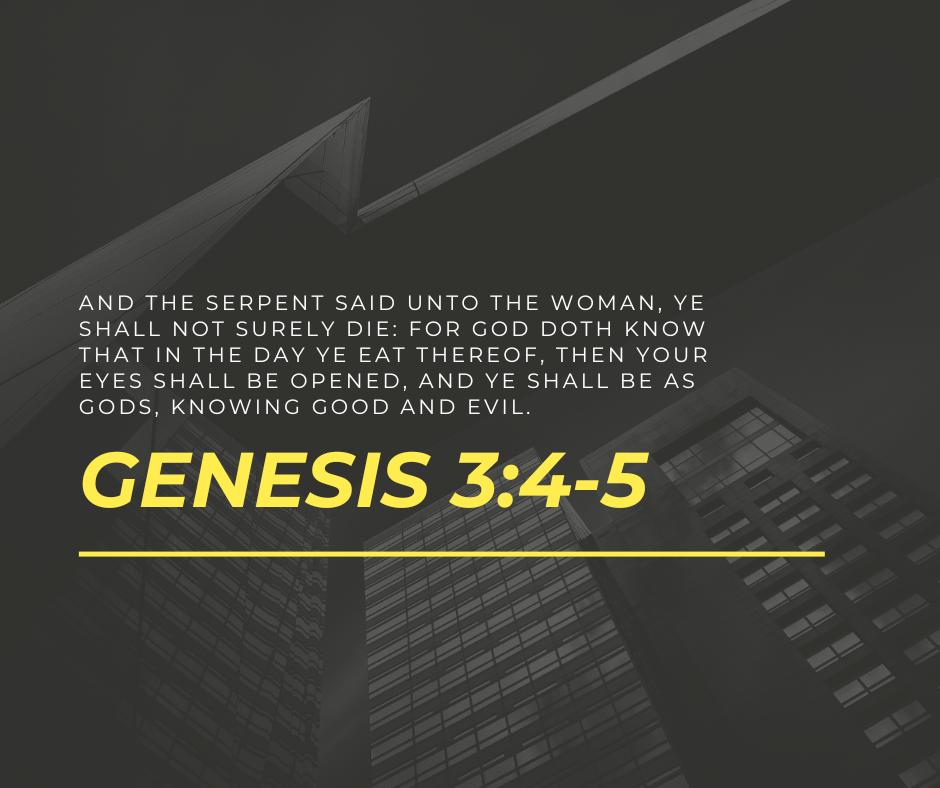
Having traced how the serpent’s lie has been rephrased and reimagined within heretical and pseudo-Christian systems, we now turn to a different but related challenge: the voice of unbelief outside the church. While heresy distorts revelation from within, skepticism denies revelation altogether. If the cults and false teachers of history have said, “God has spoken, but not quite as you think,” the modern skeptic says, “God has not spoken at all.” Both repeat the serpent’s opening question—“Yea, hath God said?”—but in different tones: one in imitation, the other in outright negation. The battlefield, however, remains the same: the authority of divine truth and the trustworthiness of the Word.
The Lie Reframed: Myth, Meaning, and the Denial of Revelation
Within modern secular biblical studies, Genesis 3:4–5 is often read not as revelation but as literature, a mythopoetic reflection on human experience rather than an account of historical or moral truth. According to this view, the serpent’s words—“Ye shall not surely die… your eyes shall be opened”—represent the timeless drama of human awakening: curiosity, risk, and the cost of consciousness. The narrative, they argue, stands alongside ancient Near Eastern stories such as Enki and Ninhursag or The Epic of Gilgamesh, in which mortals grasp for immortality or forbidden wisdom and thereby explain the sorrows of the human condition. In this literary framework, the serpent’s promise is not condemned but interpreted: a symbol of humanity’s quest for enlightenment, a parable of progress wrapped in ancient imagery.
This literary-critical approach, first popularized in the 19th century and refined through the 20th by scholars such as Hermann Gunkel and later by structuralists like Northrop Frye, treats Genesis 3 as etiology, not theology. The serpent’s dialogue is viewed as a metaphor for moral self-awareness, the emergence of conscience in the human race. The story’s “forbidden fruit” expresses, in poetic form, the tension between safety and discovery, between obedience and knowledge. For some Enlightenment and humanist interpreters, this reading carries an explicitly moral critique: the God of Genesis, they claim, fears human advancement; the serpent, meanwhile, symbolizes intellectual courage. “Ye shall be as gods” becomes the human manifesto of self-determination, while “Thou shalt surely die” is recast as the threat of authoritarian religion against the dawn of reason.
At first glance, such readings appear sophisticated, liberating the story from the “constraints” of dogma and making it relevant to modern sensibilities. Yet beneath their literary polish lies an epistemological inversion identical to that of the serpent himself: revelation is displaced by interpretation, and divine speech becomes raw material for human imagination. In denying the text’s claim to truth, the skeptic enthrones the self as the final arbiter of meaning. But Genesis 3 resists that domestication. The moral power of the passage cannot be reduced to myth, because its tension hinges on the reality of divine command and human response. The serpent’s words function not as symbols of awakening, but as instruments of rebellion, distorting the very relationship on which human knowledge depends. Far from suppressing reason, God’s command protects its proper order: knowledge under authority, wisdom within communion, freedom within truth.
What modern criticism calls “myth” Scripture calls memory, the revelation of how sin entered a good creation. The story’s universality does not arise from shared mythic patterns, but because it names with stunning accuracy the inner logic of every human heart that doubts God’s Word. Genesis 3 endures because it tells the truth: that man, in grasping for divine knowledge apart from God, blinds himself to the very light he seeks. The serpent’s lie lives on in the scholar’s confidence that he can explain away revelation by reducing it to metaphor. Yet the irony remains: those who treat the story as myth about meaning end up fulfilling it. Their eyes are indeed opened, but to themselves alone, not to the God who speaks.
The Lie Reversed: The “Jealous God” and the Moral Inversion of the Fall
Among the most persistent objections to Genesis 3:4–5 is the charge that God, not the serpent, appears morally suspect. Critics argue that the text itself seems to vindicate the tempter’s claims: the woman eats, does not die immediately, and her eyes are indeed opened. “For God doth know,” says the serpent, and, to the skeptic, He seems to have known and withheld. From this angle, God appears jealous and insecure, guarding His divine status by keeping humankind in ignorance. These critics point to this story as the moment divine authority first suppressed human freedom. To them, Eden’s prohibition epitomized the moral flaw of religion itself: that it punishes inquiry, stifles autonomy, and keeps the human race in perpetual childhood.
This interpretation has taken many forms since the Enlightenment. The Romantic poets recast the serpent as the first liberator and Eve as humanity’s courageous pioneer into self-knowledge. In the 19th century, Ludwig Feuerbach and later Friedrich Nietzsche transformed this suspicion into philosophy: if God forbids the knowledge of good and evil, it is only to keep man dependent and weak; true freedom requires the death of God and the enthronement of the self. Beneath these readings lies a single moral accusation: that divine holiness is cruelty in disguise, and divine authority a threat to human flourishing.
Yet the moral inversion at the heart of this critique reveals its flaw. It mistakes protection for prohibition and revelation for restriction. The divine command in Genesis 2:17 is not an act of jealousy but of love, a boundary given to preserve life, not to deny growth. To forbid the knowledge of good and evil is not to oppose knowledge but to prevent the self from becoming its own moral center. The serpent’s offer was not an invitation to insight but to autonomy: to know good and evil by defining them rather than by submitting to them. Eve and Adam’s eyes are indeed opened, but only to what God warned them against: shame, guilt, and alienation. The very result that skeptics call “enlightenment” the text itself identifies as loss. The problem was never that man sought knowledge; it was that he sought it apart from truth.
The charge of divine jealousy therefore collapses under the weight of its own irony. The serpent’s accusation—“God is holding you back”—is the very deception that produced the Fall, not the insight that explains it. To see the prohibition as insecurity is to repeat the lie itself. In Scripture, God’s jealousy is not the insecurity of a rival deity but the devotion of a faithful husband (Exodus 34:14). It is covenantal, not competitive, a zeal that guards relationship from self-destruction. The Lord does not fear human advancement; He desires human holiness. And holiness, in the biblical vision, is the harmony of freedom and obedience, of love and truth.
Thus, when skeptics accuse the God of Genesis of cruelty, they misread both His nature and His purpose. The narrative of the Fall is not the story of divine manipulation but of divine heartbreak. The command was life-giving; the disobedience was death-dealing. Far from vindicating the serpent, Genesis vindicates God, for His warning proves true not in the moment of the bite but in the long unfolding of human history: mortality, moral corruption, and estrangement from the Source of life. The serpent promised liberation; humanity found only loss. The supposed “jealous withholder” turns out to be the faithful Creator, who gave everything necessary for joy and whose boundaries were blessings in disguise.
The Lie Internalized: The Deception as Psychological Myth
A third strand of modern skepticism turns inward. Where literary critics see Genesis 3:4–5 as cultural myth, existential interpreters read it as the drama of human consciousness itself, a parable of fear, freedom, and the birth of the self. In this view, the Garden is not a place in time but a state of mind; the serpent and the woman are voices within the same psyche. The “temptation” becomes a metaphor for the awakening of desire and moral awareness, the first flicker of self-consciousness that divides innocence from knowledge. God’s command, then, is not divine revelation but the inner voice of anxiety, the human awareness of limits and consequence. To eat of the fruit is to cross the boundary between instinct and reflection, between the unthinking animal and the self-aware moral being. “Ye shall be as gods” marks not rebellion but emergence: man’s coming of age as a knowing, choosing creature.
This psychological turn can be traced through several modern interpreters. Some interpreters see in Freud’s theory a kind of psychological reinterpretation of the Fall: the moment when moral law (the superego) enters the human psyche, bringing guilt and repression.1 Carl Jung re-cast the serpent as the archetype of transformation, the symbol of individuation through the tension between light and shadow.2 Later existential theologians, such as Paul Tillich, retained some biblical vocabulary but reframed the Fall as an ontological event rather than a historical one: man’s estrangement from the Ground of Being, the anxiety of finitude that drives him to autonomy.3,4 In each case, the story’s focus shifts from God and His command to man and his consciousness. The serpent is no longer the deceiver, but the instrument through which humanity attains self-knowledge. What Scripture calls sin, the modern psyche calls growth.
There is insight here, to be sure. Genesis 3 does speak profoundly to the inner life. It exposes desire, shame, and fear with unnerving realism. Yet when the narrative is reduced to psychology, its vertical dimension collapses. The Fall ceases to be an act of disobedience against a personal Creator and becomes a metaphor for the tension of being human. Revelation turns into autobiography; theology becomes anthropology. In this telling, the serpent is not the father of lies but the internal voice of honest curiosity; God is not the righteous Judge but the projection of man’s guilt. Such readings achieve sympathy at the cost of truth. They diagnose the symptoms of sin while denying its cause.
And yet, even in their denial, these interpretations betray a strange reverence. The existentialist may call Genesis 3 a myth, but he cannot escape its mirror. Every age replays its questions: Why do I long for knowledge? Why do I feel shame? Why do I fear death? The story endures because it names these realities not as psychological accidents but as moral consequences. The serpent’s whisper—“Ye shall be as gods”—still reverberates within the human heart that seeks autonomy under the guise of authenticity. Thus, the existential critique, though it intends to domesticate the text, ends up confirming its power. The myth of self-definition is precisely the lie the passage exposes. We may psychologize Eden, but Eden will not stay on the couch. Its truth keeps pressing inward, reminding every self that the deepest fear is not of knowledge, but of facing the God who still asks, “Where art thou?”
The Ancient Lie and the Modern Tongue
In every age, the serpent’s voice adapts its accent but not its argument. The modern skeptic, like the ancient tempter, begins with the same premise. Whether in literary deconstruction, moral protest, or psychological reduction, the pattern repeats: the Word is questioned, reinterpreted, or replaced by human insight. The Age of Reason did not silence the serpent; it simply gave him a podium in the lecture hall. The mythic readings of the literary critic, the moral accusations of the philosopher, and the existential analyses of the psychologist all converge on one claim: that humanity must define truth for itself. Revelation becomes imagination, holiness becomes oppression, and sin becomes self-expression.
Yet Genesis 3:4-5 endures because it exposes the futility of every such attempt. The passage is not a parable of divine insecurity but a mirror of human rebellion. Its realism lies not in mythic poetry but in moral accuracy: we recognize ourselves in its dialogue. The modern mind, like Eve, suspects that obedience limits fulfillment, that freedom means independence, and that enlightenment comes from crossing divine boundaries. But the story insists otherwise: that wisdom begins with trust, that knowledge without reverence blinds, and that the desire to “be as gods” still ends in dust and distance.
Ironically, those who demythologize Genesis 3:4-5 most fully confirm its truth. The very impulse to reinterpret the Word, to stand in judgment over it, is the deception replayed in thought. The serpent’s question—“Yea, hath God said?”—echoes through the corridors of modern skepticism, dressed in the robes of scholarship, philosophy, or psychology. But the Scripture’s answer remains unshaken: God has spoken, and His Word is not a cage but a key. The light of reason, when it rebels against revelation, becomes darkness; but when it bows to truth, it becomes wisdom. The lie of the serpent still promises enlightenment, yet only the Word of God opens the eyes to see.
- David Humbert, “The Return of Adam: Freud’s Myth of the Fall,” Religious Studies 36, no. 2 (2000): 173–186, https://doi.org/10.1017/S0034412500005430. ↩︎
- Roger Jones, “The Snake in the Mandala: Dialogical Aspects of Jung’s Aion,” Journal of Analytical Psychology 65, no. 5 (2020): 847–864, https://doi.org/10.1111/1468-5922.12593. ↩︎
- Paul Tillich, Systematic Theology, Volume II: Existence and the Christ (Chicago: University of Chicago Press, 1957), 44–45, https://press.uchicago.edu/ucp/books/book/chicago/S/bo59572152.html. ↩︎
- Charlie Riggs. “The Wages of Estrangement.” The Hedgehog Review 20, no. 1 (Spring 2018). https://hedgehogreview.com/issues/theological-variations/articles/the-wages-of-estrangement. ↩︎