
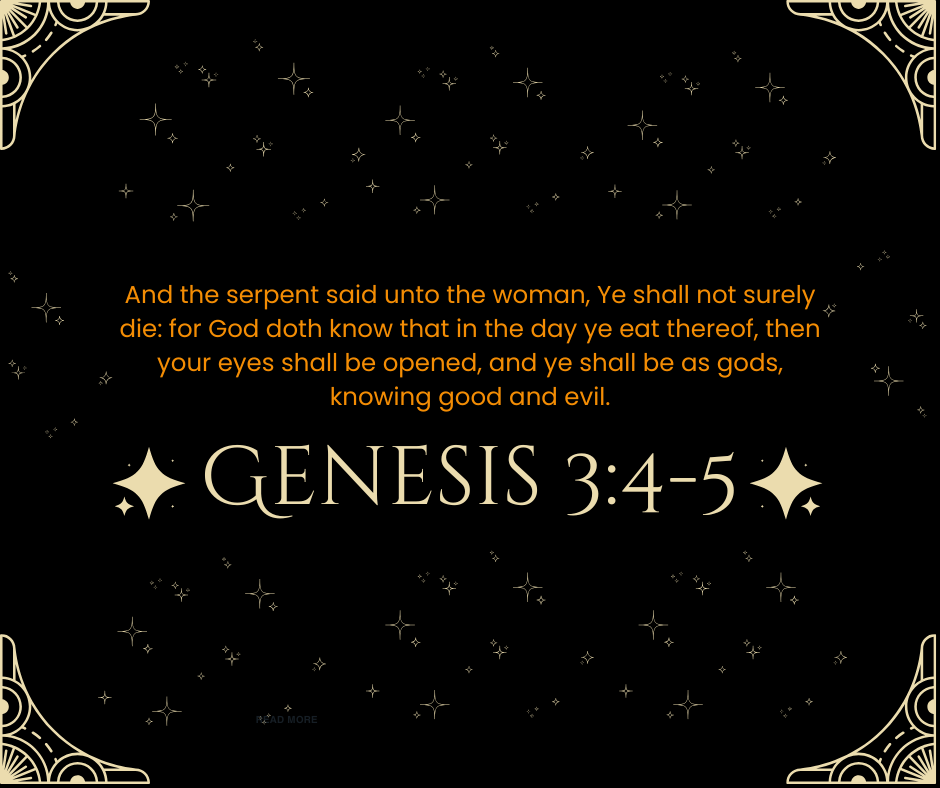
While progressive Christianity flirts with Gnosticism, esoteric and occult “Christianities” of the modern era represent its enduring offspring, adapted, rebranded, and clothed in the mystical language of enlightenment and personal transformation. Within movements such as Rosicrucianism, Theosophy, and New Age Christianity, the story of the serpent in Genesis 3:4–5 is not the tragedy of a fall, but an allegory of inner awakening. “Your eyes shall be opened” becomes the unveiling of latent divinity within the self, and “ye shall be as gods” is understood as the destiny of the spiritually illumined person who rises above ignorance through initiation and inner ascent. The serpent—so clearly the deceiver in Scripture—is reimagined as the Bearer of Light, the agent of human evolution, and sometimes even as a misunderstood symbol of Christ Himself. In such systems, the Eden narrative is transmuted from moral history into esoteric myth: a parable of spiritual evolution rather than a record of disobedience and death.
The Rosicrucian interpretation, which emerged in the early 17th century and mingled mystical Christianity with Hermetic philosophy, treats the Eden story as a coded lesson in the journey of the soul. Humanity, it teaches, fell not through sin but through immersion in matter. “The opening of the eyes” marks the soul’s awakening to the dual nature of reality—spirit and matter—and its need to harmonize them through secret knowledge. The serpent represents the principle of wisdom that guides this process of enlightenment. In this frame, “Ye shall not surely die” becomes the hidden truth that spirit cannot perish; physical death is but a transformation, a shedding of material form. “Ye shall be as gods” is interpreted as the call to self-divinization, the eventual re-ascent to the divine source from which humanity emanated. The Rosicrucian worldview thus immerses the serpent’s lie in mystical imagery, turning the rebellion of Eden into a metaphysical curriculum for spiritual advancement.
In Theosophy, popularized by Helena Petrovna Blavatsky in the late 19th century, this reinterpretation becomes even more explicit. Blavatsky’s Secret Doctrine presents the serpent as a cosmic initiator, the giver of divine wisdom who liberates humanity from the ignorance imposed by a lesser deity. For her, the serpent becomes the true benefactor, the one who awakens humanity to its divine potential.1 In this scheme, the Fall of Man is reimagined as the Rise of Consciousness, the moment humanity begins to ascend the evolutionary ladder toward divinity. This pattern has deeply influenced later occult and New Age movements, from Rudolf Steiner’s Anthroposophy to Alice Bailey’s esoteric psychology, all of which treat “the serpent’s light” as a symbol of hidden wisdom rather than moral deception.
Such teachings resonate with many modern spiritual seekers because they promise a kind of personalized salvation without repentance or dependence. The path of initiation replaces grace; hidden knowledge replaces revelation. The “opened eyes” of Genesis 3 become the awakening of the “third eye,” the chakra of inner sight; “Ye shall be as gods” becomes the affirmation of the “divine spark within.” This syncretistic blend borrows Christian vocabulary but empties it of biblical content. “Christ” is reduced to an archetype of divine consciousness rather than the incarnate Son of God. Sin is no longer rebellion but ignorance, and redemption is no longer the cross but enlightenment. In this way, esoteric Christianity continues the serpent’s catechism: it calls evil good, ignorance illumination, and self-deification salvation.
Biblical Christianity, by contrast, insists that the true path to illumination is not through esoteric ascent but through revelation and repentance. Christ is not a cosmic metaphor but a historical Redeemer who entered time and space to bear human sin. The light He gives is not self-discovery but divine disclosure: “In thy light shall we see light” (Psalm 36:9). Biblical illumination begins in humility, not initiation; it requires that the eyes first be opened to sin before they can see glory. The “godhood” the serpent promised through disobedience, God now grants by grace through union with His Son, not as ontological equality, but as adoption: “Behold, what manner of love the Father hath bestowed upon us, that we should be called the sons of God” (1 John 3:1). The esoteric path seeks ascent through secrecy; the gospel offers communion through surrender.
In the end, esoteric and occult reinterpretations of Genesis 3:4–5 are variations on a single ancient theme: the rebranding of rebellion as revelation. The serpent’s lie remains the cornerstone: there is no need for judgment, no true death, no need for a Savior, only the rediscovery of the divine self. What began in Eden as denial of God’s word has, in these movements, matured into full-blown self-theology. Yet Scripture’s verdict stands unchanged: wisdom begins not in self-knowledge but in the fear of the Lord (Proverbs 9:10). The true light that enlightens every man is not the serpent’s counterfeit illumination, but Christ Himself, the Light of the world, who exposes the lie and restores the eyes of the blind to see truth as it really is.
- Helena P. Blavatsky, The Secret Doctrine (London: Theosophical Publishing House, 1888), https://www.theosociety.org/pasadena/sd/sd-hp.htm. ↩︎