
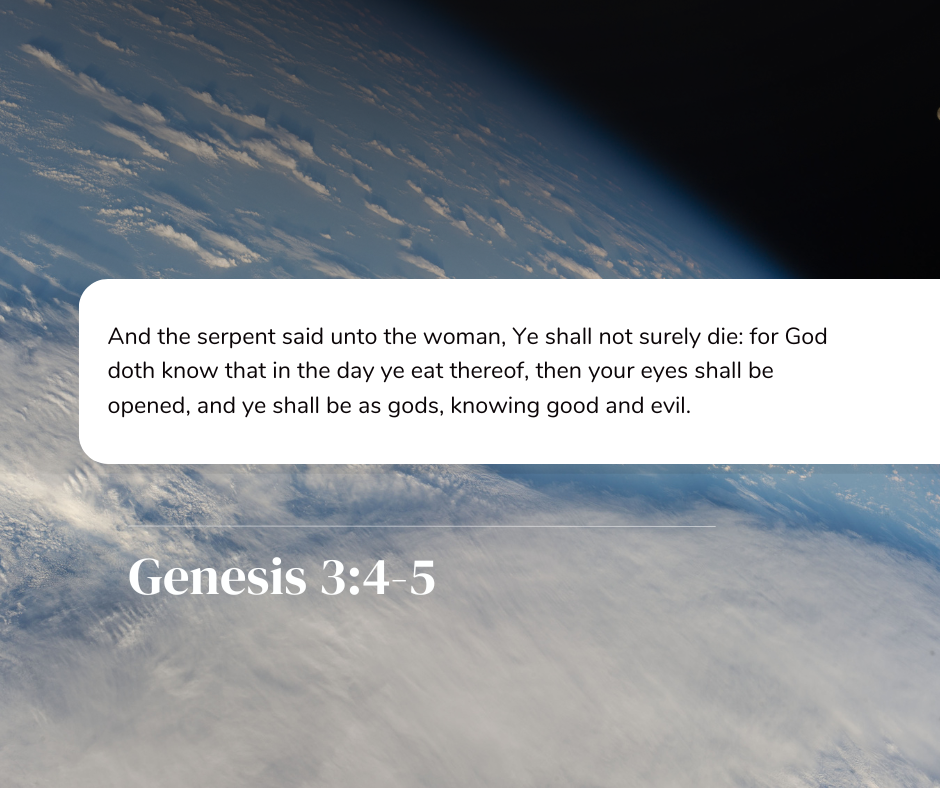
In the modern religious landscape, the same motifs that surface in Genesis 3:4–5—denial of death’s consequence, suspicion of God’s goodness, the lure of “opened eyes,” and the promise of godlike status—reappear in new constellations. The similarities are often striking at the level of imagery and aspiration, but the differences become decisive at the level of theology: What is “knowledge”? Who decides good and evil? Can creaturely limits be transcended? And is “life” received by trusting God or bypassing Him?
The Lie Transcendent: “Godlikeness” and the Non-Dual Vision of Advaita Vedānta
Few religious systems echo the serpent’s promise—“Ye shall be as gods”—with such serene confidence as Advaita Vedānta, the classical non-dual school of Hindu philosophy. Its central affirmation, tat tvam asi (“thou art that”), expresses the conviction that the deepest self (ātman) and the ultimate reality (Brahman) are one. The apparent separation between God and man, knower and known, is the illusion (māyā) born of ignorance (avidyā). Salvation (mokṣa) comes not by repentance or grace, but by awakening: by the knowledge (jñāna) that one’s self has never been other than the Absolute. Enlightenment, therefore, is not reconciliation with a personal Creator but the dissolution of individuality itself. The highest seeing is self-realization: not “I know God,” but “I am That.”1
From a biblical perspective, this vision bears a striking formal resemblance to the serpent’s words in Genesis 3:4–5. Both link transcendence to knowledge: eyes opened, illusion dispelled, divinity attained. Yet beneath this surface similarity lies a profound metaphysical and moral antithesis. In Genesis, the desire for “godlikeness” through knowledge leads to separation, not union, and shame, not liberation. Humanity reaches upward through disobedience and discovers alienation. In Advaita, by contrast, transcendence is not rebellion but realization, the awakening from multiplicity into undivided being. To “know good and evil” in the biblical sense is to define them autonomously; to “know Brahman” in the Vedāntic sense is to perceive that all dualities, moral or otherwise, are finally unreal. The serpent’s lie finds here a philosophical counterpart: divinity through inward ascent, not humble obedience; redemption through insight, not through a Redeemer.
The difference is therefore not simply theological but ontological. Scripture begins with a personal Creator who speaks, commands, and communes; Advaita begins with the axiom that the Absolute is beyond personhood and speech. For Vedānta, finitude is bondage; individuality is ignorance; and history is illusion. For Genesis, finitude is the good gift of God, the sphere in which love and holiness take shape. The human calling is not to escape creaturehood but to live it rightly, receiving being from Another and reflecting His character through moral likeness. “Godlikeness,” in Scripture, is not identity of essence but participation in goodness, righteousness, and truth (Ephesians 4:24). To seek transcendence by dissolving the self is, from the biblical view, to lose the very image of God one was made to bear.
In this light, the superficial harmony between tat tvam asi and “ye shall be as gods” conceals a deeper conflict between two worldviews: one sees salvation as the recovery of unity through self-knowledge; the other, as the restoration of relationship through grace. The gospel calls humanity not to awaken to its own divinity but to be renewed in the likeness of the divine Son (Romans 8:29). In Genesis, the serpent offered “seeing” apart from submission; in Advaita, the path of liberation is seeing beyond submission. Both bypass the Creator–creature distinction in different ways, but both end with the same result: a vision of godhood that leaves no room for worship.
The Lie Dissolved: Enlightenment Without a Lawgiver
In Buddhism, the human dilemma is not moral rebellion against a personal Creator but existential ignorance: the failure to perceive reality as it truly is. The Buddha’s awakening under the Bodhi tree is often described as “opening the eye of Dhamma,” an image that immediately invites comparison with Genesis 3:5, where the serpent promises “your eyes shall be opened.” Yet the resemblance is only verbal; the visions differ utterly. In Scripture, “opened eyes” mark the moment of alienation and guilt, an awakening to self-consciousness severed from God. In Buddhism, by contrast, “opened eyes” signify liberation: insight into impermanence, suffering, and non-self. What for Eve was the beginning of bondage is, for the Buddhist sage, the end of it.2
The Buddhist path reframes the very categories Genesis assumes. There is no Creator to disobey, no divine Word to mistrust, and therefore no lie in the moral sense. Humanity’s plight lies not in sin but in ignorance, and its redemption comes not through reconciliation but through realization. Desire—not pride or unbelief—is the root of suffering, and liberation is achieved when craving ceases. The Buddha’s victory over Māra, the tempter, mirrors temptation imagery found across religions, yet the contest is internal rather than relational: Māra symbolizes the illusions of the mind, not a personal adversary seeking moral ruin.3 The serpent of Genesis whispers rebellion against divine authority; Māra entices the mind to cling to existence and pleasure. Both represent deception, but the Buddhist mythos unfolds without a divine counterpart, a cosmic drama without a Speaker.
In this sense, Buddhism offers a world without a Word. Its enlightenment is not communion with the transcendent but release from the cycle of becoming. To “see rightly” is to perceive that there is no abiding self, no Creator, and ultimately no moral Lawgiver to reconcile with. The language of “light,” “awakening,” and “temptation” overlaps with the biblical vocabulary, but the theological center is absent. Genesis 3 is the story of truth rejected and relationship broken; the Buddhist canon tells of illusion dispelled and desire extinguished. Salvation, in Christian terms, is restoration of communion with the living God; salvation in Buddhist terms is cessation, the silencing of all desire and distinction.
From the biblical perspective, this vision represents not the serpent’s lie repeated but its inversion: where the tempter promised godhood, Buddhism dissolves the very notion of deity and self. Both paths, however, share one feature: they seek resolution without revelation and healing without holiness. The gospel proclaims that the problem of the human heart is not illusion but sin, not craving but corruption; and that the cure lies not in the extinguishing of the self but in its redemption. The Christian’s “opened eyes” are not those of detachment but of faith: the recognition of truth embodied in a Person. Where Buddhism offers peace through emptiness, Christ offers peace through reconciliation. The awakened one ends in silence; the redeemed one sings.
The Lie of Self: Haumai and the Call to Surrender in Sikh Teaching
Among the world’s religions, Sikhism stands out for its piercing moral realism about human pride. The Gurus describe haumai—literally, “I-am-ness” or ego—as a “deep disease,” a blindness of the soul that separates the creature from the Creator. In this sense, Sikhism shares a profound moral kinship with Genesis 3:4–5. The serpent’s lie—“Ye shall be as gods”—is the original haumai: the self’s declaration of independence from the Divine. In the Sikh scriptures, this self-exalting impulse becomes the root of all ignorance and bondage. The disease of ego is within everyone, but it can be cured by the Lord’s Grace.4 The path of healing is not achievement but surrender: the remembrance of the Divine Name, obedience to the divine order, and the cultivation of humility.5
Where Genesis presents the Fall as a historical rupture—a moment in which trust was replaced by autonomy—Sikhism treats pride as a universal condition, woven into human nature itself. The result is similar: estrangement from the Source of life. But the Sikh account unfolds in experiential rather than covenantal terms. Humanity’s problem is not guilt before a holy Lawgiver, but separation caused by forgetfulness and self-centeredness. The solution, accordingly, is not atonement through divine intervention but awakening through divine remembrance. The soul returns to harmony with God by aligning itself with hukam: the divine will that pervades all things.6 The serpent’s lie, in this moral framework, is every assertion of selfhood that forgets dependence on the One.
Still, the theological contrast remains decisive. In Sikhism, God is transcendent yet impersonal in essence, and creation is often understood as an emanation of the Divine Reality rather than a distinct order called into being by a personal Word. The moral life aims at self-effacement—dissolving the “I” that divides the soul from the One—through grace and disciplined devotion. In Scripture, however, humility does not erase the self but restores it to right relationship. The problem in Eden was not that man had a self, but that he placed it above God. The cure is not the absorption of the self into the Infinite but its redemption through union with Christ, the Second Adam, who “humbled himself and became obedient unto death” (Philippians 2:8).
Both traditions, then, name pride as humanity’s ruin and humility as its cure. Both call the heart away from self-will toward divine will. Yet their roads part at the crossroads of grace: Sikhism prescribes remembrance to recover nearness; Scripture proclaims redemption to restore relationship. The Sikh bows before the One and seeks freedom from haumai through meditating on the Name; the Christian bows before the Word made flesh and finds freedom in the grace of His cross. Each recognizes that “I-am-ness” is the enemy, but only one hears, in answer, the gospel’s paradox: that life is found not by losing self into the All, but by being found by the God who loves the individual He made.
The Lie Eternal: One Deception, Many Disguises
Across the world’s religious traditions, the serpent’s lie still echoes—sometimes faintly, sometimes boldly—recast in new languages and philosophies but always carrying the same undertone: that life, wisdom, and fulfillment can be found apart from humble trust in the Creator. Whether through metaphysical ascent, meditative awakening, or moral self-conquest, humanity continues to search for “opened eyes” without the Word who first spoke light into being. The forms of the lie have multiplied, but its essence remains unchanged: to become one’s own source of truth.
In Advaita Vedānta, the lie takes the form of transcendence through self-knowledge. Humanity’s problem is ignorance, not rebellion; its solution is to realize that it was never separate from the divine. “Thou art that,” says the Upaniṣadic voice, echoing the serpent’s old flattery with philosophical calm. Yet in reaching to erase the line between Creator and creature, this vision loses the wonder of both. Knowledge replaces communion; dissolution replaces worship. The desire to be “as gods” becomes the dream of being God, and the cost is the very self that God made to love Him.
In Buddhism, the lie is not repeated but reversed: the promise of godhood gives way to the denial of selfhood altogether. Enlightenment comes not through rebellion but through renunciation, the quieting of craving and the extinction of identity. Here the eyes are opened, but only to impermanence; the serpent’s pride dissolves into detachment. And yet, in seeking peace without a Lawgiver, Buddhism offers silence where Scripture offers speech and release where revelation offers relationship. Its insight into suffering is profound, but its world has no personal Redeemer to bear that suffering away.
In Sikhism, the lie is exposed rather than embraced. Pride (haumai)—that primal “I-am-ness”—is named the universal disease that blinds the soul and separates it from God. The Sikh cure of humility and remembrance parallels, at the ethical level, the biblical call to repentance and faith. Yet the difference lies in the nature of grace itself. In Sikhism, grace awakens the soul to submission within the cosmic order; in Scripture, grace redeems the soul through the cross of Christ. One calls for self-surrender to the One; the other proclaims that the One has surrendered Himself for the many.
Taken together, these global echoes of Genesis 3:4-5 reveal both the universality of humanity’s longing and the singularity of Scripture’s answer. The serpent’s lie has indeed gone global—spiritualized in monism, dissolved in non-self, moralized in humility—but its melody is still the same: find life apart from dependence and find light apart from the Word. Yet the Bible insists that the way back to life lies not in ascent but descent, not in self-realization but divine revelation. The eyes that were opened in disobedience can be opened again in grace, but only by the One who is “the light of the world” (John 8:12).
The world’s religions trace many paths toward knowledge and freedom, but Genesis reminds us that the heart of wisdom begins not in the discovery of self, but in the trust of God. In the end, every promise of godhood without God—whether mystical, moral, or metaphysical—replays the ancient deception in a different key. Only the gospel breaks the cycle, for in Christ the lie is unmasked, the curse reversed, and true vision restored. Through Him, humanity’s eyes are opened, not to see itself as divine, but to behold the glory of the One who is.
- Śaṅkarācārya. Brahma Sutra Bhāṣya of Śaṅkara. Translated by Swami Gambhirananda. Kolkata: Advaita Ashrama, 1965. https://archive.org/details/brahma-sutra-bhasya-of-sankaracarya-translated-by-swami-gambhirananda. ↩︎
- Walpola Rahula, What the Buddha Taught (New York: Grove Press, 1959), https://archive.org/details/BhanteWalpolaRahulaWhatTheBuddhaTaught. ↩︎
- Bhikkhu Bodhi, The Noble Eightfold Path: Way to the End of Suffering (Kandy: Buddhist Publication Society, 1984), https://www.bps.lk/olib/wh/wh308_Bodhi_Noble-Eightfold-Path.pdf. ↩︎
- “Ego, the Chronic Disease,” SikhNet, accessed October 12, 2025, https://www.sikhnet.com/news/ego-chronic-disease. ↩︎
- Japji Sahib (Guru Nanak), SikhNet, accessed October 12, 2025, https://www.sikhnet.com/banis/japji-sahib. ↩︎
- H.S. Singha, ed., The Encyclopedia of Sikhism (New Delhi: Hemkunt Publishers, 2000), https://ia600103.us.archive.org/32/items/TheEncyclopediaOfSikhism/TheEncyclopediaOfSikhism.pdf. ↩︎