
Genesis 1:1–2:22 unveils the sovereign and orderly work of God in creating the heavens and the earth. In six days, God forms and fills creation, culminating in the creation of mankind—male and female—in His image and entrusting them with dominion over the earth (Gen 1:26–28). Chapter 2 then retells the creation account with a particular focus on humanity, zooming in on the formation of man from the dust (Gen 2:7), his placement in the Garden of Eden (Gen 2:8), and his moral responsibility regarding the tree of the knowledge of good and evil (Gen 2:16–17). Recognizing that it is “not good” for man to be alone (Gen 2:18), God determines to make a helper fit for him. The animals are brought before Adam to be named, demonstrating his authority and intelligence, but none are found suitable as a corresponding companion (Gen 2:19–20). God then causes a deep sleep to fall upon the man, removes one of his ribs, and from it fashions a woman, an act of divine craftsmanship that establishes the origin of human companionship and marriage (Gen 2:21–22).
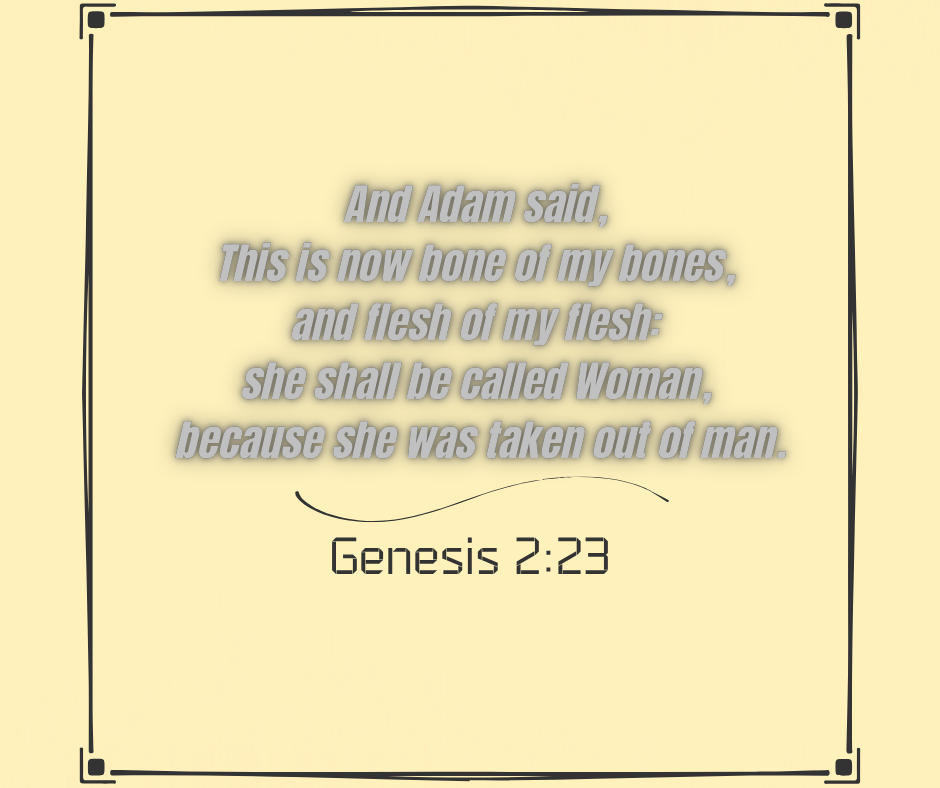
Now we turn to Genesis 2:23, which stands as a climactic declaration in the creation narrative. It is the first recorded speech of man in Scripture, and appropriately, it is a doxological utterance: a poetic exclamation of recognition, joy, and theological insight. Upon beholding the woman, Adam immediately perceives her origin and nature. His words not only affirm their shared substance—”bone of my bones, and flesh of my flesh”—but also introduce the divinely sanctioned category of “woman,” whose very identity is derived from the relational and ontological reality of being formed from man. In a world that had just witnessed the parade of animals that failed to correspond to Adam, this moment is not merely emotional, it is revelatory.
This verse functions both as a personal recognition and a theological proclamation. Adam’s spontaneous poetry conveys that the woman is not a separate species or a subordinate creature, but a part of himself, made from his own substance, and thus equal in essence. At the same time, she is distinct: not another man, but woman, formed not from the ground, but from man’s side. This is not incidental; it is fundamental to biblical anthropology and theology. The language of Genesis 2:23, concise yet profound, establishes the foundational truths of identity, kinship, and the covenantal structure of marriage. It forms the hinge between the divine act of forming woman (v. 22) and the theological institution of marriage (v. 24), linking creation with human relationships and God’s design for society.
In a single verse, the Bible presents a deeply integrated view of humanity: male and female, one yet two, equal yet ordered, united yet distinct. Genesis 2:23 is not merely the joyous exclamation of the first man; it is inspired Scripture, divinely preserved to teach successive generations what it means to be human in God’s world.