
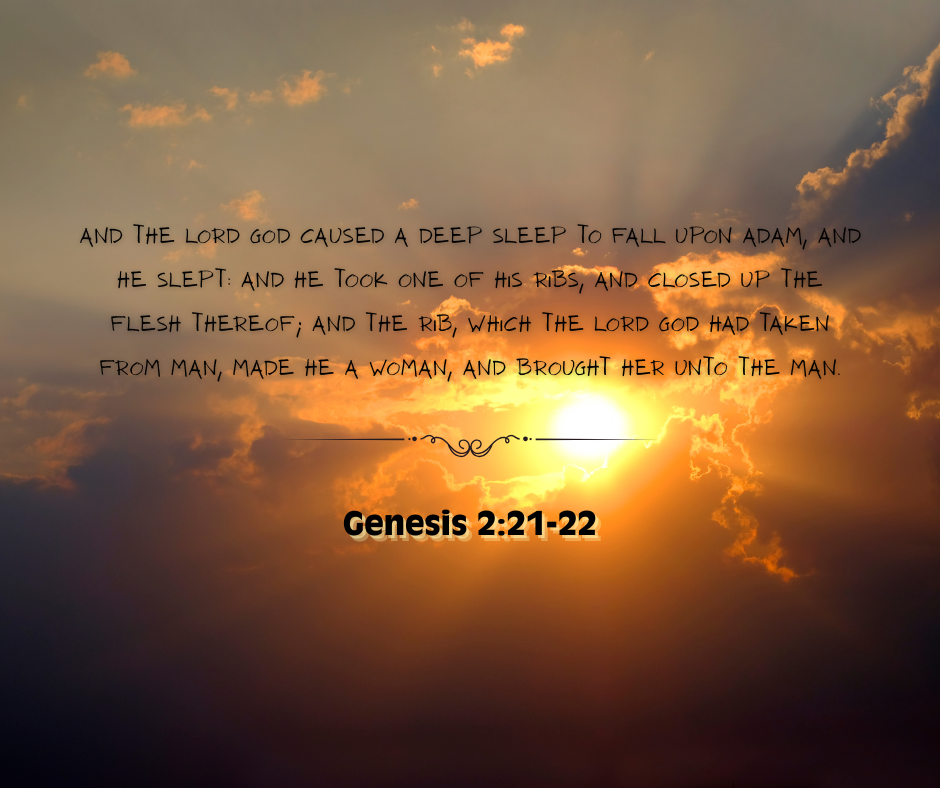
Genesis 2:21–22 is not merely an origin story; it’s a theological blueprint for understanding gender, marriage, human need, and divine provision. In these verses, the woman is not introduced as an afterthought, nor created from the dust like the man or the animals, but uniquely formed from his side, signifying shared substance, intimate origin, and God-ordained relationship. This act, deliberate and sacred, carries profound implications for how we live, love, and worship.
God’s Design for Gender and Marriage Must Be Honored
The formation of the woman from the man’s side establishes the created order of gender as purposeful, not arbitrary. The woman is not the man’s rival, replica, or possession, but his counterpart: equal in essence, distinct in role, and perfectly suited to complement him in covenantal relationship. In a cultural climate that increasingly denies or distorts the meaning of gender, Genesis calls us back to creation’s clarity: male and female are both necessary, both glorious, and both designed to reflect the image of God in their unity and distinction.
The church must resist the temptation to conform to cultural redefinitions of identity and marriage. Biblical complementarity is not a relic of patriarchy, but a revelation of divine wisdom, a pattern that glorifies God and blesses humanity. When rightly understood, it guards against both male dominance and gender confusion, offering a framework for flourishing rooted not in social constructs but in creation itself.
Marriage is a Covenant Rooted in Creation, Not Culture
The presentation of the woman to the man is not a romantic flourish; it is the inaugural marriage covenant, solemnized not by human custom but by divine initiative. The man does not stumble upon the woman, God brings her to him. This anticipates the covenantal declaration in Genesis 2:24: “Therefore shall a man leave his father and his mother, and shall cleave unto his wife: and they shall be one flesh.”
This passage affirms that marriage is not a cultural invention or temporary social arrangement, but a sacred union established by God. Christian marriages are to reflect this design: lovingly complementary, monogamous, covenantal, and lifelong. In a world that treats marriage as disposable and self-centered, Genesis calls us to view it as a covenantal bond of mutual devotion, sealed by divine intention and marked by sacrificial love.
God Provides What We Lack
Adam’s aloneness was not a flaw or an accident; it was by design, preparing him to receive God’s gracious provision. He names the animals, surveys creation, and finds no companion fit for him—not to frustrate him, but to show him the uniqueness and value of what God was about to provide. The creation of the woman from his side reveals that our deepest needs—relational, emotional, spiritual—cannot be met by creation alone or by human striving, but only by the generous initiative of the Creator.
This truth resonates far beyond marriage. Whether we are single, married, widowed, or waiting, the pattern remains: God knows what is not good, and He provides what is best in His perfect timing. The believer is called to trust—not in self-sufficiency—but in the wisdom, timing, and kindness of the One who brings every good gift from above (James 1:17).
Worship the God Who Builds Beauty
Genesis 2:21–22 invites us not only to obey but to worship. The same God who hung galaxies in place stooped to shape the woman from the side of the man, personally, lovingly, intentionally. He did not give the man something lesser or disposable, but someone who shared his very nature and would stand beside him in fellowship and covenant. In this, we see the heart of the Creator: not distant or indifferent, but near, wise, and good.
This passage reveals a God who not only makes but mends, who builds beauty from need, and who delights to form unity where there was isolation. In relationships—especially in marriage and the Church—we are called to live out this same posture: open-hearted, sacrificial, and shaped by divine design. The man’s side was opened in Eden to receive a bride; so must we open our lives to receive others in love and humility.
A Picture of Christ and the Church
Ultimately, Genesis 2:21–22 is more than anthropology; it’s typology, pointing forward to the redemptive work of Christ. Just as the first Adam was put into a deep sleep and had his side opened to bring forth a bride, so the Second Adam, Jesus Christ, was pierced in death, and from His side flowed blood and water, the signs of cleansing and covenant (John 19:34). From His suffering and sacrifice emerges the Church, His redeemed bride, made not from His dust, but from His very life (Eph 5:25–27, 30–32).
Marriage, then, is not merely a human institution; it is a living parable of the Gospel, a portrait of Christ’s love for His people, and the Church’s responsive devotion. The one-flesh union established in Eden finds its ultimate fulfillment in the spiritual union between Christ and His bride. As believers, we are called to live out that reality: whether in marriage or in singleness, in friendship or in community, we exist to reflect the relational beauty, sacrificial love, and covenantal grace of our Redeemer.
He Was Pierced That You Might Live
If you don’t yet know Jesus Christ as your Lord and Savior, I plead with you: come to Him, the Second Adam, who gave Himself for sinners like you and me. Just as the first woman was formed from the side of Adam, so from the pierced side of Christ flows the grace by which we may be made clean, made whole, and brought into eternal fellowship with God. His wounds are not mere symbols; they are the very means by which sin is atoned for, guilt is removed, and new life begins.
Just as Adam could not bring forth his bride by his own initiative, so you cannot make yourself whole. You were not created to be self-sufficient. Your need for forgiveness, for love, for peace with God, it cannot be met by religion, morality, or personal effort. It can only be met by the One who gave Himself for you.
He knows your need, even if you cannot fully name it. He sees your sin, yet He offers mercy. Jesus Christ took your guilt upon Himself. His wounds were not the tragic end of a good man; they were the intentional sacrifice of the sinless Son of God, given so that you might be made new. His death was not the loss of life; it was the opening of a new and living way (Hebrews 10:20). And now, from that pierced side, grace still flows: grace to cleanse your sins, grace to cover your shame, grace to welcome you as His own.
You do not need to earn this. You cannot. You must simply come, turn from your sin, trust in Him, and receive what He freely offers: forgiveness, restoration, and eternal life. Whether you are burdened with guilt, disillusioned with religion, or simply searching for something true, know this: Christ has already made the way. He gave Himself for you. He calls you now.
As Scripture declares, “This is a great mystery: but I speak concerning Christ and the church” (Ephesians 5:32). That mystery is no longer hidden. The love of Christ has been revealed.
Will you come to Him today, not with works in your hands but with faith in your heart? The side that was opened at Calvary still pours forth life for all who will receive it. There is no sin too great, no soul too far gone, that His redeeming love cannot reach.
He was pierced for you. Will you trust Him now?