
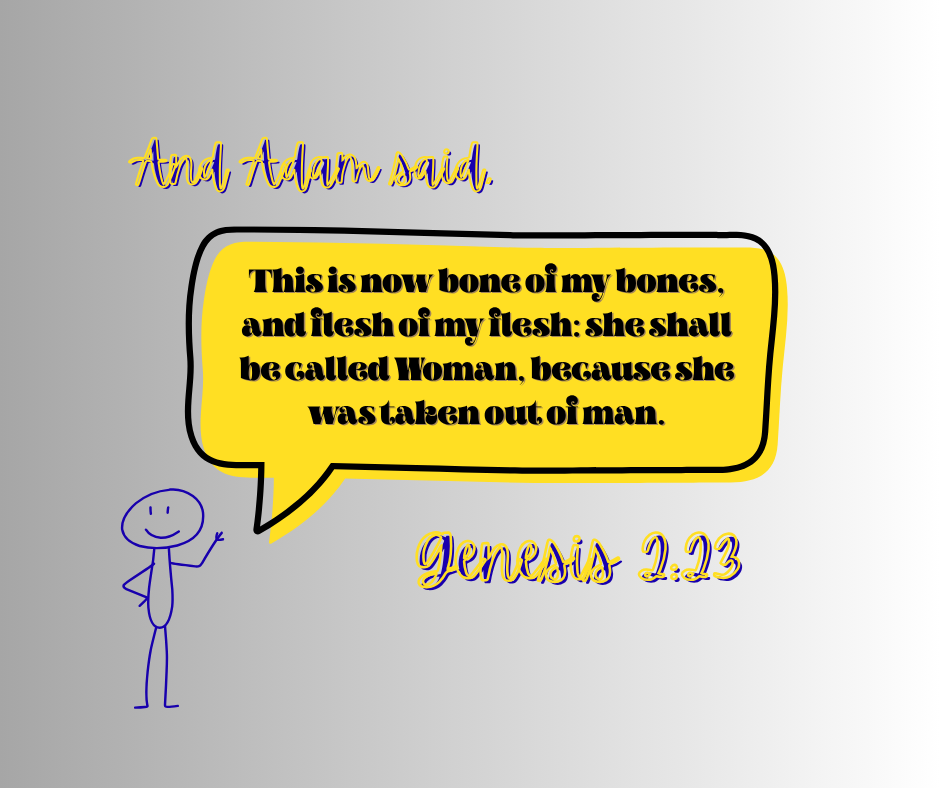
The simple phrase “And Adam said” introduces the first recorded human words in all of Scripture. Before this point, we have heard only the voice of God commanding, creating, blessing, and forming. Now, for the first time, man speaks. The significance of this cannot be overstated. Human speech, in this inaugural moment, is not used to name animals, express need, or assert independence. It is used to respond to divine revelation with recognition and joy.
The phrase structurally signals that Adam’s utterance is intentional, not incidental. The Hebrew verb amar, rendered “said,” is often used in formal or declarative speech throughout the Old Testament.1 When God “said,” creation occurred (Genesis 1). When Adam “said,” he was not creating in the divine sense, but he was interpreting, responding, and affirming the work of God. His words, recorded in poetic form, are not reactive improvisation, they are revelatory in their own right. They express not merely emotion but understanding.
That the man is referred to here as “the Adam” (hāʾādām) is also meaningful. It recalls his identity as the one formed from the ground (ʾădāmâ, Genesis 2:7), emphasizing his creatureliness even as he speaks profound theological truth.2 He is not speaking as a god or autonomous being but as one who has received life and knowledge from his Creator. As such, his first words are not directed toward God, nor toward himself, but toward the woman, demonstrating that humanity is inherently relational and communicative, oriented toward communion with others as a reflection of divine image-bearing (cf. Genesis 1:27).
The narrative context reinforces that Adam’s words are prompted by divine initiative. God brings the woman to the man (Genesis 2:22), and it is in response to this gracious act that Adam speaks. His speech is not prescriptive—it does not create the woman’s identity—but it is descriptive and declarative, naming what God has made and recognizing the correspondence between them. In this way, Adam models proper human speech: grounded in revelation, shaped by gratitude, and aligned with reality.
It is also worth noting what Adam does not say. He does not ask, “What is she?” or question her origin. His speech carries no hint of suspicion, fear, or competition. His first words are words of recognition—he sees her as part of himself—and thus his speech becomes the foundation of human fellowship. The tone is exultant, not utilitarian; he rejoices in the work of God and names the woman not as property but as partner.
From the very first human sentence in the Bible, we see that speech is a sacred gift meant to align with God’s truth. Adam’s declaration sets a pattern for all subsequent human speech: it ought to affirm what God has done, name what God has given, and celebrate what God has called good. In a world where words are now often twisted to obscure reality or deny divine design, Genesis 2:23 begins with a man who speaks in full harmony with God’s work. That alone is profound and tragically rare in the chapters to come.
- Wilhelm Gesenius, Gesenius’ Hebrew-Chaldee Lexicon to the Old Testament Scriptures, trans. Samuel Prideaux Tregelles (Grand Rapids: Baker Book House, 1979), s.v. “אָמַר.” Available online at Blue Letter Bible, https://www.blueletterbible.org/lexicon/h559/kjv/wlc/0-1/. ↩︎
- R. Laird Harris, Gleason L. Archer Jr., and Bruce K. Waltke, Theological Wordbook of the Old Testament (Chicago: Moody Press, 1980), s.v. “אָדָם.” Available online at StudyLight: https://www.studylight.org/lexicons/eng/hebrew/120.html. ↩︎