
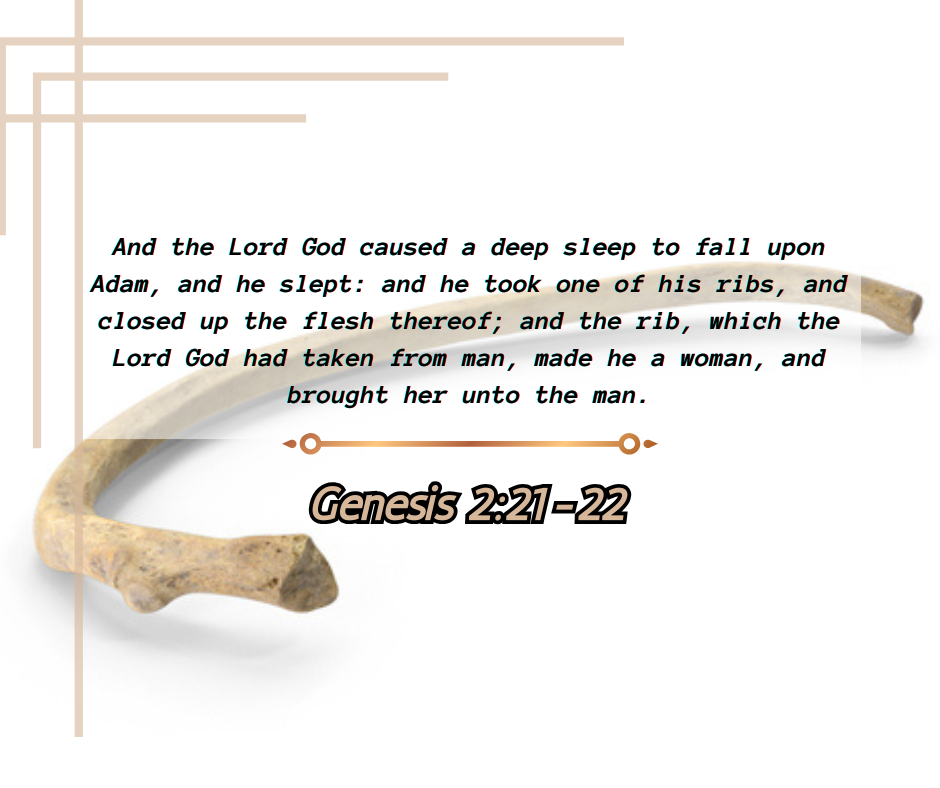
Islamic theology affirms that woman was created from man, a belief that echoes—but does not fully replicate—the biblical account in Genesis 2:21–22. The Qur’an refers to the origin of humanity in general terms, without detailing the rib episode. For instance, Surah 4:1 states: “Fear your Lord, who created you from a single soul, and created from it its mate, and propagated from them many men and women.” Similarly, Surah 7:189 declares: “It is He who created you from a single person, and made from it its mate, that he may find comfort with her.” These verses affirm a shared origin but lack the specificity of Genesis 2:21, where the woman is formed from the man’s side through a deliberate divine act.
The Hadith literature provides a more direct connection to the Genesis narrative. In Sahih al-Bukhari (Book 62, Hadith 114), Muhammad is reported to have said: “And I advise you to take care of the women, for they are created from a rib and the most crooked portion of the rib is its upper part; if you try to straighten it, it will break, and if you leave it, it will remain crooked, so I urge you to take care of the women.” Similar versions appear in Sahih Muslim, reinforcing the idea that woman was formed from a rib, suggesting at least a partial continuity with the Genesis account in form, though not necessarily in theology.
Despite the resemblance, the interpretive framing differs significantly. The rib metaphor in the Hadith is frequently used to emphasize woman’s emotional or behavioral nature as inherently fragile or curved, often understood by Muslim scholars to mean that women should be treated gently because they are predisposed toward emotional complexity or deviation from male expectations. While the Hadith encourages kindness toward women, the analogy has sometimes contributed to cultural attitudes in which women are viewed as morally or intellectually inferior. This metaphor, combined with broader Islamic jurisprudence, often results in women being placed in legally and spiritually subordinate roles—such as limited testimony rights, inheritance discrepancies, and restricted religious leadership—especially within traditional interpretations of sharia.
In contrast, Genesis 2:21–22 depicts the woman not as a crooked liability to be tolerated, but as a divinely crafted solution to man’s aloneness. The Genesis account affirms both the unity of essence and the intentionality of distinction, establishing the woman’s creation as an act of dignity and covenantal purpose, not as a metaphor for deficiency or subordination.
Thus, while Islam shares a partial conceptual overlap with the Genesis narrative, particularly through the Hadith tradition, the theological implications diverge. The biblical account elevates the creation of woman as a climactic moment of relational and spiritual completion within a good and ordered creation, rather than as a moral warning or explanatory metaphor for gender difference.