
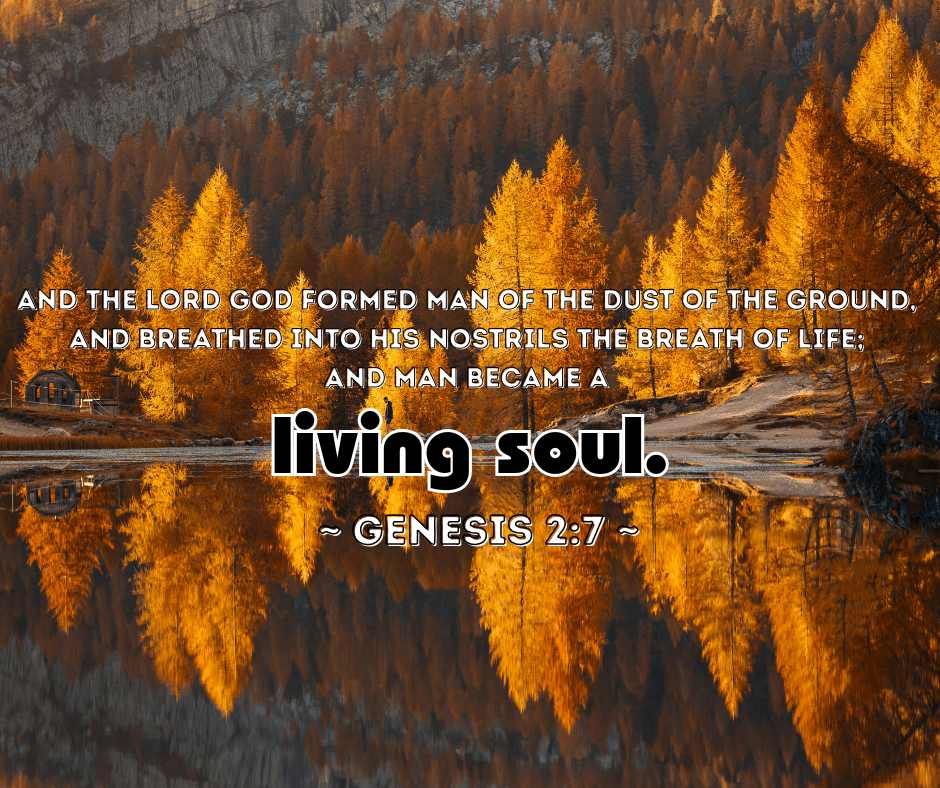
Norman Geisler and Ron Rhodes insightfully address a common doctrinal error propagated by the Jehovah’s Witnesses regarding the nature of the human soul. In their attempt to deny the soul’s immaterial and immortal essence, Jehovah’s Witnesses often cite Genesis 2:7 as a proof text, arguing that man is a soul rather than possesses a soul. They assert that the soul is nothing more than the physical life or existence of a person or animal. Geisler and Rhodes reference the Watchtower publication Mankind’s Search for God, which states, “Bible usage shows the soul to be a person or an animal or the life that a person or an animal enjoys” (Geisler & Rhodes, 1997, pp. 23–24). Based on this definition, Jehovah’s Witnesses conclude that the term “soul” (nephesh in Hebrew) refers solely to physical, biological life and not to a distinct, immaterial aspect of human nature that survives physical death.
It is true that the Hebrew word for “soul” (nephesh) in this verse can mean “living being.” However, to base a complete theological doctrine on this single usage, without considering the broader biblical context and the range of meanings the term can carry, is to commit a serious exegetical fallacy.
As Geisler and Rhodes correctly observe, a common mistake among beginning students of biblical languages is the assumption that a word must carry the same meaning every time it is used. But both Hebrew and Greek are rich languages with words that have semantic ranges—multiple meanings that shift depending on context. The term nephesh is a perfect example of this.
While nephesh in Genesis 2:7 does refer to man becoming a living being, the same word appears in other contexts where it clearly refers to an immaterial aspect of a person. Consider Genesis 35:18, which describes the death of Rachel: “And it came to pass, as her soul was in departing, (for she died)…” Here, the nephesh is something that departs from the body at death. The physical body remains, but the soul leaves. This directly contradicts the idea that the soul is nothing more than the body or physical life.
The Bible consistently testifies to the reality of the soul as an immaterial, conscious part of man that survives death and continues in existence either in the presence of God or in judgment. For instance, in Revelation 6:9-10, John records a heavenly vision: “And when he had opened the fifth seal, I saw under the altar the souls of them that were slain for the word of God, and for the testimony which they held: and they cried with a loud voice, saying, How long, O Lord, holy and true, dost thou not judge and avenge our blood on them that dwell on the earth?”
These souls are disembodied—their physical bodies have been slain—but they are still conscious, speaking, and present before God. To interpret the term “soul” here as merely “living being” would make nonsense of the passage.
Further affirmation of the soul’s existence after death is found in 1 Thessalonians 4:13-17, where Paul explains the resurrection at Christ’s return: “For if we believe that Jesus died and rose again, even so them also which sleep in Jesus will God bring with him… the dead in Christ shall rise first.” This passage reveals that believers who have died are with Christ now and will accompany Him when He returns, at which point their bodies will be raised and reunited with their souls. This implies an intermediate state in which the soul exists apart from the body.
Similarly, in Philippians 1:21-23, Paul writes: “For to me to live is Christ, and to die is gain… having a desire to depart, and to be with Christ; which is far better.” Paul clearly expects conscious fellowship with Christ immediately after death. The only way dying could be “gain” and “far better” is if Paul’s soul would continue to live in the presence of the Lord.
This is echoed in 2 Corinthians 5:6-8: “…whilst we are at home in the body, we are absent from the Lord… We are confident, I say, and willing rather to be absent from the body, and to be present with the Lord.” Here, Paul contrasts being “at home in the body” with being “present with the Lord,” further establishing the distinction between the physical body and the immaterial soul or spirit.
In sum, Scripture presents a clear and consistent picture: human beings are composed of both a material body and an immaterial soul or spirit. While the body may die, the soul continues on, either in fellowship with God or in separation from Him, awaiting final resurrection and judgment. The error of the Watchtower Society lies in its selective use of Scripture and its failure to interpret individual verses in light of the whole counsel of God. The biblical evidence—from both the Old and New Testaments—makes plain that man does indeed have a soul, and that this soul exists apart from the body and survives after death.