
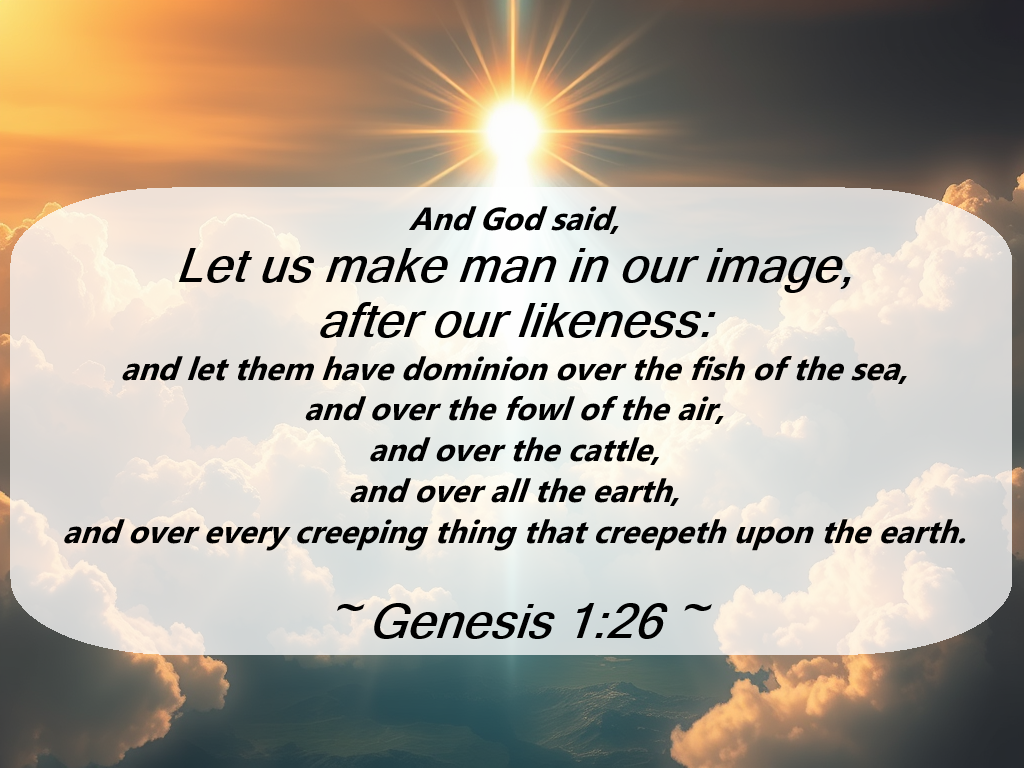
The majestic plural, or pluralis majestatis, is a linguistic device employed to express the majesty, greatness, and supreme authority of a singular subject. It is often used to elevate the significance of the speaker or the subject by attributing a sense of grandeur that surpasses the ordinary singular form. In the context of Scripture, the use of this device can underscore the unparalleled nature of God’s being and actions.
Some argue that in Genesis 1:26, the phrase “Let us make man in our image, after our likeness” serves as a profound example of this linguistic feature. While God is singular in His essence, the use of “us” conveys the fullness and depth of His divine power, wisdom, and majesty at work in the act of creation. This plural form invites reflection on the complexity and richness of God’s nature, which encompasses all authority and creativity.
Elohim as a Plural Noun
The Hebrew term for God, Elohim, is plural in form, yet it is consistently paired with singular verbs and adjectives throughout Scripture, a unique grammatical construction that underscores the singularity and unity of God while also conveying His unmatched majesty and supreme authority. This usage provides compelling support for interpreting the majestic plural in Genesis 1:26.
The plural form of Elohim serves to magnify the infinite power, sovereignty, and grandeur of the one true God, setting Him apart from all other beings or deities. This linguistic feature reflects the ancient Hebrew practice of using plural forms to denote excellence, honor, and greatness.
In the context of Genesis 1:26, the plural nature of Elohim aligns seamlessly with the phrase “Let us make man in our image, after our likeness.” This majestic plural emphasizes the fullness of God’s nature and His deliberative will in creating humanity. It also harmonizes with the understanding of God’s attributes as infinitely multifaceted—His power, wisdom, love, and holiness are without measure, yet perfectly unified within His singular essence.
Ancient Linguistic Practice
The use of plural forms to convey greatness, majesty, or authority is a well-documented linguistic feature in ancient languages, including Hebrew, Akkadian, and Ugaritic. This phenomenon, often referred to as the majestic plural or pluralis majestatis, allows for a singular subject to be described in a way that emphasizes its extraordinary nature, supreme power, or unique significance.
In Hebrew, the plural form is sometimes used for singular entities when the intention is to highlight their grandeur or exalted status. This can be seen not only in references to God but also in terms applied to important human figures or concepts. Terms like adonai (Lord) and shamayim (heavens) use plural forms to signify greatness and vastness, rather than numerical plurality.
In the broader context of ancient Near Eastern cultures, similar linguistic conventions are found. For example, kings or deities in neighboring cultures would sometimes use plural pronouns to assert their authority or to reflect their comprehensive rule over their realms. This parallel helps to clarify that the plural in Genesis 1:26 should not be understood as a statement of numerical plurality but as a stylistic choice to emphasize the uniqueness and transcendence of God.
Arguments Against the Majestic Plural Interpretation
A strong refutation of the majestic plural interpretation of Genesis 1:26 lies in the observation that the majestic plural, while a recognized linguistic device, is typically applied to nouns rather than pronouns. The phrase “Let us make man in our image, after our likeness” employs plural pronouns (“us” and “our”), which are less commonly associated with this literary convention. This inconsistency raises questions about whether the majestic plural alone can fully account for the usage here.
Additionally, the relational tone of “Let us” suggests a form of dialogue or deliberation, which does not align neatly with the idea of a purely literary or rhetorical device. The phrase does not merely aim to elevate God’s majesty but also conveys an intentional and purposeful consultation, implying interaction or communication within the speaker’s context. If the phrase were simply a stylistic embellishment, one might expect less of an interactive tone and more of a declarative or self-referential statement.
For instance, other instances of the majestic plural in Scripture or other ancient texts typically exalt the subject without implying relational engagement. In contrast, the phrasing in Genesis 1:26 appears to involve an intentional “conference” of sorts, which would be unusual for the majestic plural. This is why some interpretations suggest that the “us” reflects a genuine plurality of persons or beings within the divine context.
While the majestic plural effectively conveys the grandeur and majesty of God, its application to pronouns in Genesis 1:26 is not consistent with its typical usage. The relational tone of “Let us” suggests something beyond a mere literary device, pointing instead to a deeper and more complex understanding of God’s nature.