
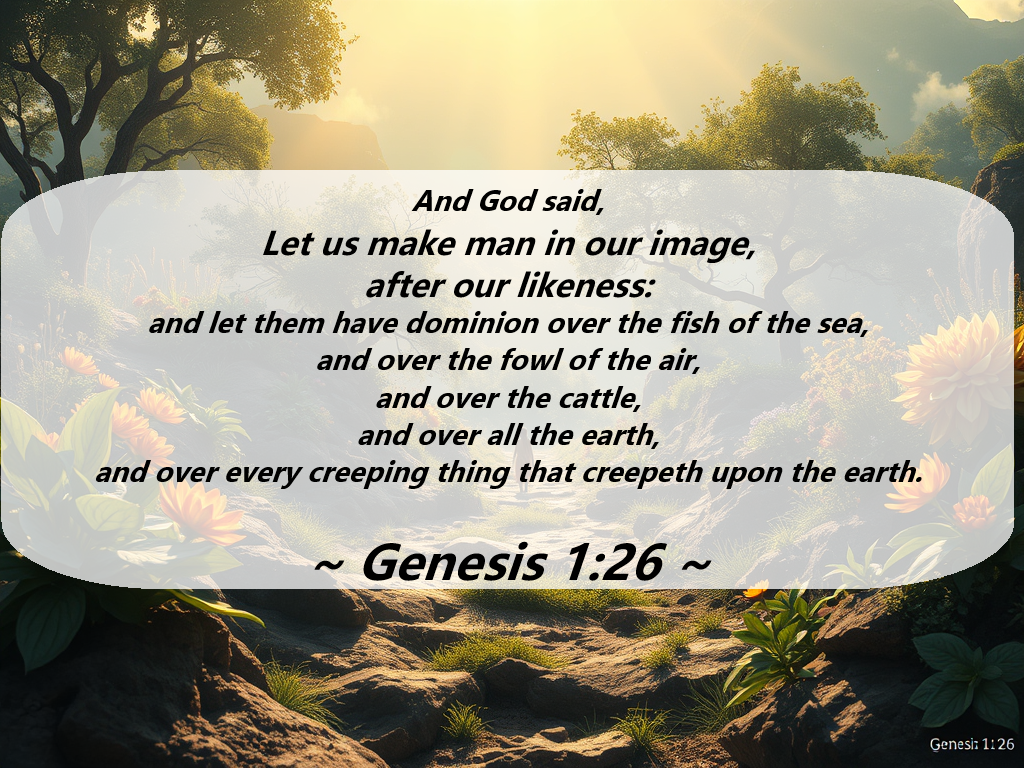
Some scholars and theologians suggest that in Genesis 1:26, God may be addressing creation itself—specifically the earth and its elements—as participants in the formation of humanity. This perspective highlights the profound connection between humanity and the physical world. For instance, Genesis 2:7 states, “And the LORD God formed man of the dust of the ground, and breathed into his nostrils the breath of life; and man became a living soul.” This emphasizes that humanity’s physical body was crafted from the very elements of the earth, anchoring us to the created order.
At the same time, this view underscores humanity’s unique spiritual connection to God. The act of God breathing the breath of life into Adam signifies the divine impartation of a soul, setting humanity apart from all other creatures. While our physical nature ties us to the earth, our spiritual nature reflects God’s image, enabling us to have fellowship with Him, exercise dominion over creation (Genesis 1:28), and reflect His moral and relational attributes.
This interpretation also resonates with the broader biblical theme of humanity’s role as stewards of creation. Since we are both part of the created order and endowed with a divine imprint, we bear a responsibility to care for the earth, recognizing our interconnectedness with it. By involving creation in the formation of man, God may be affirming the harmony and unity of His creation, where humanity serves as both a caretaker of the earth and a worshiper of its Creator.
Arguments Against the Address to Creation Interpretation
This view faces significant theological and scriptural challenges. A key point of refutation is the passive role of creation throughout the Genesis creation narrative. At no point is creation described as an active agent or contributor in God’s creative acts; rather, it is depicted as entirely responsive to God’s sovereign commands.
Psalm 33:9 underscores this truth: “For he spake, and it was done; he commanded, and it stood fast.” This verse highlights the absolute authority and effectiveness of God’s word. Creation comes into existence and order solely by the power of His spoken command. The consistent pattern in Genesis 1 affirms this, with phrases such as, “And God said, Let there be…” (Genesis 1:3, 6, 9, etc.), followed by, “and it was so.” The narrative leaves no room for creation to act as a partner or co-creator; it responds in obedience to the divine decree.
Furthermore, Genesis 2:7 provides a specific description of humanity’s formation: “And the LORD God formed man of the dust of the ground, and breathed into his nostrils the breath of life; and man became a living soul.” Here, God is the sole actor, shaping man from the dust and imparting life through His own breath. The dust is entirely passive, serving as raw material under the direct creative power of God. This reinforces the principle that God alone is the Creator, not only initiating but completing every act of creation without assistance.
Theologically, the idea that God is addressing creation in Genesis 1:26 also diminishes the distinctiveness of the statement, “Let us make man in our image, after our likeness.” This declaration reflects the deliberative and unique nature of humanity’s creation, which stands apart from all other acts of creation.
Lastly, allowing for creation to have an active role in forming humanity undermines the doctrine of God’s sovereignty and omnipotence. Scripture consistently presents God as completely self-sufficient in His creative works. Isaiah 40:14 asks rhetorically, “With whom took he counsel, and who instructed him, and taught him in the path of judgment, and taught him knowledge, and shewed to him the way of understanding?” The answer is clear: no one. God requires no assistance, whether from creation or any other source.
In summary, the view that God is speaking to creation in Genesis 1:26 is inconsistent with the passive role of creation as presented in Scripture, the nature of humanity’s unique formation, and the overarching biblical teaching of God’s sovereignty and self-sufficiency. Instead, the text points to the deliberative action of the triune God, underscoring both His omnipotence and the special place of humanity within His creation.