
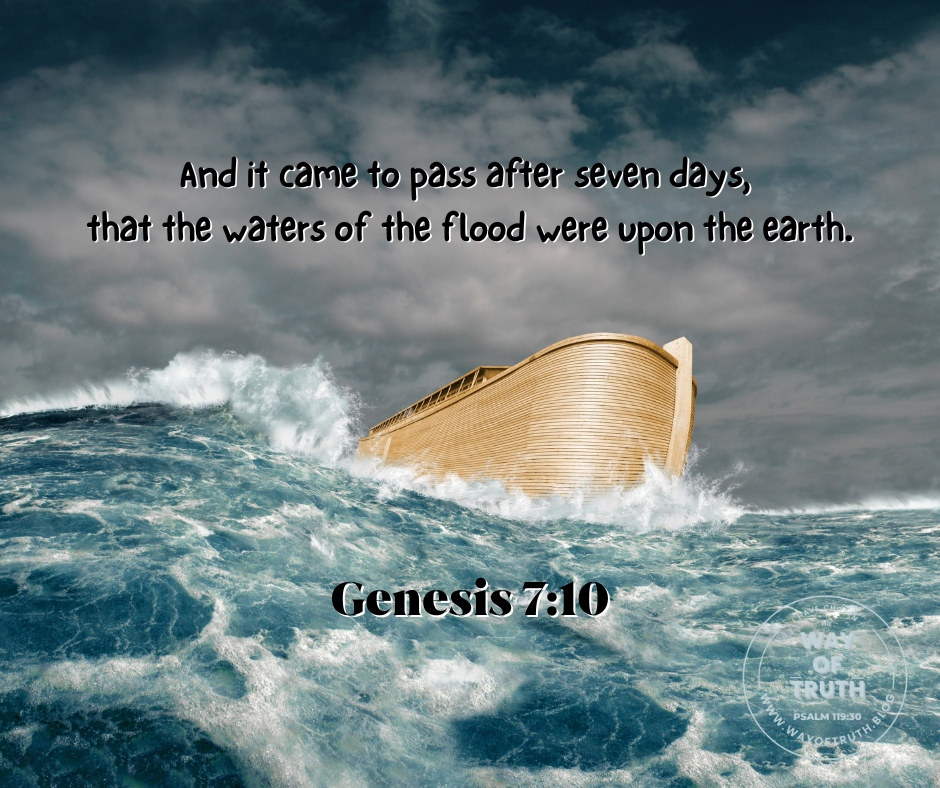
“And it came to pass after seven days, that the waters of the flood were upon the earth” (Genesis 7:10).
I. The Moment History Crossed a Threshold
Genesis 7:10 marks one of the most understated yet theologically weighty transitions in all of Scripture. With remarkable restraint, the text records the precise moment when divine warning gives way to divine action. The verse does not describe thunder, panic, or chaos. Instead, it announces—almost quietly—that after a divinely appointed interval, judgment arrived exactly as God had said.
Literarily, this verse serves as a hinge between obedience and consequence, between waiting and fulfillment. Noah has already entered the ark with his household and the appointed animals (Genesis 7:7–9). Human history now stands on the far side of opportunity. What follows is no longer invitation but execution.
Historically and culturally, ancient Near Eastern literature often portrayed floods as impulsive acts of capricious gods. Genesis, however, presents the Flood as the result of moral deliberation, covenantal warning, and measured patience. The seven-day delay emphasizes that God’s judgment is neither rash nor unannounced. It is timed, purposeful, and morally grounded.
Within redemptive history, Genesis 7:10 underscores a recurring biblical pattern: God warns, waits, and then acts decisively. This pattern echoes forward to later prophetic warnings (Isaiah 55:6), Christ’s own teaching on delayed judgment (Matthew 24:36–39), and the final eschatological reckoning (2 Peter 3:9–10). The verse stands as a solemn reminder that God’s mercy has a season, and when that season closes, His word is fulfilled without delay or revision.
II. From Announced Warning to Executed Reality
Genesis 7:10 is a single, restrained sentence, yet it bears enormous exegetical weight. The verse records the precise transition point where God’s spoken word moves from warning to fulfillment, from promise to historical fact. Every phrase is carefully placed, and none are superfluous. The economy of language itself functions theologically, emphasizing certainty, control, and inevitability rather than spectacle.
A. The Fulfillment Formula of Divine Speech
The verse opens with the familiar Hebrew narrative construction “And it came to pass,”, a phrase that frequently signals the fulfillment of a prior divine declaration. This formula is not a neutral storytelling device. In the Old Testament, it often marks moments when God’s previously spoken word enters concrete historical reality. The phrase serves as a literary bridge between prophecy and performance.
In Genesis 7:10, the phrase explicitly connects the event to God’s earlier announcement in Genesis 7:4, where the LORD declared that rain would come “after seven days.” The narrative now confirms that nothing about God’s word was hypothetical, conditional, or symbolic. What was spoken has occurred exactly as stated. Scripture thus reinforces a foundational biblical principle: God’s word is not merely informative; it is performative. When God speaks, history moves.
Importantly, the phrase does not convey surprise or suddenness. It conveys certainty. The flood did not “break out,” nor did it “unexpectedly arrive.” It “came to pass.” The language implies inevitability rather than shock. This distinction matters because it resists any reading of the Flood as a chaotic natural disaster or an impulsive divine act. Instead, the event unfolds as the deliberate execution of a previously established decree.
This opening phrase also reinforces the moral coherence of the narrative. Judgment does not appear ex nihilo. It arises within a framework of warning, patience, and declared intent. The literary calm of the phrase stands in sharp contrast to the catastrophic reality it introduces, underscoring that divine judgment is orderly even when it is severe.
B. Sacred Time and Moral Patience
The phrase “after seven days” functions as the temporal and theological center of the verse. Grammatically, it marks a precise interval; the Hebrew construction leaves no ambiguity about the literal nature of the time period. This is not a symbolic or indefinite delay but a clearly bounded span that had already been announced by God.
The number seven throughout Genesis is associated with divine ordering and completeness, beginning with the creation week. Here, the seven-day interval does not imply ritual symbolism so much as moral finality. God’s patience has been fully expressed, His warning fully delivered. Nothing remains undone or unclear. The waiting period is not for God’s benefit but for the moral clarity of the moment.
Notably, the delay occurs after Noah has already entered the ark. This detail is crucial. The seven days are not preparatory for obedience; obedience is complete. The waiting period instead highlights the distinction between those who trusted God’s word and those who did not. Noah waits in faith, safe in God’s provision, while the world outside continues unchanged, at least for a time.
Literarily, the delay heightens tension while simultaneously reinforcing justice. God does not act precipitously. Even judgment arrives on schedule, not in haste. Theologically, this underscores that divine patience is intentional but finite. The text offers no suggestion that the delay could be extended or revoked. Once God has set the time, fulfillment is certain.
This phrase also anticipates later biblical patterns where God announces a period of waiting before decisive action, reinforcing a consistent theology of warning preceding judgment.
C. Definiteness, Scope, and Historical Specificity
The phrase “the waters of the flood” is marked by definiteness. The Hebrew uses the definite article, indicating not just any floodwaters, but the Flood: the specific, previously described event. This grammatical feature ties the verse tightly to the broader narrative and resists any attempt to generalize or localize the event abstractly.
The word translated “flood” is used almost exclusively for the Noahic Flood in Scripture. Its limited usage underscores the uniqueness of this event. The author is not describing a common seasonal inundation but a singular act of divine judgment with no true parallel in later biblical history.
The emphasis on “waters” is also significant. Up to this point, no rain has been described. The verse does not yet explain mechanisms or sources; it simply announces the arrival of the instrument of judgment. This restraint preserves narrative momentum while reinforcing causality. The waters appear not because of meteorological coincidence but because God said they would.
The phrase further emphasizes that judgment is tangible and material. The Flood is not merely a moral reckoning or symbolic reset. It involves physical waters acting upon the physical world. This concreteness aligns with the Old Testament’s consistent refusal to separate moral accountability from historical consequence.
D. Universal Reach and Irreversibility
The final clause—“were upon the earth”—is deceptively simple. Grammatically, the phrase uses a construction that conveys settled presence, not momentary contact. The waters are not approaching, threatening, or gathering; they are already upon the earth. Judgment has begun.
The term “earth” in Genesis regularly refers to the inhabited world. Within the narrative context, it denotes the same realm previously described as filled with violence and corruption (Genesis 6:11–12). The correspondence is deliberate: the domain of sin becomes the domain of judgment. The scope of the Flood matches the scope of human wickedness as the text has defined it.
This clause also marks the point of no return. Once the waters are upon the earth, opportunity has ended. The narrative offers no hint of reversal, mitigation, or negotiation. The simplicity of the statement reinforces finality. There is no dramatic commentary, only the stark reality that what was warned has arrived.
Literarily, the understatement is powerful. The absence of emotional language forces the reader to confront the event without distraction. Judgment does not require embellishment to be terrifying. Its certainty is sufficient.
E. Narrative Restraint and Theological Weight
One of the most striking features of Genesis 7:10 is what it does not say. There is no description of human reaction, no cries, no resistance, no immediate chaos. The narrator withholds these details deliberately. This restraint shifts the focus away from human response and centers it entirely on divine faithfulness.
The verse functions as a theological anchor within the Flood narrative. It confirms that God governs time, action, and consequence with precision. Silence does not signal abandonment, and delay does not signal indecision. God’s word unfolds exactly as spoken, neither accelerated by panic nor postponed by pity.
This narrative calm also reinforces the moral seriousness of the event. The Flood is not portrayed as a tragic accident but as the sober execution of justice. The text does not invite the reader to debate God’s right to act but to recognize His consistency and truthfulness.
In its brevity, Genesis 7:10 accomplishes what lengthy descriptions could not. It declares that the world God judges is the world God warned, and the timing of that judgment reflects neither whim nor weakness but perfect sovereignty.
III. Divine Justice, Historical Reality, and Moral Coherence
Genesis 7:10 stands as a quiet but formidable apologetic text. With a single sentence, it confronts modern skepticism, ancient mythological parallels, and theological distortions that seek either to soften, dismiss, or reframe divine judgment. The verse does not argue; it asserts. Its strength lies precisely in its restraint. By recording the fulfillment of God’s word after a declared interval, the text defends the moral seriousness, historical credibility, and theological coherence of Scripture.
A. Against the Charge of Arbitrary or Capricious Judgment
One of the most common objections to the Flood narrative is that it portrays God as morally impulsive or excessively severe. Critics often frame divine judgment as arbitrary: an overreaction inconsistent with moral goodness. Genesis 7:10 directly undermines this claim by emphasizing timing. Judgment does not erupt suddenly; it arrives after seven days, exactly as announced.
This temporal structure matters apologetically. Arbitrary judgment is, by definition, unannounced and unreasoned. Genesis presents the opposite. The Flood follows a sequence: moral evaluation (Genesis 6:5–12), extended warning through Noah’s preaching, visible preparation of the ark, explicit divine declaration of timing, and only then execution. Genesis 7:10 functions as the narrative confirmation that God acted neither rashly nor reactively.
Moreover, the verse exposes a modern moral assumption that patience negates justice. Contemporary thought often treats delayed judgment as evidence that judgment itself is unjust. Scripture reverses this logic. Delay magnifies accountability. By waiting, God removes any claim of ignorance or surprise. When the waters arrive, they do so against the backdrop of rejected truth, not withheld information.
Theologically, Genesis 7:10 demonstrates that divine judgment is not the opposite of mercy but its counterpart. Mercy without justice collapses into moral indifference. Justice without warning would indeed be cruelty. The verse shows neither extreme. God warns, waits, and then acts. In doing so, He reveals a moral character far more coherent than the caricature often advanced by skeptics.
B. Against Mythological Reduction and Ancient Flood Parallels
Another frequent challenge claims that Genesis merely reworks ancient Near Eastern flood myths, such as those found in Mesopotamian literature. These accounts often portray floods as the result of divine annoyance, human noise, or inter-god conflict. Genesis 7:10 decisively separates the biblical account from these mythological frameworks.
First, the verse emphasizes foreordination. The Flood does not occur because events spiral out of control or because gods change their minds. It occurs because God said it would occur at a specified time. Mythological floods are reactive; the biblical Flood is judicial.
Second, the narrative tone is radically different. Ancient myths revel in drama, divine panic, and cosmic chaos. Genesis 7:10 is starkly restrained. There is no divine regret, fear, or confusion. The waters simply arrive as declared. This literary sobriety reflects theological conviction: the God of Scripture is sovereign over nature, not threatened by it.
Third, the verse reinforces moral causality. Mythological floods lack ethical grounding; Genesis roots judgment explicitly in human corruption. Genesis 7:10 presupposes the moral indictment already established in earlier chapters. The floodwaters are not cosmic accidents but moral consequences.
Apologetically, this distinction matters. Similarity of event does not imply dependence of theology. Shared memory of a catastrophic flood across cultures is better explained by a historical core event interpreted through different worldviews. Genesis preserves the event within a framework of moral monotheism, historical specificity, and divine purpose, features absent from mythological counterparts.
C. Against Symbolic or Non-Historical Reinterpretations
Modern theological revisionism often attempts to preserve the “message” of the Flood while denying its historical reality. In this view, the waters represent moral cleansing or existential crisis rather than an actual event. Genesis 7:10 resists such reduction at every grammatical and narrative level.
The verse is anchored in time (“after seven days”), action (“the waters…were”), and location (“upon the earth”). These are the markers of historical narration, not allegory. Symbolic literature does not normally bind imagery to precise chronological fulfillment. Genesis does.
Furthermore, the verse’s function within the narrative depends on historicity. Noah’s obedience, the ark’s construction, and the later covenant all presuppose a real event with real consequences. If the Flood is symbolic, then the seven-day waiting period becomes meaningless, and the fulfillment language collapses into literary fiction.
From a polemical standpoint, non-historical readings often arise not from the text itself but from external discomfort with divine judgment or supernatural intervention. Genesis 7:10 confronts such discomfort by refusing to accommodate it. The text does not ask whether modern readers find the Flood plausible; it declares that it occurred as God said it would.
Historicity here is not an incidental detail but a theological necessity. Scripture consistently treats divine judgment and salvation as actions within history. To abstract Genesis 7:10 into metaphor is to sever it from the biblical pattern that later includes the cross, resurrection, and final judgment.
D. Against the Presumption That Delay Equals Cancellation
Perhaps the most pastorally dangerous misreading confronted by Genesis 7:10 is the assumption that because judgment does not come immediately, it will not come at all. This presumption is ancient, recurring, and explicitly contradicted by the verse.
The seven-day delay created a deceptive calm. From the outside, nothing changed. The sky remained clear. Life likely continued as normal. Genesis 7:10 reveals the peril of interpreting silence as safety. The absence of immediate consequence did not signal divine reconsideration but divine restraint.
This has direct apologetic relevance to modern skepticism. Many argue that since judgment has not yet occurred, biblical warnings must be exaggerated or false. Genesis 7:10 exposes the logical flaw in that reasoning. Delay tests belief; it does not negate truth.
The verse also addresses theological distortions that emphasize God’s patience while minimizing His resolve. Patience without fulfillment would make God unreliable. Genesis 7:10 affirms both. God waited, and God acted, without contradiction.
In polemical terms, the verse warns against presumption masquerading as optimism. To assume that God will never act because He has not yet acted is to repeat the error of the pre-Flood world. Scripture records this moment not merely as history but as warning: divine timing is exact, and when fulfillment arrives, it arrives without negotiation.
Genesis 7:10 therefore stands as a quiet rebuke to complacency, a defense of biblical realism, and a testimony to the unwavering faithfulness of God’s word.
IV. Faithful Living in the Interval of God’s Patience
Genesis 7:10 speaks to the lived reality of God’s people in every age. The verse addresses what it means to live faithfully in the space between God’s word and its fulfillment, between warning and outcome, between promise and completion. Its applications are therefore not dramatic but deeply formative, shaping how believers think, wait, obey, worship, and bear witness.
A. Learning to Trust God When Obedience Precedes Evidence
Genesis 7:10 reminds believers that obedience often comes before visible confirmation. Noah had already acted on God’s word. He was inside the ark. The animals were gathered. Yet for seven days, nothing outwardly changed. The rain did not begin immediately. The earth looked the same as it always had. Faith, in that moment, consisted not in dramatic action but in patient trust.
For believers today, this challenges a results-driven spirituality that equates God’s approval with immediate outcomes. Scripture does not present obedience as a transaction that guarantees instant validation. Rather, Genesis 7:10 shows that God may intentionally place His servants in seasons where obedience is complete, but evidence is absent. These seasons are not failures of faith; they are exercises of it.
Devotionally, this calls believers to anchor their confidence in God’s word rather than in circumstances. Noah’s assurance did not come from the sky, but from what God had spoken. In the same way, Christians are often called to persevere in faithfulness—whether in prayer, holiness, ministry, or endurance—without seeing immediate fruit.
Ecclesially, churches must resist the temptation to measure faithfulness primarily by visible growth or cultural impact. Genesis 7:10 teaches that obedience is validated by God’s promise, not by public perception. A congregation may be fully aligned with God’s will long before any external sign appears. Faithfulness, not immediacy, is the biblical measure of success.
B. Recognizing the Danger of Misreading God’s Patience
The seven-day delay recorded in Genesis 7:10 carried a moral risk for those outside the ark. The absence of immediate judgment could easily be interpreted as a false alarm. From a human perspective, nothing seemed urgent. The sky was calm. Life likely continued as usual.
For modern readers, this speaks powerfully to the danger of confusing divine restraint with divine indifference. God’s patience is purposeful, but it is not permission. The text teaches that time itself can become a test of the heart. Will people respond to God’s warning, or will they presume upon His silence?
Devotionally, this calls believers to cultivate reverent seriousness about sin and repentance. The absence of immediate consequences does not mean that sin is harmless or ignored. Genesis 7:10 urges Christians to examine their own hearts and lives honestly, asking whether they are taking God’s mercy seriously or treating it casually.
Within the Church, this passage encourages sober teaching about accountability and holiness. Ecclesial life shaped only by comfort and affirmation risks dulling the biblical sense of urgency.
C. Cultivating Hope Through Confidence in God’s Perfect Timing
While Genesis 7:10 carries solemn weight, it also offers deep encouragement. The same precision that governs judgment also governs deliverance. God did not forget Noah during the waiting period. The delay was not abandonment. It was part of a larger, perfectly ordered plan.
For believers, this affirms that God’s timing is neither arbitrary nor careless. When fulfillment seems slow, Scripture invites trust rather than anxiety. God’s promises unfold according to His wisdom, not human impatience. Genesis 7:10 reassures believers that waiting does not mean uncertainty in God’s purposes.
Devotionally, this encourages a posture of calm faith. Christians often struggle with the tension between God’s promises and present experience. This verse teaches that waiting is not wasted time when it is grounded in trust. God’s delays are deliberate, and His fulfillment is never late.
Ecclesially, this truth fosters stability and perseverance. Churches navigating seasons of waiting—whether for growth, clarity, or resolution—can draw confidence from the fact that God governs time itself. The Church does not need to rush God’s work or manufacture outcomes. Genesis 7:10 invites God’s people to rest in His sovereign schedule while remaining obedient and watchful.
D. Living and Witnessing as People Who Know Fulfillment Is Certain
Genesis 7:10 ultimately shapes how believers live and witness in the world. The verse testifies that God’s word will be fulfilled exactly as spoken. This certainty should produce neither fear-driven withdrawal nor complacent delay, but sober, faithful engagement.
For individual believers, this means living with moral clarity and eternal perspective. If God’s warnings are real and His timing exact, then daily life carries eternal significance. Choices matter. Faithfulness matters. The believer’s conduct becomes a visible testimony to trust in God’s promises.
For the Church, this passage reinforces the urgency of proclamation. Just as Noah’s obedience and presence stood as a silent witness during the waiting period, so the Church exists as a living testimony to God’s truth. The mission of the Church is not to speculate about timing but to faithfully proclaim what God has said.
Genesis 7:10 also calls the Church to humility. Fulfillment belongs to God, not to human effort. The Church’s responsibility is obedience and witness, trusting God to act in His time. This guards against both despair and arrogance.
In all these ways, Genesis 7:10 teaches believers how to live faithfully in the interval—obedient without applause, patient without presumption, hopeful without denial, and watchful without fear—until God’s word is fully and finally accomplished.
V. From Warning to Rescue
If you do not yet know Jesus Christ as your Lord and Savior, Genesis 7:10 speaks to you with a clarity that is both sobering and hopeful. This verse marks the moment when God’s warning became reality, when waiting ended and fulfillment arrived. Yet embedded within that sobering transition is the heart of the gospel itself: God warns before He judges, provides refuge before destruction, and invites trust before consequences fall. The Flood narrative does not merely recount judgment; it reveals the gracious pattern by which God saves those who believe His word and enter the refuge He provides.
A. The Gospel and the Reality of Human Sin
Genesis 7:10 assumes a moral backdrop that the gospel makes explicit: judgment does not come without cause. Long before the waters arrived, God had declared that the earth was filled with corruption and violence. Human sin was not incidental or isolated; it was pervasive, willful, and deeply entrenched. The arrival of the floodwaters confirms that sin is not merely a private flaw but a public reality with real consequences.
The gospel begins with this same truth. Scripture teaches that all have sinned and fallen short of God’s holiness. Sin is not merely a mistake or weakness; it is rebellion against the Creator’s authority and goodness. Like the world before the Flood, humanity stands accountable before a righteous God whose moral standards do not bend with time or culture.
Genesis 7:10 confronts the illusion that sin can persist indefinitely without consequence. The seven-day delay did not erase guilt; it exposed hearts. In the same way, the time we live in now—between Christ’s first coming and His return—is not moral neutrality. It is a season of accountability.
The gospel does not minimize sin; it names it honestly. Yet it does so not to condemn without hope, but to prepare the heart to receive grace. Until sin is taken seriously, salvation will seem unnecessary. Genesis 7:10 reminds us that God’s patience exists because sin is real and because rescue is still being offered.
B. Christ as the True and Final Refuge
While Genesis 7:10 records the arrival of judgment, it also presupposes the existence of refuge. Noah was already inside the ark. Judgment fell on the world, but not on those whom God had safely enclosed. The ark was not an afterthought; it was God’s appointed means of salvation, prepared long before the rain began.
The gospel reveals that Jesus Christ is the true and final refuge to which the ark pointed. Just as Noah entered the ark by faith in God’s word, sinners are invited to come to Christ by faith in His finished work. The ark did not save by human strength or ingenuity; it saved because God designed it, provided it, and sealed it. So too, salvation in Christ is not earned or engineered. It is received.
Christ bore judgment so that those who trust Him would not. On the cross, God’s justice and mercy met perfectly. The judgment sin deserved fell upon the Son, so that forgiveness could be offered freely to those who believe. As the ark shielded Noah from the waters, Christ shields believers from the wrath to come.
Genesis 7:10 reminds us that refuge must be entered before judgment begins. The door of the ark did not remain open indefinitely. In the same way, Scripture urges sinners to come to Christ while grace is still extended. Salvation is certain for those who trust Him, because the refuge God provides is sufficient, secure, and sealed by His promise.
C. Repentance and Faith in the Time of God’s Patience
The seven-day interval before the Flood illustrates a profound gospel truth: God grants time for response. That delay was not uncertainty; it was mercy. It allowed space for repentance, reflection, and belief even though Scripture records that the world did not take it.
The gospel calls for a response during the season of God’s patience. Repentance is not mere regret; it is a turning of the heart from sin toward God. Faith is not vague belief; it is trusting God’s word enough to act upon it. Noah’s faith was demonstrated not by words but by obedience: by entering the ark before the rain began.
Today, the call of the gospel is the same. God’s patience is not an endorsement of sin, but an invitation to salvation. Scripture warns against presuming that delay means exemption. The fact that judgment has not yet come does not mean it will not come. It means God is giving time for repentance.
Genesis 7:10 encourages urgency without panic. The gospel does not coerce; it calls. It does not threaten; it warns. Faith responds not because fear is overwhelming, but because God’s word is trustworthy. To delay repentance is to gamble with grace. To respond in faith is to rest in God’s promise.
D. The Promise of New Life Beyond Judgment
The Flood was not the end of the story. Judgment cleared the way for renewal, covenant, and hope. After the waters receded, God established His covenant with Noah, reaffirming His commitment to preserve life and advance His purposes in the world. Judgment served redemption, not chaos.
The gospel proclaims this truth in its fullest form. Through Christ, judgment gives way to new life. Those who trust in Him are not merely spared; they are made new. Forgiveness is not merely the absence of punishment. It is also the beginning of transformation, reconciliation, and eternal life.
Jesus rose from the dead as the guarantee that judgment does not have the final word for those who believe. Just as Noah stepped into a cleansed world, believers in Christ are promised resurrection and restoration in a renewed creation. The gospel offers not only escape from wrath, but entry into joy.
Genesis 7:10 therefore invites a response of trust and hope. God’s word will be fulfilled. The question is not whether He will act, but whether you will respond. Today, the door of grace remains open. Christ stands ready to save all who come to Him in repentance and faith.
Come to Him now. Trust in the Savior who bore judgment in your place. Enter the refuge God has provided, and live for His glory, secure in the promise of forgiveness, new life, and eternal salvation.