
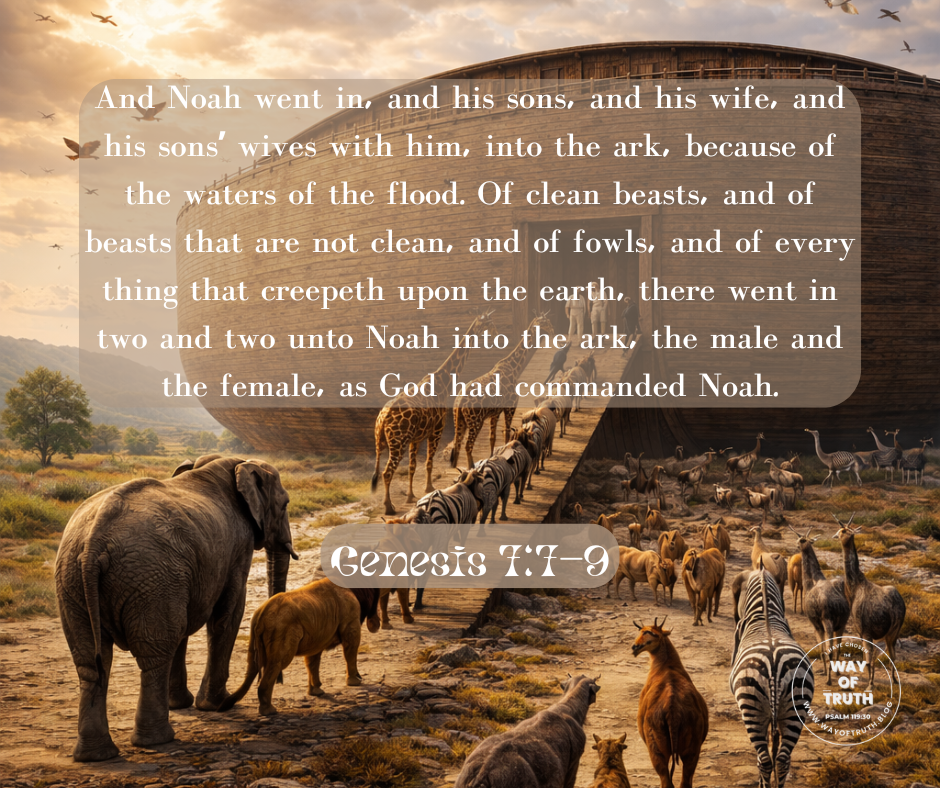
“And Noah went in, and his sons, and his wife, and his sons’ wives with him, into the ark, because of the waters of the flood. Of clean beasts, and of beasts that are not clean, and of fowls, and of every thing that creepeth upon the earth, there went in two and two unto Noah into the ark, the male and the female, as God had commanded Noah” (Genesis 7:7-9).
I. The Threshold of Judgment and the Doorway of Mercy
Genesis 7:7–9 stands at the decisive threshold between divine warning and divine action. The long-announced judgment of the Flood is no longer theoretical; it is imminent. These verses narrate the moment when obedience gives way to embodiment, when faith becomes movement, and when God’s word proves to be not only true but urgent. The passage functions literarily as a hinge, closing the era of divine patience described in Genesis 6 and opening the era of divine judgment and preservation.
Within the broader Genesis narrative, this scene represents a reversal of Eden. Whereas Adam and Eve were expelled from God’s sanctuary because of sin, Noah and his household are invited into a God-appointed refuge because of faith expressed in obedience (cf. Genesis 6:22). The ark itself functions as a liminal space—both coffin and cradle, judgment and salvation—anticipating later biblical patterns in which God preserves a remnant through judgment rather than apart from it.
Historically and culturally, the language reflects ancient Near Eastern family solidarity. Salvation here is not individualistic but covenantal and household-oriented, consistent with the broader patriarchal structure of Genesis. Linguistically, the repeated emphasis on movement “into the ark” underscores intentionality and completion. Noah does not merely prepare; he enters. Faith, in biblical terms, is never static.
Redemptively, this moment anticipates later acts of deliverance through judgment, most fully realized in Christ, where salvation is likewise entered by trust in God’s provision rather than achieved by human ingenuity.
II. Obedience in Motion
Genesis 7:7–9 records not preparation but execution. The ark has been built, provisions gathered, and instructions given. What remains is the decisive act of obedience at the boundary between warning and fulfillment. The narrative slows here, carefully describing who enters, what enters, how they enter, and why. The text is intentionally repetitive and orderly, underscoring that nothing about salvation in this moment is accidental, improvised, or emotionally driven. These verses emphasize movement in response to God’s spoken word, portraying obedience not as abstract belief but as concrete alignment with divine command. The passage also reinforces God’s sovereignty over human history and the natural world at the very moment when judgment is about to fall.
A. Faith Made Visible
The verse opens with decisive action: “And Noah went in.” The Hebrew verb translated “went in” conveys intentional movement toward a defined destination. This is not flight or panic; it is obedience rooted in trust. Noah enters the ark not because the rain has begun, but “because of the waters of the flood,” that is, because God has declared what is coming. The motivation is faith in God’s word rather than reaction to visible threat. The text highlights obedience that precedes empirical confirmation, a recurring biblical pattern (cf. Abraham departing before knowing the destination).
The inclusion of Noah’s entire household reflects the covenantal structure of divine dealings in Genesis. God’s saving purposes regularly operate through families without collapsing individual responsibility. The text does not suggest coercion or automatic salvation but presents a unified household responding to the same divine warning. The repetition of relational identifiers—sons, wife, sons’ wives—emphasizes completeness and order rather than sentiment. Salvation here is not private or mystical; it is embodied, communal, and visible.
The phrase “with him” subtly reinforces Noah’s representative role. He stands as covenant head, yet his obedience does not negate the participation of others. Each member enters the ark personally, but none enter independently. This anticipates later biblical patterns where covenant heads act representatively while still calling for individual faithfulness.
Theologically, the verse underscores that obedience is not merely believing God will judge, but ordering one’s life in light of that judgment. Noah’s entry marks the final separation between those who heed God’s word and those who disregard it. Once this step is taken, the narrative moves inexorably toward fulfillment.
B. Creation Preserved in Moral Order
Verse 8 functions as a descriptive expansion, reinforcing that the Flood does not erase God’s created distinctions. The explicit reference to clean and unclean animals is particularly significant. This distinction predates the Mosaic Law and therefore cannot be reduced to later priestly categories. Instead, it reflects a moral and functional order embedded in creation itself, likely connected to sacrificial suitability and human interaction rather than dietary regulation alone.
The verse’s cataloging structure echoes Genesis 1, intentionally invoking creation language. Beasts, birds, and creeping things recall the original ordering of life, suggesting that the Flood is not a collapse into chaos but a controlled, judicial unmaking that still honors God’s creational design. Judgment does not negate order; it exposes the seriousness of violating it.
The presence of both clean and unclean animals also anticipates post-Flood worship (Genesis 8:20). God’s provision for sacrifice is already embedded in His preservation plan. The ark is not merely a biological vessel but a theological one, carrying forward the means by which humanity will continue to approach God after judgment.
Grammatically, the verse lacks a finite verb, functioning almost as a heading or inventory list. This stylistic feature slows the narrative and invites reflection. The text wants the reader to see the scope and intentionality of preservation. Nothing essential to God’s purposes is omitted.
Importantly, the verse resists any reading of the Flood as indiscriminate destruction. God distinguishes even as He judges. Preservation is selective, purposeful, and aligned with future redemptive intentions. The ark safeguards not only life in general but the ordered life God intends to sustain beyond the Flood.
C. Divine Command Executed
Verse 9 draws the section to a theological conclusion by emphasizing divine command as the controlling force behind every movement. The phrase “two and two” highlights precision and sufficiency. God preserves life not through excess or spectacle but through exactly what is required to sustain future generations. The pairing of male and female reaffirms the creational design of Genesis 1:26-27 and 1:28, anchoring post-Flood continuity in God’s original purposes for fruitfulness and multiplication.
The animals come “unto Noah,” not Noah to them. This detail subtly underscores divine sovereignty over creation. Noah does not hunt, herd, or coerce. The animals’ movement reflects God’s unseen governance, aligning natural behavior with redemptive intent. Creation itself cooperates with the Creator’s word.
The concluding clause—“as God had commanded Noah”—serves as a narrative refrain that has appeared repeatedly since Genesis 6:22. Its repetition is intentional. The text insists that nothing about the ark episode can be attributed to human ingenuity or coincidence. Noah’s righteousness is expressed not through innovation but through submission. He does not improve upon God’s plan, reinterpret it, or delay it.
This verse also reinforces a biblical principle often overlooked: obedience is measured by conformity to God’s word, not by perceived outcomes. Noah’s task is fidelity, not success as defined by human standards. The results belong entirely to God.
Literarily, verse 9 closes the preparatory phase of the Flood narrative. All is in place. The door is about to be shut. From this point forward, events unfold according to divine timing, underscoring that the moment of decision has passed and the consequences of response—or refusal—are now fixed.
III. The Coherence, Authority, and Historicity of Genesis 7:7–9
Genesis 7:7–9 does not present itself as theological poetry or symbolic myth, but as sober historical narrative shaped by theological purpose. Its restrained tone, repetitive structure, and emphasis on obedience, order, and command invite careful apologetic reflection. These verses quietly but firmly answer a range of modern objections, from claims of mythological borrowing, to accusations of moral incoherence, to dismissals based on naturalism. Rather than functioning as a proof-text, the passage defends itself through internal coherence, canonical consistency, and alignment with the broader biblical worldview.
A. The Textual Marks of Intentional History
A common skeptical claim is that the Flood account belongs to the genre of ancient myth rather than historical narrative, often compared to Mesopotamian flood stories such as the Epic of Gilgamesh. Genesis 7:7–9, however, exhibits literary features that sharply distinguish it from mythic storytelling. Myths typically emphasize heroic embellishment, divine conflict, and symbolic abstraction. By contrast, this passage is marked by repetition, procedural detail, and an almost understated prose style.
The text focuses on mundane realities: family members entering a structure, animals categorized and counted, and actions taken “as God had commanded.” There is no dramatic dialogue, no cosmic battle among deities, and no attempt to glorify Noah as a legendary hero. The narrative instead emphasizes obedience and order. Such features align with Hebrew historical prose rather than mythological epic.
Additionally, the repetition of phrases like “went in,” “into the ark,” and “as God had commanded Noah” functions as legal-style verification rather than narrative flourish. The author appears more concerned with establishing that events occurred in precise conformity to divine instruction than with crafting an imaginative story. This restraint is difficult to reconcile with the claim that the passage arose from mythic imagination.
Comparisons to ancient Near Eastern flood traditions actually strengthen the biblical case. Shared memory of a catastrophic flood is plausible in a postdiluvian world, but Genesis stands apart by presenting a morally coherent God who judges sin, preserves life intentionally, and acts without caprice. The text’s historical posture is not undermined by parallels; it is clarified by contrast.
B. Clean and Unclean Before Moses?
One frequent critical objection targets the mention of clean and unclean animals, arguing that such distinctions must reflect later Mosaic or priestly redaction rather than early tradition. Genesis 7:8–9 is often cited as evidence of anachronism. However, this objection rests on an unwarranted assumption: that moral or ritual distinctions cannot precede codified law.
The text itself offers no hint that these categories are newly invented or controversial. They are treated as established realities, assumed rather than explained. This strongly suggests that the distinction is rooted in divine revelation prior to Sinai, consistent with later biblical testimony that God’s moral order precedes formal legislation. Law does not create moral reality; it codifies it.
Furthermore, the presence of clean animals is narratively necessary. Genesis 8:20 records Noah offering sacrifices after the Flood. Without a prior distinction, such worship would be incoherent. The text demonstrates theological foresight rather than editorial confusion. God’s preservation plan already anticipates post-Flood worship, reinforcing the unity and intentionality of the narrative.
Source-critical attempts to fragment the text often rely on stylistic variation as proof of multiple authors. Yet repetition and categorization are common features of Hebrew narrative emphasis. Rather than signaling clumsy editing, they underscore theological precision. The passage reads not like stitched tradition but like deliberate composition, reflecting a worldview in which God’s commands are orderly, consistent, and authoritative across generations.
C. Is the Flood Ethically Defensible?
Another major polemical challenge questions the morality of divine judgment itself. Critics argue that the Flood portrays God as excessively violent or unjust. Genesis 7:7–9 directly undermines this caricature by highlighting provision before punishment. The ark stands open before the rain begins. Obedience is invited, not coerced, and judgment is neither impulsive nor unexplained.
The text frames entry into the ark as a response to divine warning, not sudden catastrophe. This reflects a consistent biblical pattern: God reveals His intentions, provides a means of escape, and then acts decisively. Judgment in Scripture is judicial, not arbitrary. Genesis 7:7–9 emphasizes this by grounding action in prior command.
Moreover, the passage stresses preservation alongside judgment. God safeguards human and animal life, maintaining creation’s order even as He restrains wickedness. This balance reveals a moral coherence absent from pagan flood myths, where destruction often stems from divine irritation or overpopulation. Here, judgment serves righteousness, and mercy tempers wrath.
The objection often arises from a modern assumption that human moral intuition stands in judgment over divine action. Scripture reverses that hierarchy. Genesis presents God as the standard of justice, not subject to it. Far from depicting cruelty, the passage portrays a God who patiently warns, carefully preserves, and acts in accordance with His holy character.
D. Naturalism and the Problem of Order
A final apologetic challenge emerges from philosophical naturalism, which seeks to explain the passage entirely in terms of natural processes or dismiss it as impossible. Genesis 7:9 confronts this worldview directly through its emphasis on order and command. Animals enter “two and two,” “male and female,” and do so “unto Noah.” The narrative attributes coordination not to instinct alone but to divine orchestration.
Naturalism struggles to account for purposeful convergence without invoking teleology. The text unapologetically affirms that God governs creation in ways that transcend purely mechanistic explanation. This is not a God-of-the-gaps argument but a worldview assertion: creation responds to its Creator.
Attempts to reinterpret the passage as local flood tradition or symbolic theology falter on the text’s insistence on specificity. Numbers, categories, and commands dominate the narrative. Symbolism does not require such precision. Theology does not demand logistical detail unless it is rooted in real events.
Genesis 7:7–9 ultimately exposes the philosophical commitments behind many objections. The resistance is not merely to the Flood but to the God who speaks, commands, and is obeyed. The text stands as a quiet rebuke to any worldview that denies divine authority, reminding the reader that Scripture does not ask to be revised to fit modern assumptions. It calls modern assumptions into question.
IV. Walking into God’s Word
Genesis 7:7–9 presses Scripture out of the realm of distant history and into lived discipleship. The text does not merely recount who entered the ark; it confronts readers with how obedience actually functions when God’s word demands movement, trust, and separation from the surrounding world. These verses speak powerfully to personal faith, congregational identity, and the Church’s mission in an age that often treats divine warning as implausible and obedience as optional. Application here must remain tethered to the passage itself: obedience before sight, faith expressed in action, and salvation entered, not admired from a distance.
A. Obedience Before Evidence
Genesis 7:7 emphasizes that Noah entered the ark because of the coming flood, not because he could see it. This is obedience grounded in revelation rather than confirmation. For believers today, this challenges a deeply ingrained instinct to wait until God’s word is validated by circumstances before acting upon it. Scripture consistently reverses that logic. Faith responds to God’s voice, not to visible outcomes.
Devotionally, this passage calls believers to examine areas of delayed obedience. It is entirely possible to affirm God’s truth intellectually while postponing submission practically. Noah had already believed God enough to build the ark, but the decisive test came when he stepped inside it. In the same way, believers may assent to biblical teaching while hesitating to align their lives fully with it, whether in matters of repentance, reconciliation, generosity, or vocational faithfulness.
The text also reminds us that obedience often appears unreasonable to those outside the covenant. Entering a massive vessel under clear skies would have seemed absurd to Noah’s contemporaries. Faithful obedience frequently invites misunderstanding or mockery, yet Scripture presents such moments as spiritually decisive rather than socially embarrassing.
Pastorally, this calls the Church to cultivate a theology of trust that does not depend on immediate results. God’s people must learn to obey even when obedience feels premature, costly, or lonely. Genesis 7:7 affirms that obedience before evidence is not recklessness; it is reverent trust in a faithful God.
B. Moving from Preparation to Participation
A striking feature of Genesis 7:7–9 is its emphasis on entry. The ark had been constructed, stocked, and ready for some time. Yet none of that would have mattered if Noah and his household had remained outside. Preparation, however extensive, is not the same as participation. Salvation required stepping into God’s provision.
This distinction carries profound devotional weight. Many people stand near the means of grace without fully embracing them. One can admire biblical truth, respect Christian morality, and even prepare religiously while remaining functionally outside obedience. Genesis 7 reminds us that proximity to salvation is not salvation itself.
For believers, this challenges the temptation toward spiritual inertia. Growth in Christ requires movement: repentance enacted, faith exercised, and obedience embodied. The Christian life is not sustained by past acts of faith but by continual submission to God’s word. Noah’s obedience did not end with the ark’s completion; it culminated in entering it.
The Church must resist reducing discipleship to instruction alone. Teaching is essential, but Scripture demands response. Churches faithful to Genesis 7 will not only explain God’s word but call people to step into it, even when that step involves separation from prevailing cultural norms.
The ark did not save by symbolism but by shelter. Likewise, Christ does not save as an idea but as a living refuge entered by faith. Genesis 7:7–9 presses the reader to ask not merely, “Do I believe this is true?” but “Have I acted upon what I believe?”
C. A People Set Apart Together
Genesis 7:7 highlights that Noah entered the ark with his household. Salvation in this passage is not isolated or individualistic. God preserves a people, not merely a person. This has important implications for how believers understand community, family discipleship, and ecclesial responsibility.
The text affirms that faith is often sustained and strengthened within covenant relationships. Noah does not enter alone, nor does his household scatter in separate directions. They move together in obedience. This underscores the biblical pattern in which families and communities are shaped collectively by God’s word, even while personal responsibility remains intact.
For the Church, this passage reinforces the importance of shared obedience. Congregations are not merely gatherings of autonomous believers but covenant communities called to walk together in faithfulness. When churches hesitate to obey Scripture—whether due to cultural pressure, fear of offense, or desire for relevance—they place the entire community at risk of spiritual drift.
Devotionally, the passage encourages believers to consider how their obedience affects others. Noah’s faithfulness had generational consequences. Likewise, parents, leaders, and mature believers are called to model obedience that invites others into faithful response.
The ark stands as a reminder that God often works through ordered, visible communities that bear witness to His truth. In a world marked by fragmentation and individualism, Genesis 7:7–9 calls the Church to embody a countercultural unity rooted in shared submission to God’s commands. Faith is personal, but it is never meant to be solitary.
V. Entering the Greater Ark
Genesis 7:7–9 is a living witness to the way God saves. The passage presents salvation as something God provides, commands, and invites sinners to enter by faith. The ark does not save because of Noah’s craftsmanship, but because it is God’s appointed refuge from judgment. In the same way, the gospel does not call us to construct our own deliverance, but to trust, enter, and rest in the salvation God has already prepared in Jesus Christ. These verses quietly but powerfully proclaim the shape of the gospel: judgment is real, mercy is offered, and salvation must be personally embraced before the door is closed.
A. The Reality of Judgment and the Mercy of Advance Warning
If you have never trusted in Jesus Christ as your Lord and Savior, Genesis 7:7–9 begins by confronting you with a truth our age often avoids: judgment is real, and God does not conceal it from humanity. The Flood did not arrive without warning. God spoke, explained, and provided a way of escape long before the rain began to fall. The problem was not a lack of information but a lack of response.
Scripture consistently teaches that humanity stands under judgment because of sin. Sin is not merely wrongdoing but rebellion against the Creator’s authority, a refusal to trust and obey His word. Just as the world of Noah’s day continued its routines while judgment approached, many today live as though God’s warnings are symbolic or irrelevant. Yet Genesis reminds us that divine patience is purposeful, not permissive.
The mercy of God is evident in the timing. Noah entered the ark before the floodwaters came. Likewise, God now warns the world through the gospel before final judgment arrives. The message of Christ crucified and risen is not a threat but an invitation. God announces judgment so that sinners may flee from it.
The gospel declares that judgment has already been acknowledged and addressed at the cross. Jesus Christ bore God’s righteous judgment against sin in the place of sinners. To ignore that provision is not neutrality; it is refusal. Genesis 7 teaches that the greatest tragedy is not judgment itself but neglecting the mercy that precedes it.
B. Christ the True Ark
Genesis 7:7–9 proclaims a salvation that is entered, not earned. Noah did not design the ark, redefine its purpose, or improve its structure. He trusted God’s provision and stepped inside. That pattern finds its fulfillment in Jesus Christ, who stands as the true and greater Ark.
The ark bore the full force of judgment while those inside were kept safe. In the same way, Christ endured the judgment our sins deserved. On the cross, God’s justice and mercy met. Jesus did not merely offer moral instruction or spiritual inspiration; He absorbed the wrath of God against sin so that sinners might be spared. His resurrection declares that judgment has been satisfied and death defeated.
The gospel therefore does not ask, “Have you tried hard enough?” but “Have you entered?” Salvation is not achieved through religious effort, moral improvement, or delayed intention. It is received through repentance and faith: turning from sin and trusting fully in Christ alone.
Genesis reminds us that standing near the ark was not enough. Knowing its dimensions did not save. Admiring its construction did not protect. Only those who entered were preserved. Likewise, knowing about Jesus is not the same as trusting Him. The gospel calls you to step out of self-reliance and into Christ, resting entirely in His finished work.
C. The Open Door and the Call to Respond
If you sense the weight of this passage, that is not accidental. Genesis 7:7–9 carries a quiet urgency. The door of the ark was open for a time, but it did not remain open forever. Scripture later tells us that God Himself shut the door. That sobering detail underscores a gospel truth repeated throughout the Bible: the invitation to salvation is gracious, but it is not indefinite.
Today, the door of grace stands open in Christ. God calls sinners to repent, believe, and be reconciled to Him. The promise is clear: forgiveness of sins, new life through the Spirit, and eternal fellowship with God. This invitation is not extended because humanity deserves it, but because God is merciful.
The gospel does not demand perfection before entry. Noah’s family entered the ark as they were, trusting God to carry them through what lay ahead. In the same way, Christ does not call you to fix yourself before coming to Him. He calls you to come, to trust, and to live under His lordship.
If God is stirring your heart, do not delay. Faith is not postponed obedience. Repent of sin, place your trust in Jesus Christ, and step into the salvation God has provided. As Genesis 7 reminds us, there is safety inside God’s refuge and only there. Enter today and live henceforth for the glory of the God who saves.