
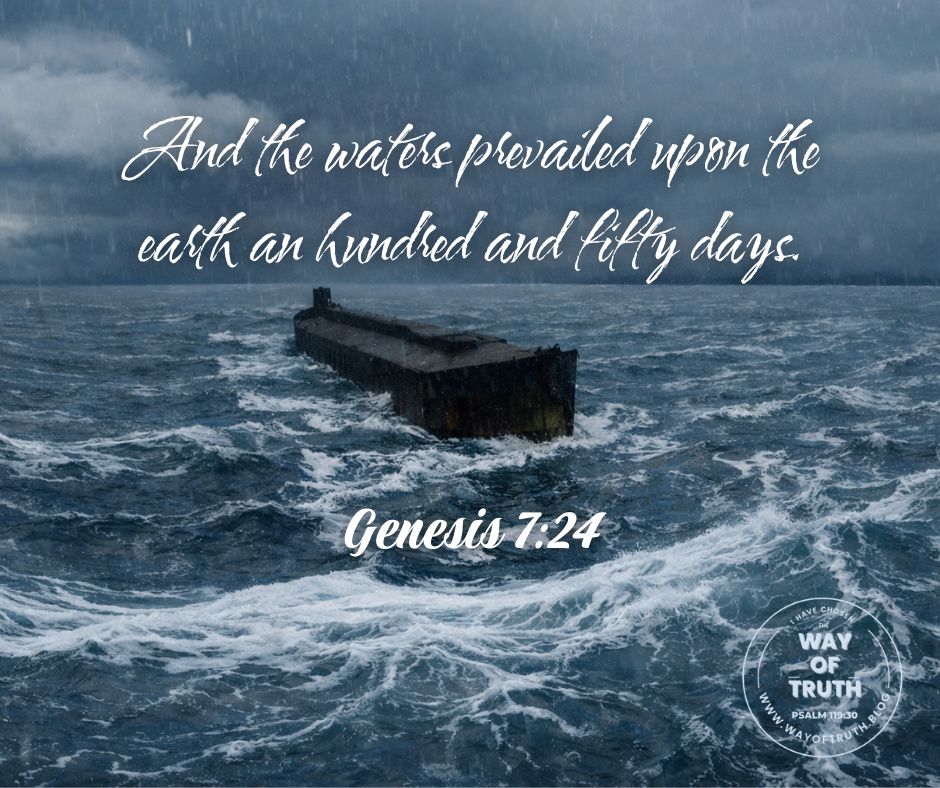
“And the waters prevailed upon the earth an hundred and fifty days” (Genesis 7:24).
I. Introduction
Genesis 7:24 stands as a brief but weighty summary statement at the close of the Flood’s initial phase. Though composed of only a single verse, it performs an important literary and theological function within the Flood narrative (Genesis 6–9). It does not merely restate that the waters were present; it specifies duration. Judgment is not described as momentary chaos or uncontrolled devastation but as a sustained, divinely governed period lasting one hundred and fifty days.
Within the broader structure of Genesis, this verse marks the conclusion of the “prevailing waters” section and prepares the reader for the transition toward divine remembrance and reversal in Genesis 8:1. In this verse, judgment has reached its full extent, neither abbreviated nor excessive, but precisely timed according to God’s decree.
In redemptive history, the Flood functions as a paradigmatic act of judgment—historical, global, and moral—while also establishing patterns that later Scripture will echo: patience before judgment, completeness in judgment, and mercy that follows judgment for those preserved by God’s provision. Genesis 7:24 emphasizes that even God’s wrath operates within measured bounds. Time itself is shown to be an instrument of divine governance.
II. The Persistence, Precision, and Purpose of Divine Judgment
Genesis 7:24 is deceptively simple. With a single sentence, the narrator brings the Flood’s destructive phase to its full and sobering conclusion. Yet the verse is not a mere narrative footnote. It functions as a theological summary, a chronological anchor, and a literary pause before the movement toward reversal and restoration in Genesis 8. The verse demands careful attention because it reveals how God judges, not only that He does. Its language emphasizes duration, restraint, and sovereign control, all expressed through measured time rather than emotional intensity or descriptive excess.
A. Sustained Dominion, Not Chaotic Force
The opening clause, “And the waters prevailed,” draws on a Hebrew verb consistently used in the Flood narrative to describe dominance, strength, and overcoming power. Earlier occurrences in chapter 7 emphasize the waters’ vertical superiority, rising above the mountains and submerging all land. Here, however, the emphasis subtly shifts. The waters do not merely prevail in height or scope but in continuance. Their dominance endures.
This distinction is significant. The text does not describe a momentary cataclysm or a brief surge of destruction. Instead, it presents judgment as something that remains in effect. The waters prevail not because they’re uncontrollable, but because they’re permitted—indeed commanded—to do so. The grammar offers no hint of instability or randomness. The verb form conveys steady action rather than violent fluctuation.
This sustained prevailing also reinforces divine intentionality. In ancient Near Eastern flood stories, water often represents chaos overpowering the gods themselves. Genesis presents the opposite picture. The waters are powerful, but not autonomous. They prevail because God wills them to prevail. Their strength is derivative, not inherent. Even at the height of judgment, creation remains under the authority of its Creator.
Theologically, this clause resists sentimental readings of divine judgment. God’s response to human wickedness is not impulsive, symbolic, or merely illustrative. It is real, forceful, and sustained. Yet it is also deliberate, governed, and purposeful. Judgment, in Scripture, is not a loss of control, but the exercise of it.
B. Total Scope Without Hyperbole
The phrase “upon the earth” reinforces the comprehensive nature of the Flood’s judgment while maintaining the restrained tone that characterizes the biblical account. The Hebrew term can, in some contexts, refer to a land or region. However, within the immediate and broader context of Genesis 6–7, its meaning is unambiguous. The earth described here is the same earth that was filled with violence (Genesis 6:11-12), the same earth from which all flesh was to be destroyed (Genesis 6:13), and the same earth whose highest mountains were covered (Genesis 7:19-20).
What is striking is the absence of rhetorical exaggeration. The narrator does not embellish the devastation with graphic imagery or emotional language. Instead, universality is communicated through calm repetition and comprehensive scope. Everything that breathes has already been described as perishing. Now the earth itself remains submerged under prevailing waters.
This restraint is itself exegetically important. The text is not trying to persuade the reader through drama. It assumes the reality of the event and focuses on its meaning. The earth is entirely subjected, not as an object of divine hostility, but as the theater in which moral judgment is enacted. Creation suffers because humanity has corrupted its vocation within creation.
At the same time, the phrase subtly preserves the goodness of the created order. The earth is not annihilated or abandoned. It is temporarily overwhelmed, awaiting divine reversal. The text leaves room for renewal by refusing to portray the earth as disposable. Judgment affects the earth, but it is not God’s final word concerning it.
C. Measured Judgment and Narrative Precision
The specification of “an hundred and fifty days” introduces one of the most important features of the Flood account: chronological precision. Biblical judgment is not vague or mythic in its presentation. It unfolds within measured time. This duration corresponds with other temporal markers in the narrative, forming a coherent timeline that spans from the onset of rain (Genesis 7:11) to the beginning of the waters’ retreat (Genesis 8:3).
This precision serves several purposes. First, it underscores historicity. Time is counted because the event is understood as real history, not symbolic drama. Second, it demonstrates divine restraint. Judgment lasts exactly as long as God has determined, no longer and no shorter. Third, it prepares for transition. The reader senses that a turning point is coming, even though it has not yet arrived.
Importantly, the length of time also shapes the experience of those preserved in the ark. Deliverance is real, but not immediate. God’s salvation often involves prolonged dependence rather than instant resolution. The text does not explore Noah’s emotional state, but the duration invites reflection on faith sustained in waiting.
From a narrative standpoint, the 150 days form the apex of judgment. After this point, the verbs will change. Prevailing will give way to diminishing. Covering will give way to uncovering. The exactness of the number reinforces that this shift is not accidental but divinely timed.
D. Judgment with an Appointed End
Although Genesis 7:24 contains no explicit statement of mercy, it implicitly testifies to it. The waters prevail, but they do not prevail endlessly. The verse marks completion, not finality. It closes one movement of the narrative while making space for the next. Judgment has done its work.
This is a crucial observation. Scripture consistently portrays divine judgment as purposeful and bounded. Even in its most severe forms, it is never portrayed as arbitrary or infinite in duration. Genesis 7:24 fits this broader biblical pattern. God judges thoroughly, but He does not abandon His redemptive intentions.
The verse therefore functions as a theological pause. Everything that was corrupt has been addressed. Everything that was preserved remains secure. The stage is set, not yet for celebration, but for remembrance. When Genesis 8 opens with “And God remembered Noah,” that remembrance does not arise in opposition to judgment but as its rightful successor.
In this way, Genesis 7:24 teaches that judgment, rightly understood, is not the opposite of faithfulness. It is one of its expressions. God remains faithful to His holiness, His word, and His purposes for creation, even when that faithfulness requires sustained and sobering judgment.
III. Duration, History, and Divine Control
Genesis 7:24 directly confronts modern skepticism regarding the historicity of the Flood. Critics often argue that the Flood account borrows from ancient mythological traditions and lacks historical grounding. Yet the precise chronological framework of Genesis sharply distinguishes it from mythic parallels such as the Epic of Gilgamesh. Myth traffics in archetypal time; Genesis records measured history.
Additionally, some have attempted to reinterpret the Flood as a localized or symbolic event to accommodate modern geological assumptions. However, the language of prevailing waters “upon the earth” for a sustained period resists such reduction. A local flood does not require 150 days of prevailing waters, nor does it coherently account for the narrative’s internal chronology. The text’s own logic argues for a judgment of global scope and extraordinary magnitude.
Genesis 7:24 also counters modern conceptions of divine passivity. God is not reacting helplessly to runaway natural forces. The duration of the Flood demonstrates intentional restraint and authority. Even chaos obeys Him. The waters prevail only as long as He wills, and no longer.
This verse also addresses moral objections that portray divine judgment as impulsive or excessive. The Flood follows centuries of patience (Genesis 6:3), extensive warning through Noah’s obedience, and a carefully bounded execution. Judgment unfolds under moral necessity, not divine caprice.
IV. Waiting While the Waters Prevail
Genesis 7:24 forces us to reckon not only with the fact of divine judgment, but with its duration. The waters prevailed for a defined season, long enough to accomplish God’s purpose, yet not beyond His intent. This measured span of time invites reflection on how God works through extended seasons that test patience, shape obedience, and expose what we trust when outcomes are delayed. The verse speaks to the life of faith lived between promise and fulfillment.
A. Trusting God When the Season Does Not Quickly Change
One of the most challenging aspects of Genesis 7:24 is not the judgment itself, but its length. One hundred and fifty days is a long time to remain enclosed, uncertain, and waiting. For Noah and those with him, deliverance had already begun—they were safe—but resolution had not yet arrived. The waters prevailing meant survival without visibility, protection without progress.
This speaks to a common experience in the life of faith. There are seasons when obedience has been rendered, danger has been averted, and yet circumstances remain unchanged. Scripture does not suggest that faith always produces immediate relief. Sometimes faith means trusting God while nothing outwardly improves.
Genesis 7:24 teaches that prolonged seasons are not signs of divine neglect. God was no less sovereign on the hundredth day than on the first. The same hand that shut the door of the ark governed the passing days within it. Waiting, in biblical terms, is not wasted time. It is time under God’s care.
This challenges the instinct to measure God’s faithfulness by speed. Faith learns to rest not in how quickly God acts, but in how surely He does. The verse encourages us to remain steady, obedient, and prayerful even when circumstances feel suspended. God’s purposes are not stalled simply because they’re not yet visible.
B. Learning Humility Under God’s Timetable
Genesis 7:24 confronts modern impatience. We’re conditioned to expect swift outcomes, immediate clarity, and constant movement. Yet Scripture often reveals God working through extended processes that resist human urgency. The Flood did not resolve overnight. Judgment unfolded slowly, thoroughly, and without apology.
This teaches humility. God does not consult human expectations when executing His purposes. The duration of the waters reminds us that God is not hurried, nor is He inefficient. He acts in ways that fully address the problem at hand. In this case, the moral corruption of humanity required not a symbolic gesture, but a complete and sustained response.
Humility grows when believers accept that God’s timing is wiser than their own. Genesis 7:24 invites us to surrender the demand for control. Noah could not shorten the days, alter the conditions, or hasten the outcome. His calling was endurance, not intervention.
For the life of the church, this encourages patience in ministry, faithfulness in prayer, and perseverance in obedience even when fruit is slow to appear. God’s work often unfolds beneath the surface long before it becomes visible. The prevailing waters remind us that unseen processes may still be purposeful ones.
C. Bearing Witness to a God Who Judges Carefully, Not Carelessly
In a culture uncomfortable with the idea of judgment, Genesis 7:24 offers an important corrective. God’s judgment is not reckless or indiscriminate. It is measured, intentional, and bounded. The waters prevailed for exactly as long as God decreed, no more, no less.
This matters for how we speak about God. The church is called to bear witness to the whole counsel of Scripture, including the reality of judgment, without misrepresenting God’s character. Genesis 7:24 shows that divine judgment is not the opposite of wisdom or patience. It’s an expression of them.
This shapes how Christians engage a skeptical world. Rather than presenting judgment as arbitrary or vindictive, Scripture presents it as morally necessary and carefully administered. God responds proportionately to human corruption. He acts decisively, but not impulsively.
For the community of faith, this fosters reverence rather than fearmongering. It encourages sober reflection rather than sensationalism. The church honors God not by softening His holiness, but by speaking truthfully about it with humility and restraint. Genesis 7:24 helps believers hold that balance.
D. Living with Hope
Although Genesis 7:24 describes the height of judgment, it does not end the story. The waters prevail, but they do not reign forever. The verse stands at the edge of transition, even if that transition is not yet named. God’s purposes are moving forward, even when the scene appears static.
This offers hope for believers facing long seasons of difficulty, discipline, or uncertainty. Scripture consistently teaches that God’s judgments are purposeful and temporary, while His mercy endures. Genesis 7:24 prepares the reader to receive Genesis 8:1 without diminishing the seriousness of what came before.
For the church, this encourages steady hope grounded in God’s character rather than circumstances. Faith does not deny hardship, but it refuses to believe hardship has the final word. God’s redemptive work often begins quietly, long before visible change occurs.
The verse therefore calls us to live attentively and to remain faithful in the middle of the story, not only at its resolution. God is at work even when progress feels slow. The waters may prevail for a time, but they will not prevail forever.
V. From Prevailing Waters to Saving Promise
Genesis 7:24 confronts us with a sobering reality: judgment is not theoretical, symbolic, or fleeting. The waters prevailed, and they did so for a defined season under God’s authority. Yet the same verse that emphasizes the endurance of judgment also invites reflection on something deeper: God’s purpose in judging, and His provision of salvation in the midst of it. The gospel does not soften the seriousness of judgment; it answers it. In the Flood narrative, salvation is not found by escaping judgment, but by entering the refuge God provides. That pattern reaches its fulfillment in Jesus Christ.
A. The Gospel Begins with the Reality We’d Rather Avoid
If you don’t already know Jesus Christ as your Lord and Savior, Genesis 7:24 speaks honestly about a truth many would rather ignore: God’s judgment is real, sustained, and unavoidable apart from His provision. The waters didn’t simply appear and disappear. They prevailed. Scripture doesn’t present judgment as a scare tactic, but as a moral necessity grounded in God’s holiness.
The gospel cannot be understood apart from this reality. Human sin is not a minor flaw or a temporary lapse; it’s rebellion against a holy Creator. The Flood narrative reminds us that God does not overlook corruption indefinitely. Judgment may be delayed, but it is never denied. That’s not cruelty. It’s justice.
Many people struggle with the idea of divine judgment because they imagine it as uncontrolled anger. Genesis 7:24 shows something very different. Judgment unfolds under God’s command, within God’s timing, and according to God’s purpose. The problem, then, is not that God judges, but that we stand guilty before Him.
The gospel begins by telling the truth about our condition. We are not merely misunderstood or spiritually unfinished; we are sinners in need of rescue. Until that truth is faced, grace will always seem unnecessary. But once judgment is taken seriously, grace becomes not offensive, but precious.
B. God’s Provision Always Accompanies His Judgment
Genesis 7:24 describes prevailing waters, but it does not describe prevailing despair. Long before the waters rose, God provided an ark. Judgment came, but salvation was already in place. This is not an incidental detail. It reveals the heart of God.
The same God who judged the world also invited Noah to enter a place of safety. Salvation was not earned by climbing above the waters or enduring them longer than others. It was received by trusting God’s word and entering the refuge He provided.
This points directly to the gospel of Jesus Christ. God has not left humanity to navigate judgment on its own. He has provided a Savior. Jesus Christ is not a moral example meant to inspire improvement; He is a refuge meant to save sinners. At the cross, judgment did not merely threaten. It fell. And it fell upon Him.
Christ endured the full weight of God’s righteous judgment against sin so that those who trust in Him would not have to. Salvation is not found in denial, comparison, or effort. It’s found in God’s provision, received by faith.
As God took the initiative to save in the days of Noah, He has taken the initiative again in sending His Son. Judgment is real, but so is grace.
C. The Call Is Not to Admire the Ark, but to Enter It
One of the quiet dangers in reading accounts like the Flood is remaining at a distance. It’s possible to acknowledge judgment, admire God’s provision, and still remain outside the place of safety. Noah’s contemporaries were not condemned for failing to understand the ark; they were condemned for refusing to enter it.
The gospel makes the same demand. Jesus Christ is not merely to be studied, respected, or appreciated. He is to be trusted. Salvation is personal. It involves repentance—turning away from sin—and faith—placing trust in Christ alone for forgiveness and life.
Genesis 7:24 reminds us that time is real and limited. The waters prevailed for a season, and then the door of the ark remained shut. Scripture consistently warns against presuming upon time. God is patient, but patience is not permission.
If you sense the weight of this truth, don’t dismiss it. Conviction is not condemnation. It’s an invitation. God calls sinners not to fix themselves, but to come to Him. The ark was not entered by strength, knowledge, or worthiness. It was entered by obedience to God’s word.
Christ extends the same call today.
D. A Gracious Invitation to Trust in Christ Today
Genesis 7:24 invites you to consider where you stand, not in comparison to others, but before God Himself. Judgment isn’t hypothetical, and neither is salvation.
Jesus Christ lived the sinless life we couldn’t live, died the atoning death we deserved, and rose again in victory over sin and death. He now offers forgiveness, reconciliation with God, and eternal life to all who repent and believe.
You don’t need to wait until you feel ready or worthy. You don’t need to clean yourself up before coming. God’s invitation is extended now, while the call still stands. The same God who measured the days of judgment has opened a way of salvation through His Son.
Turn from your sin. Trust in Christ. Enter the refuge God has provided. And live—not in fear of judgment—but in grateful obedience to the One who saves, keeps, and will one day make all things new.