
I. The Evidence Demands an Honest Verdict
A. A Familiar Illustration with a Serious Purpose
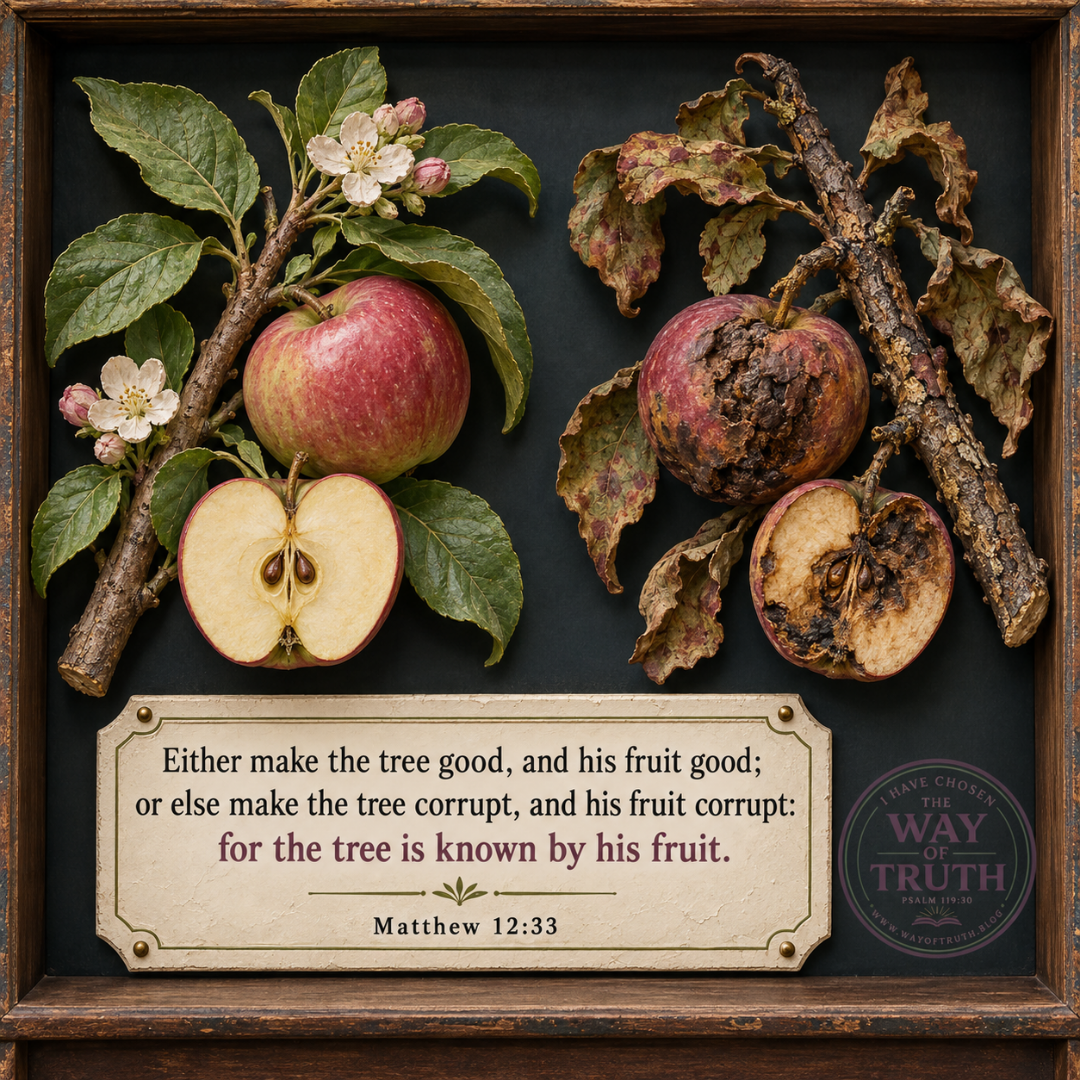
Jesus often used ordinary things to communicate profound spiritual truths. In Matthew 12:33, He draws upon the familiar relationship between a tree and its fruit to expose a contradiction in the reasoning of His opponents.
The illustration is straightforward. A healthy tree produces fruit consistent with its nature, while a corrupt tree produces fruit reflecting its condition. We don’t ordinarily expect delicious apples from a rotten apple tree. The fruit tells us something important about the tree that produced it.
Jesus had previously used this illustration in Matthew 7:15–20 to warn against false prophets. There, the emphasis was on recognizing false teachers by their fruits. Here, however, He applies the principle to the religious leaders’ judgment of His own ministry.
The immediate context is essential. In Matthew 12:22, Jesus healed a man who was possessed by a devil and could neither see nor speak. The miracle prompted the people to wonder whether Jesus was the promised Messiah. But rather than acknowledge the significance of what had happened, the Pharisees accused Him of casting out devils through the power of Beelzebub, the prince of the devils.
Jesus had already challenged their reasoning by explaining that Satan wouldn’t undermine his own kingdom. Now He presses the issue further. If His works demonstrate God’s goodness and authority, how can His opponents consistently attribute those works to Satan? The question exposes more than an intellectual inconsistency. It reveals their resistance to recognizing what God’s doing through His Son.
B. The Demand for Consistency
Jesus begins: “Either make the tree good, and his fruit good; or else make the tree corrupt, and his fruit corrupt.” The word make might initially suggest changing the nature of a tree. But in this context, Jesus is calling His opponents to make a consistent judgment about the tree and its fruit. They can’t reasonably acknowledge the goodness of His works while condemning their source as evil. If they insist that His power comes from Satan, they must explain why His ministry is delivering people from Satan’s oppression rather than advancing it. Jesus isn’t asking them to accept His claims without evidence. He’s challenging them to examine the evidence fairly.
Earlier, He identified the true source of His authority: “But if I cast out devils by the Spirit of God, then the kingdom of God is come unto you” (Matthew 12:28). His miracles demonstrated God’s kingdom advancing against the powers of darkness. They weren’t isolated displays of supernatural ability but expressions of divine authority, compassion, and deliverance.
The Pharisees’ accusation therefore required them to disregard the very character of the works they had witnessed. Their problem wasn’t that they lacked sufficient religious knowledge. It was that their hostility toward Jesus had distorted their judgment.
C. What the Fruit Reveals
Jesus concludes: “for the tree is known by his fruit.” Fruit doesn’t create the nature of the tree; it reveals its nature. Likewise, Jesus’ works provided visible evidence of His identity and authority. His healing of the oppressed, His teaching of righteousness, His fulfillment of Scripture, and His compassion toward sinners were consistent with His claim to act through the power of God.
However, this principle shouldn’t be reduced to the idea that every apparently beneficial result must come from God. Jesus Himself warns in Matthew 7:22–23 that impressive religious accomplishments don’t necessarily establish genuine faithfulness. Deuteronomy 13:1–3 likewise teaches that extraordinary signs can’t justify rejecting God’s revealed truth.
The biblical standard involves more than outward success. We must consider whether someone’s teaching, conduct, and influence agree with Scripture. Jesus’ works satisfied that standard because they were consistent with God’s character, promises, and purposes. His opponents weren’t being asked to ignore contrary evidence. They were being confronted with evidence they couldn’t adequately explain away.
II. When Judgment Reveals the Heart
A. The Problem Beneath the Accusation
Matthew 12:33 prepares us for Jesus’ statement in the following verse: “for out of the abundance of the heart the mouth speaketh” (Matthew 12:34). The Pharisees’ words revealed something deeply troubling about their spiritual condition. They possessed considerable knowledge of Scripture, held recognized religious authority, and maintained a reputation for devotion. Yet these advantages hadn’t produced a willingness to acknowledge the truth standing before them.
This reminds us that religious knowledge and spiritual integrity aren’t necessarily the same thing. A person may understand biblical terminology, defend theological positions, and speak confidently about righteousness while remaining unwilling to confront personal pride or prejudice.
Knowledge becomes particularly dangerous when it’s used to justify resistance to truth rather than encourage submission to it. The Pharisees were accustomed to evaluating others, but Jesus’ response revealed that their own judgments deserved examination. Their accusation exposed the condition of their hearts more clearly than it revealed anything about Him.
B. The Difference Between Discernment and Prejudice
The passage raises an important question: How can we distinguish genuine spiritual discernment from prejudice disguised as conviction? Genuine discernment seeks truth according to God’s Word and considers the available evidence honestly. Prejudice begins with a preferred conclusion and selectively interprets the evidence to support it.
Even sincere Christians can become attached to opinions that aren’t adequately supported by Scripture. We may dismiss a sound argument because it comes from someone we dislike. We may overlook misconduct because the person responsible belongs to our preferred group. Or we may demand evidence from our opponents while accepting weak explanations from our allies. Such inconsistency undermines our commitment to truth.
Of course, honest disagreement isn’t necessarily evidence of a hardened heart. Believers can misunderstand passages, evaluate circumstances differently, and reach mistaken conclusions without deliberately rejecting God’s revelation. The important question is whether we’re willing to reconsider our judgments when Scripture and reliable evidence challenge them. Spiritual discernment requires conviction, but it also requires humility.
C. Receiving Christ as He Reveals Himself
Jesus’ confrontation with the Pharisees points toward an even greater concern: our response to His identity and authority. The religious leaders could question His motives and reject His claims, but their opinions couldn’t change who He was. The same remains true today. Christ’s authority isn’t established by popular approval, personal preference, or religious consensus. It rests upon who He is as the Son of God.
This doesn’t mean Christians should discourage sincere questions or thoughtful examination. Scripture provides a foundation for reasoned faith, and misunderstandings should be addressed patiently. But there’s a difference between seeking to understand Christ and insisting that He conform to our expectations. We can’t faithfully receive His promises while treating His commands as optional whenever they challenge our preferences. Christian discipleship begins with recognizing Jesus as He reveals Himself in Scripture and responding to Him with repentance, faith, and obedience.
III. Living with Honest Eyes and Faithful Hearts
A. Examine Our Judgments Before Defending Them
Matthew 12:33 encourages us to evaluate our own reasoning before passing judgment on others. It’s easy to form an opinion and then interpret everything through that conclusion. Once we’ve decided someone is wrong, even their legitimate accomplishments may become difficult to acknowledge. As believers, we should resist this tendency.
Before criticizing someone’s motives, we ought to distinguish what we actually know from what we’re merely assuming. We should also be willing to recognize wrongdoing in people we admire rather than excusing it out of loyalty.
One useful question is: Would I reach the same conclusion if someone else had done exactly the same thing? The answer may reveal inconsistencies we hadn’t recognized. Christian integrity means applying standards fairly, acknowledging uncomfortable facts, and correcting our judgments when necessary.
B. Recognize Genuine Spiritual Fruit
The Church must also exercise discernment when evaluating ministries, teachers, and spiritual leadership. Popularity, financial success, impressive facilities, and large audiences don’t necessarily demonstrate God’s approval. Neither does obscurity or limited visible growth automatically indicate spiritual failure.
We need to look beyond appearances. Does the teaching faithfully represent Scripture? Does the ministry direct people toward Jesus Christ? Are honesty, humility, accountability, and genuine concern for others evident? These questions are more meaningful than outward measures of success.
At the same time, we should distinguish between a struggling believer who needs encouragement and someone who consistently refuses correction. Genuine Christians remain imperfect, and spiritual maturity develops through God’s gracious work over time. Discernment shouldn’t become an excuse for harshness or suspicion. A faithful church must uphold biblical truth while extending patience and compassion to those who are growing in grace.
C. Consider What Our Own Words Reveal
It’s tempting to read Jesus’ illustration and immediately think about whose fruit we ought to examine. But His teaching should also prompt personal reflection. What do our words reveal when we’re frustrated, disappointed, or offended? Do we represent others fairly, acknowledge our mistakes, and resist the temptation to assign motives we can’t know?
Our speech can either strengthen relationships or inflict lasting harm. Careless accusations may damage someone’s reputation long after the conversation has ended. Rather than concentrating entirely on speaking more carefully, we should ask the Lord to address whatever resentment, pride, or bitterness may be influencing our words.
When we recognize that we’ve misjudged someone, we should be willing to acknowledge our error and make things right. Such humility doesn’t weaken our Christian witness. It strengthens it. Ultimately, we glorify God not by pretending our judgments are always correct, but by submitting them to His Word and allowing His grace to shape our character.
IV. The Savior Whose Works Reveal His Mercy
The Pharisees witnessed the goodness of Jesus’ works yet refused to acknowledge their divine source. But the most important question for each of us isn’t simply whether we recognize His miracles. It’s whether we’ve personally received the salvation He came to provide.
Scripture teaches that all humanity has sinned against a holy and righteous God. “For all have sinned, and come short of the glory of God” (Romans 3:23). Our sins deserve God’s judgment, and no amount of religious activity, charitable work, or personal improvement can erase our guilt.
But God, in His great mercy, has made a way for sinners to be forgiven and reconciled to Him. Jesus Christ, the sinless Son of God, willingly died upon the cross, bearing the penalty for sin as our substitute. On the third day, He rose bodily from the dead, demonstrating His victory over sin and death. Through His finished work, God offers forgiveness, reconciliation, and eternal life to those who place their faith in Him. Salvation isn’t something we earn by producing enough good works. It’s God’s gracious gift, received through faith in Jesus Christ.
Perhaps you’ve admired Jesus as a teacher or wondered about the truth of Christianity without personally trusting Him. You don’t have to possess every answer before coming to Christ. But you do need to recognize your sin, turn to Him in repentance, and trust in His death and resurrection as the only sufficient basis for your salvation.
The Savior whose works revealed God’s mercy still calls sinners to Himself. Receive Him by faith, rest in His promises, and seek to live for His glory.
V. Reflection and Response
- Am I willing to examine evidence fairly, even when it challenges my existing opinions, loyalties, or assumptions?
- Do I receive Jesus as He’s revealed in Scripture, or am I tempted to reshape His teaching around my personal preferences?
- What do my conversations, criticisms, and reactions reveal about the attitudes of my heart?
- How can I encourage biblical discernment that values sound doctrine, spiritual integrity, humility, and genuine Christian growth?
- Where do I need to acknowledge an unfair judgment, correct a harmful attitude, or submit more fully to God’s Word?