
I. The Kingdom Revealed Through the Power of the Spirit
A. From Defending His Works to Declaring God’s Kingdom
Throughout this confrontation with the Pharisees, Jesus has been dismantling their accusation that He casts out demons through the power of Satan. He exposed the contradiction in their reasoning, challenged their inconsistent standards, and demonstrated why their explanation makes no sense.
But in Matthew 12:28, Jesus moves beyond refuting their accusation. He makes a declaration about the significance of His ministry. The question is no longer simply whether Jesus is working through God or Satan. The greater issue is what His works reveal about God’s activity in the world.
The Pharisees witnessed undeniable evidence of a man being delivered from demonic oppression (Matthew 12:22). Rather than recognizing God’s power, they attributed the miracle to Beelzebub, the prince of the devils. Jesus now presents the conclusion they should have reached: if He’s casting out demons by the Spirit of God, then God’s kingdom has come upon them.
Notice the force of His argument. Jesus isn’t merely claiming that God approves of His ministry. He’s declaring that something extraordinary is happening in their presence. God’s promised reign is being revealed through the person and works of His Messiah. The Pharisees thought they were evaluating a controversial religious teacher. In reality, they were being confronted with the authority of the King Himself.
B. The Spirit of God at Work Through Christ
Jesus identifies the source of His miraculous works with the words: “But if I cast out devils by the Spirit of God.” This statement connects directly with Matthew’s earlier quotation from Isaiah concerning God’s chosen Servant: “I will put my spirit upon him, and he shall shew judgment to the Gentiles” (Matthew 12:18). Matthew already presented Jesus as the promised Servant upon whom God’s Spirit rests. Now Jesus identifies the Spirit of God as the power through which He casts out demons. His actions fulfill what Scripture had announced concerning the Messiah.
This doesn’t mean Jesus lacked divine authority of His own or that He was merely an ordinary man empowered by God. Scripture consistently reveals Christ as the eternal Son of God who took upon Himself a genuine human nature. In His earthly ministry, He willingly fulfilled the Father’s will in the power of the Holy Spirit.
We see the Father, Son, and Holy Spirit working in perfect agreement in the accomplishment of God’s redemptive purposes. The Father sends the Son, the Son carries out His mission, and the Spirit empowers His earthly ministry. That unity makes the Pharisees’ accusation especially serious. They were attributing to Satan works that Jesus explicitly identifies with the Spirit of God. Their charge wasn’t simply an error about the source of a miracle. It was a rejection of God’s testimony concerning His Son.
Luke records the same teaching with slightly different language: “But if I with the finger of God cast out devils, no doubt the kingdom of God is come upon you” (Luke 11:20). The expressions Spirit of God and finger of God emphasize the same essential reality: Jesus’ authority over demons comes from God.
The reference to God’s finger also recalls the confrontation between Moses and Pharaoh. When Pharaoh’s magicians could no longer imitate the plagues, they acknowledged: “This is the finger of God” (Exodus 8:19). The situations aren’t identical, but the resemblance is striking. In both accounts, God’s power confronts forces that resist His purposes. The difference is that Jesus doesn’t merely announce God’s deliverance. He personally exercises authority over the evil spirits holding people captive. And that authority reveals something remarkable about His identity.
C. What Does It Mean That the Kingdom Has Come?
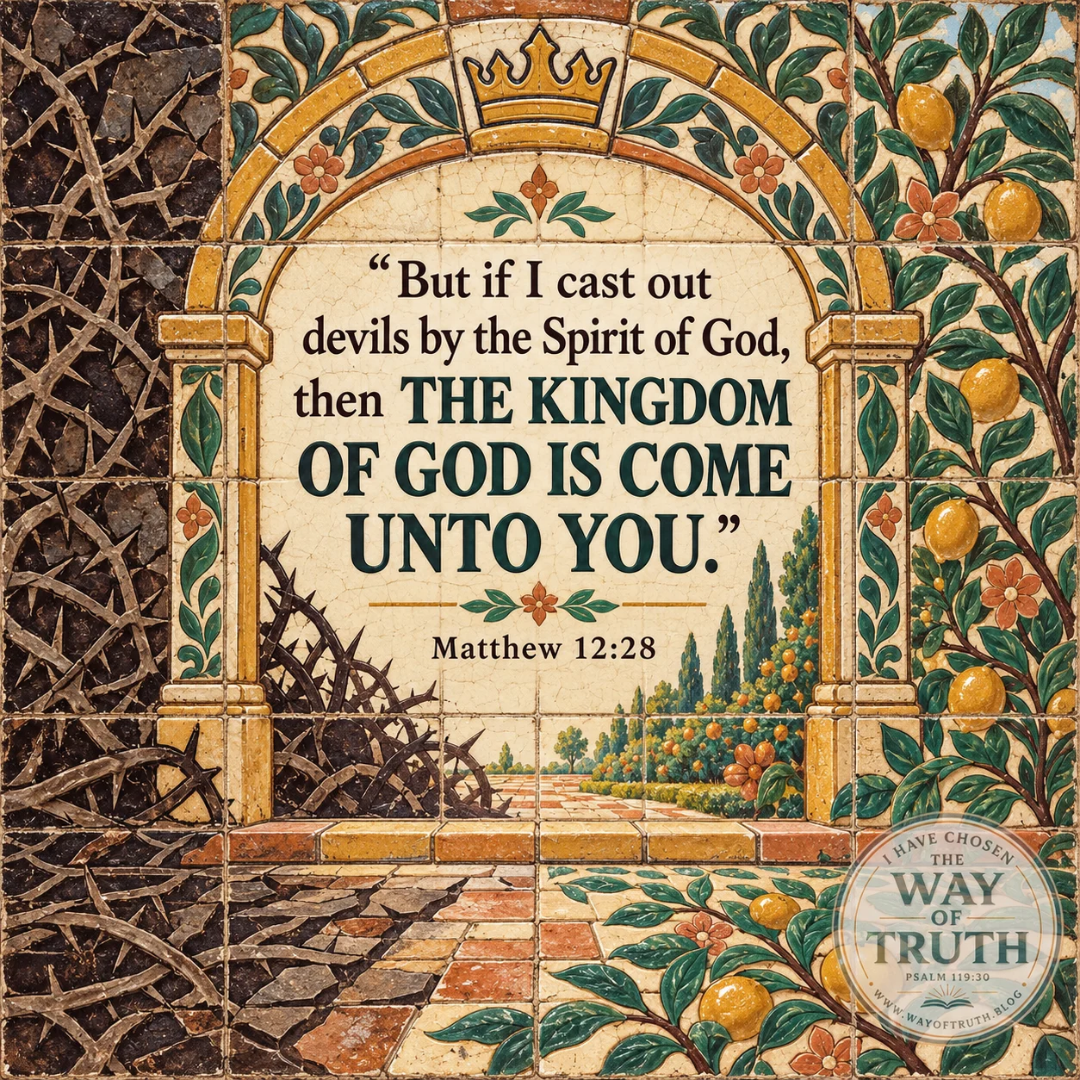
The central declaration of Matthew 12:28 is: “Then the kingdom of God is come unto you.” Jesus isn’t describing a distant possibility. He’s announcing a present reality. The kingdom of God refers fundamentally to God’s royal authority and reign. Although God has always ruled sovereignly over His creation, Scripture also promises a particular manifestation of His kingdom through the Messiah.
Daniel had foretold a kingdom established by God that would never be destroyed (Daniel 2:44). John the Baptist later announced that the kingdom of heaven was at hand (Matthew 3:2). Jesus likewise began His public preaching with that announcement (Matthew 4:17). Now, in Matthew 12:28, Jesus explains what His miraculous works demonstrate: the promised reign of God is already being manifested through His ministry. This wasn’t merely another promise about something God would eventually accomplish. The King had arrived, and His authority was being exercised before their eyes.
That doesn’t mean every promise associated with the kingdom had already reached its final fulfillment. Evil still operated in the world. Sin and death remained present. Jesus had yet to accomplish His atoning death and resurrection, and the final judgment was still future.
Scripture therefore presents both a present and a future aspect of God’s kingdom. Through Christ’s first coming, God’s saving reign has entered human history in a decisive way. Through His resurrection and exaltation, Christ’s victory is established and His authority openly proclaimed. At His return, His triumph will be fully manifested, and the remaining effects of sin and evil will be removed.
Matthew 12:28 emphasizes the first of these realities: God’s promised kingdom was already making its presence known through Jesus Christ. The deliverance of the demon-possessed man was evidence of that reality. Satan’s power was being challenged by One whose authority was greater.
D. The Kingdom’s Arrival Demands a Response
There’s an important distinction in Jesus’ declaration that we shouldn’t overlook. He says the kingdom has come unto His hearers. He doesn’t say they have all entered it. The Pharisees stood in the presence of the Messiah and witnessed the works of God’s kingdom. Yet their opposition demonstrated that encountering the kingdom’s power isn’t the same as submitting to its King. A person can hear the gospel, witness genuine evidence of God’s work, and understand Christian teaching without personally trusting Christ. Religious familiarity doesn’t automatically produce saving faith.
Jesus’ declaration also presents a challenge to those who dismiss His miracles as nothing more than ancient superstition or misunderstood natural events. Matthew’s account presents the deliverance as a real confrontation with demonic oppression, not simply an unexplained illness. The Pharisees’ accusation concerned the source of Jesus’ power, and His response addresses that charge directly.
Of course, the Gospel’s testimony involves supernatural claims that can’t be established merely by assuming miracles are possible or impossible. The historical question deserves serious consideration rather than dismissal through an automatic rejection of the supernatural. Nor should we assume that every illness, disability, or psychological difficulty results from demonic activity. Scripture distinguishes among different forms of human suffering, and Matthew 12:28 doesn’t authorize us to diagnose spiritual causes without evidence.
What the passage does establish within Matthew’s account is that Jesus demonstrated authority over evil spirits through the Spirit of God. The following verse will develop this truth further through the illustration of binding the strong man (Matthew 12:29). For now, the central point is clear: the presence of God’s kingdom is demonstrated through the authority of Jesus Christ over the powers of darkness.
II. Living Under the Authority of the King
A. Recognize That God’s Kingdom Centers on Christ
Matthew 12:28 challenges us to consider how we understand the kingdom of God. It’s tempting to associate God’s kingdom primarily with visible accomplishments, religious organizations, cultural influence, or impressive spiritual experiences. Churches can become preoccupied with their activities and achievements while giving less attention to the One they’re supposed to represent.
Jesus points to Himself and the works accomplished through the Spirit as evidence of the kingdom’s presence. His declaration reminds us that God’s kingdom can’t be separated from Christ’s authority. This means our first responsibility isn’t to establish our own religious influence. It’s to recognize and obey the King whom God has revealed.
We demonstrate that allegiance through submission to Scripture, repentance from sin, obedience to Christ’s commands, and a sincere desire to honor Him in everyday life. The question isn’t merely whether we appreciate what Jesus has done. It’s whether we’re willing to let Him rule our decisions, priorities, relationships, and conduct.
B. Depend on God’s Power Rather Than Human Ability
Jesus’ reference to the Spirit of God also reminds us that spiritual victories ultimately depend upon divine power. We aren’t capable of freeing ourselves from sin through determination, religious activity, or personal improvement. Nor can the Church accomplish its spiritual mission through persuasive techniques, organizational efficiency, or human enthusiasm alone. Those things may have appropriate uses, but they can’t replace the work of God.
The Church must therefore remain dependent upon the Lord through prayer, biblical teaching, faithful witness, and obedience to the Holy Spirit. This doesn’t mean believers should expect to reproduce every miracle recorded in Christ’s earthly ministry. His miraculous works uniquely testified to His identity and the arrival of God’s kingdom. But the same Spirit who worked through Christ’s earthly ministry now indwells believers, enabling them to live in obedience and bear witness to the Savior (Romans 8:9–13; Acts 1:8). We should seek spiritual fruit rather than sensational experiences and measure faithfulness by God’s Word rather than outward excitement.
C. Rejoice in Christ’s Authority Over Evil
The deliverance described in Matthew 12 offers genuine encouragement to believers who feel discouraged by the presence of evil in the world. Satan is real, and his influence should never be treated lightly. Yet Scripture doesn’t present him as an equal rival to God.
Jesus commands, and evil spirits must obey. That authority should strengthen our confidence in Christ without encouraging careless assumptions about spiritual warfare. We don’t need to become preoccupied with Satan, attribute every difficulty to demonic activity, or live in constant fear of unseen spiritual forces.
Instead, we’re called to remain watchful, resist temptation, put on the whole armor of God, and stand firm in the faith (Ephesians 6:10–18). Even when circumstances appear troubling, we can remember that Christ’s authority isn’t diminished by the opposition of evil. His kingdom has already been revealed, His victory has been secured through His death and resurrection, and His final triumph is certain.
D. Let the Kingdom Shape Our Witness and Fellowship
Jesus’ declaration also carries implications for how believers represent Him together. If we belong to Christ’s kingdom, our churches should reflect the character of our King. That means proclaiming His truth faithfully, caring for those who suffer, confronting sin without self-righteousness, and encouraging one another toward genuine spiritual maturity.
The man Jesus delivered wasn’t simply an exhibit in a theological dispute. He was a person who had suffered under terrible oppression and experienced real deliverance. The Pharisees became so concerned with discrediting Jesus that they failed to acknowledge the significance of the man’s restoration.
We should guard against a similar failure. It’s possible to become so absorbed in religious controversy, defending positions, or proving ourselves right that we overlook the people affected by the matters we’re debating. Truth matters. Sound doctrine matters. But so do the people whom Christ calls us to love. Our witness should therefore combine biblical conviction with genuine concern for others.
Above all, we must keep directing attention to Jesus. The Church doesn’t possess authority independently of Him, and our message isn’t that Christianity can make every earthly problem disappear. Our message is that the promised King has come, salvation is available through Him, and everyone is called to repent and believe the gospel.
III. The King Who Came to Deliver Sinners
The deliverance Jesus performed in Matthew 12:28 points us toward an even greater need shared by every human being. Not everyone experiences demonic oppression, but everyone has sinned against God. We’ve violated His commands, pursued our own desires, and failed to give Him the honor and obedience He deserves. And sin carries a terrible consequence. Scripture declares: “For the wages of sin is death; but the gift of God is eternal life through Jesus Christ our Lord” (Romans 6:23).
Our greatest problem isn’t simply that we live in a world affected by evil. It’s that we’re personally guilty before a holy and righteous God, unable to make ourselves acceptable to Him through our own efforts. But God, in His mercy, sent His Son to save sinners.
Jesus Christ lived a perfectly righteous life, willingly died upon the cross, and bore the penalty for sin. He rose bodily from the dead on the third day, demonstrating His victory over sin and death. Through His sacrifice, forgiveness and reconciliation with God are offered to all who repent and place their faith in Him.
The same Jesus who demonstrated authority over evil spirits possesses authority to forgive sins and grant eternal life. And His invitation isn’t limited to those who consider themselves worthy. He calls sinners to turn from their rebellion and trust in Him. You don’t need to earn your way into God’s kingdom. You need the Savior who came to rescue those who could never save themselves.
If you haven’t trusted Christ, consider what His words reveal. God’s promised King has come, and He offers something far greater than temporary relief from life’s troubles: forgiveness, new life, and everlasting fellowship with God. Turn to Jesus Christ in repentance and faith. Receive the salvation He freely offers, acknowledge Him as Lord, and begin living for His glory.
IV. Reflection and Response
- Matthew 12:28 presents Jesus’ authority over evil spirits as evidence of God’s kingdom. How does this deepen my understanding of who Jesus is and why He deserves my complete allegiance?
- Are there areas of my life where I acknowledge Christ as Savior but struggle to submit to His commands as King?
- When facing spiritual struggles or seeking to serve others, am I relying primarily on my own strength, or am I faithfully depending upon God’s power through prayer and obedience?
- Does my involvement in Christian teaching, ministry, or disagreement demonstrate genuine concern for people, or can defending a position sometimes overshadow my responsibility to love them?
- How can I more faithfully direct others toward Jesus Christ, emphasizing His authority, His saving work, and the call to repentance and faith?