
I. The Strong Man and the Greater Authority
A. A Picture That Exposes the Truth
Jesus had just answered the Pharisees’ accusation that He was casting out demons through the power of Satan. After exposing the contradiction in their reasoning, He explained that His authority over evil spirits demonstrated the arrival of God’s kingdom. Now, in Matthew 12:29, He illustrates that authority with a simple but powerful picture.
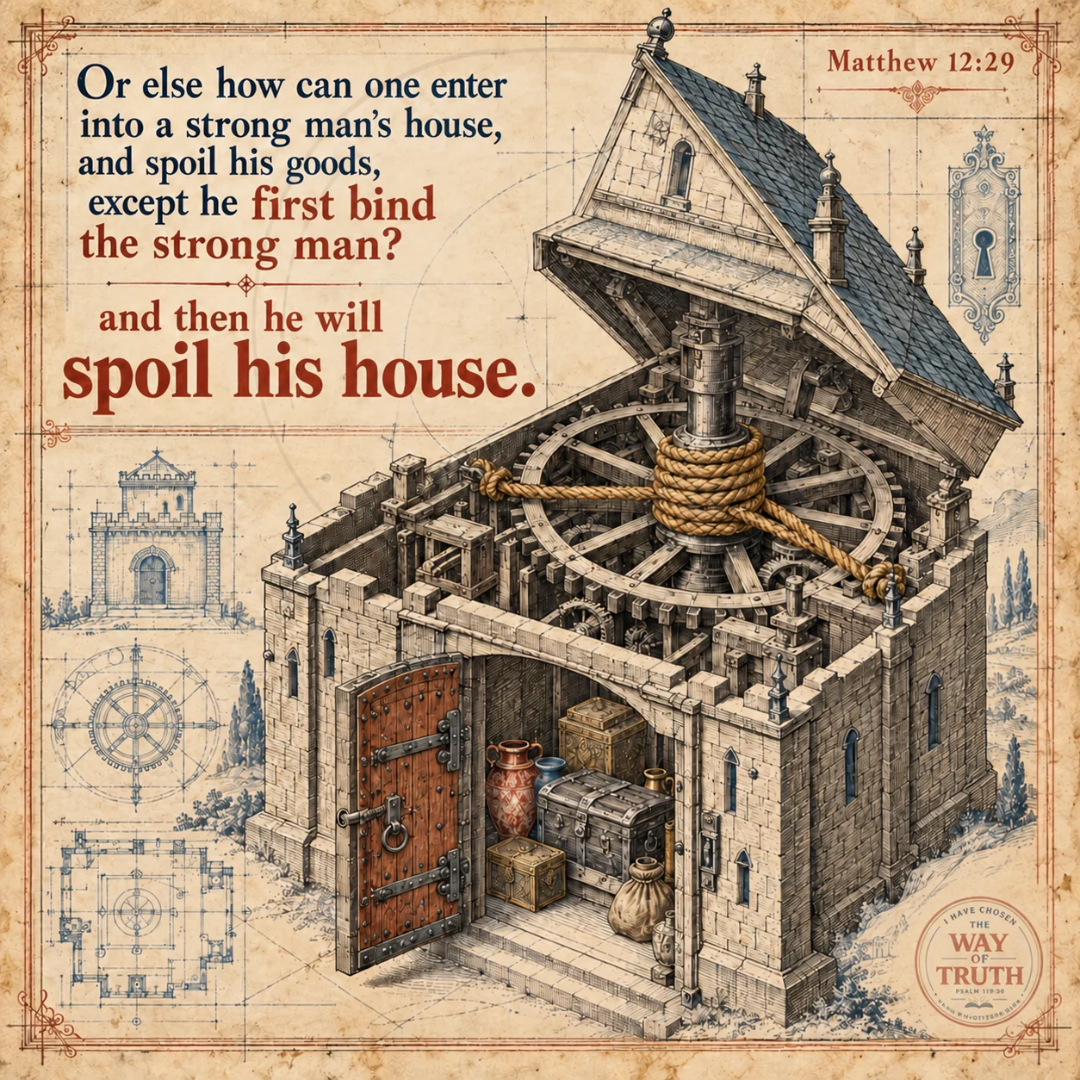
Imagine someone attempting to enter the home of a strong, well-prepared man and carry away his possessions. As long as the homeowner remains free to defend his property, the intruder faces serious opposition. To succeed, he must first overpower and restrain the man who controls the house.
Jesus wasn’t offering advice about burglary. He was illustrating what His deliverance of the demon-possessed revealed about the spiritual conflict taking place. The strong man represents Satan, whose influence and power had brought people into spiritual bondage. His house represents the realm in which he exercises that influence, while the goods being carried away illustrate what’s being taken from his control. In the immediate context, Jesus is speaking particularly about the liberation of those oppressed by demons.
The implication is unmistakable: Jesus couldn’t be repeatedly overthrowing Satan’s works if He were acting as Satan’s servant. His authority to deliver those under demonic oppression demonstrated that He was confronting and overcoming the enemy, not cooperating with him. The Pharisees had accused Jesus of being an agent of evil. Yet His actions revealed Him to be the very One who possessed the authority to defeat it.
B. The Stronger One Has Arrived
The central point of Jesus’ illustration isn’t merely that Satan possesses considerable power. It’s that someone greater has arrived to overcome him.
Satan is a real and dangerous spiritual adversary. Scripture doesn’t portray him as a harmless symbol of evil or as an imaginary explanation for human wrongdoing. He deceives, tempts, accuses, and opposes God’s purposes. Nevertheless, he remains a created being whose power is limited and subordinate to God’s sovereign authority.
Jesus’ illustration makes an important distinction between the strength of an enemy and the superior authority of the One who defeats him. Luke‘s parallel account makes this contrast especially clear. Jesus describes an armed man guarding his possessions until “a stronger than he” (Luke 11:22) comes against him, overcomes him, and takes away the armor in which he trusted. That stronger One is Christ.
Throughout His earthly ministry, Jesus demonstrated authority that no ordinary human being possessed. Demons submitted to His commands, and those suffering under their oppression were delivered. These weren’t contests between equally powerful spiritual opponents. The authority of God’s Son stood above the powers confronting Him.
This matters because Christianity doesn’t teach that God and Satan are opposing forces of comparable strength, locked in an uncertain struggle for control of the universe. Satan is neither God’s equal nor an independent ruler capable of frustrating His ultimate purposes. Christ’s authority is greater, His purposes can’t be defeated, and His final triumph is assured.
C. Binding the Strong Man and Taking His Goods
Jesus identifies two actions in His illustration: first binding the strong man and then plundering his house. The order is important. The strong man’s resistance must be overcome before his possessions can be taken. Applied to Jesus’ ministry, the illustration explains why His successful deliverance of the demon-possessed was so significant. His works demonstrated that Satan’s power was being decisively challenged and overcome.
The language of plundering might initially seem unusual, especially since taking another person’s possessions is ordinarily wrong. But Jesus isn’t presenting Satan as a rightful owner whose property deserves protection. He’s describing the defeat of an oppressive enemy. The people Jesus delivered weren’t valuable objects belonging legitimately to Satan. They were human beings suffering under powers hostile to God. Their liberation revealed the mercy and authority of the Messiah.
The imagery also recalls God’s promise of deliverance in Isaiah 49:24–25, where the Lord declares that even captives held by mighty oppressors can be rescued. Although the passages arise in different historical settings, they share an important truth: No oppressor is beyond the power of God to overcome. This theme extends beyond the individual deliverances recorded during Jesus’ ministry. The apostle John explains Christ’s mission with these words: “For this purpose the Son of God was manifested, that he might destroy the works of the devil” (1 John 3:8).
Jesus’ miracles anticipated the fuller triumph accomplished through His sacrificial death and bodily resurrection. Through His death, He dealt with the guilt of sin and broke the power of death over those He redeems (Hebrews 2:14–15). Through His resurrection, He demonstrated His victory over the grave. The deliverance of the demon-possessed was therefore more than temporary relief from terrible suffering. It was visible evidence that the promised Messiah had entered the conflict against evil with authority to overcome it.
D. What the Binding Does and Doesn’t Mean
Some Christians understand this passage as describing a decisive limitation of Satan’s power that began during Christ’s earthly ministry and is closely connected with His death, resurrection, and exaltation. Others distinguish this restraint from the binding described in Revelation 20:1–3, which they understand as a separate future event. Those differences involve broader questions about the timing and nature of Christ’s kingdom. Matthew 12:29 itself doesn’t provide a complete timetable of Satan’s defeat. What it does clearly establish is that Jesus’ authority to liberate those under demonic oppression demonstrated His superiority over Satan.
Nor does the passage suggest that Satan became completely inactive during Jesus’ ministry. The New Testament continues to warn believers about his schemes and opposition (Ephesians 6:11; 1 Peter 5:8). Likewise, Jesus isn’t giving His followers a formula for binding Satan through particular words, declarations, or rituals. The subject of this illustration is Christ’s authority, not a technique believers must learn to exercise supernatural control.
Modern readers may also question whether the Gospel accounts of demonic oppression should be understood as descriptions of genuine spiritual activity. Scripture presents these encounters as real events, not merely as illustrations of psychological distress. At the same time, the Bible doesn’t attribute every illness, emotional struggle, or troubling behavior to demonic influence. Such assumptions go beyond what the passage teaches.
The Pharisees’ accusation was especially serious because it rejected the significance of what Jesus was doing. Rather than honestly considering the evidence before them, they attributed His deliverance of suffering people to the very evil He was overcoming. The proper response to Christ’s authority isn’t speculation about hidden spiritual activity. It’s to recognize who He is and respond to Him with faith.
II. Living in the Light of Christ’s Superior Power
A. Confidence That Rests in Christ
Jesus’ illustration provides believers with a firm reason for confidence. Our hope doesn’t depend upon our ability to overpower evil through determination, religious effort, or personal strength. It rests upon the authority of the Savior who has already demonstrated His superiority over Satan.
That doesn’t mean spiritual opposition will disappear from our lives. Temptation remains real, and believers must guard against deception, pride, and disobedience. However, we don’t have to face these struggles as though their outcome depends entirely upon us. James instructs believers: “Submit yourselves therefore to God. Resist the devil, and he will flee from you” (James 4:7).
Notice where the instruction begins. Submission to God comes before resistance to the devil. Spiritual steadfastness isn’t found in self-confidence but in dependence upon the Lord. When we’re tempted to compromise, discouraged by repeated failures, or troubled by spiritual opposition, our response should be to draw near to Christ through prayer, Scripture, repentance, and obedience. We have every reason to take the enemy seriously, but no reason to regard him as greater than our Savior.
B. Freedom Is Meant to Produce Faithful Living
The liberation pictured in Matthew 12:29 also reminds us that Christ’s work isn’t merely about removing what oppresses us. He calls those He redeems into a new relationship of trust and obedience. Through salvation, believers are delivered from the dominion of sin and brought into a life shaped by God’s righteousness (Romans 6:17–18).
That freedom doesn’t mean Christians never struggle with sinful habits or experience setbacks. It means sin no longer possesses the rightful authority to govern their lives. We should therefore examine the influences we willingly entertain, the compromises we excuse, and the patterns of behavior that draw our hearts away from Christ.
Are we resisting what Scripture condemns, or are we becoming comfortable with it? Are we cultivating habits that strengthen our faith, or allowing distractions to weaken our devotion? These questions aren’t meant to produce despair. They’re invitations to live consistently with the freedom Christ has given us.
C. A Church That Proclaims Deliverance
The Church isn’t called to manufacture spiritual power or build its identity around dramatic confrontations with evil. Its responsibility is to proclaim the gospel, teach God’s Word, make disciples, and demonstrate Christ’s love through faithful service. Paul described his commission as turning people “from darkness to light, and from the power of Satan unto God” (Acts 26:18). That remains central to the Church’s witness.
When we share the gospel, we announce that forgiveness and reconciliation with God are available through Jesus Christ. When we care for those struggling with sin, suffering, or discouragement, we demonstrate something of the mercy of the Savior we proclaim.
We must also resist the temptation to treat people as enemies simply because they oppose our beliefs. Scripture reminds us that our ultimate struggle isn’t against flesh and blood (Ephesians 6:12). People aren’t trophies to be won in an argument. They’re individuals who need the truth and grace of God, just as we do.
A faithful church therefore confronts error without cruelty, speaks truth without arrogance, and remains united around Christ rather than personalities or competing claims of spiritual authority. Our calling is to make the victorious Savior known, trusting Him to accomplish what human persuasion alone can’t.
III. The Savior Who Can Set You Free
Perhaps you’ve struggled with guilt, regret, or habits you haven’t been able to overcome. Matthew 12:29 reminds us that Jesus possesses an authority greater than the powers that hold people in bondage. But our deepest need is more than relief from life’s struggles. We need to be reconciled to God.
Scripture teaches that every person has sinned and fallen short of God’s glory (Romans 3:23). Our sin separates us from God, and its deserved penalty is death and eternal judgment. No amount of personal effort, religious activity, or good behavior can erase that guilt.
Yet God, in His love and mercy, has provided the way of salvation through His Son. Jesus Christ lived without sin and willingly died upon the cross, bearing the penalty for sin as our substitute. On the third day, He rose bodily from the dead, demonstrating His victory over sin and death.
The One who overcame Satan’s works also accomplished everything necessary to save sinners who come to Him in faith. You don’t have to earn His forgiveness or make yourself worthy before approaching Him. God calls you to repent, turn from your sin, and trust in Jesus Christ alone for salvation. His promise is wonderfully clear: “For whosoever shall call upon the name of the Lord shall be saved” (Romans 10:13).
If you haven’t trusted in Christ, consider what His authority means for you personally. The Savior who came to rescue sinners is worthy of your trust. Turn to Him today, receive the forgiveness and new life He freely offers, and follow Him in grateful obedience.
IV. Reflection and Response
- How does Jesus’ description of the strong man deepen my understanding of His superiority over Satan and every opposing spiritual power?
- When facing temptation or spiritual discouragement, am I relying primarily on my own determination, or am I seeking Christ’s strength through prayer, Scripture, and obedience?
- Are there sinful habits, influences, or compromises that I need to confront more seriously in light of the freedom Christ has provided?
- How can I demonstrate the truth and mercy of Jesus toward people who are struggling, deceived, or resistant to the gospel?
- Am I faithfully directing others toward Christ as the One who can forgive sin, overcome evil, and grant eternal life?