
I. Strength Without Self-Promotion
Matthew 12:19 continues Matthew’s quotation from Isaiah 42, explaining the character of the Servant whom God had promised and whom Matthew identifies as Jesus Christ. Verse 18 introduced Him as God’s chosen and beloved Servant, the One upon whom God would put His Spirit and through whom judgment would ultimately be proclaimed to the Gentiles. Now verse 19 tells us something remarkable about how that Servant would carry out His mission.
He wouldn’t advance His kingdom through noisy self-promotion, quarrelsome aggression, or public spectacle.
A. “He Shall Not Strive”
The word strive here doesn’t mean that Jesus would never disagree with anyone or confront error. The Gospels plainly show otherwise. Christ rebuked hypocrisy, corrected false teaching, exposed unbelief, and openly challenged religious leaders when truth required it. Matthew 23, for example, records some of the strongest rebukes found anywhere in Scripture. Jesus didn’t hesitate to call the scribes and Pharisees hypocrites when their conduct deserved the charge.
So, Matthew 12:19 can’t mean that Jesus avoided all controversy. Rather, it describes the way He pursued His mission. Christ wasn’t quarrelsome. He didn’t pick fights simply to dominate opponents. He wasn’t driven by wounded pride, personal rivalry, or the need to win every argument.
There’s a tremendous difference between contending for truth and simply being contentious. Jesus did the first perfectly and never descended into the second. This becomes especially significant when we remember the immediate context. The Pharisees had begun plotting how they might destroy Him: “Then the Pharisees went out, and held a council against him, how they might destroy him” (Matthew 12:14).
Jesus knew what they were doing. Yet rather than organizing His followers for retaliation, He withdrew from the confrontation and continued healing those who followed Him. That wasn’t weakness. It was obedience. Christ would confront His enemies when the Father’s purpose required it, but He wouldn’t allow His mission to be dictated by their hostility.
B. “Nor Cry”
Matthew continues: “He shall not strive, nor cry…” The idea isn’t that Jesus never raised His voice or preached publicly. He plainly did both. The emphasis is again upon the character of His ministry. Christ didn’t behave like someone desperately trying to attract attention to Himself. This fits beautifully with what Matthew has just described: “And charged them that they should not make him known” (Matthew 12:16).
Jesus had healed great multitudes, yet instead of encouraging publicity, He warned them against spreading His fame. That’s striking. Most people who possess even a fraction of Christ’s power would immediately hire a publicity team. Jesus did the opposite. He wasn’t attempting to build a celebrity brand. He was fulfilling the will of His Father.
Christ certainly called people to believe in Him, and He openly declared who He was when the time and circumstances required it. But He never depended upon theatrics, exaggerated claims, manufactured excitement, or human applause. His authority didn’t need advertising to make it real.
C. “Neither Shall Any Man Hear His Voice in the Streets”
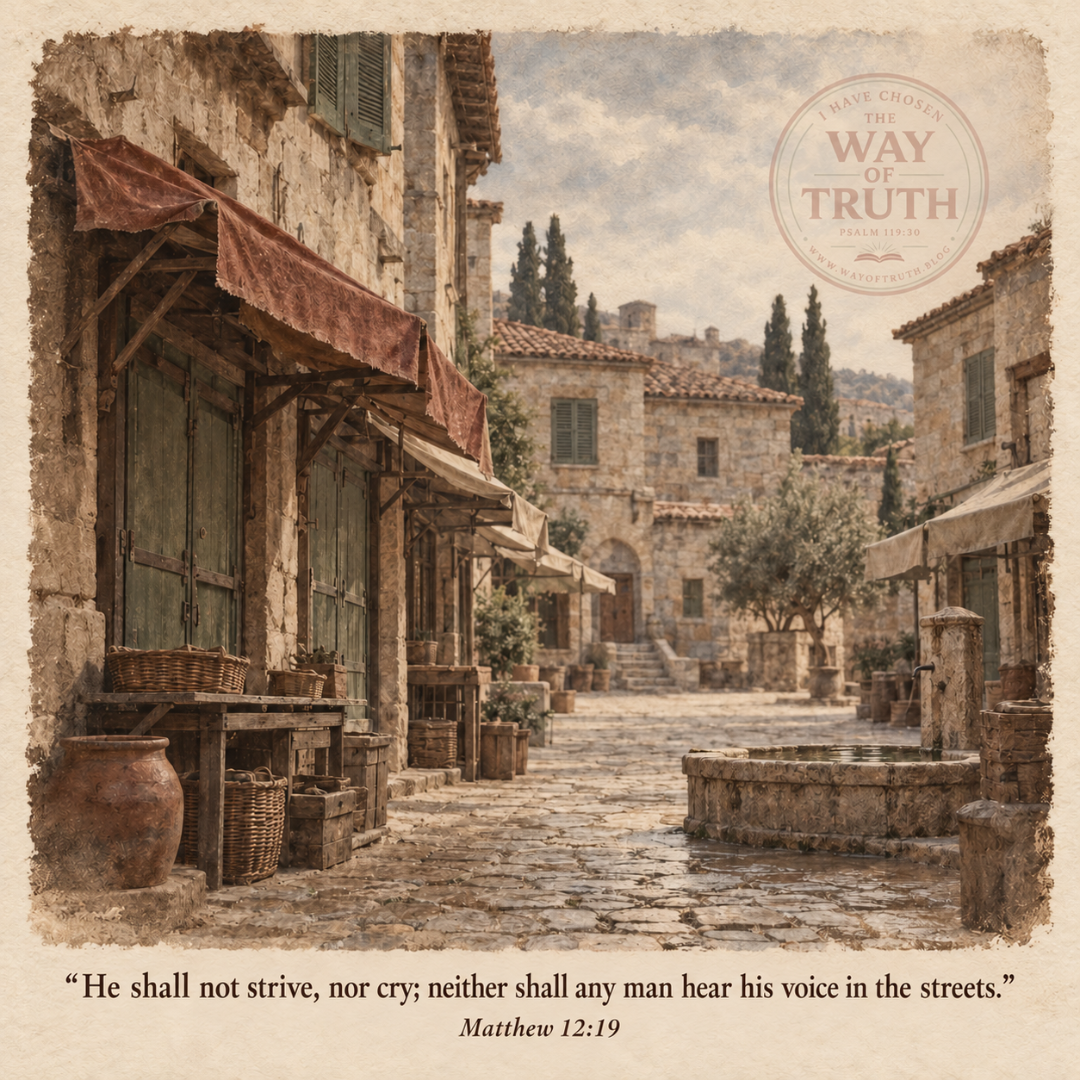
In the ancient world, public streets and marketplaces were natural places for announcements, disputes, political appeals, and public demonstrations. Matthew’s description therefore presents a Servant whose kingdom wouldn’t advance through the kinds of public agitation often associated with earthly movements.
Jesus wasn’t a political revolutionary gathering crowds in the streets to overthrow Rome. He wasn’t a religious agitator building influence through spectacle. He wasn’t a demagogue stirring people through emotional manipulation. Yet He was establishing a kingdom greater than every empire on earth.
That contrast is one of the remarkable features of Christ’s ministry. Kings normally announce themselves with trumpets, but Jesus often told healed people to remain quiet. Earthly rulers surround themselves with displays of power, but Jesus repeatedly withdrew from crowds. Political movements frequently grow through slogans, demonstrations, and public pressure. Christ changed the world by faithfully preaching truth, showing mercy, calling sinners to repentance, training disciples, and ultimately laying down His life. His kingdom would advance differently.
II. The Servant Isaiah Had Promised
Matthew doesn’t invent this description of Jesus. He’s quoting the prophet Isaiah. “He shall not cry, nor lift up, nor cause his voice to be heard in the street” (Isaiah 42:2). Centuries before Christ’s earthly ministry, Scripture had described the character of the coming Servant.
A. Prophecy Fulfilled in Character, Not Merely Events
Biblical prophecy is sometimes reduced to dramatic predictions about dates, rulers, wars, or future events. But prophecy can also describe the character of the Messiah. That’s what happens here. Isaiah didn’t merely predict something Christ would do. He described the kind of Messiah He would be.
Matthew observes Jesus withdrawing from unnecessary confrontation, healing the sick, discouraging publicity, and quietly continuing His mission. He recognizes that these actions fit the portrait Isaiah had written long before.
The fulfillment is therefore deeply personal. Jesus doesn’t merely check boxes on a prophetic list. His very character fulfills Scripture.
B. Quietness Doesn’t Mean Weakness
Modern culture often associates strength with visibility. The loudest person in the room appears powerful. The person with the biggest platform seems important. The one who dominates the conversation appears confident.
Jesus overturns that assumption. He possessed absolute authority and yet didn’t constantly advertise it. He could silence storms, command demons, heal disease, forgive sins, and raise the dead. Yet He didn’t need to shout His greatness from street corners.
True authority doesn’t require constant self-assertion. There’s a quiet strength in Christ that comes from knowing exactly who He is and exactly what the Father has sent Him to accomplish. He doesn’t need human applause because His Father has already declared: “…my beloved, in whom my soul is well pleased…” (Matthew 12:18). That approval was enough.
And there’s something here worth noticing for every believer: much of our craving for recognition comes from forgetting whose approval ultimately matters.
III. What Matthew Isn’t Saying
Matthew 12:19 can be misunderstood if it’s separated from the rest of Scripture.
A. Jesus Wasn’t Silent About Truth
Some might use this verse to picture Jesus as someone who never spoke strongly, confronted wrongdoing, or challenged anyone. That Jesus doesn’t exist in the Gospels. The real Christ could be extraordinarily gentle, yet He could also speak with uncompromising clarity.
He told religious leaders: “Ye serpents, ye generation of vipers, how can ye escape the damnation of hell?” (Matthew 23:33). He cleansed the temple. He confronted hypocrisy. He rebuked unbelief. He warned about judgment.
Matthew 12:19 therefore can’t mean that Christian faithfulness requires silence whenever truth becomes controversial. Christ’s gentleness never became cowardice.
B. Jesus Did Preach Publicly
Someone might also object that Jesus clearly taught publicly, including in synagogues, houses, open fields, and near the temple. That’s true. But there’s no contradiction.
Isaiah and Matthew aren’t saying that Christ would literally never speak where other people could hear Him. They’re describing the spirit and method of His Messianic mission. He wouldn’t be characterized by shouting contests, public agitation, political theatrics, or self-promotional spectacle.
The same Jesus who could preach to thousands could also withdraw alone to pray. The same Messiah who could confront religious leaders could quietly leave when opponents attempted to force the timing of His mission.
Biblical interpretation requires us to read a statement within its context rather than turning one phrase into an absolute rule the passage never intended.
IV. A Kingdom Built Differently
Matthew 12:19 reveals something about the nature of Christ’s kingdom as well as the character of the King.
A. Christ Doesn’t Need Manipulation
Human movements often depend upon persuasion techniques designed to generate excitement, fear, outrage, or loyalty. Christ’s kingdom doesn’t need such manipulation. The gospel is proclaimed openly and urgently, but Christians are never authorized to deceive people into believing it.
Paul later expressed the same principle: “But have renounced the hidden things of dishonesty, not walking in craftiness, nor handling the word of God deceitfully…” (2 Corinthians 4:2). The truth of God doesn’t need dishonest assistance. Christ didn’t manipulate crowds. Neither should His Church.
B. The Gospel Advances Through Truth and the Spirit of God
Matthew 12:18 has already told us that the Spirit of God rests upon Christ. Jesus didn’t need theatrical self-promotion because His ministry was empowered by the Spirit and directed by the Father. The Church should remember the same principle.
We should work diligently, communicate clearly, use appropriate means to reach people, and take advantage of opportunities God provides. But we must never begin thinking that clever marketing, emotional pressure, impressive personalities, or cultural influence can produce spiritual life. God alone can change the heart.
“So then faith cometh by hearing, and hearing by the word of God” (Romans 10:17). Our responsibility is faithful proclamation. The results belong to God.
V. The Discipline of Quiet Faithfulness
Matthew 12:19 speaks directly to a culture that constantly encourages us to announce ourselves. Social media has only intensified something already present in the human heart: the desire to be noticed. We want people to recognize what we’ve accomplished. We want our opinions heard. We want credit when we’re right. We want acknowledgment when we’ve sacrificed. We want others to understand how much we’ve done. Jesus shows us another way.
A. Not Every Battle Needs to Be Fought
Jesus didn’t respond to every opponent in the same way. Sometimes He confronted. Sometimes He answered. Sometimes He asked a question. Sometimes He walked away. Wisdom knows the difference.
Christians can mistakenly believe that courage means responding to every criticism, correcting every mistaken opinion, and entering every theological or cultural dispute. It doesn’t. Some battles matter greatly. Others merely consume time and stir anger.
Scripture tells us: “A soft answer turneth away wrath: but grievous words stir up anger” (Proverbs 15:1). There are times when truth must be spoken firmly, but there are also times when silence demonstrates greater strength than another argument. Before responding, we should ask: Am I defending God’s truth, or simply defending my pride? That question can save us a remarkable amount of unnecessary conflict.
B. Faithfulness Doesn’t Require Recognition
Jesus’ ministry wasn’t built around applause. Ours shouldn’t be either.
Much of Christian faithfulness happens where very few people notice. A parent patiently teaching a child Scripture. A believer quietly praying for an unbelieving friend. Someone serving behind the scenes at church. A Christian refusing to compromise at work even when nobody would know. A widow praying faithfully in her home. A worker treating others honestly and kindly when there’s no earthly reward for doing so.
None of these things may attract attention, but God sees them. “…thy Father, which seeth in secret, shall reward thee openly” (Matthew 6:18). We don’t need an audience for obedience to matter.
C. The Church Should Reflect the Character of Her Lord
Churches can also become tempted by the world’s obsession with visibility. Attendance numbers, platforms, influence, personalities, branding, buildings, online reach, and public recognition can gradually become measurements of spiritual importance. None of those things is automatically wrong. But none proves faithfulness either.
A congregation may have little cultural influence and still be deeply pleasing to Christ. Another may attract enormous attention while drifting from biblical truth. The question isn’t simply, Are people noticing us? The better question is, Are we faithfully representing Christ?
Our goal isn’t to make the Church famous but to make Christ known. And following the Servant described in Matthew 12:19 sometimes means being willing to serve faithfully even when very few people notice.
D. Evangelism Without Pressure
This verse also shapes the way we share the gospel. We should speak clearly and courageously. We should warn honestly about sin and judgment. We should invite people sincerely to repent and believe in Christ. But we don’t need to pressure, bully, embarrass, manipulate, or argue someone into the kingdom.
Salvation is God’s work. “I have planted, Apollos watered; but God gave the increase” (1 Corinthians 3:6). That truth relieves us of an enormous burden. Our responsibility is faithfulness. God gives the increase.
VI. The Quiet Servant Who Went to the Cross
The character revealed in Matthew 12:19 reaches its fullest expression when Jesus moves toward Calvary. The One who wouldn’t quarrel for personal advantage eventually stood before men who falsely accused Him. Isaiah had also foretold: “He was oppressed, and he was afflicted, yet he opened not his mouth…” (Isaiah 53:7).
Jesus certainly spoke during His trials, but He refused to defend Himself in the desperate, self-preserving manner we might expect from an innocent man facing death. Why? Because the cross wasn’t an accident from which He was trying to escape. It was the mission He’d come to accomplish.
Christ possessed the power to prevent His arrest. He could have called for angelic deliverance. He could have judged His enemies immediately. Instead, He submitted Himself to the Father’s redemptive purpose.
The quiet strength hinted at in Matthew 12:19 ultimately leads us to Calvary. There we see that Christ’s meekness was never powerlessness, but power perfectly submitted to the will of God.
VII. The Savior Who Calls You to Himself
Perhaps you’ve spent much of your life trying to prove yourself. Trying to be good enough. Trying to silence guilt. Trying to convince yourself that your failures aren’t really that serious. Jesus offers something far better than another opportunity for self-improvement. He offers salvation.
Scripture teaches that every one of us has sinned: “For all have sinned, and come short of the glory of God” (Romans 3:23). Sin separates us from God, and its rightful penalty is death: “For the wages of sin is death…” (Romans 6:23).
But Jesus Christ, the righteous Servant described by Isaiah and revealed in Matthew, came to do what we could never do for ourselves. He lived without sin, willingly gave His life upon the cross, and bore the judgment sinners deserve. He died, was buried, and on the third day, He rose bodily from the grave, victorious over sin and death.
Salvation isn’t earned through religious effort, good works, church attendance, or becoming a better version of yourself. God calls you to repent of your sin and place your faith in Jesus Christ. “Believe on the Lord Jesus Christ, and thou shalt be saved…” (Acts 16:31).
If you’ve never trusted Him, you can come to Him today. Turn from your sin. Trust Christ alone. Receive the forgiveness and eternal life that God freely gives through His Son. And then live, not to make your own name great, but to glorify the One who quietly, faithfully, and willingly gave Himself to save you.
VIII. Reflection and Response
- When conflict arises, am I primarily concerned with defending God’s truth, or am I sometimes defending my own pride and reputation?
- Are there arguments, controversies, or personal disputes I need to leave behind so I can focus more faithfully on what God has actually called me to do?
- How much of my motivation comes from wanting people to notice, appreciate, or affirm what I do? Am I willing to serve Christ faithfully when nobody sees except God?
- Does my manner of speaking about truth reflect both the courage and the gentleness of Christ, especially when interacting with people who disagree with me?
- How can I glorify God and proclaim the gospel without depending upon pressure, spectacle, or human approval, trusting instead that God works through His Word?