
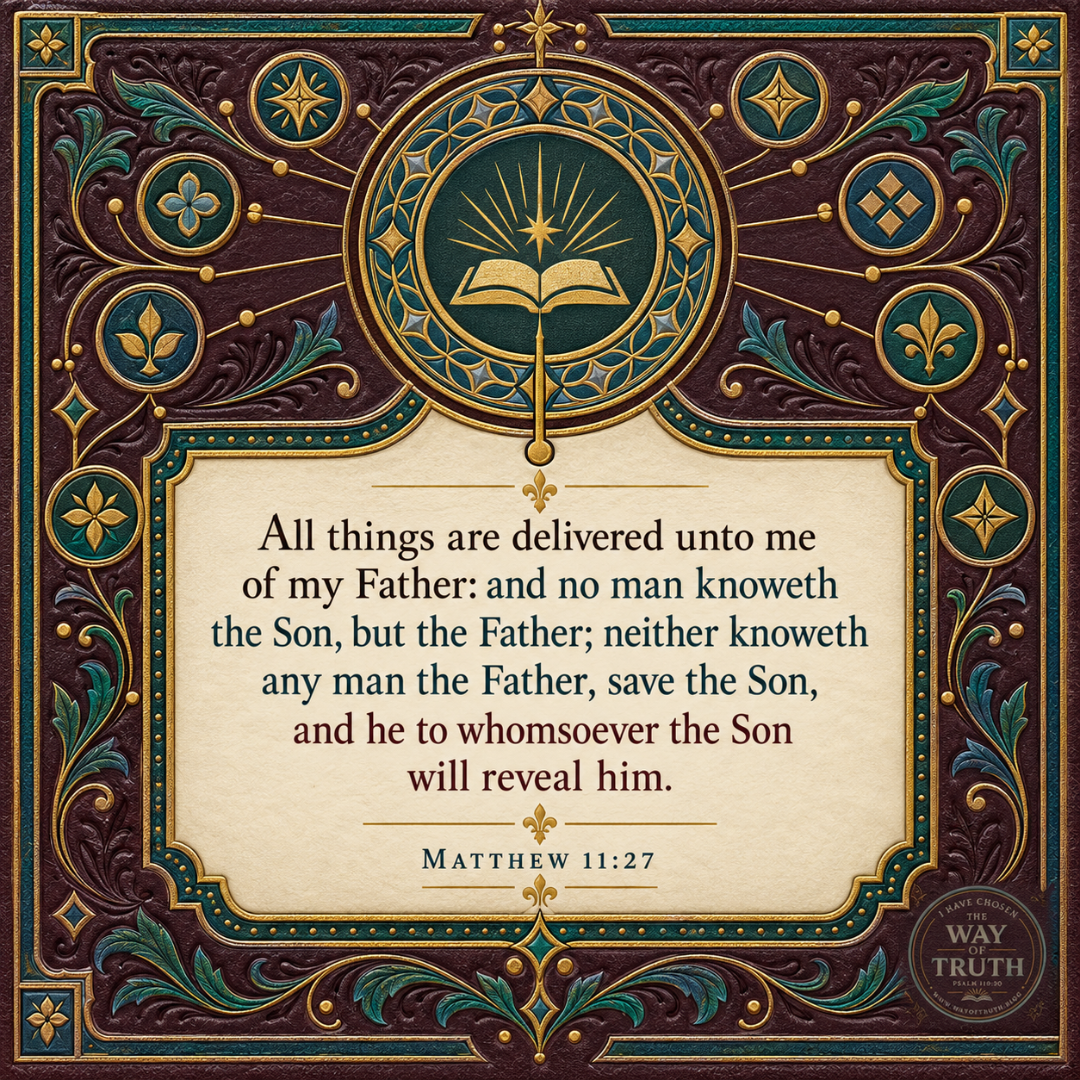
Matthew 11:27 grows directly out of what Jesus has just said. In verse 25, Jesus praised the Father because divine truth had been “hid” from the “wise and prudent” and “revealed” unto “babes.” In verse 26, He rested completely in the Father’s wisdom: “Even so, Father: for so it seemed good in thy sight.” Now Jesus explains something essential about that revelation. The Father doesn’t make Himself known independently of the Son. The Son stands at the very center of God’s self-revelation.
That makes verse 27 an important turning point. Jesus is no longer speaking merely about why some receive truth while others reject it. He tells us where the knowledge of God is found.
It’s found in Him.
This is an extraordinary claim. Jesus doesn’t present Himself as one religious teacher among many who happens to know a great deal about God. He claims a relationship with the Father that no one else possesses and an authority to reveal the Father that no one else has. And He begins with a sweeping statement.
“All Things Are Delivered Unto Me”
The Father has entrusted “all things” to the Son. In the immediate context, revelation is especially prominent. Jesus has been speaking about truth being hidden and revealed, and He’ll immediately speak of His unique knowledge of the Father. Yet “all things” is broader than merely possessing religious information. Jesus speaks as the One to whom the Father has given authority in the accomplishment of His divine mission.
Matthew will return to this truth near the end of his Gospel when the risen Christ declares: “All power is given unto me in heaven and in earth” (Matthew 28:18). The Jesus who speaks in Matthew 11 is already conscious of an authority far beyond that of a prophet, rabbi, or miracle worker.
At the same time, the words “delivered unto me of my Father” reveal the relationship between the Father and the Son. Jesus doesn’t act independently from the Father or in competition with Him. Throughout the Gospels, the Father and Son work in perfect harmony.
This statement shouldn’t be misunderstood as though Jesus were saying that the Father created Him and then promoted Him to a higher position. The verse is describing what has been entrusted to the Son in His mission, not explaining the origin of His existence. In fact, what Jesus says next makes reducing Him to a mere creature extremely difficult.
A Son Known Fully Only by the Father
Jesus continues: “and no man knoweth the Son, but the Father.” That doesn’t mean no human being knew anything about Jesus. Plenty of people knew His name, saw His miracles, heard His teaching, and knew that He came from Nazareth.
Some knew many facts about Him while completely misunderstanding who He truly was. That’s precisely the point.
The full reality of the Son can’t be discovered merely through human observation. People could watch Jesus heal the sick, hear Him preach, eat bread multiplied by His hands, and still ask, in one form or another, “Who is this man?”
His true identity runs deeper than outward appearances. Only the Father knows the Son completely. That statement becomes even more remarkable when Jesus immediately reverses it.
The Son’s Unique Knowledge of the Father
Jesus says: “neither knoweth any man the Father, save the Son.” Here the relationship becomes reciprocal. The Father uniquely knows the Son, and the Son uniquely knows the Father.
Jesus doesn’t say, “I understand God better than most people.” Nor does He place Himself at the end of a long line of prophets who gradually accumulated greater spiritual insight. The Son possesses a knowledge of the Father that belongs uniquely to Him.
John expresses the same truth: “No man hath seen God at any time; the only begotten Son, which is in the bosom of the Father, he hath declared him” (John 1:18). This helps us understand why Jesus can reveal the Father perfectly. He does’t give secondhand information.
The prophets spoke truthfully because God revealed truth to them. Jesus is different. He knows the Father in a unique and immediate way arising from His relationship as the Son. That’s one reason Christianity can’t reduce Jesus to simply a moral teacher. A moral teacher might tell us how God wants us to behave. A prophet might tell us what God has said. Jesus claims to make God Himself known.
The Son Isn’t Merely One More Messenger
Matthew 11:27 presents serious difficulty for any view that reduces Jesus to a created spiritual messenger. Ancient Arianism and modern groups that similarly deny the full deity of Christ attempt to place Jesus somewhere between God and ordinary humanity: greater than us, perhaps, but still fundamentally a creature. This verse contradicts that framework.
The Father uniquely knows the Son. The Son uniquely knows the Father. And the Son possesses the authority to reveal the Father to others. No prophet in Scripture speaks this way.
Moses knew God. David knew God. Isaiah knew God. John the Baptist knew God. Yet none of them could say that no one knows the Father except himself and those to whom he chooses to reveal Him.
There’s also an important distinction between Father and Son here. They’re not merely two titles for the same divine Person. The Father knows the Son, and the Son knows the Father. There’s genuine personal distinction alongside profound unity.
Matthew 11:27 doesn’t contain a complete explanation of the doctrine of the Trinity, but it fits naturally within what Scripture progressively reveals: the Father is God, the Son is God, the Father is not the Son, and yet there is one God.
The verse also confronts a very modern idea: that Jesus may be helpful for Christians, while people can know God just as well through entirely separate spiritual paths. Jesus doesn’t leave that option open. He says that the Father is known through the Son.
That may sound exclusive, because it is. But Christian exclusivity isn’t the claim that Christians are unusually clever people who discovered the correct religion while everybody else has failed. It’s almost the opposite. Humanity didn’t climb its way upward and discover God. God came down and made Himself known.
“He to Whomsoever the Son Will Reveal Him”
The final words of the verse bring us back to the theme that began in verse 25: “and he to whomsoever the Son will reveal him.” Knowing God requires revelation. Human intelligence alone can’t accomplish it. Education can’t accomplish it. Religious tradition can’t accomplish it. Philosophical sophistication can’t accomplish it. God must make Himself known. And Jesus says that He’s the One who reveals the Father.
Notice also the strength of His wording. He does’t say the Son reveals the Father to whomever the Father reluctantly permits Him to tell. The Son possesses genuine authority: “whomsoever the Son will reveal him.”
Christ isn’t merely carrying information from one place to another like a heavenly courier. He possesses authority in the giving of divine revelation. Yet the very next words spoken by Jesus prevent us from turning this sovereignty into fatalism. Matthew 11:28 begins: “Come unto me, all ye that labour and are heavy laden, and I will give you rest.”
The sovereign Son who chooses to reveal the Father is also the Son who openly calls the weary to come to Him. Scripture gives us both truths. We should be careful not to weaken either one.
A Verse Bigger Than Our Theological Systems
The words “he to whomsoever the Son will reveal him” naturally enter the long-running discussion between Calvinists and Arminians.
Calvinists rightly emphasize that this verse places the initiative with Christ. The Son isn’t passively waiting for spiritually neutral people to discover Him. Revelation depends upon divine action, and the Son’s will is plainly involved. Human beings can’t congratulate themselves for having independently reasoned their way to God.
Arminians rightly point out that the verse doesn’t explain the entire process by which divine revelation and human response relate. It doesn’t explicitly say that the Son reveals the Father only to an unchangeably predetermined group, nor does it describe whether grace can be resisted. Furthermore, the next verse contains Christ’s genuine invitation: “Come unto me, all ye that labour and are heavy laden.”
The immediate context therefore gives us something more basic than either theological system. No one truly knows the Father apart from the gracious revelation of the Son, and the Son possesses sovereign authority in giving that revelation. That conclusion comes directly from Jesus’ words.
Questions concerning election, prevenient grace, effectual calling, human freedom, and the resistibility of grace must be answered from the whole counsel of Scripture rather than settled by forcing all of them into this single sentence.
Matthew seems quite comfortable placing divine sovereignty and human responsibility beside one another. We should be careful about becoming uncomfortable where Scripture isn’t. The revelation is Christ’s to give. The invitation is also Christ’s to extend. Both are true.
You Can’t Know the Father While Bypassing the Son
There’s a deeply practical truth here that our culture increasingly resists. People often speak warmly about “God” while remaining deliberately vague about who they mean.
A generic God is relatively easy to live with. We can quietly reshape Him according to our preferences. He can approve our values, endorse our priorities, overlook whatever sins we would prefer not to discuss, and generally remain agreeable. Jesus doesn’t give us that option.
If we want to know the Father, we must come through the Son. Later Jesus will say: “I am the way, the truth, and the life: no man cometh unto the Father, but by me” (John 14:6).
Matthew 11:27 lays the foundation for that same truth. Jesus isn’t simply one source of information about God. He’s the One through whom the Father is known. We can’t correct Jesus with our preferred picture of God. Jesus corrects our picture of God.
Knowing God by Looking to Christ
For believers, Matthew 11:27 should reshape the way we think about knowing God. We sometimes speak about “wanting to know God better” as though the answer were hidden somewhere behind a spiritual curtain and we simply need to become insightful enough to pull it back. Jesus points us somewhere much more concrete. Look to the Son.
If you want to understand the holiness of God, look at Christ’s hatred of sin. If you want to understand the compassion of God, watch Christ touch the leper, receive the outcast, and show mercy to sinners. If you want to understand God’s attitude toward hypocrisy, listen to Jesus confront it. If you want to understand God’s love, look toward Calvary. If you want to understand God’s power over death, look at the empty tomb. The answer to our desire to know God more deeply isn’t to move beyond Christ into something supposedly deeper. We go deeper into the truth of who Christ is.
That should affect the way we read Scripture. Bible study isn’t simply the collection of interesting facts, theological vocabulary, historical details, or cross-references. Those things can be useful, but they’re not the goal. We’re listening to the God who’s made Himself known.
It should also produce humility. If knowing God depends upon His gracious revelation, none of us has grounds for spiritual pride. We didn’t figure God out. He revealed Himself.
That should make the local church a strange place for intellectual arrogance. Some believers have extensive theological training. Others have never attended a seminary class. Some can explain difficult doctrines in detail. Others struggle to pronounce half the names in Numbers. Yet every genuine believer knows God for exactly the same fundamental reason: God has graciously made Himself known through His Son. There’s room for growth in understanding, of course. But there’s no room for boasting.
This truth should also deepen our worship of Christ. Sometimes Christians unconsciously treat Jesus mainly as the One who solved our sin problem so that we could get back to God. Scripture gives us something richer. In Christ, God comes near and makes Himself known. We don’t leave Jesus behind once we’ve been forgiven so that we can pursue some supposedly higher spirituality. Christ remains central forever.
And that has enormous importance for the Church’s mission. Our task isn’t to make Christianity sound vaguely spiritual enough that everyone can fit Jesus into whatever beliefs they already hold. We’re called to proclaim Him. Paul wrote: “For we preach not ourselves, but Christ Jesus the Lord” (2 Corinthians 4:5).
That is still the Church’s mission. We can’t reveal the Father in the unique way Christ does. But we can faithfully point people to the Son who does. That means evangelism doesn’t require us to win every philosophical debate, answer every possible objection on the spot, or possess a personality capable of charming strangers within thirty seconds. We bear faithful witness to Jesus Christ through Scripture and entrust the work of revelation to God.
This verse should therefore encourage believers who feel inadequate in evangelism. The salvation of another person doesn’t ultimately depend upon our eloquence. Be clear. Be truthful. Be gracious. Know the gospel well enough to explain it. Answer questions when you can. Admit when you don’t know something. But point people to Christ. He’s the One who reveals the Father.
There’s also comfort here for our own uncertain moments. There may be times when God seems difficult to understand. Providence can confuse us. Suffering can raise painful questions. Prayers may appear unanswered. Circumstances may not fit the picture we expected.
Matthew 11:27 reminds us not to build our understanding of God’s character primarily from changing circumstances. Look again to Christ.
We may not understand everything God’s doing, but in Jesus Christ we haven’t been left wondering what God’s like. The Son has made the Father known. And immediately after saying so, Jesus turns toward weary people and says: “Come unto me.”
That’s not accidental. The One who reveals the Father also welcomes the burdened. Knowing God isn’t merely filling our minds with correct information about Him. Through Christ, sinners are invited into a reconciled relationship with the God they were created to know.
The God Who’s Made Himself Known
Perhaps you’ve wondered whether God can really be known. Maybe you believe He exists but have never known what to do with that belief. Perhaps religion has seemed like a maze of competing opinions, each claiming to know something about a God none of us can see.
Matthew 11:27 gives a remarkably direct answer.
God hasn’t left us to find Him by guessing. He’s revealed Himself through His Son, Jesus Christ. That matters because our deepest problem isn’t merely that we lack information about God. Our problem is sin. Scripture says: “For all have sinned, and come short of the glory of God” (Romans 3:23). That includes every one of us. We’ve broken God’s commands, resisted His authority, loved ourselves more than our Creator, and failed to give Him the glory He deserves.
Sin carries a penalty. “For the wages of sin is death” (Romans 6:23). We can’t erase that guilt by becoming nicer people, doing religious works, attending church, giving money, or promising God that we’ll try harder.
But the God we’ve sinned against has acted to save us. Jesus Christ, the eternal Son of God, came into this world, lived without sin, and willingly died upon the cross. There He bore the judgment sinners deserve. Scripture says: “Christ died for our sins according to the scriptures; And that he was buried, and that he rose again the third day according to the scriptures” (1 Corinthians 15:3–4). Jesus didn’t remain in the grave. He rose bodily from the dead, victorious over sin and death.
Now He calls sinners to repent and believe. Repentance means turning from your rebellion against God. Faith means trusting Jesus Christ rather than yourself, your morality, your religion, or anything else to make you right with God.
And the invitation is real. The same Jesus who says in verse 27 that He reveals the Father will say in the very next verse: “Come unto me, all ye that labour and are heavy laden, and I will give you rest” (Matthew 11:28).
You’re not being asked to discover your own path to God. Christ is calling you to Himself. Come to Him with your guilt. Come with your questions. Come knowing that you have nothing with which to purchase God’s favor.
Trust the Savior who died for sinners and rose again. Through Him you can be forgiven, reconciled to God, given new life, and receive the gift of eternal salvation. And then live the life He gives you for the glory of the Father whom the Son has graciously made known.
Reflection and Response
- When I think about what God’s like, am I allowing Jesus Christ and Scripture to shape that understanding, or have I constructed a version of God that better fits my own preferences?
- How does Christ’s unique knowledge of the Father deepen my worship of Him and remind me to give God glory for making Himself known rather than taking spiritual understanding for granted?
- Does the fact that knowing God depends upon His gracious revelation produce humility in me, especially when interacting with believers who have different levels of biblical knowledge or theological training?
- When God’s providence is difficult for me to understand, do I judge His character primarily by my circumstances, or do I return to the clearest revelation of His character in Jesus Christ?
- Who in my life needs to hear that God hasn’t left us searching blindly for Him, but has made Himself known through Jesus Christ, and how can I faithfully share that good news with them?