
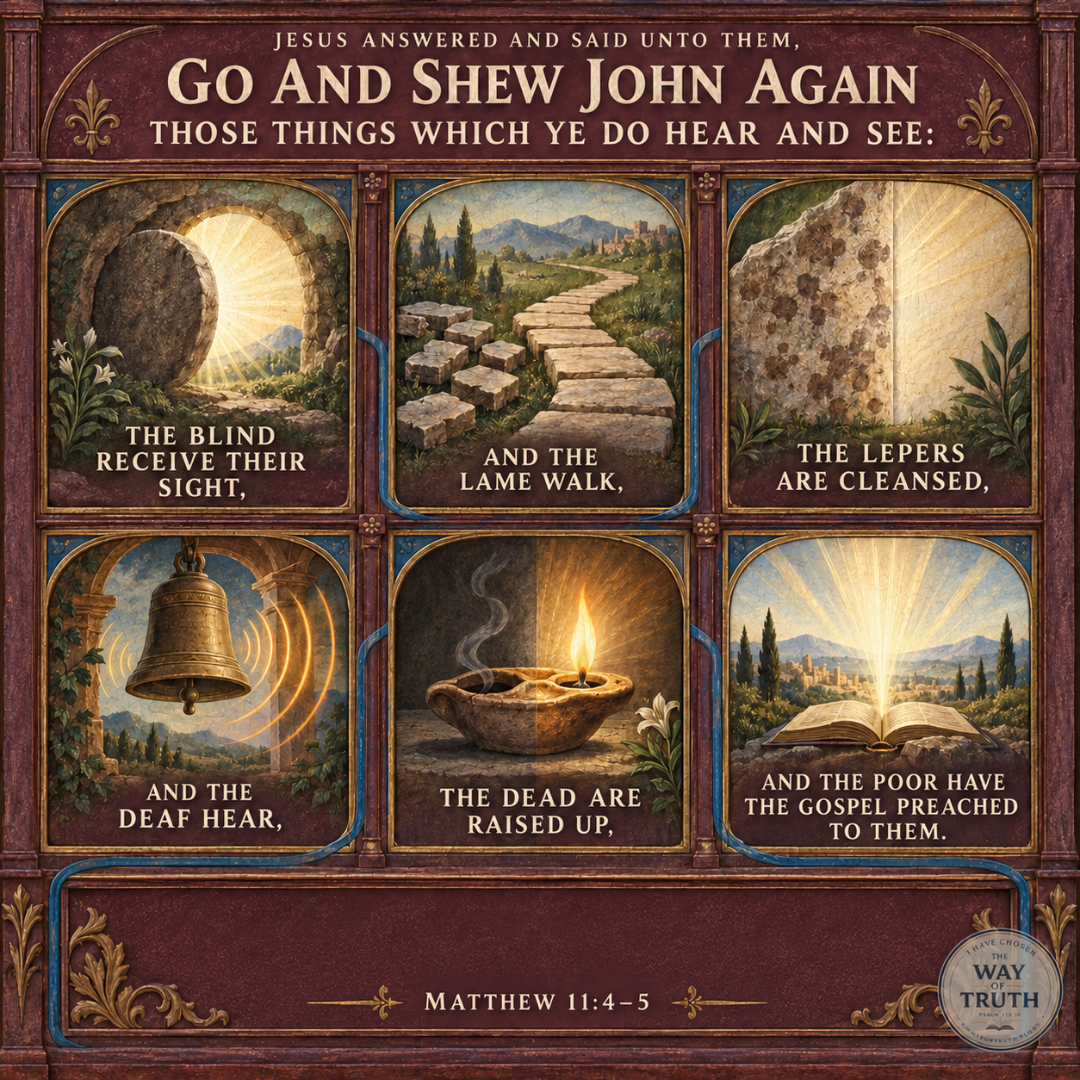
John the Baptist had sent two disciples to ask Jesus, “Art thou he that should come, or do we look for another?” Jesus now answers them, but He doesn’t respond with a bare yes. Nor does He criticize John for asking. He points to what is happening before their eyes.
“Go and shew John again those things which ye do hear and see.”
The word “shew” means to report or announce. John’s disciples were to return with firsthand testimony. They had heard Christ’s teaching and seen His works. Their assignment wasn’t to improve the story, argue John into submission, or offer their own theories about why he remained in prison. They were simply to tell him what Jesus was doing.
That isn’t an evasive answer. It’s a stronger answer than a mere claim because it gives John evidence he can compare with Scripture. Anyone can claim an impressive title. Jesus directs attention to works that reveal who He is.
His answer also treats John with remarkable tenderness. Jesus knows that John needs more than a slogan. The imprisoned prophet needs something solid enough to carry back into his cell. Christ therefore gives him truth grounded in divine revelation and confirmed by observable events.
Faith isn’t strengthened by pretending that hard questions don’t exist. It’s strengthened when those questions are brought under the light of God’s Word and the works of Christ.
The Evidence Matthew Has Already Presented
These verses build directly upon the preceding chapters. Matthew doesn’t suddenly introduce reports of miracles because John has asked for proof. The Gospel has already shown Jesus performing the very works He now describes.
Christ cleansed a leper in Matthew 8:1–4. He enabled a paralyzed man to rise and walk in Matthew 9:1–8. He restored sight to two blind men in Matthew 9:27–31. He raised a ruler’s daughter from death in Matthew 9:18–26. Throughout Galilee, He was “teaching in their synagogues, and preaching the gospel of the kingdom, and healing every sickness and every disease among the people” (Matthew 9:35).
Matthew has allowed the reader to see the evidence before recording John’s question about it. Jesus’ response in Matthew 11:4–5 gathers those earlier works into a concentrated summary. The miracles of chapters 8 and 9 weren’t disconnected displays of power. Together they identified the King and revealed the character of His kingdom.
Matthew 11:1 also tells us that Jesus continued “to teach and to preach in their cities.” John then heard “the works of Christ” from prison. Now Jesus explains how those works should be understood. His miracles and His message belong together. His deeds confirm His words, and His words explain His deeds.
Isaiah’s Promises Coming to Life
Jesus’ answer draws upon several promises in Isaiah. He doesn’t quote one passage word for word. Instead, He brings together a recognizable collection of prophetic signs.
Isaiah had written: “Then the eyes of the blind shall be opened, and the ears of the deaf shall be unstopped. Then shall the lame man leap as an hart, and the tongue of the dumb sing” (Isaiah 35:5–6).
Isaiah also described the Lord’s Anointed One as sent “to preach good tidings unto the meek” (Isaiah 61:1).
John knew those Scriptures. Jesus was effectively telling him, “Judge what you hear by what God has already promised.” Blind eyes were opening. Deaf ears were hearing. Lame people were walking. The unclean were being cleansed. The dead were being raised. Good news was reaching people whom society routinely ignored. Isaiah’s promised restoration was no longer confined to a scroll. It was taking place wherever Jesus went.
There’s also a deeper claim within Isaiah 35. The promised signs follow the declaration, “Behold, your God will come.” Jesus applies those signs to His own ministry. He’s not presenting Himself merely as another prophet who predicts God’s saving work. God’s saving power is arriving through Him.
The works don’t replace Scripture as the standard of truth. They fulfill it. The prophecies explain the works, and the works confirm that God’s promises are unfolding in Christ.
The Messiah Restores What Sin Has Ruined
“The blind receive their sight, and the lame walk.”
Blindness and physical disability aren’t presented as proof that particular individuals committed particular sins. Jesus rejected that careless assumption elsewhere. Yet sickness, suffering, disability, and death exist because humanity lives in a world broken by sin. They’re part of the larger ruin that entered creation through mankind’s rebellion against God.
When Jesus restores sight and enables the lame to walk, He displays His authority over that ruin. His miracles are acts of real compassion toward real people, but they’re also signs of something greater. They offer a preview of the complete restoration God will bring through His kingdom.
“The lepers are cleansed, and the deaf hear.”
Leprosy brought physical misery and social separation. Under the law, a leper was regarded as ceremonially unclean. Jesus didn’t keep such people at a safe spiritual distance. He touched the untouchable, removed the disease, and cleansed the unclean.
The deaf also received more than an inspiring message about discovering their inner potential. They actually heard. The bodily nature of these miracles matters. Suffering isn’t an illusion, and salvation isn’t merely a change in how we think about our circumstances. Christ entered a suffering world and exercised genuine authority over its afflictions.
“The dead are raised up.”
Here the evidence reaches its dramatic height. Disease might sometimes improve naturally. Death doesn’t. When Jesus raised the dead, He demonstrated authority over mankind’s final enemy.
Those whom Jesus raised during His earthly ministry eventually died again. Their restoration was real, but temporary. His own resurrection would be different. He would rise in victory, never to die again. These earlier miracles therefore point beyond themselves to the One who would declare, “I am the resurrection, and the life” (John 11:25).
Good News Reaches the Poor
The final evidence Jesus gives may sound less spectacular than raising the dead: “and the poor have the gospel preached to them.” Yet Christ places gospel proclamation alongside His mighty miracles as proof of His identity.
The poor often lacked social influence, political power, education, and access to respected religious circles. Jesus didn’t treat them as an inconvenient audience or an unpromising ministry demographic. The good news of God’s kingdom was proclaimed openly to them.
This doesn’t mean poverty earns salvation. Scripture doesn’t teach that every poor person is righteous or that every wealthy person is condemned. Everyone must repent and believe. The point is that God’s grace isn’t reserved for those who can purchase influence, impress religious leaders, or offer something valuable in return.
Human systems tend to work upward. They seek the approval of people with wealth, status, and connections. The gospel moves freely toward those who have nothing with which to bargain. In Christ’s kingdom, no one is too poor to hear, too unimportant to notice, or too broken to receive mercy.
Nor should this phrase be reduced to either physical relief or social reform. Jesus cared for bodily needs, but He also preached the gospel. Food, medicine, shelter, and compassionate service matter deeply, yet none of them can reconcile a sinner to God. On the other hand, gospel proclamation should never become an excuse for cold indifference toward suffering. Christ’s ministry joined truthful preaching with visible mercy without confusing the two.
Mercy Has Arrived, but the Story Isn’t Finished
John had preached that the Coming One would bring both salvation and judgment. Isaiah had also joined those themes. Isaiah 35 spoke of God coming with vengeance and salvation, while Isaiah 61 announced both “the acceptable year of the Lord” and “the day of vengeance of our God.”
Jesus’ answer emphasizes restoration, mercy, and gospel proclamation. The promised judgment hadn’t been forgotten, but it hadn’t yet arrived in its final form. John’s difficulty arose partly because he could see one side of the prophetic promise unfolding while another side appeared delayed.
There’s a painful detail here. Jesus mentions cleansing, healing, resurrection, and good news, but John is still in prison. Isaiah 61 spoke of “the opening of the prison to them that are bound,” yet John’s cell door remained closed. Jesus was fulfilling God’s Word perfectly, but not according to the timetable John may have expected.
We should be careful not to claim that Jesus deliberately omitted prison release as a coded message to John. The text doesn’t say that. Still, John couldn’t have missed the personal tension. God’s saving work was advancing, yet his own circumstances remained unchanged.
That tension continues in the Christian life. Christ may be working powerfully while one particular prayer remains unanswered. Evidence of His faithfulness doesn’t mean every grief is immediately removed. The kingdom has truly entered history through Christ, but its fullness awaits His return.
What These Miracles Do and Don’t Mean
Jesus’ miracles weren’t religious theater. They were compassionate works, fulfillments of prophecy, and signs identifying Him as the promised Messiah. They showed that the powers of sin, disease, uncleanness, and death couldn’t withstand His authority.
The passage doesn’t, however, promise that every believer will receive immediate physical healing. John himself remained imprisoned and would soon be put to death. Faithful Christians still become sick, live with disabilities, suffer persecution, and die. It’s cruel to tell suffering believers that their continued illness proves they lack faith. Matthew 11:4–5 gives us no permission to place that burden upon them.
Christians may pray boldly for healing because God is powerful and compassionate. We should also use the ordinary means He provides, including responsible medical care. But our final hope isn’t that every present affliction will disappear before death. Our hope is the resurrection, when Christ will complete the restoration His miracles anticipated.
Neither may we strip these works of their supernatural character and turn them into metaphors for social improvement. Matthew describes people actually seeing, walking, hearing, being cleansed, and returning from death. Jesus is certainly concerned with the whole person, but the text won’t allow us to shrink Him into a humanitarian teacher with unusually memorable sayings.
Evidence Worth Examining
Some modern readers dismiss miracles before considering the testimony because they assume that supernatural events can’t occur. But that’s not a conclusion reached from the evidence. It’s a rule imposed upon the evidence beforehand.
Matthew presents Jesus’ works as public and observable. John’s messengers are told to report what they hear and see. Earlier chapters provide particular examples involving homes, crowds, religious leaders, disciples, desperate families, and people whose changed conditions could be recognized. Later opponents within Matthew’s Gospel don’t simply say that nothing happened. They attempt to explain Christ’s power in a hostile way (Matthew 12:24).
This doesn’t mean the passage demands thoughtless acceptance of every modern miracle claim. Jesus warned about false prophets, and Scripture calls believers to exercise discernment. Extraordinary claims shouldn’t be accepted merely because a persuasive speaker, emotional crowd, or carefully edited video promotes them.
The works of Jesus occupy a unique place in God’s plan. They agree with earlier prophecy, accompany holy teaching, display compassion rather than vanity, and direct attention to Christ rather than to a human performer. Most importantly, they form part of the larger testimony that leads to His death and bodily resurrection.
Christian faith isn’t blind faith. It listens to God’s Word, considers God’s works, and trusts the Christ to whom both testify.
Learning to Recognize the Work of Christ
Jesus’ answer teaches us how to evaluate what God is doing when His work doesn’t match our expectations.
We begin with Scripture. John wasn’t asked to measure Jesus against popular excitement, political frustration, or his own preferred timetable. He was given evidence that corresponded with God’s written promises. We need the same discipline. A ministry isn’t faithful merely because it’s growing, exciting, emotional, or widely praised. The real question is whether its message, methods, and fruit agree with the Word of God.
We should also learn to notice forms of grace that the world overlooks. A crowd might be impressed by a spectacular healing while barely noticing that the poor hear the gospel. Jesus includes both. Heaven doesn’t measure significance by publicity. When the gospel is faithfully explained to a struggling family, a forgotten neighbor, a prisoner, a nursing-home resident, or someone who can’t repay the kindness, Christ’s priorities are being honored.
Churches should therefore hold proclamation and compassion together. We must tell people plainly about sin, repentance, forgiveness, and eternal life in Christ. We must also care about hunger, illness, loneliness, disability, and practical need. Mercy without the gospel may relieve temporary suffering while leaving the deepest need untouched. Words without mercy can make a truthful message sound strangely unlike the compassionate Savior who proclaimed it.
This passage also corrects our attraction to status. Jesus regarded preaching to the poor as evidence that God’s promised salvation had arrived. We sometimes build ministries around the people most likely to increase attendance, improve finances, or expand influence. Christ notices those who have nothing impressive to offer. His Church should be a place where a person’s bank account, clothing, education, occupation, or social confidence doesn’t determine how warmly that person is received.
For believers living with illness or disability, these verses offer hope without making false promises. Jesus isn’t indifferent to bodily pain. His healings prove His compassion and His authority. If He doesn’t remove an affliction now, that doesn’t mean He’s unable, uncaring, or absent. The miracles assure us that suffering won’t have the last word. The same Lord who made the lame walk and raised the dead will one day raise all who belong to Him.
We also learn something about Christian testimony. John’s disciples were told to report what they’d heard and seen. We must be equally honest. We don’t need to embellish God’s work to make Christ appear impressive. Exaggerated stories, dubious miracle claims, and polished testimonies that hide every ongoing struggle eventually damage trust. Tell the truth about what Christ has done. Tell the truth about what remains difficult. His glory doesn’t depend upon our creative editing.
Perhaps you’re in a season when you can see God working in many places except the one place where you most want relief. John heard about healing while sitting in prison. That must have been difficult. Matthew 11:4–5 doesn’t give a quick explanation for every unanswered prayer. It gives us Christ Himself, acting consistently with Scripture and steadily advancing His saving work.
When you can’t understand every part of His plan, pay careful attention to what God has already revealed. Remember Christ’s works. Listen to His words. Let Scripture interpret the moment rather than allowing the moment to rewrite Scripture.
The Good News for Those Who Can’t Rescue Themselves
The final line of Christ’s answer opens the door for each of us personally: “the poor have the gospel preached to them.” The gospel comes as good news because our condition before God is far worse than we can repair and His grace is far greater than we deserve.
Our deepest problem isn’t poor health, limited income, social rejection, or disappointed expectations. Those burdens are real, but beneath them lies a universal problem: sin. “For all have sinned, and come short of the glory of God” (Romans 3:23). We’ve disobeyed God, pursued our own way, and failed to love Him with the whole heart. No amount of kindness, religion, or self-improvement can erase that guilt.
Sin brings a penalty. “For the wages of sin is death” (Romans 6:23). Physical death is part of that judgment, but Scripture also warns of final separation from God. We can’t heal our own spiritual blindness, cleanse our own guilt, or raise ourselves from spiritual death. We’re the poor in the most basic sense: we have nothing with which to purchase peace with God.
But the verse continues with good news. The One who opened blind eyes and raised the dead came to accomplish a greater rescue. Jesus Christ, the sinless Son of God, took the judgment sinners deserve when He died upon the cross. He didn’t die because evil overcame Him. He willingly gave Himself as the sacrifice for sin.
Scripture declares “that Christ died for our sins according to the scriptures; And that he was buried, and that he rose again the third day according to the scriptures” (1 Corinthians 15:3–4). His resurrection isn’t merely a symbol of hope. He conquered death. The One who raised others was Himself raised, and He lives forever.
God now commands us to repent and believe the gospel. Repentance means turning from sin and abandoning our claim to rule our own lives. Faith means relying upon Jesus Christ rather than our morality, church background, good intentions, or religious effort. Salvation can’t be bought, earned, or negotiated. It’s received through faith in Christ.
The promise is wonderfully plain: “Believe on the Lord Jesus Christ, and thou shalt be saved” (Acts 16:31). Everyone who comes to Him in repentance and faith receives forgiveness, new life, reconciliation with God, and the sure hope of resurrection.
You don’t need influence to approach Him. You don’t need an impressive record, polished words, or something valuable to offer. Come honestly, acknowledging your sin and trusting in what Christ has accomplished. The gospel is good news for those who know they can’t save themselves.
Turn to Jesus Christ today. Receive Him as Savior, follow Him as Lord, and let the life He gives be lived for His glory.
Reflection and Response
- When circumstances confuse me, do I evaluate Christ by my expectations, or do I allow Scripture to shape my understanding of His work?
- What do Jesus’ works in this passage reveal about His identity, compassion, and authority?
- Does my concern for people hold gospel proclamation and practical compassion together, or have I neglected one in favor of the other?
- Am I tempted to overlook people who lack status, influence, wealth, or the ability to repay my kindness?
- Where do I need to trust Christ’s revealed character even though He hasn’t changed a painful circumstance in the way I hoped?