
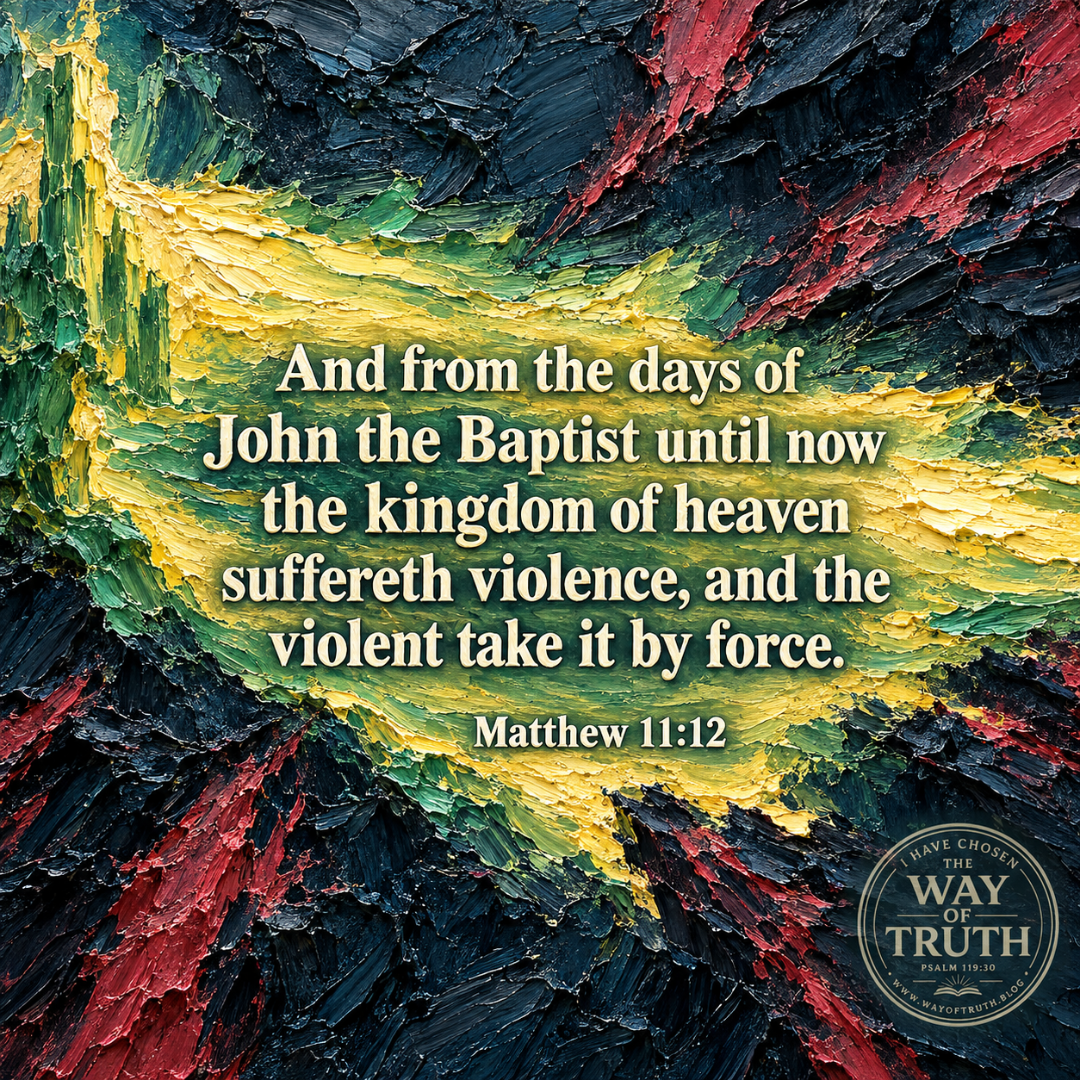
Matthew 11:12 is one of the more difficult sayings of Jesus. At first glance, it may sound as though Christ is praising aggressive people who force their way into the kingdom of heaven. That interpretation has appeared in Christian teaching, usually as an appeal for spiritual earnestness. There’s a valid lesson elsewhere in Scripture about seeking the Lord wholeheartedly, but the immediate context points in a different direction here.
Jesus has been explaining the importance of John the Baptist. John wasn’t a wavering reed, a comfortable courtier, or merely one prophet among many. He was the promised messenger who prepared the way for Christ. Yet as Jesus spoke, that faithful messenger was sitting in Herod’s prison.
That fact casts a shadow over verse 12.
“The days of John the Baptist” refers to the period beginning with John’s public ministry. John announced, “Repent ye: for the kingdom of heaven is at hand” (Matthew 3:2). His preaching marked a decisive moment in God’s unfolding work. The promised King had arrived, and the kingdom was being openly proclaimed.
But the announcement didn’t produce universal repentance. It exposed sin, threatened comfortable arrangements, and provoked opposition. Herod imprisoned John because John had confronted his unlawful marriage. Religious leaders rejected John’s baptism. Many people later resisted Jesus even after witnessing His works. The kingdom had drawn near, but sinful men didn’t quietly surrender their authority.
Where the reign of God is proclaimed, rebellion is uncovered.
“The Kingdom of Heaven Suffereth Violence”
The words “suffereth violence” can be understood in more than one way. Some interpreters take them positively, meaning that the kingdom is advancing powerfully and spiritually earnest people are pressing into it. They connect this with Luke 16:16: “The law and the prophets were until John: since that time the kingdom of God is preached, and every man presseth into it.”
This reading contains an important truth. Entering the kingdom isn’t a matter of casual curiosity. Christ calls sinners to repent, believe, deny themselves, and follow Him. No one should imagine that an indifferent nod toward Jesus is saving faith.
Even so, Matthew’s wording and immediate context favor a darker emphasis. The “violent” are most naturally understood as hostile people, and John’s imprisonment provides a living example of the violence being described. The kingdom “suffereth violence” in the sense that its messengers and its King are being attacked. Men are attempting to oppose, control, and suppress what God’s doing.
This doesn’t mean that anyone can overthrow God’s sovereign reign. Human beings can’t break into heaven, overpower God, or steal eternal life from His people. Jesus is describing how the kingdom is treated as it enters a rebellious world. Its herald has been seized. Its King is being slandered. Before long, Christ Himself will be arrested and crucified.
The verse therefore describes attempted assault, not successful conquest.
The Violent Try to Seize What Belongs to God
“The violent take it by force” continues the picture. The language suggests people laying hostile hands upon the kingdom and its representatives. Herod had already seized John. The religious establishment would increasingly oppose Jesus. Some would eventually try to use His popularity for political purposes, while others would plot His death.
Their methods varied, but their underlying error was the same: they refused to receive God’s kingdom on God’s terms.
Some wanted a kingdom without repentance. Others wanted national deliverance without inward righteousness. The religious leaders wanted to preserve their influence. Herod wanted to preserve his sinful relationship. Each tried, in one way or another, to make God’s work submit to human desires.
That temptation remains with us. People may not place a prophet in prison, but they still try to reshape Christ’s kingdom. Political movements may attempt to recruit Jesus as a mascot. Religious leaders may use His name to build personal empires. Individuals may want Christ as Savior while resisting His authority as Lord. Modern culture is often willing to tolerate a harmless, agreeable Jesus who blesses every desire. The biblical Christ, however, commands repentance and exposes sin. That Christ still meets resistance.
Matthew 11:12 doesn’t authorize Christians to spread the faith through physical force. Christ’s kingdom isn’t advanced by coercion, intimidation, or violence. Jesus later told Peter, “Put up again thy sword into his place: for all they that take the sword shall perish with the sword” (Matthew 26:52). The gospel summons people to willing repentance and faith; it doesn’t drag them into the kingdom at sword point.
The verse also doesn’t teach that salvation is seized through human effort. Eternal life is God’s gift, not a prize captured by the strongest, loudest, or most disciplined person. Spiritual earnestness matters, but earnestness doesn’t purchase grace. We enter the kingdom because Christ saves sinners who repent and believe.
Opposition Doesn’t Mean God’s Plan Has Failed
John’s imprisonment could have looked like defeat. The promised messenger had faithfully completed his work, yet he was confined while a wicked ruler remained in power. If outward circumstances were the only measure of success, Herod appeared to be winning.
Jesus saw the situation differently.
John remained God’s appointed messenger. His chains didn’t cancel the prophecy concerning him. Herod could control the prison door, but he couldn’t reverse God’s Word. The King had come, the kingdom was being proclaimed, and redemption was moving toward the cross exactly as God had purposed.
This pattern continues throughout Scripture. Pharaoh oppressed Israel, but God delivered His people. Jezebel threatened Elijah, but she couldn’t silence God’s truth. Babylon burned Jerusalem, yet the Lord preserved a remnant and fulfilled His promises. Religious and political authorities crucified Christ, but their worst act became the very means through which God accomplished redemption. As Peter later declared, Jesus was delivered “by the determinate counsel and foreknowledge of God” (Acts 2:23).
The cross is the clearest demonstration that human hostility can’t defeat divine purpose. Men treated Christ as though He were helpless, but His death wasn’t the collapse of His mission. It was its fulfillment. He rose bodily from the grave, conquered death, and now reigns as Lord.
Violence may wound the kingdom’s servants, but it can’t dethrone its King.
Faithfulness in a World That Pushes Back
Matthew 11:12 prepares believers for an uncomfortable reality: genuine faithfulness won’t always be applauded. Sometimes obedience disrupts the peace people have made with sin. John could have enjoyed an easier life if he had remained silent about Herod’s conduct. He chose faithfulness instead.
Christians must be careful here. Not every unpleasant reaction proves that we’ve been persecuted for righteousness. Sometimes people resist us because we’ve been harsh, careless, proud, or needlessly argumentative. Being offensive isn’t the same as suffering for Christ. The gospel itself is an offense to human pride, but our behavior shouldn’t add an unnecessary stumbling block.
When opposition truly arises from loyalty to Christ, however, we shouldn’t assume that something has gone wrong. Jesus told His disciples, “If they have persecuted me, they will also persecute you” (John 15:20). Resistance isn’t always evidence of failure. It may reveal that the truth has reached a place people would rather keep hidden.
Standing Firm Without Becoming Violent Ourselves
The Church must never answer the world’s hostility by imitating it. We don’t defend Christ’s kingdom through rage, manipulation, threats, or cruelty. The weapons of Christian faithfulness are truth, prayer, holiness, love, patient endurance, and the clear proclamation of the gospel.
This requires real courage. It’s easier to shout than to remain composed under pressure. It’s easier to insult an opponent than to answer honestly and graciously. It’s easier to join a political or cultural mob than to speak with both conviction and compassion. Biblical courage isn’t loudness. It’s steady obedience when compromise would be more comfortable.
We should also examine whether we’ve subtly tried to take hold of God’s kingdom for our own purposes. Churches can become preoccupied with numbers, visibility, influence, or branding. Leaders can begin treating ministry as personal property. Believers can confuse loyalty to Christ with loyalty to a party, personality, denomination, or tradition.
Christ’s kingdom belongs to Christ. We’re servants within it, not owners of it.
That truth should produce humility. We proclaim the message He gave us. We obey the commands He established. We depend upon the power He supplies. We seek His glory rather than our recognition. If God gives visible fruit, we thank Him. If faithfulness brings rejection, we continue trusting Him.
Practical Courage for Everyday Faithfulness
Most believers won’t face imprisonment like John, but every Christian will feel some pressure to make obedience more convenient.
You may be encouraged to remain quiet when dishonesty benefits your workplace. You may fear losing a friendship if you speak honestly about Christ. A family member may treat biblical conviction as judgmental simply because it refuses to call sin good. You may even feel pressure within a church to follow personalities without carefully testing their teaching by Scripture.
Matthew 11:12 reminds us that resistance to God’s authority isn’t new. We should neither panic nor become bitter when it appears.
First, let this verse strengthen our confidence in God. The kingdom has endured imprisonment, slander, persecution, and martyrdom. It’s outlasted rulers who believed they could crush it. Christ is still saving sinners, building His Church, and keeping His promises. We don’t need to behave as though His throne depends upon our ability to win every argument.
Second, let it deepen our prayer for persecuted believers. For many Christians, hostility isn’t an abstract theological idea. They worship under surveillance, meet quietly, lose employment, face imprisonment, or suffer violence because they bear the name of Christ. Their suffering shouldn’t become background noise to comfortable churches. We should remember them, pray for them, support them where possible, and learn from their courage.
Third, let it correct our expectations about gospel ministry. Faithful proclamation may produce repentance in one hearer and anger in another. We can’t measure truth by immediate popularity. John’s message didn’t become false when Herod rejected it. Our responsibility isn’t to manufacture results but to speak God’s Word faithfully, clearly, and lovingly.
Fourth, we must guard our own hearts against the very resistance this verse exposes. It’s possible to admire John’s courage while resenting any part of Scripture that confronts us. Whenever we bargain with God, excuse cherished sin, or obey only the commands that fit our preferences, we’re resisting His rule. The right response is humble repentance.
Finally, this passage should shape the Church’s public witness. We must not confuse Christian courage with political aggression or cultural bullying. The Church proclaims a crucified and risen King. We persuade from Scripture, serve our neighbors, defend truth, show mercy, care for the vulnerable, and endure hostility without surrendering either conviction or love.
A frightened church may hide the truth. An angry church may speak the truth without Christlike love. A faithful church does neither. It stands firm, speaks clearly, suffers patiently, and keeps pointing people to Jesus.
The King Who Can’t Be Overthrown
Matthew 11:12 is sobering, but it’s not hopeless. The kingdom is opposed because fallen humanity resists the rightful rule of God. Yet that opposition won’t prevail.
John would eventually be killed. Jesus would be crucified. The apostles would suffer. From a merely human point of view, the violent appeared to take everything.
But Christ rose from the dead.
That changes how we read every prison cell, every threat, and every apparent setback. Evil may act fiercely, but it acts within limits established by God. The kingdom’s servants may suffer temporary loss, but the King will bring His work to completion. Scripture’s record is morally coherent and historically grounded precisely because it doesn’t hide this conflict or pretend that faithful people always enjoy easy circumstances. It shows God fulfilling His promises through real opposition, real suffering, and ultimately real victory.
Our confidence isn’t that the world will become harmless. Our confidence is that Christ remains Lord.
Come Willingly to the King
Perhaps you recognize something of your own heart in the resistance described by this verse. You may not consider yourself hostile to God. You may respect Jesus, appreciate Christian values, or believe that religion has a useful place. But the deeper question is whether you’ve submitted to Christ Himself.
By nature, every one of us resists God’s rightful authority. Scripture says, “For all have sinned, and come short of the glory of God” (Romans 3:23). Sin includes the wrong things we do, but it goes deeper than individual actions. It’s the stubborn desire to rule ourselves instead of trusting and obeying our Creator.
That rebellion carries a real penalty: “For the wages of sin is death” (Romans 6:23). We can’t overcome our guilt by becoming more religious, more respectable, or more determined. We certainly can’t seize our way into heaven through force of will. Salvation isn’t a reward for people strong enough to take it. It’s mercy given to sinners who have no hope apart from Christ.
God hasn’t left us without hope. Jesus Christ, the sinless Son of God, entered this hostile world. He obeyed the Father perfectly, suffered willingly, and died upon the cross as the atoning sacrifice for sin. He bore the judgment sinners deserve. On the third day, He rose bodily from the grave, proving that His sacrifice was sufficient and that sin and death had been defeated.
The same King whom sinners resisted is the Savior who invites sinners to come.
Christ calls you to repent. That means turning from sin, abandoning the claim that your life belongs to you, and coming under His gracious rule. He calls you to believe the gospel, trusting His death and resurrection rather than your morality, religious activity, or good intentions.
His invitation isn’t a summons to clean yourself up before approaching Him. Come honestly. Bring your guilt, your resistance, your fear, and your need. Jesus said, “Him that cometh to me I will in no wise cast out” (John 6:37).
Those who trust in Christ receive forgiveness, reconciliation with God, new spiritual life, and the sure promise of eternal salvation. You don’t have to remain among those who resist the King. By His grace, you can become one of His redeemed people.
Turn to Jesus Christ today. Trust Him as your Savior, submit to Him as your Lord, and begin living for His glory beneath the gracious rule of the King who died for sinners and rose in victory.
Reflection and Response
- When God’s Word confronts something in my life, do I submit to Christ or look for a way to protect what I want?
- Have I mistaken aggression, anger, or political forcefulness for Christian courage?
- Where is God calling me to remain faithful even though obedience may bring discomfort or opposition?
- How can I more faithfully pray for and support believers who face serious persecution for Christ?
- Does my confidence rest in favorable circumstances, or in the risen King whose kingdom can’t be overthrown?