
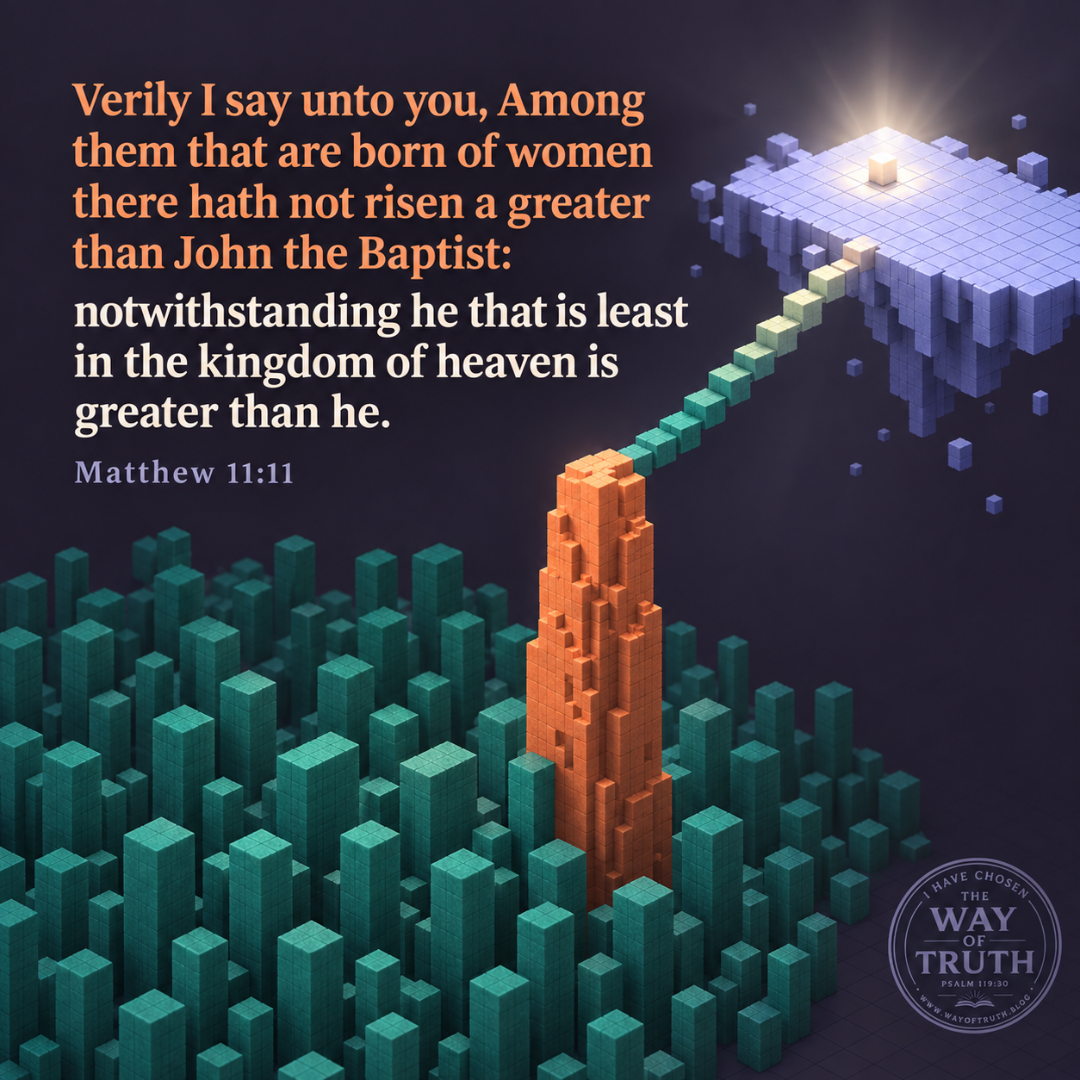
Jesus begins with the solemn words, “Verily I say unto you.” He isn’t offering a flattering opinion about John the Baptist. He’s making an authoritative declaration. The One who knows every heart, every hidden sacrifice, and every act of obedience gives His assessment of John’s place in God’s unfolding plan.
This builds directly upon the preceding verses. Jesus has already told the crowd that John was not “a reed shaken with the wind” (Matthew 11:7), nor a man softened by luxury and royal approval (Matthew 11:8). He was “more than a prophet” because Scripture had appointed him as the messenger who would prepare the way before Christ (Matthew 11:9–10). Now Jesus carries that evaluation to its highest point: among those born of women, no greater servant had arisen.
That would be an astonishing statement about anyone. It becomes even more striking when we remember where John was at that moment. He wasn’t standing before an applauding crowd. He was sitting in prison. Herod held the keys to John’s cell, but Christ delivered the verdict on John’s life. Earthly circumstances made John look defeated; the Lord called him great.
God’s judgment is often very different from ours.
Greatness Measured by a God-Given Calling
The expression “born of women” refers to ordinary human birth and emphasizes the broad scope of Jesus’ comparison. John stood among the great servants who had come before him: Abraham, Moses, David, Elijah, Isaiah, Jeremiah, and the other prophets. Yet Jesus said, “there hath not risen a greater than John the Baptist.”
This doesn’t mean that John was sinless, possessed a superior nature, or excelled every biblical figure in every possible quality. Moses performed signs that John never performed. David ruled a kingdom, wrote inspired psalms, and received the promise concerning the royal line of the Messiah. Abraham was called the friend of God. John himself “did no miracle” (John 10:41).
John’s greatness must therefore be understood according to the context. He was greatest in the unique position God had assigned him within the progress of revelation. Earlier prophets foretold the coming of Christ from a distance. John stood at the doorway of fulfillment. He saw the Messiah, baptized Him, and publicly declared: “Behold the Lamb of God, which taketh away the sin of the world” (John 1:29).
John didn’t merely predict that Christ would come someday. He pointed to Jesus and announced that the promised One had arrived.
His greatness also appeared in his faithfulness to that calling. John refused to make himself the center of attention. He said of Christ, “He must increase, but I must decrease” (John 3:30). He preached repentance without adjusting the message to suit the crowd. He confronted Herod’s sin even when silence would have been safer. John’s ministry wasn’t long, comfortable, or career-enhancing, but it accomplished exactly what God had appointed it to accomplish.
Biblical greatness isn’t measured by fame, comfort, visible results, or the size of a following. It’s measured by faithfulness to God’s revealed will.
The Surprising Turn in Christ’s Words
Just when Jesus’ praise of John seems unable to rise any higher, the verse takes an unexpected turn: “Notwithstanding he that is least in the kingdom of heaven is greater than he.”
Jesus isn’t insulting John or withdrawing what He’s just said. Nor is He teaching that every believer possesses greater courage, character, or spiritual maturity than John. A careless Christian isn’t morally greater than the man who prepared the way of the Lord and suffered imprisonment for speaking the truth.
The comparison concerns position and privilege within God’s unfolding work.
John stood at the boundary between promise and fulfillment. He announced that the kingdom was near and identified its King, but his public ministry belonged to the period of preparation. He died before seeing Christ’s atoning death, bodily resurrection, ascension, and the worldwide proclamation of the completed gospel. He saw the dawn breaking, but he didn’t live to see the light spread across the sky.
Even the least prominent person who receives the kingdom in its fulfillment through Christ possesses privileges that John didn’t enjoy during his earthly ministry. The believer can look back upon the finished work of the cross and the empty tomb. We can proclaim not merely that the Lamb has arrived, but that He “died for our sins according to the scriptures; And that he was buried, and that he rose again the third day” (1 Corinthians 15:3–4).
This doesn’t make us more deserving than John. It makes us more privileged.
The Kingdom Is More Than Going to Heaven
The phrase “the kingdom of heaven” shouldn’t be reduced to a synonym for going to heaven after death. Throughout Matthew, the kingdom refers to God’s saving rule being revealed and established through Jesus Christ. Its King had come, its power was already being displayed, and its good news was being proclaimed. Its fullness, however, still awaited Christ’s death, resurrection, return, and final reign.
Jesus was announcing a decisive change in the history of redemption. John was the greatest figure of the age of preparation, yet the kingdom arriving through Christ brought something greater than preparation. Promise was giving way to fulfillment. Shadows were yielding to substance. The messenger was important, but the King and His saving work were infinitely more important.
Hebrews describes a similar relationship between earlier believers and those who receive the fulfillment brought by Christ: “And these all, having obtained a good report through faith, received not the promise: God having provided some better thing for us, that they without us should not be made perfect” (Hebrews 11:39–40).
The earlier saints were truly saved by faith in God’s promises. Yet they awaited the completion of what God had promised. Believers living after Christ’s resurrection don’t possess a better Savior or a different means of salvation. We possess a clearer view of the one salvation God has accomplished through His Son.
John Wasn’t Excluded from Salvation
Some interpretations treat this verse as though Jesus were saying that John would never belong to the kingdom of heaven. That conclusion goes beyond the text and conflicts with Christ’s praise of him.
Jesus contrasts John’s position as the climactic messenger of preparation with the privilege belonging to those who participate in the kingdom’s fulfillment. He isn’t pronouncing John lost. John believed in Christ, confessed His greatness, and directed others to trust Him. Like every other redeemed sinner, John’s salvation depended entirely upon the grace of God and the work of Christ.
John’s earthly assignment stood on one side of a great turning point, but John himself belonged to God. When the kingdom reaches its final glory, John won’t be left outside watching everyone else celebrate. He’ll share in the salvation secured by the Lamb whom he faithfully proclaimed.
We should also resist dividing Scripture into disconnected plans of salvation. Old Testament believers weren’t saved by works while New Testament believers are saved by grace. No sinner has ever earned acceptance with God. The sacrifices of the old covenant pointed forward to Christ, and the faithful trusted the promises God had revealed. We now look back upon the sacrifice that has been offered once for all. The direction of sight differs, but the Savior is the same.
Privilege Doesn’t Automatically Produce Faithfulness
There’s a sobering edge to this verse. If believers living in the light of Christ’s completed work possess privileges greater than John enjoyed during his earthly ministry, then we also carry greater responsibility.
John served faithfully with the revelation given to him. We possess the completed testimony of Scripture. We know about the cross, the resurrection, the ascension, the promised return of Christ, and the commission to take the gospel to all nations. We can read in a few minutes truths that generations of faithful believers longed to understand more fully.
Yet greater access to truth doesn’t guarantee greater obedience.
A person may own several Bibles and rarely open one. A congregation may profess belief in the gospel while becoming preoccupied with entertainment, personalities, or internal disputes. A believer may understand the doctrine of Christ’s resurrection and still live as though this temporary world were all that mattered. Having more light while refusing to walk in it isn’t spiritual greatness.
Jesus’ words leave no room for pride. We didn’t earn our place in this privileged period of God’s plan. We were born into it. We received truths preserved through the suffering and faithfulness of generations before us. The proper response is gratitude, humility, obedience, and worship.
Greatness in the Kingdom Has a Different Shape
Human beings are talented at turning nearly everything into a competition. We compare churches, ministries, audiences, accomplishments, and influence. Even service to Christ can become another place where we keep score.
Matthew 11:11 overturns that way of thinking. John was greater than those before him because of the calling God gave him, not because he defeated them in a contest for religious importance. The least in the kingdom is greater in privilege, not because they’ve earned a higher personal rank.
Kingdom greatness is received before it’s expressed. It begins with grace. We enter Christ’s kingdom as forgiven sinners who have nothing to boast about except the Lord who saved us. Whatever calling, influence, ability, or opportunity follows remains a gift.
Later in Matthew, the disciples would argue about who was greatest. Jesus responded by placing a child among them and teaching that entrance into the kingdom requires humility: “Whosoever therefore shall humble himself as this little child, the same is greatest in the kingdom of heaven” (Matthew 18:4).
The kingdom doesn’t reward our appetite for recognition. It changes it. Its King took the form of a servant, submitted to the cross, and gave His life for sinners. We can’t follow Him faithfully while treating ministry as a platform for self-promotion.
Living Worthy of Greater Light
This verse should deepen our appreciation for the place God has given us in His unfolding purpose. We stand on the fulfillment side of events that John could announce but not yet explain in their fullness. We know why the Lamb came. We know what happened at Calvary. We know that death couldn’t hold Him.
That privilege should make us eager students of Scripture. If God has graciously given us the completed biblical witness to Christ, we shouldn’t be content with borrowed opinions, isolated quotations, or whatever happens to appear in our social-media feed. We need to read the Word carefully, receive correction humbly, and let its truth shape our thinking. John’s generation was told that the Messiah had arrived. We’ve been shown what He accomplished. Neglecting that revelation is no small matter.
This truth should also protect the Church from celebrity culture. Christ’s praise of John was enormous, but John’s own desire was to become less visible so that Christ would be seen more clearly. A healthy church appreciates faithful pastors, teachers, missionaries, and servants without turning them into spiritual celebrities. The messenger must never replace the message, and no ministry leader should occupy the place that belongs to Jesus alone.
At the same time, those who serve without much recognition shouldn’t assume that their labor is insignificant. The world may never notice the person who cleans the building, cares for children, visits the lonely, quietly gives to missions, prays for the lost, or speaks a timely word of biblical encouragement. Christ sees every faithful act. The kingdom’s “least” aren’t forgotten by its King.
This also speaks to believers who feel that their opportunities are small. You may never preach to crowds as John did. You may not possess a dramatic testimony or a widely recognized ministry. But if you belong to Christ, you’ve been brought under His saving rule and entrusted with the completed gospel. You can tell another person that Jesus Christ died for sinners and rose again. You can serve your family, congregation, workplace, and community with integrity. You can obey God where He’s placed you.
Our responsibility isn’t to manufacture an impressive calling. It’s to be faithful within the one God has given us.
Churches should therefore measure success more carefully. Attendance, budgets, programs, buildings, and online reach may tell us something, but they can’t tell us everything. The more important questions are less glamorous. Is Christ being proclaimed clearly? Is Scripture governing the church’s beliefs and practices? Are sinners being called to repentance and faith? Are believers growing in holiness, love, discernment, and obedience? Is attention being directed toward Jesus or gathered around human personalities?
John’s ministry would probably have disappointed anyone obsessed with long-term institutional growth. His public work was brief, his message offended powerful people, and his earthly life ended in prison. Yet Christ called him great. The Lord’s approval is a much safer measure than the crowd’s applause.
The verse also calls us to unity. All believers stand within the kingdom by grace. Differences in gifts, responsibilities, visibility, and maturity are real, but none gives us permission to despise another member of Christ’s body. The unnoticed believer belongs to the same King as the well-known preacher. The new Christian who’s still learning possesses the same Savior as the seasoned teacher. We should help one another use our privileges faithfully instead of competing for prominence.
Above all, greater light should produce clearer witness. We know that Christ has conquered death. We know forgiveness is offered in His name. We know He’ll return. These aren’t truths to be locked inside church buildings or saved for private reflection. God has placed His people in homes, neighborhoods, factories, warehouses, offices, hospitals, schools, and countless ordinary settings where the gospel can be displayed and spoken.
John pointed forward and said, in effect, “The Lamb is here.” We can point to the cross and empty tomb and say, “The Lamb has finished the work, He is risen, and He saves all who come to Him.”
The King Who Brings Sinners Near
Perhaps you admire John’s courage but wonder where you stand with the King that John announced. This verse isn’t asking you to become impressive enough for Christ’s kingdom. It’s directing your attention to the privilege Christ freely gives to people who could never earn a place there.
Every one of us has sinned against God. Sin includes the wrong things we do, but it reaches deeper than outward behavior. We’ve resisted God’s rightful authority, loved created things more than our Creator, and failed to love Him and others as we should. Scripture declares, “For all have sinned, and come short of the glory of God” (Romans 3:23).
Sin deserves judgment because God is perfectly holy and just. We can’t erase guilt through better behavior, religious activity, good intentions, or comparison with people who seem worse. “The wages of sin is death” (Romans 6:23). That includes physical death and final separation from God under His righteous judgment.
But the King that John announced came to save sinners. Jesus Christ, the eternal Son of God, entered our world, lived without sin, and willingly gave Himself upon the cross. He bore the penalty sinners deserved, satisfying divine justice through His atoning death. He was buried, and on the third day He rose bodily from the grave. His resurrection declares His victory over sin and death.
The gospel isn’t advice about how to make yourself worthy of God. It’s good news about what Christ has done for the unworthy.
God commands you to repent and believe the gospel. To repent is to turn from sin and abandon every attempt to justify yourself. To believe is to trust Jesus Christ as your Lord and Savior, resting in His death and resurrection as your only hope of forgiveness. Scripture promises: “That if thou shalt confess with thy mouth the Lord Jesus, and shalt believe in thine heart that God hath raised him from the dead, thou shalt be saved” (Romans 10:9).
Christ receives those who come to Him in sincere repentance and faith. He forgives their sins, gives them new life, brings them under His gracious rule, and promises them eternal salvation. The least-known, least-impressive, and most visibly broken sinner who comes to Christ isn’t treated as an unwanted outsider. By grace, that person is welcomed into the kingdom.
Don’t remain at a distance admiring the messenger while refusing the King. Turn to Jesus Christ today. Trust the Lamb of God who died and rose again, receive the forgiveness only He can give, and live henceforth for His glory.
Reflection and Response
- Do I measure greatness by Christ’s approval and faithfulness to His calling, or by visibility, comfort, achievement, and human praise?
- How faithfully am I using the greater light God has given through the completed Scriptures and the finished work of Christ?
- Have I allowed a pastor, teacher, ministry, or Christian personality to receive attention that properly belongs to Jesus?
- Where has God placed me to serve Him faithfully, even if that service seems small or goes largely unnoticed?
- Does my life clearly point others toward the crucified and risen Christ, or am I quietly trying to keep the attention on myself?