
I. The Voice Fear Can’t Muffle
A. “Fear Them Not Therefore”
Matthew 10:26 begins with a command and a connection: “Fear them not therefore.” The word “therefore” reaches back to everything Jesus has just said. The disciples will face councils, rulers, family betrayal, hatred, persecution, and slander. They may even be called servants of the devil because their Master was called Beelzebub. Jesus doesn’t minimize any of that. He tells them not to fear the people who do it.
That may seem like an odd conclusion. We might expect Him to say, “Since the opposition will be severe, be very afraid.” Instead, He says, “Fear them not.”
Christ isn’t forbidding every feeling of nervousness. Courage isn’t the complete absence of fear. A disciple may speak with a trembling voice and still be faithful. The problem comes when fear becomes master, when the threat of rejection or suffering gains the authority to silence what Christ has commanded us to say.
This is the first of three commands not to fear in Matthew 10:26–31. Here, Jesus gives the first reason: truth can’t remain buried forever. In the verses that follow, He will explain that persecutors can’t destroy the soul and that the Father knows and values His children. Christ answers fear by directing His disciples away from the apparent power of their enemies and toward the authority, judgment, and fatherly care of God.
The people opposing the disciples may control a courtroom, spread an accusation, close a synagogue door, or drive them from a city. But they don’t control the final verdict. Their power is real, but it’s neither complete nor permanent.
B. What’s Covered Won’t Stay Covered
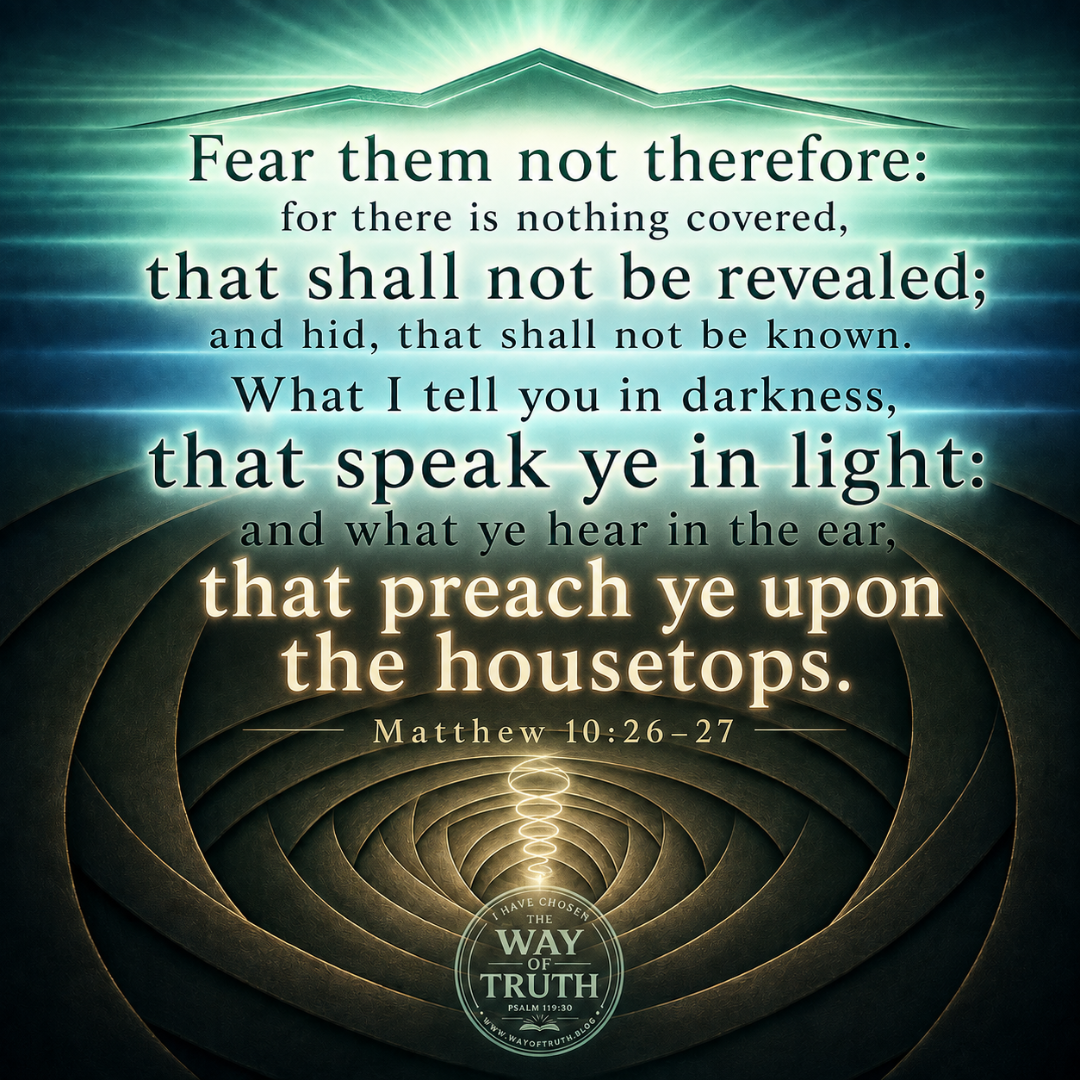
Jesus continues, “for there is nothing covered, that shall not be revealed; and hid, that shall not be known.”
This saying has more than one possible application. It certainly agrees with the broader biblical truth that God will expose hidden deeds and bring every person into judgment. Ecclesiastes 12:14 declares, “For God shall bring every work into judgment, with every secret thing, whether it be good, or whether it be evil.” False charges, concealed motives, and injustice won’t remain hidden. Even when believers die without receiving public vindication, their cause isn’t lost. God knows the truth, and His judgment will be perfect.
However, verse 27 shows that the immediate emphasis isn’t merely the exposure of the persecutors’ wickedness. Jesus is speaking primarily about the unveiling of His message. What’s presently being taught to the disciples in relative privacy must eventually be announced openly. Opposition may try to cover the truth, but the disciples must cooperate with its unveiling by proclaiming what Christ has told them.
This keeps us from turning verse 26 into an unrealistic promise that every false rumor will be corrected during our lifetime. Sometimes lies travel quickly while the truth seems to have missed the bus. Faithful Christians have occasionally gone to their graves misunderstood. Jesus doesn’t promise immediate control over our reputation. He promises that secrecy, slander, and suppression won’t have the final word over His truth.
The gospel doesn’t depend upon favorable public opinion for its survival. Christ knew His messengers would be threatened, scattered, and condemned, yet He spoke as One completely certain that His message would reach the light.
C. From the Ear to the Housetop
“What I tell you in darkness, that speak ye in light,” Jesus commands.
“Darkness” isn’t being used here as a symbol of evil. Christ’s teaching is holy and true. The contrast concerns the setting in which the message is received and the setting in which it must be proclaimed. What the disciples are learning quietly from Christ must not remain confined to their private conversations.
Likewise, “what ye hear in the ear” describes close, personal instruction. Jesus is preparing His chosen messengers before sending them into public ministry. They’re not being initiated into a secret religion whose essential truths must be guarded from outsiders. Their private instruction is preparation for public proclamation.
Then comes the striking image: “preach ye upon the housetops.” Jesus isn’t requiring every Christian to climb onto a roof. The housetop pictures maximum publicity. What has been whispered in the ear is to be announced where others can hear it.
There is a clear order here:
- Christ speaks.
- His disciples hear.
- His disciples proclaim.
The messenger doesn’t invent the message. Christian witness begins by listening faithfully to Christ through His Word. The disciples weren’t commissioned to share whatever spiritual ideas happened to occur to them. They were to repeat what they’d received from the Lord.
This pattern continues throughout the New Testament. After Christ’s resurrection, the apostles publicly proclaimed what they had seen and heard. When authorities ordered Peter and John to remain silent, they answered, “For we cannot but speak the things which we have seen and heard” (Acts 4:20). The light had reached the housetop, and threats couldn’t push it back into hiding.
D. An Open Gospel in an Honest Book
Matthew 10:26–27 leaves no room for the idea that Christianity rests upon saving secrets known only to an enlightened inner circle. Ancient and modern groups have sometimes claimed that spiritual salvation depends upon hidden knowledge, private revelations, secret ceremonies, or teachings available only through a particular leader. Jesus establishes the opposite pattern. His instruction to the apostles was intended for open proclamation.
That doesn’t mean every private conversation should become public. Jesus is speaking about His message, not authorizing the betrayal of confidences or the exposure of another person’s pain. Nor does this passage forbid wise timing. Earlier in the same discourse, Christ told the disciples to be “wise as serpents,” and He instructed them to flee from one city to another when persecuted. Christian courage isn’t recklessness.
The disciples may withdraw from danger, but they must not hide the gospel out of shame. Prudence determines how and where they speak. Fear must not determine whether they speak at all.
A skeptic might object that such public proclamation is inherently aggressive or intolerant. Yet the surrounding passage contains no command to force belief through political control, violence, or manipulation. The disciples proclaim, endure rejection, and move on when they’re not received. Christ commands confident witness, not coercion.
Matthew’s honesty also deserves notice. This is hardly polished recruitment material promising comfort, applause, and an uncomplicated life. Jesus tells His disciples beforehand that faithful witness will bring opposition. That candor doesn’t, by itself, prove every historical claim of the Gospel, but it’s consistent with truthful testimony rather than flattering propaganda. The book of Acts then records the very pattern Jesus described: public proclamation, official resistance, suffering, and continued witness.
The gospel’s spread wasn’t an accident Christ failed to foresee. It unfolded under His authority and in fulfillment of His command.
II. Courage That Listens Before It Speaks
This passage calls us to speak, but it first calls us to listen. Before Christ says, “speak ye,” He says, “What I tell you.” Before He commands the disciples to preach, He refers to what they “hear.”
Christian courage without biblical truth quickly becomes loud confusion. We’re not called to put every opinion on a housetop and attach Jesus’ name to it. We must receive the Word humbly, understand it carefully, and communicate it faithfully. Our task isn’t to improve Christ’s message but to carry it.
For individual believers, this means spending time in Scripture before trying to speak for Scripture. Ask what the passage actually says. Read it in context. Resist the temptation to turn a favorite idea, political preference, personal experience, or internet slogan into the voice of Christ. The faithful witness says what the Lord has said.
We should also examine the fears that keep us silent. Are we afraid of being thought unintelligent, narrow-minded, or unfashionable? Do we worry that a family member will become uncomfortable? Are we waiting for a moment when speaking about Christ will involve no relational risk at all? That moment may never arrive.
At the same time, boldness doesn’t require a booming personality. Some believers speak comfortably before crowds. Others communicate Christ more naturally through a thoughtful conversation, a carefully written message, an invitation to study Scripture, or a quiet answer to a sincere question. Volume isn’t the measure of faithfulness. A soft-spoken Christian can be courageous, while a loud Christian may simply be loud.
Jesus doesn’t command obnoxiousness. “Preach ye upon the housetops” isn’t permission to treat every conversation as though we brought our own spiritual bullhorn. It’s a command not to be ashamed of His truth. We should speak clearly, patiently, and lovingly, remembering that the people hearing us aren’t targets for debate, but souls made in the image of God.
This passage also challenges the Church. A congregation can become very busy and yet strangely quiet about Christ. Programs, music, charitable work, community events, political concerns, and carefully managed public images can occupy plenty of space while the gospel is barely explained. Good activities must not cover the message Jesus told His people to bring into the light.
The Church must speak openly about the holiness of God, the sinfulness of humanity, the cross of Christ, His bodily resurrection, repentance, faith, forgiveness, and eternal life. These truths shouldn’t be softened into vague religious encouragement because we fear offending modern sensibilities. If we remove the truths that make the gospel uncomfortable, we also remove the truths that make it the good news that saves.
Church unity is strengthened when believers gather around the message received from Christ rather than personal agendas. We don’t need every Christian to have the same personality, ministry, political opinion, or communication style. But we do need the Church to speak with one voice about who Jesus is and what He’s done.
The promise that hidden truth will be revealed also helps us entrust our reputations to God. If we obey Christ, some people may misunderstand our motives. Others may repeat unfair accusations. We should correct falsehood when possible, apologize when genuinely wrong, and live above reproach. But we can’t make universal approval a condition of obedience.
Our responsibility is faithfulness. Vindication belongs to God.
This passage should also make us careful never to weaponize exposure. “Nothing covered” doesn’t authorize church leaders to demand access to every private detail of a person’s life or to publicize confidential struggles. The immediate command concerns bringing Christ’s teaching into the open. Churches should proclaim truth while protecting the vulnerable, handling confessions responsibly, and refusing the secrecy that allows abuse or corruption to flourish.
The world still needs the message Christ placed in the care of His people. Fear may suggest that silence is safer. Jesus reminds us that His truth is headed for the light. We have the privilege of carrying it there.
III. The Good News Meant for the Housetops
The message Jesus commands His disciples to proclaim isn’t merely advice about becoming kinder, braver, or more religious. It’s the good news that guilty sinners can be forgiven and reconciled to God through Jesus Christ.
Our deepest problem is sin. We’ve broken God’s commands, rejected His rightful authority, and lived for ourselves. Some sins are public, while others remain hidden from everyone around us. None are hidden from God. Scripture says, “For all have sinned, and come short of the glory of God” (Romans 3:23).
Sin carries a real penalty. “For the wages of sin is death” (Romans 6:23). This includes physical death, separation from God, and final judgment. We can’t erase our guilt through good intentions, religious ceremonies, generosity, church attendance, or personal improvement. Good works can’t undo sin any more than clean pages added to the end of a book can remove what was written in the earlier chapters.
But God didn’t leave sinners without hope. Jesus Christ, the sinless Son of God, came into the world to save. He willingly died upon the cross, bearing the judgment sinners deserve. The gospel declares “that Christ died for our sins according to the scriptures; And that he was buried, and that he rose again the third day according to the scriptures” (1 Corinthians 15:3–4).
Christ’s resurrection was a real victory over sin and death. Jesus isn’t merely a teacher whose private words survived Him. He’s the risen Lord whose saving work His disciples were commanded to proclaim openly.
God now calls you to repent and believe. Repentance means turning from sin and abandoning the attempt to rule your own life. Faith means trusting Jesus Christ, relying upon His death and resurrection rather than your goodness or religious effort. When the Philippian jailer asked how he could be saved, the answer was clear: “Believe on the Lord Jesus Christ, and thou shalt be saved” (Acts 16:31).
Speaking courageously about Jesus can’t save us. We’re saved by Christ, not by our boldness. Yet those who trust Him receive forgiveness, new life, peace with God, and the sure hope of eternal salvation. He begins changing us from the inside, teaching us to love Him, obey His Word, and live for His glory.
You don’t need to hide from Christ until you become worthy. You can’t make yourself worthy. Come to Him honestly. Confess your sin, turn from it, and place your trust in the Savior who died and rose again. The gospel belongs in the light because its invitation is meant to be heard. Trust Christ today, receive His mercy, and let the life He gives become a testimony to His grace.
IV. Reflection and Response
- Whose opinion or opposition am I most tempted to fear, and how has that fear affected my willingness to speak about Christ?
- Am I listening carefully to what Christ has said in Scripture, or am I sometimes more eager to express my own opinions than to communicate His truth?
- How can I speak openly about the gospel with greater clarity, love, wisdom, and courage in the relationships God has given me?
- Is my church clearly proclaiming Christ’s death, resurrection, call to repentance, and promise of salvation, or have other concerns begun to cover the central message?
- Have I personally stepped into the light by repenting of my sin and trusting Jesus Christ as my Lord and Savior?