
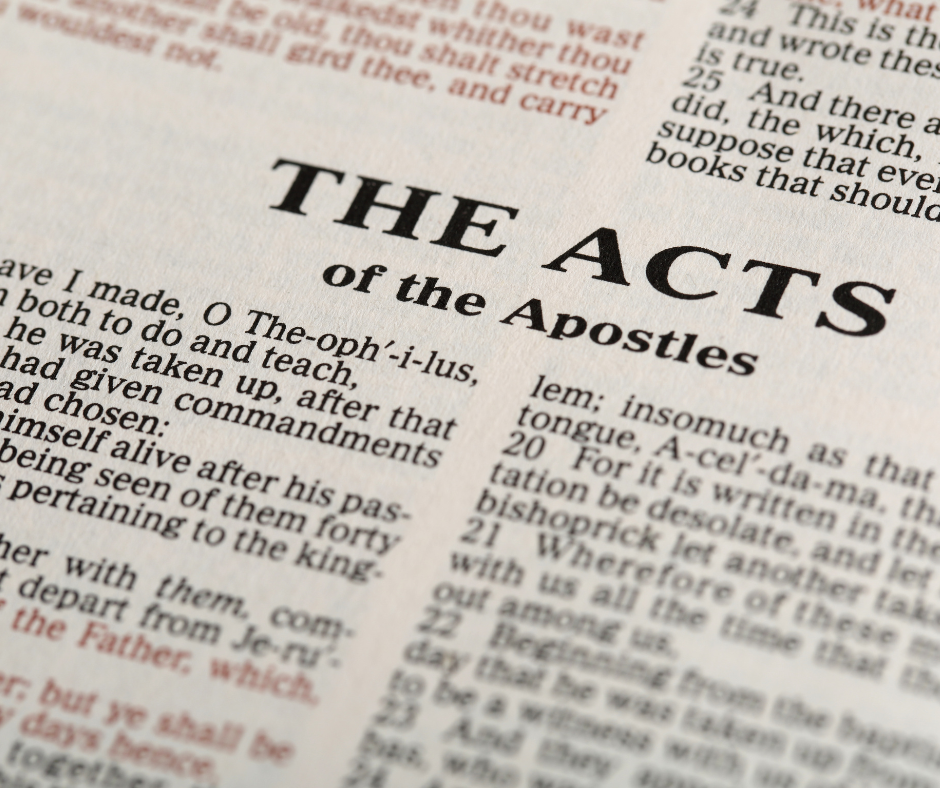
The Acts of the Apostles stands as the Spirit-inspired continuation of the Gospel of Luke and the essential historical bridge between the earthly ministry of Christ and the expansion of His Church. It is the only New Testament book devoted entirely to the history of the early Christian movement, tracing the sovereign work of the risen Lord through the power of the Holy Spirit. Acts records how Christ’s kingdom advances, not by human strength or political force, but by the authoritative Word of God, proclaimed by Spirit-empowered witnesses, and confirmed through divine providence.
Acts does more than recount events. It reveals the unstoppable mission of the risen Christ; it displays the Spirit’s formation of the Church; it preserves the apostolic foundation of Christian doctrine; and it sets forth the pattern of gospel proclamation that continues until the Lord returns. Through its pages, the Church sees how the saving work of Christ extends from Jerusalem to Judea, to Samaria, and into the Gentile world, fulfilling the promise Jesus declared before His ascension: “Ye shall be witnesses unto me… unto the uttermost part of the earth” (Acts 1:8).
I. Authorship, Unity, and Literary Purpose
The unanimous testimony of the early Church affirms Luke—physician, historian, companion of Paul, and author of the Third Gospel—as the writer of Acts. The seamless literary and theological connection between Luke and Acts supports this conclusion: both books are addressed to Theophilus, share the same stylistic signature, and together form a two-volume work. Luke’s Gospel presents what Jesus began to do and teach (Acts 1:1); Acts reveals what He continues to do from heaven through His Spirit, His Word, and His apostles.
Luke writes as a careful historian who has investigated events with precision, employed reliable sources, and participated personally in portions of the story. The “we” sections of Acts—found in chapters 16, 20, 21, and 27–28—confirm his direct presence during many of Paul’s journeys. Yet Luke is far more than a historian; he is a theologian guided by the Holy Spirit to show how the risen Lord builds His Church, preserves His truth, and advances His kingdom.
His purpose is both historical and pastoral. He writes to provide certainty regarding the origins of the Church, to defend the gospel against misunderstanding, to demonstrate the continuity between Jesus’ ministry and the apostolic mission, and to strengthen believers in every age with the assurance that the Word of God cannot be stopped.
II. Historical Setting and Canonical Place
Acts begins in Jerusalem around A.D. 30–33 and concludes approximately three decades later with Paul under house arrest in Rome. The book covers a vast geographical and cultural landscape: Jewish synagogues, Samaritan villages, Greco-Roman cities, rural regions, seaports, courts of Roman authorities, and even the heart of the imperial capital. Throughout these diverse settings, the gospel advances with divine authority, transforming individuals, households, and communities.
The world of Acts is marked by political tension, religious pluralism, persecution, and moral confusion, conditions strikingly similar to the modern world. Yet Acts shows that no cultural, political, or spiritual barrier can hinder the Word of God when it is carried by Spirit-filled witnesses.
In the canon, Acts serves as the indispensable link between the Gospels and the Epistles. Without it, the reader would know the resurrected Christ but not the formation of the Church; the teachings of Paul but not his conversion; the letters to churches but not the missionary journeys that founded them. Acts is the Spirit’s record of how the apostolic foundation of the Church was laid, and how the message of Christ spread from a small Jewish remnant to a globally expanding community of faith.
III. Structure, Themes, and Theological Emphases
While Acts unfolds as narrative history, its structure follows the programmatic outline given by Christ in Acts 1:8:
- Jerusalem (chapters 1–7)
- Judea and Samaria (chapters 8–12)
- To the ends of the earth (chapters 13–28)
This geographical progression is also a theological progression. The gospel rooted in Israel extends outward to the nations, fulfilling God’s covenant promise to Abraham that all peoples would be blessed through his Seed. The Church is not an interruption in God’s plan but the continuation of His mission through the Messiah’s reign from heaven.
Several themes shape Luke’s narrative with remarkable clarity:
1. The Reign of the Risen Christ
Acts begins with Christ’s ascension, not as a departure but as an enthronement. Jesus rules from the right hand of the Father, directing the mission of the Church, opening doors, guiding His servants, and advancing His kingdom.
2. The Ministry of the Holy Spirit
The Spirit descends at Pentecost, empowering proclamation, producing unity, granting gifts, authenticating the message with signs, and guiding the Church through every conflict. Acts reveals the Spirit not as an impersonal force but as the divine Author of the Church’s mission.
3. The Centrality of the Word
The Word of God is proclaimed with boldness, resisted fiercely, and yet continually triumphs. It spreads across continents, crosses ethnic and cultural boundaries, and establishes churches wherever it is faithfully preached.
4. The Nature of Apostolic Witness
The apostles testify to Christ’s life, death, resurrection, and exaltation. Their preaching forms the doctrinal foundation of the Church, and their Spirit-guided leadership establishes patterns for faithful ministry.
5. The Unity and Expansion of the Church
Acts records both internal challenges and external persecution, yet unity is preserved through prayer, teaching, discipline, and the Spirit’s leading. The Church grows not through human ingenuity but through divine power.
6. The Inclusion of the Gentiles
One of the most significant theological developments in Acts is the full inclusion of Gentiles into the people of God. The conversion of Cornelius, the Jerusalem Council, and the ministry of Paul all testify that salvation is by grace alone through faith alone, apart from ethnic distinction or ceremonial law.
IV. Acts as Pastoral Encouragement and Missional Charge
Acts is a pastoral encouragement to every generation of the Church. It shows that suffering does not hinder the gospel, that persecution purifies the Church, and that God uses ordinary believers to accomplish extraordinary purposes. It exposes the idols of every culture, challenges believers to bold witness, and assures them that no earthly power can thwart the counsel of God.
The book also issues a standing commission. What Christ began in the Gospels, He continues in Acts. And what He continued in Acts, He carries on through the Church today. The mission to bear witness to Christ “to the ends of the earth” remains the central calling of God’s people.
V. Conclusion
The Acts of the Apostles is a monumental testimony to the risen Christ who reigns over history and builds His Church through the power of the Holy Spirit. It records the triumph of the gospel in the face of opposition, the unity of believers from every background, the formation of apostolic teaching, and the unstoppable advance of the kingdom.
To study Acts is to walk with the early Church: to stand in the upper room, to witness Pentecost, to watch the gospel cross cultures and continents, and to see the hand of God directing His mission through ordinary people equipped with an extraordinary calling. The story of Acts does not truly end in chapter 28. The risen Christ continues His work still, and the Church today stands in the stream of this same divine mission.