
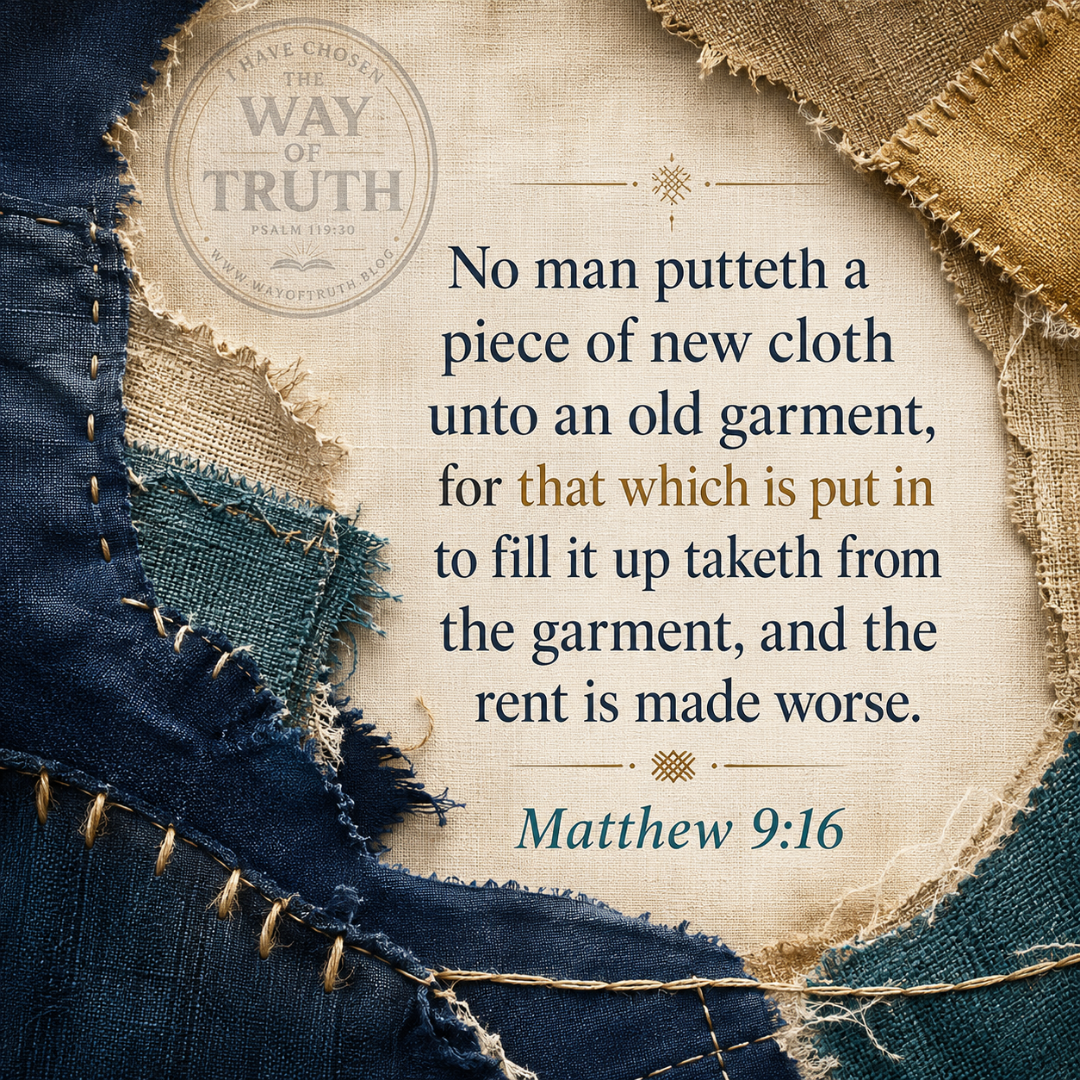
Jesus’ illustration about cloth is part of His answer to a question about fasting.
The disciples of John had asked why they and the Pharisees fasted frequently while Jesus’ disciples didn’t (Matthew 9:14). Jesus first answered by comparing Himself to a bridegroom. Wedding guests didn’t mourn while the bridegroom was present. His disciples were living in a season unlike any that had come before because the promised Christ was standing among them.
That answer explained why His disciples weren’t fasting at that particular moment. Matthew 9:16 goes further. Jesus now shows why His disciples couldn’t simply adopt the religious patterns of others without considering what His coming meant.
“No man putteth a piece of new cloth unto an old garment.”
The picture would have been familiar. An old garment had already been worn, stretched, washed, and weakened. A piece of new cloth hadn’t yet gone through that process. Sewing the new material over a tear might appear to solve the problem temporarily, but after the garment was washed, the new cloth would shrink. Because it had been firmly attached to the older, weaker fabric, it would pull against it. The attempted repair would enlarge the tear.
The problem wasn’t that the patch lacked strength. It was too strong for the worn fabric surrounding it.
Jesus wasn’t giving His disciples a lesson in clothing repair. He was explaining that His presence couldn’t be treated as a small adjustment to an existing religious system. He hadn’t come merely to patch a few holes, reinforce a few customs, or help people become slightly more respectable versions of what they already were.
Something greater had arrived.
When a Repair Makes the Damage Worse
The attempted repair in Jesus’ illustration is sincere but misguided. The person sees a tear and tries to fix it. Yet because the materials are incompatible, their solution makes the damage worse.
That’s a sobering picture of what happens when people try to fit Christ into a life that remains fundamentally under their own control.
A person may recognize that something is torn. Their conscience bothers them. Their relationships are strained. Their choices have left scars. Their fear of death occasionally breaks through the distractions. They may decide that some religion would help. Perhaps prayer could bring calm. Church attendance might give the family better values. A few biblical principles could improve their decisions.
So, they add a patch.
Jesus is permitted to cover the most visible tear, but He’s not allowed to claim the whole garment. The person wants Christ’s comfort without His authority, His promises without His commands, His forgiveness without repentance, and His kingdom without surrender.
But Christ doesn’t offer Himself as a religious accessory.
Jesus didn’t say, “I am one helpful way to improve your present direction.” He said, “I am the way, the truth, and the life: no man cometh unto the Father, but by me” (John 14:6). He doesn’t merely reinforce human goodness. He confronts human sin, exposes false righteousness, forgives the guilty, and gives new life.
Trying to make Jesus serve an unchanged heart eventually increases the tension. His words pull against our pride. His holiness pulls against our secret compromises. His authority pulls against our demand for personal control. His call to forgive pulls against our bitterness. His command to follow Him pulls against our carefully protected independence.
The conflict doesn’t prove that something is wrong with Christ. It reveals the weakness of the life we expected Him merely to patch.
Christ Can’t Be Added Without Changing Everything
Jesus’ illustration teaches that His coming introduced something that couldn’t be contained within old expectations.
The disciples of John were looking at Jesus through familiar religious categories. Fasting was a recognized expression of mourning, repentance, and earnest prayer. It had a legitimate place. Jesus didn’t condemn fasting. In the previous verse, He said that His disciples would fast after the Bridegroom was taken from them.
The mistake was assuming that every religious practice should continue in exactly the same manner, regardless of the presence and work of Christ.
The arrival of the Bridegroom changed the season.
The Messiah had come. The kingdom of heaven had drawn near. Sinners were being called. The sick were being healed. The unclean were being cleansed. Sins were being forgiven. Jesus wasn’t another teacher entering an already crowded religious marketplace. He was the promised King bringing God’s saving purposes toward their fulfillment.
This is why Jesus can’t be reduced to a supporting figure in someone else’s system. He’s not a footnote to our philosophy, a mascot for our politics, a motivational speaker for our ambitions, or a stamp of approval placed on whatever life we’ve already chosen.
He is Lord.
The Christian message isn’t that Jesus can help us make our old life work a little better. The gospel announces that our old life under sin must be surrendered to the One who died and rose again.
Paul later described the transforming result of union with Christ: “Therefore if any man be in Christ, he is a new creature: old things are passed away; behold, all things are become new” (2 Corinthians 5:17).
Christ doesn’t merely cover the tear. He makes the sinner new.
Fulfillment Doesn’t Mean Discarding Scripture
Jesus’ words have sometimes been twisted to mean that everything old is bad and everything new is good. That can’t be what He meant.
The “new cloth” in this passage doesn’t represent every new idea, modern trend, or religious innovation. Churches don’t honor this verse by chasing whatever is fashionable. The newness Jesus describes is centered upon Him, His kingdom, and the saving work He came to accomplish.
Neither was Jesus condemning the Old Testament as false, defective, or unworthy. Earlier in Matthew, He plainly declared: “Think not that I am come to destroy the law, or the prophets: I am not come to destroy, but to fulfil” (Matthew 5:17).
The same Jesus who spoke about the old garment had just quoted the prophet Hosea: “I will have mercy, and not sacrifice” (Matthew 9:13). He wasn’t separating Himself from the revelation God had already given. He was demonstrating its true meaning and bringing its promises to fulfillment.
Some ancient false teachers claimed that the Old Testament came from a different and lesser god and should be rejected by Christians. Jesus’ own words leave no room for that idea. He honored the Law and the Prophets as the Word of God. He fulfilled their promises, obeyed their righteous demands, and revealed the goal toward which they pointed.
The problem wasn’t God’s Word. The problem was the attempt to contain Christ within human traditions, expectations, and systems of self-righteousness.
The Law revealed God’s holiness and exposed human sin, but it couldn’t be turned into a ladder by which sinners climbed into God’s favor. Rituals couldn’t replace repentance. Fasting couldn’t substitute for faith. Sacrifices couldn’t excuse hearts that withheld mercy. Religious activity couldn’t make sinners righteous before God.
Jesus came to accomplish what sinners could never accomplish for themselves.
The New Covenant Hope Behind the Picture
Matthew 9:16 doesn’t explain the entire doctrine of the new covenant, but it points in that direction.
Long before Christ came, God promised through Jeremiah: “Behold, the days come, saith the LORD, that I will make a new covenant with the house of Israel, and with the house of Judah” (Jeremiah 31:31).
God’s answer to human sin would be more than external repair. He promised to write His law upon the heart, forgive iniquity, and remember sin no more (Jeremiah 31:33–34). Through Ezekiel, He promised: “A new heart also will I give you, and a new spirit will I put within you” (Ezekiel 36:26).
These promises find their fulfillment in Christ. On the night before His crucifixion, Jesus took the cup and said: “This cup is the new testament in my blood, which is shed for you” (Luke 22:20).
The new covenant didn’t come through human improvement. It was established through the blood of Christ.
Jesus bore the judgment sinners deserved. He fulfilled the righteousness they lacked. He rose from the dead in victory. Through Him, guilty people receive forgiveness, hardened hearts are renewed, and those once separated from God are reconciled to Him.
That’s far more than patchwork.
The gospel doesn’t tell sinners to hide the tear more skillfully. It tells us to come honestly to Christ. We don’t need to pretend the damage is smaller than it is. We don’t need to stitch together religious habits, charitable acts, good intentions, and respectable appearances in the hope that God will overlook our guilt.
We need the saving grace found in Jesus Christ.
The Danger of a Patchwork Christianity
It’s possible to become familiar with Christian language while carefully resisting the rule of Christ.
Someone may add church attendance to a life still governed by selfish ambition. Another may add prayer to a life of deliberate disobedience. Someone else may add a Christian label to political, cultural, or personal loyalties that are never brought under Scripture.
We can even use biblical truth selectively, keeping the parts that comfort us while quietly setting aside the parts that correct us.
That’s patchwork Christianity.
It says, “Jesus may strengthen what I’ve already chosen, but He may not redirect me.” It wants Him near enough to provide help but not near enough to exercise authority.
The problem eventually becomes visible. Christ’s teaching won’t peacefully coexist with cherished sin. His grace doesn’t teach us to excuse ungodliness but to deny it (Titus 2:11–12). His cross destroys boasting. His resurrection gives us a new purpose. His lordship reaches into every corner of life.
Any religious system that teaches that Christ begins salvation but human merit, ceremonies, or loyalty to an organization must complete it has misunderstood the gospel. Scripture doesn’t present Jesus as a partial Savior. His sacrifice is sufficient, His resurrection is decisive, and His saving work doesn’t need to be completed by our achievements.
Good works matter deeply, but they’re the fruit of salvation, not its purchase price. Obedience is the response of a redeemed heart, not a payment that places God in our debt.
A patchwork gospel always leaves people uncertain because they can never know whether they’ve done enough. The true gospel directs faith toward Christ and what He has finished.
The Newness Is Christ, Not Novelty
This verse should also keep churches from confusing faithfulness with novelty.
“New cloth” doesn’t mean new teaching should automatically replace old teaching. Error doesn’t become truth because it was published recently, presented attractively, or delivered by someone with a large following. The Church has no authority to renovate the gospel so it better suits the preferences of the age.
Jesus Christ is the newness at the center of the passage.
The question isn’t whether something feels modern, creative, or culturally relevant. The question is whether it’s faithful to Christ and His Word.
At the same time, churches must not preserve customs as though every inherited method carried the authority of Scripture. A congregation can become so committed to familiar routines that it resists any change, even when those routines no longer serve the mission Christ gave His people.
The answer isn’t restless innovation or stubborn traditionalism. It’s submission to Christ.
Some traditions faithfully preserve wisdom and protect the Church from repeating old errors. Others may become empty habits maintained simply because “we’ve always done it this way.” Scripture must judge both our innovations and our traditions.
Christ isn’t called to serve the Church’s preferences. The Church is called to serve Christ.
Letting Christ Address the Whole Garment
The application of Matthew 9:16 begins with a simple but searching question: Have we received Christ as Lord, or have we merely attached Him to the life we were already determined to live?
That question reaches far beyond church attendance.
It reaches our use of money. Do we acknowledge that everything belongs to the Lord, or do we offer Him a small religious portion while guarding the rest for ourselves?
It reaches our relationships. Are we willing to forgive as Christ commands, speak truthfully, remain faithful, and put away bitterness? Or do we want Him to bless relationships we insist on handling according to our own desires?
It reaches our private conduct. Do we submit our thoughts, entertainment, habits, and hidden choices to Him? A Christian appearance in public can’t repair a life of deliberate secrecy.
It reaches our work. Following Christ changes how we handle pressure, authority, conflict, physical labor, deadlines, customers, coworkers, employees, and responsibilities that no one else notices. Honesty isn’t merely a patch added when convenient. It belongs to the new life Christ produces.
It reaches our suffering. Christ doesn’t always remove our pain, but He gives us grace to endure it and hope that reaches beyond it. He teaches us to trust the Father when circumstances can’t yet be explained.
It also reaches our worship. We shouldn’t come before God merely to maintain appearances, satisfy guilt, or complete a weekly obligation. We gather because Christ is worthy, because His people need one another, and because the truth of the gospel must shape us repeatedly.
For the Church, this verse calls for careful faithfulness. We should never attempt to hold people together with entertainment, pressure, personality, or shallow encouragement while neglecting the transforming truth of the gospel. Those things may temporarily cover a tear, but they can’t give life.
The Church must proclaim the whole Christ to the whole person.
That means preaching repentance as well as forgiveness, holiness as well as comfort, obedience as well as belief, and the cross as well as the crown. It means welcoming sinners without pretending sin is harmless. It means showing mercy without rewriting truth. It means discipling people rather than merely attracting them.
Christ’s grace doesn’t leave people where it finds them.
This truth should also make us patient with one another. Transformation is real, but growth is often gradual. New believers may still carry old fears, habits, misunderstandings, and wounds. Mature believers haven’t outgrown their need for grace either.
We shouldn’t demand instant perfection, but neither should we lower the goal of discipleship. Christ lovingly works through His Word, His Spirit, and His people to bring every part of life increasingly under His rule.
Sometimes we ask Jesus to repair a particular problem, and He begins exposing something deeper. We ask Him to relieve our anxiety, and He reveals our demand for control. We ask Him to fix a relationship, and He confronts our pride. We ask Him to change another person, and He begins with us.
That can feel uncomfortable. Yet it’s mercy.
The Lord sees the entire garment. He knows where the fabric is thin, where the seams are strained, and where we’ve tried to hide the damage. He doesn’t expose us to shame those who come to Him. He exposes what’s broken so that we’ll stop trusting our own repairs.
You don’t need to defend the old life before Christ. You need to surrender it.
When Religious Appearance Is Not Enough
Jesus’ illustration leaves no room for confidence in outward religion alone.
The Pharisees fasted. John’s disciples fasted. From the outside, fasting could look deeply spiritual. Yet the presence of a religious practice didn’t automatically mean that those performing it understood what God was doing.
It’s possible to engage in good practices for the wrong reasons. We can pray to appear spiritual, give to receive praise, serve because we crave recognition, or study Scripture merely to win arguments. Even sound practices become distorted when separated from faith, humility, and love for Christ.
The answer isn’t to abandon prayer, giving, service, fasting, or Bible study. The answer is to bring them under the lordship of Jesus.
Spiritual disciplines aren’t patches by which we make ourselves acceptable to God. They’re means through which redeemed people seek, obey, and enjoy the God who has already shown them grace in Christ.
We should therefore ask not only, “Am I doing the right thing?” but also, “Am I doing it in response to Christ, according to His Word, and for His glory?”
The difference matters.
Christ Offers More Than Repair
Perhaps you recognize something of yourself in Jesus’ illustration.
You know there are tears in your life. Some were caused by what others did to you. Others came through your own choices. You may have tried to cover them with success, relationships, entertainment, moral effort, or religion. For a while, the patch may have held. Eventually, however, the deeper problem appeared again.
The Bible says our deepest problem is sin.
Sin isn’t merely an occasional flaw in an otherwise innocent life. It’s rebellion against the holy God who created us. “For all have sinned, and come short of the glory of God” (Romans 3:23). Because God’s righteous, sin brings judgment. “For the wages of sin is death” (Romans 6:23).
No amount of outward improvement can erase that guilt. Good deeds can’t undo evil deeds. Religious ceremonies can’t cleanse the conscience. Comparing ourselves with people who appear worse can’t make us righteous before God.
But God didn’t leave sinners without hope.
Jesus Christ, the sinless Son of God, came into the world to save sinners. He obeyed the Father perfectly and willingly went to the cross. There He bore the penalty sin deserves. Scripture says that Christ “his own self bare our sins in his own body on the tree” (1 Peter 2:24).
He truly died, was buried, and rose bodily from the grave on the third day. His resurrection declares His victory over sin and death. Salvation is therefore not a reward for those who repair themselves. It’s God’s gift to those who come to Him through Christ.
Jesus calls you to repent. That means turning from sin, laying down your claim to rule your own life, and coming honestly to God. He calls you to believe the gospel, trusting not in your goodness or religious effort but in Christ alone.
His promise is gracious: “Him that cometh to me I will in no wise cast out” (John 6:37).
Christ doesn’t merely offer to improve your old life. He offers forgiveness, reconciliation with God, a new heart, a new standing, and eternal life. The change begins the moment a sinner trusts Him and continues as He shapes that believer into His likeness.
Come to Christ as you are, but don’t come demanding to remain as you are. Bring Him the guilt, the failure, the pride, and every attempted repair. Trust the Savior who died and rose again for sinners. Receive His forgiveness, follow Him as Lord, and let your new life display the glory of His grace.
Reflection and Response
- Have I surrendered my whole life to Christ, or have I treated Him as a patch for only the areas where I want help?
- Are there habits, ambitions, relationships, or private choices that I’m trying to protect from Christ’s authority?
- Do my spiritual practices flow from love for Christ, or have they become ways of maintaining an outward religious appearance?
- Is my church more committed to preserving personal preferences than to obeying Christ and proclaiming His gospel?
- Where might the Lord be exposing a deeper problem beneath the particular difficulty I’ve asked Him to repair?
[…] then gave two closely related illustrations. In Matthew 9:16, He spoke of putting a piece of new cloth on an old garment. The unshrunk cloth would pull away and […]