
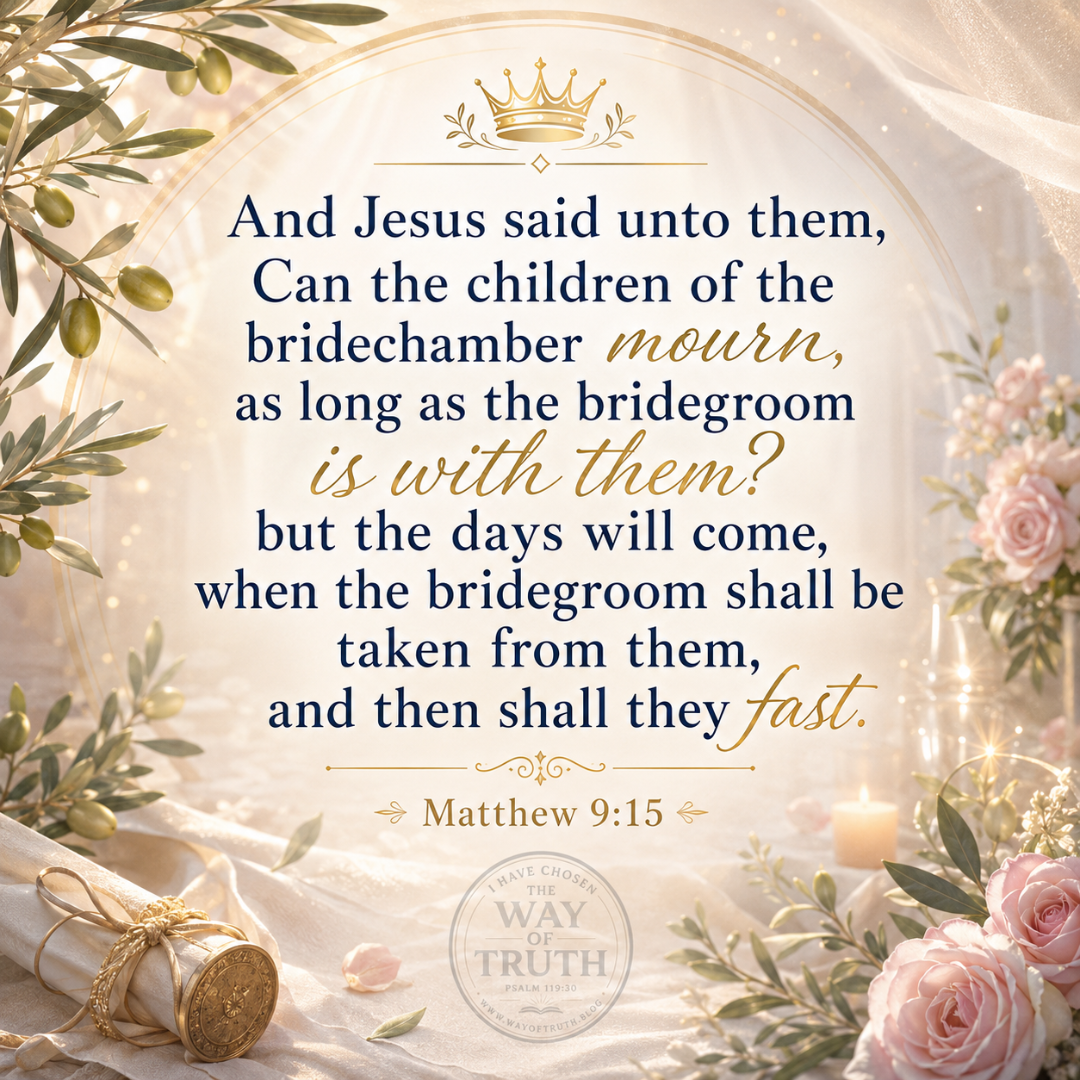
The disciples of John had asked why they and the Pharisees fasted often while Jesus’ disciples didn’t. Jesus answered by drawing their attention away from the religious practice itself and toward His own presence.
The question was about fasting, but Jesus’ answer was about the Bridegroom. He didn’t begin by comparing the fasting habits of the different groups. He didn’t provide a schedule, settle a dispute about frequency, or establish a new rule. Instead, He explained that the appropriateness of fasting depended upon what God was doing at that particular moment.
“Can the children of the bridechamber mourn, as long as the bridegroom is with them?”
The “children of the bridechamber” were those who participated in the wedding celebration. They were friends, attendants, and guests who shared the bridegroom’s joy. A wedding wasn’t the place for deliberate mourning. Showing up at a wedding dressed for a funeral wouldn’t have demonstrated superior spirituality. It would have shown a failure to understand the occasion.
Jesus’ disciples weren’t avoiding fasting because they were careless, lazy, or spiritually shallow. They were rejoicing because the promised Christ stood among them. The One to whom the law and the prophets had pointed was present. The kingdom of heaven had drawn near. Sinners were being called, the sick were being healed, and the good news was being preached.
This builds naturally upon the previous verse. Matthew 9:14 records the question, but verse 15 reveals that the disciples’ conduct couldn’t be judged properly without recognizing who Jesus was. The questioners saw a group of men who weren’t fasting. Jesus saw wedding attendants standing beside the Bridegroom.
The difference wasn’t merely one of religious practice. It was one of spiritual perception.
Joy Is Right When the Bridegroom Is Near
Jesus didn’t condemn mourning. He placed it in its proper season.
There are times when grief is fitting. Scripture doesn’t teach believers to pretend that pain is pleasant, loss is insignificant, or every difficult experience should be met with a forced smile. Jesus Himself wept at the grave of Lazarus. He was “a man of sorrows, and acquainted with grief” (Isaiah 53:3). Biblical faith never requires us to deny reality.
Yet mourning would have been inappropriate while the Bridegroom was visibly present with His disciples. The long-awaited Messiah was walking beside them, teaching them, eating with them, and revealing the compassion and authority of God. His presence made that season one of celebration.
This reminds us that genuine spirituality isn’t measured by how gloomy we can appear. Some people seem to imagine that a permanently troubled expression is evidence of deep holiness. Jesus didn’t share that assumption. There was a time to fast, but there was also a time to feast. There was a time to weep, but there was also a time to rejoice.
The presence of Christ gave His disciples a reason for joy that their critics hadn’t understood.
Christian joy isn’t shallow cheerfulness. It doesn’t depend upon easy circumstances or the absence of suffering. It arises from knowing that God has drawn near to us in His Son. The angel announced the birth of Christ as “good tidings of great joy” (Luke 2:10). Those who received Him weren’t merely given another religious duty. They were given a Savior.
The disciples’ joy was therefore not a distraction from spiritual life. Their joy was the proper response to Jesus.
The Bridegroom’s Identity Carries Divine Weight
Jesus’ choice of the bridegroom illustration wasn’t casual.
Throughout the Old Testament, the relationship between the Lord and His covenant people was sometimes described with the language of marriage. Isaiah declared: “For thy Maker is thine husband; the LORD of hosts is his name; and thy Redeemer the Holy One of Israel” (Isaiah 54:5). God also promised Israel: “And as the bridegroom rejoiceth over the bride, so shall thy God rejoice over thee” (Isaiah 62:5).
Against that biblical background, Jesus’ identification of Himself as the Bridegroom carries considerable significance. He wasn’t merely claiming to be another prophet inviting people to return to God. He placed Himself at the center of the covenant celebration. The joy of the moment existed because He was present.
This verse alone doesn’t state every truth Scripture later reveals about Christ’s divine nature, but it fits perfectly with that larger revelation. Jesus possesses the authority to forgive sins, calls sinners to Himself, receives worship, commands creation, and identifies Himself with imagery Scripture uses for the Lord’s relationship with His people.
Later, John the Baptist would speak of Christ in the same way: “He that hath the bride is the bridegroom” (John 3:29).
Paul would describe Christ’s love for the church using the pattern of a husband’s sacrificial love for his wife (Ephesians 5:25–32). Revelation looks ahead to “the marriage supper of the Lamb” (Revelation 19:9).
The Bible’s marriage imagery moves toward Jesus Christ. He’s not an optional guest at the celebration. He’s the Bridegroom for whom the celebration exists.
This corrects every version of Christianity that treats Jesus as a useful accessory to an otherwise self-directed life. He’s not merely a source of inspiration, a moral teacher, or a religious symbol we bring out when life becomes difficult. He’s the Lord who claims the devotion, love, obedience, and worship of His people.
The Shadow of the Cross Falls Across the Celebration
The tone of Jesus’ answer changes abruptly with the words, “but the days will come.”
The wedding celebration wouldn’t continue in its present form. A painful interruption was approaching. The disciples were enjoying the Bridegroom’s presence, but they didn’t yet understand where His path would lead.
Jesus did.
Long before the disciples fully grasped the necessity of the cross, Jesus knew what awaited Him. His death wasn’t an unexpected failure that forced God to develop a backup plan. Christ deliberately moved toward the suffering He had come to endure.
This brief statement is an early shadow of the cross. Jesus doesn’t explain every detail here. He doesn’t yet describe the betrayal, arrest, mocking, scourging, crucifixion, and burial. He simply says that the Bridegroom will be taken away.
The words are quiet but heavy.
The skeptical claim that Jesus was merely an unfortunate teacher overwhelmed by events doesn’t fit the way Matthew presents Him. Jesus anticipated His removal before His enemies carried it out. As the Gospel continues, His predictions become increasingly plain, and the events unfold according to what He had told His disciples.
The cross didn’t catch Christ by surprise.
Jesus did not say that the Bridegroom would casually depart. He said that He would “be taken from them.”
The language suggests a sudden and painful removal. The disciples wouldn’t simply wave goodbye while Jesus traveled elsewhere. He would be seized, condemned, and put to death. Their fellowship with Him would be violently interrupted.
The wording also fits the suffering described in Isaiah’s prophecy: “He was taken from prison and from judgment: and who shall declare his generation? for he was cut off out of the land of the living” (Isaiah 53:8).
Jesus was taken by wicked men, but He wasn’t helplessly trapped by forces beyond His control. He later said concerning His life: “No man taketh it from me, but I lay it down of myself” (John 10:18).
Both truths must be kept together. Human beings acted wickedly in betraying, condemning, and crucifying Christ. At the same time, Jesus willingly gave Himself to accomplish the Father’s saving purpose. His death was a real act of human injustice and a willing act of divine redemption.
The Bridegroom was taken because He chose to bear what His people deserved.
That gives the marriage imagery even greater depth. Christ doesn’t obtain His bride by flattering her, overlooking her guilt, or pretending that sin doesn’t matter. He gives Himself for her. Paul writes that “Christ also loved the church, and gave himself for it” (Ephesians 5:25).
His love isn’t sentimental. It’s sacrificial.
“Then Shall They Fast”
Jesus didn’t abolish fasting. He placed it on the far side of His removal.
“Then shall they fast.”
The words show that fasting would have a continuing place among His followers. After Christ’s death, resurrection, and ascension, the church did fast. Believers fasted while worshipping, praying, appointing leaders, and seeking the Lord’s direction (Acts 13:2–3; 14:23).
Yet the fasting Jesus describes isn’t empty religious performance. It grows from longing for the absent Bridegroom.
Christ is spiritually present with His people. He promised, “lo, I am with you alway, even unto the end of the world” (Matthew 28:20). Through the Holy Spirit, believers enjoy real fellowship with Him. We’re not abandoned or orphaned.
At the same time, Christ isn’t presently with us in the same bodily manner in which He walked beside the disciples. He has ascended to the Father, and the church waits for His visible return. We live between the empty tomb and the marriage supper of the Lamb.
That gives Christian fasting a distinctive character. It may include sorrow over sin, grief over suffering, urgency in prayer, or a deep desire for God’s will to be done. Beneath all of these lies a larger longing: we want Christ’s kingdom to come in fullness. We want faith to become sight. We want the Bridegroom to return.
Christian fasting should therefore never become an attempt to earn God’s acceptance or pressure Him into granting a request. Hunger isn’t a lever by which we move a reluctant God. Fasting is a humble confession that we need Him more than we need the ordinary comforts we temporarily set aside.
It’s not a way of proving that we’re stronger than other believers. It’s one way of admitting that we’re weak and dependent upon the Lord.
Neither Empty Ritual nor Spiritual Carelessness
Matthew 9:15 guards against two opposite errors.
One error turns fasting into a spiritual requirement by which salvation, holiness, or superior status is supposedly earned. Some religious systems burden people with man-made rules, fixed demands, or public displays that go beyond what Christ commanded. Such practices can create pride in those who succeed and unnecessary guilt in those who don’t.
Jesus doesn’t present fasting as payment for grace. The Bridegroom’s sacrifice, not the disciple’s hunger, provides redemption.
The opposite error dismisses fasting as unnecessary or outdated. That position also fails to take Jesus’ words seriously. He didn’t say, “Then they may fast if the idea happens to appeal to them.” He said, “then shall they fast.” He expected this discipline to have a place in the lives of His followers.
The answer is neither legalism nor neglect.
Biblical fasting normally involves voluntarily going without food for a spiritual purpose. Taking a break from entertainment, social media, or another distraction may be useful, but it shouldn’t automatically be treated as identical to the fasting described in Scripture. Clear words help preserve clear practices.
At the same time, fasting isn’t a spiritual hunger contest. Longer doesn’t automatically mean holier. More uncomfortable doesn’t automatically mean more sincere. Fasting that produces pride, irritability, public performance, or contempt for others has missed its purpose.
Jesus had already taught: “Moreover when ye fast, be not, as the hypocrites, of a sad countenance” (Matthew 6:16).
Notice that He said “when ye fast,” not “when ye advertise that ye are fasting.” Fasting belongs before God. Its deepest work is often hidden.
Learning to Fast Without Losing the Feast
Matthew 9:15 teaches us to let Christ, rather than religious comparison, determine the shape of our spiritual lives.
That sounds simple, but it reaches into many areas of church life.
We often copy another believer’s practice without first asking whether Scripture actually requires it or why that person follows it. Someone rises at 4:30 every morning to pray, so we assume mature Christians must do the same. Someone fasts every Friday, and before long the practice becomes an unofficial test of commitment. Someone else never fasts and quietly treats those who do as unnecessarily dramatic.
Jesus doesn’t encourage any of those attitudes.
The disciples of John had looked at Jesus’ disciples and measured them by their own pattern. Christ redirected the conversation toward Himself. We need that same correction. Spiritual disciplines are valuable when they help us seek, obey, and delight in the Lord. They become harmful when they draw attention to us or become standards by which we rank the faithfulness of other believers.
Before fasting, it’s wise to ask what’s drawing us to it. Are we grieving over sin? Seeking the Lord’s wisdom? Praying urgently for someone in need? Longing for revival, reconciliation, or the spread of the gospel? Expressing dependence upon God during a difficult season?
A clear spiritual purpose keeps fasting from becoming vague religious discomfort.
Fasting should also be joined with prayer and attention to Scripture. Merely skipping meals may make us hungry, but hunger by itself doesn’t produce holiness. The time and attention normally given to food should be redirected toward seeking God. When hunger returns, it can become a reminder to pray rather than an excuse to announce our sacrifice to everyone within hearing distance.
The passage also speaks to the church’s worship. Christian worship should contain both joy and longing.
We rejoice because Christ has come, the sacrifice has been offered, the tomb is empty, and salvation is available. The church has no reason to behave as though the resurrection never happened. Our songs, prayers, preaching, fellowship, and observance of the Lord’s Supper should reflect genuine gratitude.
But our joy isn’t yet complete. Sin still wounds. Death still separates. Believers still suffer. The nations still need the gospel. The church still battles weakness, division, compromise, and distraction. We still pray, “Thy kingdom come” (Matthew 6:10).
Healthy Christian worship makes room for celebration without pretending that everything is already as it should be. It also makes room for lament without acting as though Christ remains in the tomb.
We grieve, but not without hope. We celebrate, but not with shallow carelessness.
Matthew 9:15 also shapes the church’s mission. The Bridegroom has been taken, risen, and exalted, and He will return. That means the present time isn’t meant to be spent staring passively toward heaven. The gospel must be proclaimed. People must be told that the crucified and risen Christ offers forgiveness and eternal life.
Longing for Christ’s return should make us more faithful, not less involved.
There’s a temptation to use spiritual concern as an escape from ordinary obedience. We may speak passionately about revival while neglecting kindness at home. We may fast for the nation while refusing to forgive someone in the next pew. We may pray for missionaries while avoiding a simple conversation about Christ with someone we know.
True longing for the Bridegroom produces love for the people He came to save.
This passage also gives comfort to believers passing through sorrow. There are seasons when the wedding music seems far away. Prayer feels heavy. Loss has entered the home. A familiar voice is gone. The future looks uncertain, and joy doesn’t come easily.
Jesus doesn’t shame His disciples for the sorrow they would later experience. He knew they would mourn when He was taken. Their grief would be real.
But their grief wouldn’t have the final word.
The Bridegroom who was taken would rise again. Their mourning would be interrupted by resurrection. What appeared to be the end of the celebration would become the foundation of a greater one.
The same hope belongs to every believer. We may fast now. We may weep now. We may carry burdens that no one else fully understands. But the church is moving toward a wedding feast, not a funeral.
Christ will return. Faith will become sight. The long season of waiting will end.
Until then, we should neither despise the fast nor forget the feast.
The Bridegroom Was Taken So Sinners Could Be Brought Near
Perhaps you understand religious practices but don’t yet know the Bridegroom.
You may know how Christians pray, worship, fast, give, and gather. You may even respect Jesus as a wise teacher. But Christianity isn’t ultimately about adopting a set of spiritual habits. It’s about being reconciled to God through Jesus Christ.
Our greatest problem is sin. We haven’t merely made a few unfortunate choices. We’ve resisted God’s authority, broken His commands, and lived for ourselves. Scripture says, “For all have sinned, and come short of the glory of God” (Romans 3:23).
Sin brings death and judgment. No religious ceremony, moral improvement, charitable act, or period of fasting can remove our guilt. We can’t punish ourselves into innocence or discipline ourselves into salvation.
That’s why the Bridegroom was taken.
Jesus Christ, the sinless Son of God, willingly went to the cross. He bore the penalty sinners deserve and gave His life as a sacrifice for sin. He was buried, but on the third day He rose bodily from the dead. His resurrection declares His victory over sin, death, and the grave.
The cross wasn’t the defeat of Christ. It was the place where He accomplished redemption.
Salvation is received through repentance and faith. Repentance means turning from sin and surrendering the right to rule your own life. Faith means trusting in Jesus Christ alone, believing that His death and resurrection are sufficient to save you.
You’re not invited merely to admire Him from a distance. You’re called to come to Him.
Christ promises forgiveness, new life, and eternal salvation to those who trust Him. He receives sinners not because their guilt is small, but because His sacrifice is sufficient. He doesn’t ask you to clean yourself up before approaching Him. He calls you to come honestly, confessing your need and resting in what He’s done.
The Bridegroom who was taken will come again. For those who belong to Him, His return will be the fulfillment of every faithful hope. For those who continue to reject Him, it will bring judgment.
The invitation is gracious, but it’s also urgent.
Turn from sin. Trust in the Lord Jesus Christ. Receive the mercy He purchased through His blood, and begin living for the glory of the One who gave Himself to bring sinners near.
Reflection and Response
- Have I allowed a personal spiritual practice to become a standard by which I judge the faithfulness of other believers?
- Does my view of Jesus reflect the full weight of His identity as the divine Bridegroom, or have I reduced Him to a teacher, helper, or religious accessory?
- When I fast or practice another spiritual discipline, am I genuinely seeking the Lord, or am I trying to prove something about myself?
- Does my Christian life hold together both resurrection joy and a sincere longing for Christ’s return?
- How should the certainty that the Bridegroom is coming again affect my worship, my treatment of others, and my willingness to proclaim the gospel?