
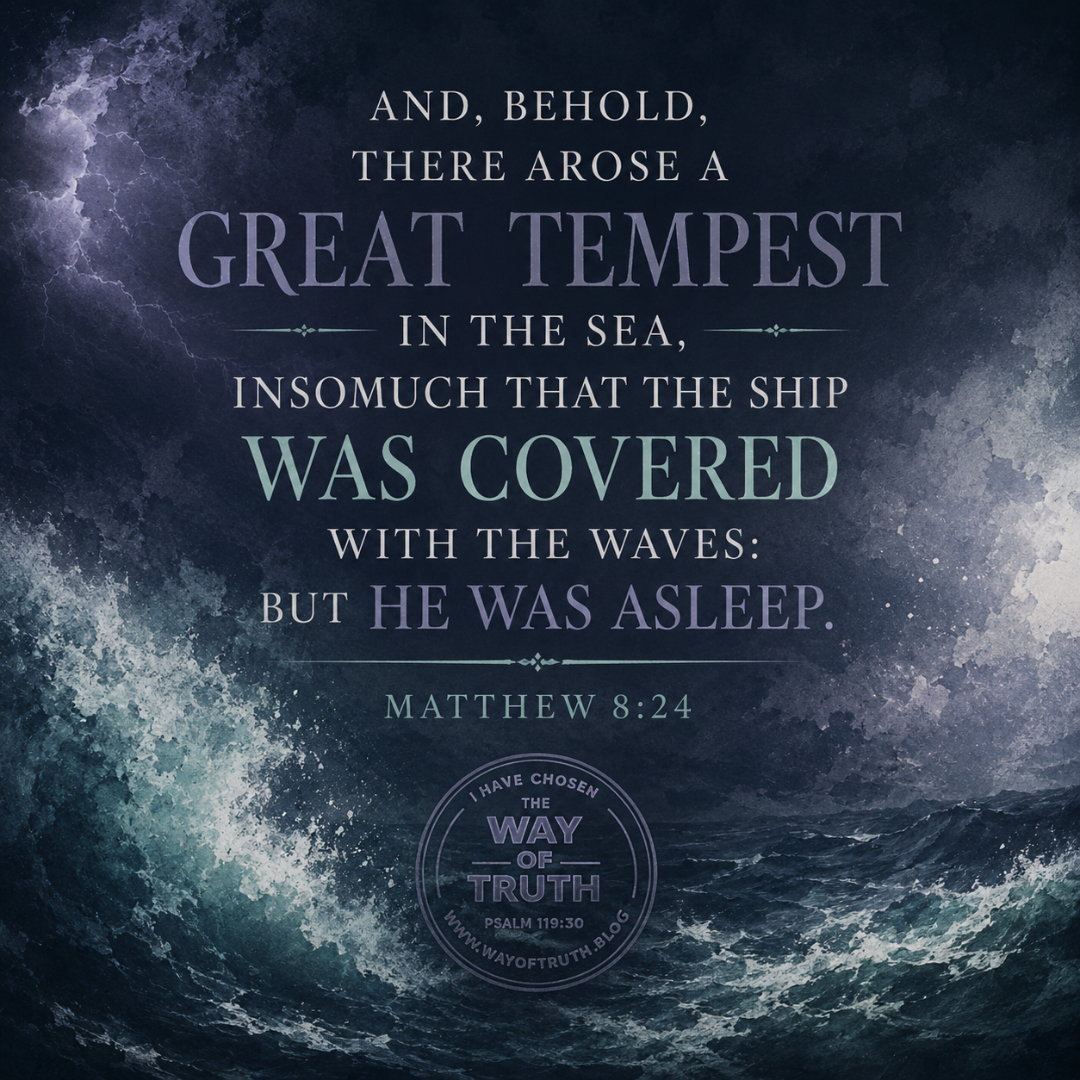
Matthew doesn’t ease us into this scene. He writes, “And, behold,” as though he wants the reader to feel the suddenness of what happened. One moment, the disciples are following Jesus into the ship. The next, they’re caught in “a great tempest in the sea.” This wasn’t a mild inconvenience or a little rough water. Matthew describes a violent storm strong enough that “the ship was covered with the waves.” The waves weren’t politely tapping the sides. They were coming over the vessel.
And here’s the surprise: “but he was asleep.”
The verse builds directly on Matthew 8:23: “And when he was entered into a ship, his disciples followed him.” That means the storm came while they were following Jesus. They weren’t running from Him like Jonah. They weren’t disobeying a command. They were exactly where disciples should be: with Christ, following His lead.
That alone corrects a shallow idea that still floats around in Christian circles: if we’re obedient, life will stay calm. Matthew will have none of that. The disciples followed Jesus into the ship, and the ship entered a storm. Obedience doesn’t exempt believers from trouble. Sometimes obedience carries us straight into trouble that we would never have chosen for ourselves.
But the verse gives us something deeper than the storm. It gives us Christ in the storm.
The Fury Around Him and the Rest Within Him
The contrast in this verse is striking. Outside, everything is violent. Waves rise. Water breaks over the boat. Experienced men are facing conditions that make them fear for their lives. Yet Jesus sleeps.
This doesn’t mean He’s careless. It doesn’t mean He’s unaware. It doesn’t mean the disciples matter less to Him than His nap. There’s a bit of holy irony here: the disciples are being drenched, the boat is being battered, and Jesus is asleep. If we were writing the scene, we might have Him standing heroically at the bow from the beginning, robe dramatically blowing in the wind. Matthew gives us something better. He gives us the real Christ, fully human, truly tired, resting in perfect peace.
This verse beautifully shows the real humanity of Jesus. He wasn’t pretending to be a man. He grew weary. He slept. The eternal Son of God truly entered our condition. He didn’t merely appear in human form like a visitor wearing a costume. He took upon Him real humanity, sin excepted. Hebrews 4:15 says He “was in all points tempted like as we are, yet without sin.” Matthew 8:24 helps us see that truth. Jesus knows bodily weakness. He knows exhaustion. He knows what it is to sleep in a boat after a long day of ministry.
Yet the larger passage won’t allow us to treat Him as merely human. In the next verses, He will rebuke the winds and the sea, and “there was a great calm.” So, this sleeping Christ is not powerless. He’s the Lord of creation resting in the middle of creation’s rage.
That’s the mystery and glory of the incarnation. Jesus is truly man and truly Lord.
The Storm Was Real, and So Was the Savior
Some skeptical readers try to treat Gospel miracles as exaggerated stories made up later to make Jesus look impressive. But Matthew’s account has the ring of concrete memory. The scene isn’t vague. There’s a ship, a sea, a sudden tempest, waves covering the boat, and Jesus asleep. The danger is physical and specific. The disciples’ fear in the following verse isn’t theatrical; it fits the situation.
The Sea of Galilee was known for sudden storms because of its geography, but Matthew’s point isn’t meteorology. He’s not giving a boating safety lecture, though “don’t ignore waves covering your boat” is probably decent advice. His point is theological: creation may rage, disciples may fear, but Christ remains Lord.
The Bible often connects the sea with human helplessness before forces too great to control. Psalm 107 describes sailors whose “soul is melted because of trouble,” and then says of the Lord, “He maketh the storm a calm, so that the waves thereof are still.” Matthew’s account stands in that same biblical stream. The God who rules the waters in the Old Testament is revealed in the person of Jesus Christ in the Gospel.
There’s also a meaningful contrast with Jonah. Jonah slept in a ship during a storm because he was fleeing from the command of God. Jesus sleeps in a ship during a storm while walking in perfect obedience to the will of His Father. Jonah’s presence endangered the sailors until he was cast into the sea. Jesus’ presence is the only hope of the disciples in the sea. Jonah points forward by contrast. Christ is the greater Prophet, the obedient Servant, and the Savior whose presence brings deliverance.
This also guards us from distorted interpretations. Some might say Jesus slept because He lacked divine knowledge or power. Others might overcorrect and say His sleep wasn’t truly human sleep. The verse doesn’t support either error. Jesus truly slept. Yet the context shows that the sleeping One is also the sovereign One. Scripture doesn’t shrink from either truth.
When It Feels Like Heaven Is Silent
This verse speaks tenderly to a struggle many believers know well: the feeling that God is silent while the storm gets louder.
There are seasons when prayer doesn’t seem to calm the wind right away. The waves keep coming. The diagnosis doesn’t change. The bills still sit on the table. The conflict remains unresolved. The grief still rolls in. The temptation keeps pressing. And somewhere in the heart, a frightened question forms: Lord, are You asleep?
Matthew 8:24 doesn’t shame us for feeling the force of the storm. The waves were real. The danger was real. Faith isn’t pretending water isn’t coming into the boat. Biblical faith looks at the waves honestly and still reckons with Christ truly.
Notice where Jesus is. He’s not on the shore watching from a safe distance. He’s in the ship. That’s a great comfort. The disciples may not yet understand the fullness of His glory, but they’re not abandoned. Their storm isn’t Christless. Their danger isn’t outside His presence.
For the believer, this matters deeply. Christ doesn’t promise a life without storms. He promises Himself. And His presence isn’t small comfort. It’s the difference between terror without hope and fear that has somewhere to run.
The sleeping Savior teaches us that peace isn’t always the immediate removal of trouble. Sometimes peace is the presence of Christ before the trouble is removed. The calm in Jesus comes before the calm on the sea. That order is worth noticing. The storm hasn’t changed yet, but Christ is undisturbed.
This doesn’t mean we should become emotionally numb. It doesn’t mean Christians should smile awkwardly in crisis and say, “Everything is fine,” while the boat is sinking. Everything wasn’t fine with the boat. But everything was under Christ’s authority.
That’s where faith learns to breathe.
Learning to Follow Christ Without Bargaining for Calm
Matthew has just shown us the cost of discipleship. A scribe said he would follow Jesus wherever He went, and Jesus answered that “the Son of man hath not where to lay his head.” Another disciple wanted to delay the call, and Jesus answered, “Follow me; and let the dead bury their dead.” Now the disciples actually follow Him, and almost immediately they face a storm.
That sequence isn’t accidental. Matthew is showing us that discipleship isn’t theory. It’s not merely saying, “I will follow thee whithersoever thou goest.” It’s getting into the boat with Jesus and discovering that “whithersoever” may include wind, waves, fear, and helplessness.
We often want to negotiate the terms of obedience. We might not say it out loud, but the heart whispers: Lord, I’ll follow You as long as the waters stay manageable. I’ll obey as long as my plans remain intact. I’ll trust You as long as I can see exactly where this is going.
Matthew 8:24 exposes that bargain. The disciples followed, and the storm came anyway.
That doesn’t make Christ unkind. It makes Him truthful. He never promised that following Him would make life easier in every earthly sense. He promised something better: that He is worth following in calm and storm alike.
This shapes the life of the Church too. A faithful church shouldn’t measure God’s favor merely by smooth conditions. Sometimes churches obey Scripture and face opposition. Sometimes gospel work brings hardship. Sometimes unity is tested not because a congregation has failed, but because real disciples are learning to trust Christ together under pressure.
In those moments, the Church must resist panic-driven ministry. Fear can make believers reactive, harsh, suspicious, and quick to grab whatever strategy promises immediate relief. But Matthew 8:24 calls us to remember who’s in the ship. Christ isn’t frantic. He’s not overwhelmed. He’s not checking the weather report and muttering, “Well, this got out of hand.”
The mission of the Church rests on the authority and presence of the Lord Jesus. We proclaim the gospel not because the cultural winds are favorable, but because Christ is Lord. We worship not because circumstances are easy, but because He’s worthy. We love one another not because everyone feels calm, but because we belong to the Savior who’s with us in the storm.
Personally, this verse invites us to examine where fear has begun to interpret Christ’s silence as Christ’s absence. That’s easy to do. When the answer doesn’t come quickly, we may assume the Lord is distant. When the waves rise, we may assume obedience has failed. When we feel weak, we may assume faith must be absent.
But the text teaches something better. The storm may be loud, and Christ may seem quiet, but He’s still present. His silence isn’t neglect. His rest isn’t indifference. His timing isn’t cruelty.
So, bring Him your fear. Bring Him your honest prayers. Bring Him the places where you feel soaked, battered, and worn thin. You don’t need to impress Him with polished courage. The disciples didn’t look especially impressive in this boat, and yet they were in the right place because they were with Him.
And when we gather with the people of God, we should help one another remember that. Some believers come to worship with waves already breaking over the sides. They don’t need clichés. They need the truth spoken with tenderness: Christ is in the ship. He’s not absent. He’s not powerless. He’s not careless. Trust Him. Call upon Him. Stay near Him.
The storm is real, but it’s not ultimate. Christ is.
Hope Beneath the Waves
There’s a deeper storm beneath every earthly storm, and Matthew’s Gospel will keep leading us toward it. The greatest danger we face isn’t wind, sickness, loss, disappointment, or even death itself. The greatest danger is sin and separation from God.
Every one of us has sinned against the Lord. We haven’t loved Him with all our heart. We haven’t obeyed Him with perfect faith. We’ve wanted our own way, trusted our own wisdom, excused our own rebellion, and treated God’s mercy as though it were something small. Scripture says, “For all have sinned, and come short of the glory of God.” Sin isn’t merely a mistake or a personality flaw. It’s guilt before a holy God. And “the wages of sin is death.”
That’s the storm no human being can sail through by strength, religion, morality, intelligence, or good intentions. We need a Savior.
The good news is that Jesus Christ didn’t merely enter a boat. He entered our world. The Son of God took on real humanity, lived without sin, and went willingly to the cross. There He bore the judgment sinners deserve. He died, was buried, and rose again in victory over sin and death. The One who slept in the storm would later sleep in the tomb, but not forever. On the third day, He rose.
That means forgiveness isn’t a vague hope. It’s offered through a living Savior. New life isn’t earned by trying harder. It’s received by repentance and faith. To repent is to turn from sin and stop defending the rebellion that’s separated you from God. To believe is to trust Jesus Christ Himself, resting your whole hope on who He is and what He has done.
Maybe your life feels storm-tossed right now. Maybe things look calm on the outside, but inside you know you’re not right with God. Don’t wait for the waves to get worse before crying out to Christ. He’s merciful. He receives sinners. He forgives fully. He saves eternally.
Come to Him honestly. Confess your sin. Trust His death and resurrection. Follow Him as Lord. The Savior who’s present with His people in the storm is also mighty to save from sin, judgment, and death. There’s no safer place than with Christ, and no greater life than living for His glory.
Reflection and Response
- Where have I mistaken obedience to Christ for a guarantee that life should become easier or calmer?
- What current “storm” has tempted me to think the Lord is absent, silent, or unconcerned?
- How does Jesus’ true humanity comfort me when I feel tired, weak, or overwhelmed?
- How can I help my church family remember Christ’s presence and authority when fear begins to shape our thinking?
- Have I personally trusted Christ for salvation, or am I still trying to survive the deepest storm of sin by my own strength?