
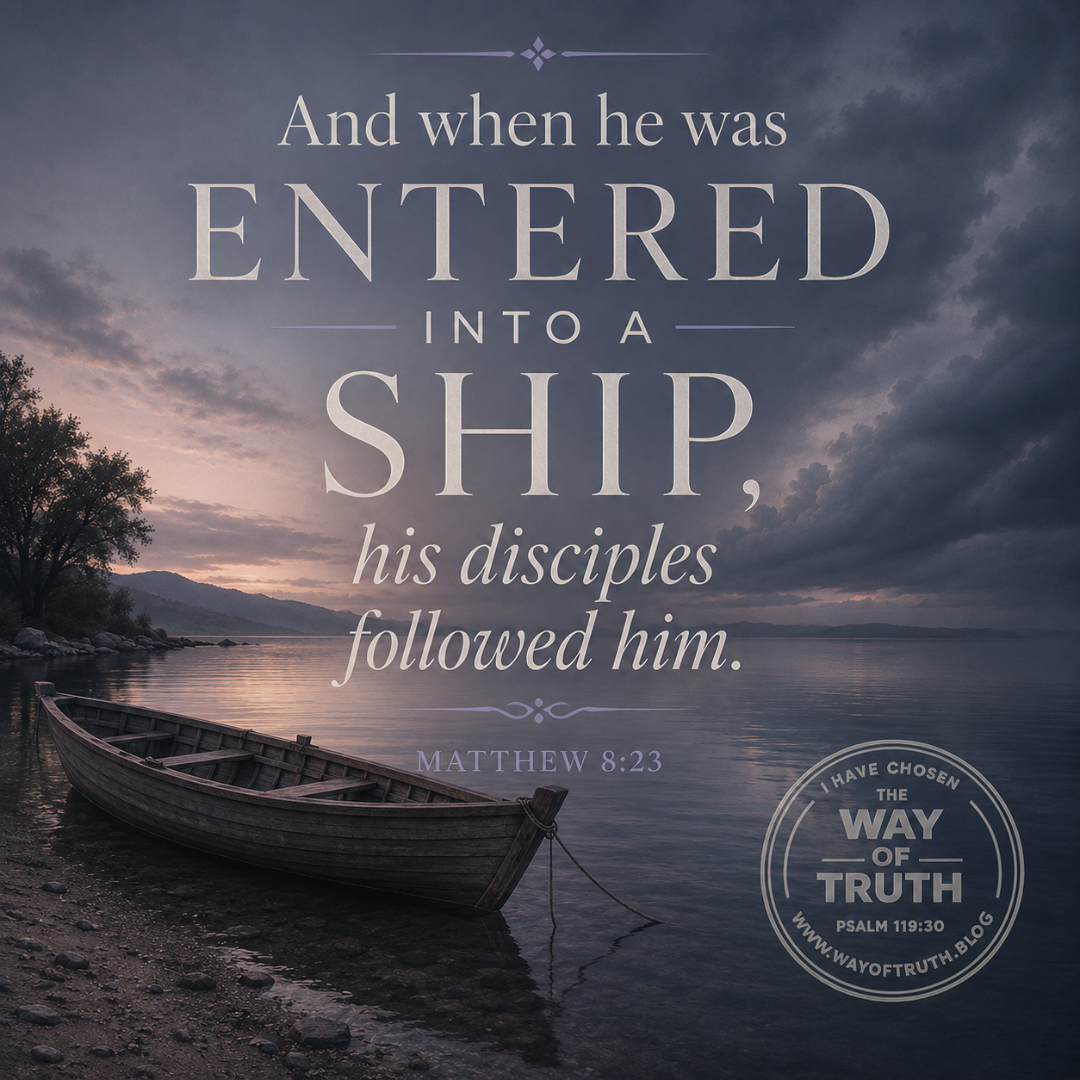
Matthew 8:23 is easy to skim because it feels like a simple transition verse. Jesus gets into a ship, and His disciples follow Him. On the surface, that’s all Matthew says. No sermon. No miracle. No confrontation. No dramatic statement from the Lord. Just movement.
But in Scripture, even the quiet movements matter.
This verse comes after Jesus commanded His disciples to depart to the other side in Matthew 8:18. Great multitudes had gathered around Him, but Jesus wasn’t governed by popularity, crowd pressure, or public excitement. He gave commandment to leave. Then two would-be followers appear in Matthew 8:19-22. One declares his willingness to follow Christ anywhere, and Jesus warns him that the Son of man has “not where to lay his head.” Another asks for delay, saying, “Lord, suffer me first to go and bury my father,” and Jesus answers, “Follow me; and let the dead bury their dead.”
Then Matthew writes, “And when he was entered into a ship, his disciples followed him.”
That order matters. Jesus enters first. His disciples follow.
The verse doesn’t present discipleship as an idea to admire from a safe distance. It’s physical obedience to the living Christ. Jesus moves, and His disciples move after Him.
The ship itself isn’t the point. The point is that following Jesus requires leaving the shore when He leaves it. In the previous verses, Jesus has stripped away false expectations. Discipleship isn’t a path of guaranteed earthly comfort. It’s not something that can be delayed whenever another priority presses forward. Now the disciples must do what disciples do: follow Him.
This little verse becomes the doorway into the storm that follows. Matthew 8:24 says, “And, behold, there arose a great tempest in the sea, insomuch that the ship was covered with the waves: but he was asleep.” That means verse 23 isn’t merely travel information. It’s the moment of obedience before the test arrives.
That’s often how the Lord works. He calls His people to follow before He shows them everything that following will involve. He doesn’t deceive them. He already told them the cost. But He doesn’t hand them a detailed weather report for every mile ahead. The disciples step into the ship because Christ is there, not because the lake is guaranteed to be calm.
The Disciples Followed a Person, not a Program
Matthew says, “his disciples followed him.” That phrase is simple, but it carries weight. The disciples aren’t following a philosophy, a movement, a moral improvement plan, or a religious brand. They’re following Him.
This is one of the great distinctions of biblical Christianity. At the center of the faith isn’t merely a set of principles, though Christianity certainly teaches truth. At the center is Christ Himself. He’s the One who calls, leads, commands, saves, and keeps His people.
The verse also quietly reminds us that discipleship belongs to those who are already identified with Christ. They are “his disciples.” They’ve heard Him, seen His authority, and responded to His call. Earlier in Matthew, Jesus taught as One having authority, healed the sick, cleansed the leper, marveled at the centurion’s faith, and showed compassion in Peter’s house. His authority has been displayed in word and deed. Now His disciples follow Him into the next scene.
This builds naturally on the wider flow of Matthew’s Gospel. Jesus isn’t presented as a distant religious teacher who gives advice and then sends people off to figure life out on their own. He is “Emmanuel,” God with us. He enters the world He made. He walks among sinners. He touches the unclean. He heals the suffering. And here, He enters a ship with His disciples.
There’s something wonderfully ordinary about that. The eternal Son of God gets into a boat.
The same Gospel that shows His divine authority also shows His real humanity. He moves from place to place. He becomes tired. In the next verse, He sleeps. The Lord of glory doesn’t float above human life like an untouchable idea. He enters it. Fully. Truly. Humbly.
That matters because the storm that follows will reveal His power over creation, but verse 23 reminds us that He’s also truly present with His people in the vessel. He’s not shouting instructions from a safe hillside while they struggle alone on the water. He’s with them.
The Shore Behind and the Storm Before
There’s an important lesson in the timing of this verse. The disciples follow Jesus before the storm begins.
This corrects a common misunderstanding. Some assume that obedience to Christ should make life smoother, safer, and more predictable. The passage doesn’t allow that conclusion. These men don’t get caught in the storm because they disobeyed. They get caught in it after they followed Christ.
That doesn’t mean every hardship is a direct test from God in the same way. We should be careful not to oversimplify suffering. But Matthew’s order is clear. The path of obedience led them into rough water.
This gives the passage strong moral coherence. Scripture never promises that following Christ removes all trouble from earthly life. It promises something better: Christ Himself. The disciples are safer with Jesus in the storm than they would be on the shore without Him.
The Old Testament prepares us for this kind of truth. Noah entered the ark before the flood came. Israel passed through the Red Sea because God led them there. Jonah’s story shows a disobedient prophet in a storm, but Matthew gives us obedient disciples in a storm. The difference matters. Not every storm means rebellion. Sometimes the storm comes while you’re exactly where the Lord told you to be.
Psalm 107:23-30 speaks of those who go “down to the sea in ships” and see “the works of the LORD.” The psalm says, “Then they cry unto the LORD in their trouble, and he bringeth them out of their distresses. He maketh the storm a calm, so that the waves thereof are still.” Matthew will soon show Jesus doing exactly that: calming the sea. Verse 23 prepares the reader for that revelation.
Skeptics may look at this passage and treat it as religious storytelling dressed up as history. But Matthew’s account is strikingly restrained. He doesn’t overdecorate the scene. He gives the simple movement: Jesus enters, the disciples follow, and the storm comes. The plainness of the narrative fits the texture of eyewitness-rooted testimony. It reads less like mythmaking and more like a remembered event.
There are also distortions to avoid. This verse shouldn’t be twisted into a promise that believers will never suffer if they follow Jesus. The very next verse says the opposite. Nor should it be used by religious manipulators to demand blind loyalty to human leaders. Matthew doesn’t say the disciples followed a charismatic personality or a controlling institution. They followed Christ. Only Jesus has the right to claim this kind of obedience from the conscience.
The Boat Is Small, But the Lord Is Not
The ship in Matthew 8:23 wasn’t a luxury liner. The disciples weren’t stepping onto a floating resort with buffet access and a calming playlist in the background. They were entering a working boat on a real body of water where storms could become dangerous quickly.
That ordinary setting matters. Jesus often teaches His disciples in the middle of real life. He doesn’t wait until conditions are ideal. He uses roads, homes, tables, fields, synagogues, mountainsides, and here, a boat. The classroom of discipleship is often whatever space obedience places us in next.
This verse also challenges modern spiritual consumerism. Many people want Jesus as comforter, counselor, and encourager, but not as Lord. They want the benefits of His presence without the surrender of following Him. Matthew gives us no room for that division. The disciples belong to Him, and because they belong to Him, they follow Him.
There’s no complicated formula here. Jesus enters. They follow.
That simplicity is both beautiful and uncomfortable. We often make obedience more complex than it is because complexity gives us room to negotiate. We want to analyze the boat, inspect the clouds, check the wind patterns, consult our fears, and maybe ask whether there’s another boat with better seating. But the text presses a simpler question: Is Christ going there?
If He is, His disciples follow.
Following Christ Together When the Shore Is Behind Us
Matthew 8:23 speaks powerfully to the life of the believer and to the life of the church. Notice that Matthew says “his disciples followed him.” This is personal obedience, but it’s not isolated obedience. They follow together.
That matters because the Christian life was never meant to be lived as a private spiritual hobby. We follow Christ as individuals, yes, but we also follow Him as part of His people. The church is a gathered company of disciples who hear the voice of Christ in His Word and move in obedience together.
Sometimes that obedience is joyful and clear. The Lord opens a door for ministry, reconciliation, generosity, witness, or service, and the church gladly steps forward. Other times, obedience feels like stepping into a small boat while the sky looks a little too moody for comfort. The Lord may call His people to forgive when bitterness feels easier, to speak truth when silence feels safer, to serve when fatigue is real, or to hold fast to Scripture when culture insists that faith should be trimmed down to something more fashionable.
Matthew 8:23 reminds us that the safest place isn’t the easiest place. The safest place is with Christ.
This doesn’t mean we become reckless. The Bible doesn’t praise foolishness dressed up as faith. But it does call us away from a discipleship governed by comfort. If Jesus has spoken clearly through His Word, our task isn’t to wait until obedience feels risk-free. It rarely does. Our task is to follow Him.
For the individual believer, this verse asks a searching question: are you willing to go where Christ leads, even when the next step isn’t fully explained? That question reaches into daily life. It touches our habits, relationships, schedules, spending, speech, and ambitions. Following Jesus isn’t only about major life decisions. It’s also about the ordinary next act of obedience.
For the church, the verse reminds us that unity is formed around Christ’s leadership. The disciples didn’t each pick their own direction. They followed Him. Churches drift when personalities, preferences, traditions, fears, or cultural pressure become the practical leader. A congregation may still use Christian language while quietly following something other than Christ. That’s a dangerous place to be.
But when the church follows the Lord together, even the storm becomes a place where His glory can be seen. The storm in Matthew 8 will expose the disciples’ fear, but it will also reveal Christ’s authority. Their weakness will become the setting for His power. That’s often the pattern of Christian growth. The Lord doesn’t wait for us to become fearless before teaching us faith. He brings us with Him, exposes what needs to be strengthened, and shows us more of Himself.
This is deeply encouraging. The disciples followed Jesus into the boat, but they didn’t yet understand Him as fully as they would. Their faith was real, but immature. Their obedience was genuine, but their fear would soon surface. And still, they were His disciples. He didn’t abandon them because their faith needed growth.
Believers should take heart from that. The Lord is patient with His people. He calls us to follow, corrects us when fear takes over, and teaches us through the very circumstances we would have preferred to avoid. None of us enjoys discovering how small our faith can feel when the waves rise. But even that discovery can become grace when it drives us back to Christ.
This verse also strengthens our witness. A watching world doesn’t need a church that pretends the sea is always calm. People can tell when that’s fake. The world needs to see disciples who follow Christ because He’s worthy, even when obedience is costly, confusing, or uncomfortable. Our message isn’t, “Come to Jesus and avoid every storm.” Our message is, “Come to Jesus, because He is Lord, Savior, and life itself. He’s worthy in calm seas and rough ones.”
And when we proclaim the gospel, we do so as people who know what it means to follow. We’re not inviting others into a vague spirituality. We’re pointing them to the living Christ. The One who entered the ship with His disciples is the same Savior who entered our world to redeem sinners. He doesn’t call from a distance. He comes near. He leads. He saves. He keeps.
So, when Christ enters the ship, follow Him.
Not because you know every detail about what lies ahead.
Not because the water is guaranteed to stay smooth.
Not because your faith is already as strong as it should be.
Follow Him because He’s Christ. Follow Him because His Word is true. Follow Him because His presence is better than the shore. Follow Him because there’s no safer place in all creation than being where the Lord has called you to be.
The Savior Who Entered Our World Calls Us to Enter Life
Matthew 8:23 gives us a small picture of a much larger truth. Jesus entered the ship, and His disciples followed Him. But the gospel begins with an even greater wonder: the Son of God entered our world to save sinners.
We needed Him to come because we couldn’t rescue ourselves. Sin isn’t merely a mistake, a weakness, or a bad habit we can polish into something acceptable. Sin is rebellion against the holy God who made us. Scripture says, “For all have sinned, and come short of the glory of God” (Romans 3:23). The penalty isn’t small, because the offense is against the eternal God. “For the wages of sin is death” (Romans 6:23).
That is our greatest storm. Not bad circumstances. Not disappointment. Not even death by itself. Our deepest danger is guilt before God.
But Christ came in mercy. The Lord Jesus lived without sin. He obeyed the Father perfectly. Then He went to the cross, not as a helpless victim, but as the willing Savior. “Christ died for our sins according to the scriptures; And that he was buried, and that he rose again the third day according to the scriptures” (1 Corinthians 15:3-4). On the cross, He bore the judgment sinners deserve. In His resurrection, He conquered sin and death.
The call of the gospel isn’t to admire Jesus from the shoreline. It’s to come to Him personally. Turn from sin. Trust Him. Receive Him as Savior and Lord. “Believe on the Lord Jesus Christ, and thou shalt be saved” (Acts 16:31).
Maybe you’ve respected Christianity for years but have never truly followed Christ. Maybe you’ve known the language, appreciated the morals, or admired the teachings, but still remained on the shore. The invitation of the gospel is gracious and serious: come to Christ. He forgives sinners. He gives new life. He doesn’t merely improve your old life; He makes you His own.
And believer, the same Savior who saved you still calls you onward. Continue to trust Him. Follow Him today. Live for His glory. The shore may feel familiar, but Christ is better.
Reflection and Response
- Where might Christ be calling me to simple obedience that I’ve made unnecessarily complicated?
- Am I willing to follow Jesus when the next step doesn’t come with a guarantee of comfort?
- How does this verse challenge the idea that obedience should always make life easier?
- In what ways does my church, family, or ministry need to follow Christ’s Word more clearly together?
- How can I bear witness to the gospel by showing that Christ is worthy in both calm and storm?