
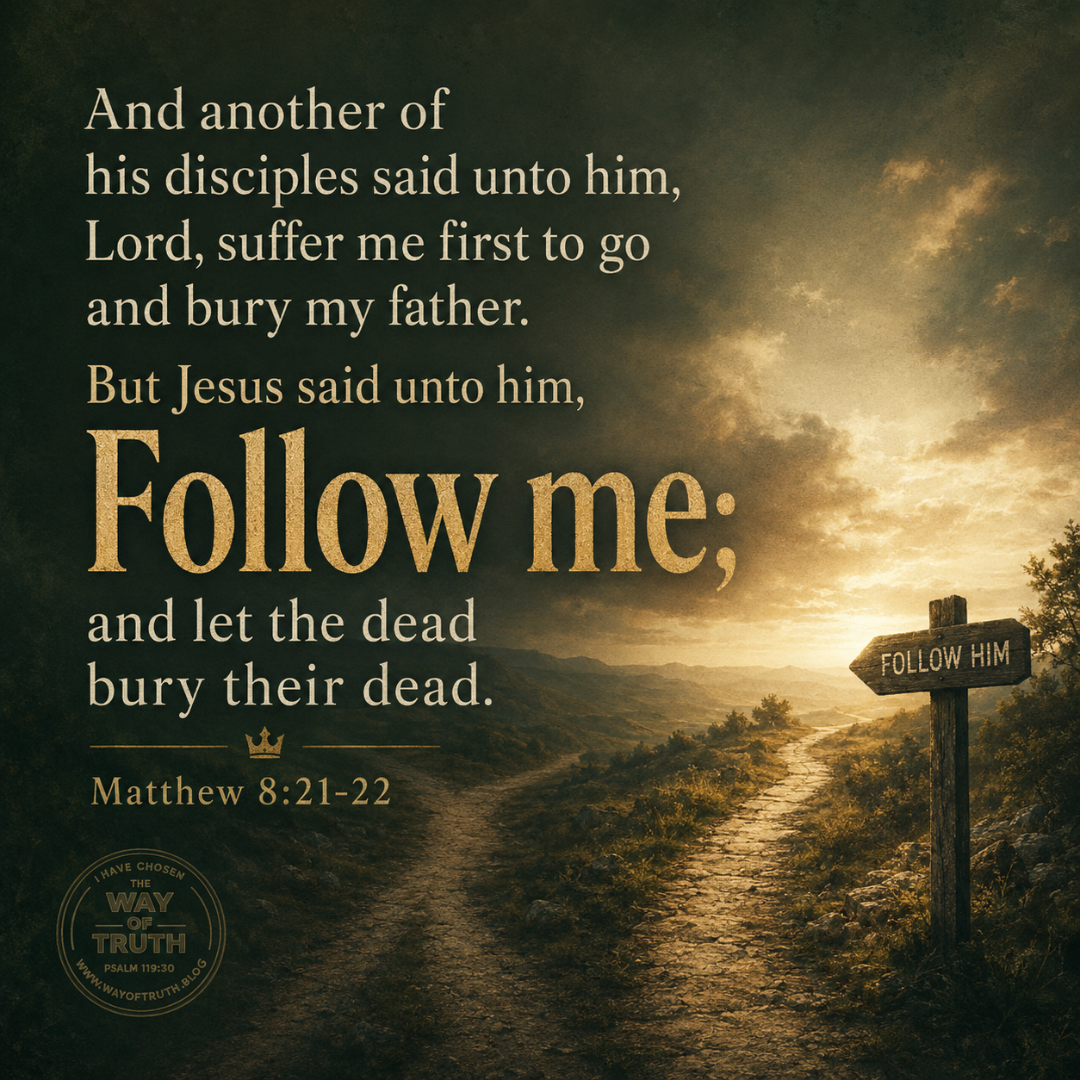
Matthew places this brief exchange immediately after Jesus gives commandment to depart unto the other side and after the scribe says, “Master, I will follow thee whithersoever thou goest.” In Matthew 8:19-20, Jesus answers an eager profession by revealing the cost of following Him: “The foxes have holes, and the birds of the air have nests; but the Son of man hath not where to lay his head.” Now, in Matthew 8:21-22, another man speaks. This time the issue isn’t rash enthusiasm, but delayed obedience.
Matthew calls him “another of his disciples.” That doesn’t necessarily mean he was one of the twelve. In the Gospels, “disciple” can refer more broadly to someone attached to Jesus as a learner or follower. This man addresses Jesus respectfully: “Lord.” His request sounds honorable: “suffer me first to go and bury my father.”
On the surface, this seems entirely reasonable. Burial was a serious family responsibility. Scripture honors father and mother. Jesus Himself upheld that commandment and rebuked those who used religious language to avoid caring for their parents. In Matthew 15:4, He says, “For God commanded, saying, Honour thy father and mother.” So, Jesus isn’t dismissing parental duty, mocking grief, or treating burial as unimportant.
The key phrase is “me first.”
That’s where the passage presses into the heart. The man isn’t merely asking to obey God’s commandment concerning family. He’s placing a condition before obedience to Christ. “Lord, suffer me first…” is a strange sentence when we slow down and hear it. He calls Jesus “Lord,” but then asks to set the terms and timing of his obedience. That’s not an ancient problem only. We know that sentence better than we’d like to admit. “Lord, I’ll follow You but first let me settle this. First let me secure that. First let me wait until life feels less complicated.” Somehow “first” has a way of quietly becoming “never.”
The Command That Reveals Christ’s Supreme Authority
Jesus answers with striking force: “Follow me; and let the dead bury their dead.”
This is one of those sayings that can feel severe until we read it in its context and in the light of the whole Bible. Jesus isn’t contradicting the command to honor father and mother. He’s not teaching coldness toward family. He’s showing that no earthly responsibility, however meaningful, may become lord over the call of Christ.
The phrase “let the dead bury their dead” is best understood as a distinction between those who are spiritually dead and those who are being called into the life of discipleship. The physically dead must be buried, but those who remain spiritually indifferent can attend to ordinary earthly matters while the one called by Christ must not postpone obedience. Jesus is speaking with holy urgency. The kingdom of God isn’t a hobby squeezed into the spare corners of life.
Some interpreters have suggested that the man’s father may not yet have died, and that the request could mean, “Let me stay home until my father eventually passes, then I will follow.”1 Matthew doesn’t give enough detail for us to insist on that with certainty. But either way, the point remains the same: the man wants delay, and Jesus calls him to immediate allegiance.
This command also shows the unique authority of Jesus. A mere teacher could say, “Follow God.” A prophet could say, “Obey the Lord.” But Jesus says, “Follow me.” He places Himself at the center of the decision. That’s not arrogance. It’s revelation. Jesus is the Son of man who has authority on earth, the King who commands the journey, the Messiah whose call outranks every competing claim.
This fits the flow of Matthew’s Gospel. In Matthew 4:19, Jesus said to Peter and Andrew, “Follow me, and I will make you fishers of men.” In Matthew 6:33, He taught, “But seek ye first the kingdom of God, and his righteousness; and all these things shall be added unto you.” Now He applies that truth personally. The kingdom must be first because the King must be first.
A Hard Saying That’s Morally Good
Skeptics sometimes point to this verse and accuse Jesus of being harsh, anti-family, or unreasonable. But that objection only works if the verse is isolated from the rest of Scripture. Jesus honored the moral law. He showed compassion to grieving families. He restored life to the dead. He provided for His mother even while dying on the cross. There’s no moral contradiction in Christ.
The real tension isn’t between Jesus and family love. It’s between Jesus and misplaced priority. Family is a gift from God, but even God’s gifts become dangerous when they become excuses for disobedience. A good thing can become a false first thing. That’s not because the good thing is bad, but because the heart has placed it in the wrong seat.
This passage also guards against cultic misuse. False teachers and controlling religious groups have sometimes twisted verses like this to demand unhealthy loyalty to themselves, their organization, or their leader. That’s not what Jesus is doing. Christ isn’t handing His authority to manipulative men. The command is “Follow me,” not “follow any leader who quotes this verse.” Biblical discipleship may cost us deeply, but it never authorizes spiritual abuse, cruelty, or the abandonment of God’s moral commands.
Jesus’ words are hard, but they’re righteous. They cut because they tell the truth. He knows how easily delay disguises itself as wisdom. He knows how quickly responsibility can become an excuse when the heart is avoiding surrender. He speaks with the authority of the One who sees not only the schedule, but the soul.
The Living Must Not Be Governed by the Dead
There’s a solemn contrast in Jesus’ words: “the dead” and “their dead.” Without Christ, people may be alive physically and still dead spiritually. That’s not meant as an insult. It’s a diagnosis. Scripture repeatedly teaches that sin brings death. A person can have plans, duties, relationships, routines, and respectable concerns, yet still lack spiritual life before God.
Jesus calls this man out of the realm of spiritual death and into the life of following Him. That’s why the command is urgent. He’s not asking the man to become busier. He’s calling him to life.
This also reminds us that discipleship isn’t merely admiration for Jesus. Many people admire Christ from a safe distance. They respect His morals, enjoy His compassion, quote His sayings, and appreciate His influence. But Jesus doesn’t simply ask to be appreciated. He commands, “Follow me.”
The difference matters. Admiration can remain in control. Following requires surrender. Admiration says, “Jesus is impressive.” Faith says, “Jesus is Lord.” Admiration can applaud while staying seated. Discipleship gets up and goes where Christ commands.
When Obedience Interrupts Our Carefully Arranged Lives
The practical force of this passage isn’t that Christians should neglect family responsibilities. A believer who uses “ministry” as an excuse to be selfish at home has missed the heart of Christ. Scripture doesn’t honor spiritual-sounding disobedience. If a person refuses ordinary love, care, honesty, or responsibility while claiming to be devoted to God, something has gone badly wrong.
But this passage does confront the subtle ways we postpone obedience. We may not say, “Lord, suffer me first to bury my father.” Our version may sound like this: “Lord, I’ll obey after life settles down.” “I’ll serve when I have more time.” “I’ll speak about Christ when it feels less awkward.” “I’ll repent once I understand everything.” “I’ll get serious about prayer when my schedule opens up.” “I’ll follow You fully after I finish building the life I want.”
And honestly, some of those excuses can sound very responsible. That’s what makes them dangerous. The issue isn’t whether the thing we mention is real or important. The issue is whether we’re using it to put Christ second.
For the individual believer, Jesus’ words call us to examine the order of our loves. Not merely our stated beliefs, but our working priorities. What gets our first obedience? What gets the final word? What are we willing to rearrange for Christ, and what do we quietly treat as untouchable?
For the Church, this passage is a needed correction. Churches can also say, “Lord, suffer us first…” Lord, let us first preserve our comfort. First let us protect our traditions. First let us avoid controversy. First let us keep everyone pleased. First let us maintain the appearance of success. But Christ doesn’t call His Church to be a religious waiting room. He calls His people to follow Him, proclaim His gospel, worship in truth, love one another sincerely, and obey His Word even when obedience is costly.
This matters for mission. The world doesn’t need a Church that merely knows how to manage delay. It needs a Church alive in Christ, submitted to Scripture, and willing to follow the Lord across uncomfortable lines. We’re not called to be reckless, careless, or rude. But we are called to be obedient. There’s a difference between wisdom and hesitation dressed up in church clothes.
This passage also brings comfort. That may seem surprising, because the words are sharp. But there’s comfort in knowing that Jesus calls us out of half-heartedness because He’s worthy of our whole life. He doesn’t call us away from death into misery. He calls us from death into life. He doesn’t expose our excuses to shame us for sport. He exposes them to free us from the little kingdoms that can’t save us.
And when obedience is hard, we should remember who gives the command. This is the same Christ who touches the leper, heals the centurion’s servant, restores Peter’s wife’s mother, casts out devils with His word, and bears our infirmities. The One who says “Follow me” isn’t cruel. He’s merciful, wise, and faithful. He may lead us through costly obedience, but He never leads wrongly.
So, the question isn’t whether following Christ will disrupt our plans. It will. The better question is whether our plans are safer than His will. They’re not. Christ is better than the life we’re afraid to surrender.
The Savior Who Calls the Dead to Life
There’s a deeply personal invitation inside this command. Jesus says, “Follow me.” That means He’s not merely pointing out the way from a distance. He Himself is the way. He calls sinners not just to improve their priorities, but to come to Him for life.
Every one of us has tried, in some way, to put something before God. We’ve said “me first” in more ways than we can count. Sin isn’t only the obvious evil we regret. It’s also the inward refusal to give God His rightful place. It’s the desire to rule ourselves, excuse ourselves, and arrange life around our own will. Scripture teaches that the wages of sin is death. That death isn’t only physical; it’s spiritual separation from God, and it leads to eternal judgment.
But the good news is that Jesus Christ came for sinners like us. The One who said “Follow me” also went to the cross. He bore the penalty His people deserved. He died not for His own sin, for He had none, but for the sins of others. He shed His blood as the atoning sacrifice. He was buried, and He rose again the third day in victory over sin, death, and the grave.
This is why His call isn’t merely a demand. It’s grace. He calls the spiritually dead to life. He calls the guilty to forgiveness. He calls the wandering to Himself.
You don’t become a Christian by cleaning up your life enough to impress God. You come as a sinner to the Savior. You turn from sin and trust in Christ. That means you stop clinging to your excuses, your self-rule, your religious pride, or your delay, and you cast yourself upon the mercy of the risen Lord.
And His promise is sure. Those who trust in Christ are forgiven, made new, and given eternal life. They’re brought out of death into life, out of darkness into light, out of guilt into peace with God.
So, hear the kindness in His command: “Follow me.” Don’t wait for a perfect season. Don’t wait until your heart feels impressive. Don’t wait until every earthly matter is neatly settled. Come to Christ. Trust Him. Follow Him. He’s worthy of your life, and He’s gracious enough to save all who come to Him by faith.
Reflection and Response
- Where am I most tempted to say, “Lord, I will follow You, but first…”?
- Have I allowed a good responsibility, relationship, plan, or fear to become an excuse for delayed obedience?
- How does Jesus’ command, “Follow me,” reveal His authority over every part of my life?
- In what ways should my church be more fully shaped by obedience to Christ rather than comfort, approval, or routine?
- How does the gospel give me both the courage and the grace to follow Christ without delay?
- Michael J. Wilkins, Matthew, NIV Application Commentary (Grand Rapids: Zondervan, 2004), 350. ↩︎