
Jesus has just finished speaking about treasure, where we store it and what it reveals about our hearts (Matthew 6:19–21). Now He moves seamlessly into the eye, which at first feels like a sudden shift, but it’s not. He’s still talking about what governs us from within.
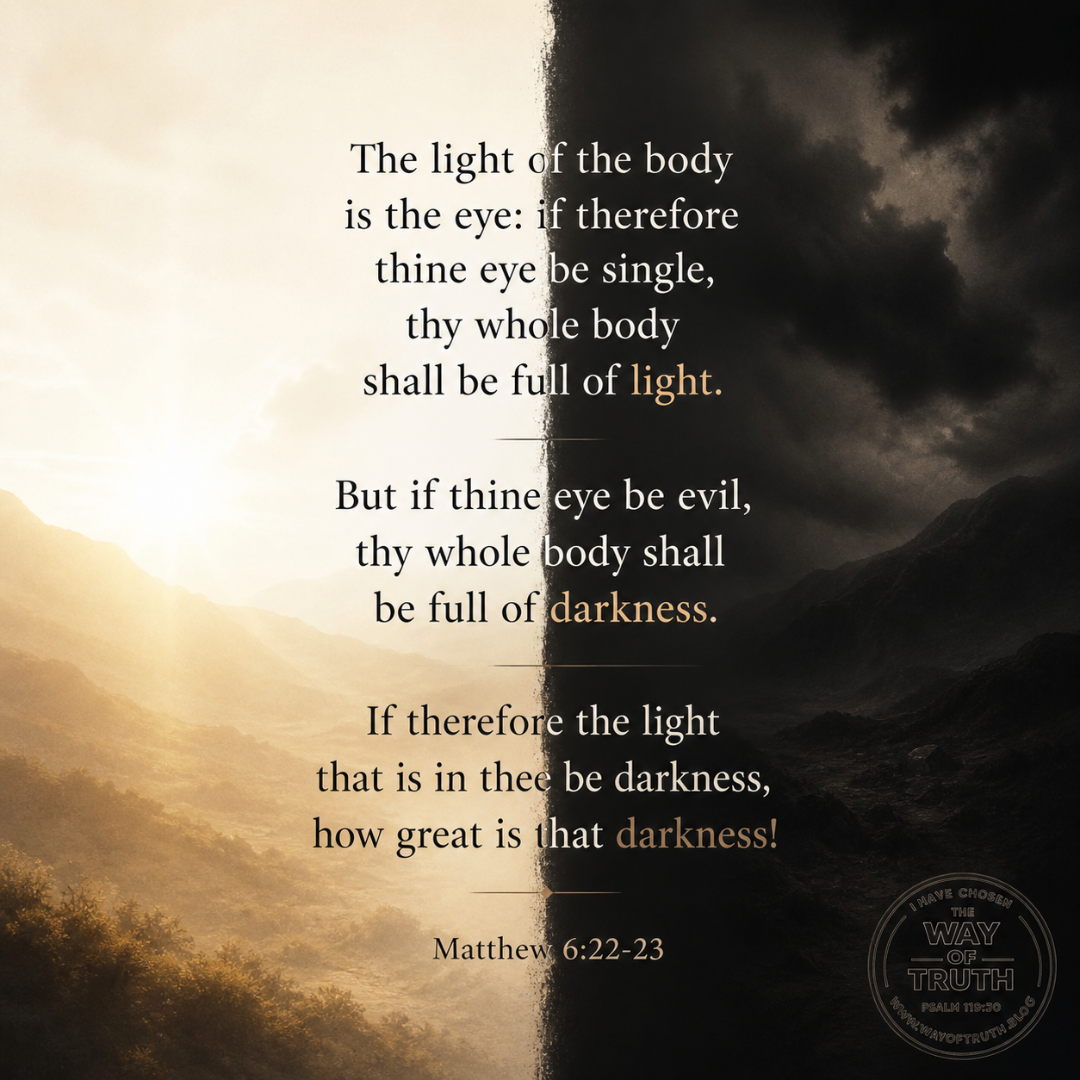
“The light of the body is the eye.” In simple terms, the eye is the gateway. It’s how we take in the world, how we perceive, how we interpret reality. But Jesus isn’t giving a lesson on biology. He’s speaking about spiritual perception.
“If therefore thine eye be single…” The word single carries the idea of being undivided, clear, sincere, focused. A “single eye” is not distracted by competing loyalties. It’s fixed on one thing: God and His kingdom. This connects directly to the previous passage: if your treasure is in heaven, your “eye” is set in that direction. Your vision is aligned.
When that’s true, “thy whole body shall be full of light.” In other words, your entire life becomes shaped by truth, clarity, and righteousness. You’re not stumbling around trying to figure out what matters. You see it. You know it. You walk in it.
But then comes the warning: “if thine eye be evil…” In Scripture, an “evil eye” often refers to selfishness, greed, envy, or moral corruption. It’s not just seeing wrong things; it’s seeing wrongly. It’s a distorted lens. When the eye is corrupted, everything downstream is affected.
“Thy whole body shall be full of darkness.” That’s sobering. If your perception is off, your decisions will be off. If your values are twisted, your life will follow. Jesus isn’t saying people occasionally make mistakes. He’s describing a condition where the inner compass is broken.
And then He sharpens it further: “If therefore the light that is in thee be darkness, how great is that darkness!” That’s the most unsettling line in the passage. It speaks of self-deception: thinking you see clearly when you don’t. Calling darkness “light.” Believing you’re on the right path while moving further from God.
This cuts against a common modern assumption: that sincerity equals truth. Jesus says that’s not enough. You can be sincere and still be deeply wrong if your “eye” isn’t rightly set.
This passage also answers a subtle objection. Some claim moral truth is subjective, that people simply “see things differently.” But Jesus speaks as though there is a right way to see and a wrong way. Light is real. Darkness is real. And the difference between them isn’t determined by preference but by alignment with God’s truth.
In the broader sweep of Scripture, this makes perfect sense. From Genesis onward, sin is often described as blindness or deception. And salvation, in contrast, is described as opening the eyes (Psalm 119:18; John 9). Jesus Himself is called “the light of the world” (John 8:12), the One who enables us to truly see.
So, this isn’t just about what you look at. It’s about how you look, what you value, and what ultimately directs your life.
Guarding Your Vision in a Distracted World
If the eye shapes the whole life, then what we allow to guide our vision matters more than we often admit.
We live in a world that constantly competes for our attention. Every day presents a buffet of values: success defined by wealth, identity rooted in approval, purpose reduced to comfort. None of these announce themselves as darkness. In fact, they often come dressed as “light.” That’s what makes this passage so relevant.
Jesus is calling us to examine not just our actions, but our focus. What are we aiming at? What are we trusting to define what’s good, worthwhile, and true?
A “single eye” doesn’t mean a narrow life in the sense of missing out. It means a clarified life. When your heart is set on God, decisions become simpler. Not always easier, but clearer. You don’t have to constantly renegotiate your values because they’re anchored.
This applies to the life of the Church as well. A church with a “single eye” stays centered on Christ, the gospel, and the glory of God. It doesn’t drift into becoming a social club, a political platform, or a self-help center. When that focus is lost, confusion follows. Programs multiply, but clarity diminishes.
On a personal level, this passage invites some honest questions. Are we seeing clearly, or are we being shaped by subtle distortions? It’s possible to be busy with religious activity and still have a divided focus. Jesus isn’t impressed by outward motion if the inward vision is misaligned.
If your life feels scattered or dim, Jesus isn’t telling you to try harder to produce light. He’s pointing you back to the source: your “eye,” your focus. Realignment begins there.
And yes, this takes intentionality. It means guarding what influences your thinking. It means saturating your mind with Scripture. It means asking not just “Is this allowed?” but “Is this helping me see clearly?”
At times, it may even feel a bit like cleaning a smudged window. You didn’t realize how much it was affecting your view until it’s wiped clean. Suddenly, things look different, not because the world changed but because your vision did.
Ultimately, living with a “single eye” is about living with a steady gaze on God’s glory. It’s about valuing what He values, loving what He loves, and walking in the light He provides. And when that happens, your life—quietly, steadily—begins to reflect that light to others.
Come Into the Light
Maybe as you read this, something feels off, not just in theory but personally. You recognize that your focus hasn’t been clear. You’ve been pulled in different directions, chasing things that promised light but delivered something dimmer.
That awareness matters. It’s not something to ignore. It’s an invitation.
The Bible teaches that our problem goes deeper than distraction. At the core, we’re sinners. We don’t naturally see God clearly because we don’t naturally love Him as we should. We turn inward. We prioritize ourselves. And that leads to spiritual darkness, no matter how bright things may appear on the surface.
But God didn’t leave us there.
He sent His Son, Jesus Christ, into the world, not only to teach truth but to be the light. He lived a perfectly righteous life, never once distorted in His vision or divided in His devotion. Then He went to the cross, where He bore the penalty for our sin. The judgment we deserved fell on Him.
He died, was buried, and rose again in victory over sin and death.
This means forgiveness is real. Not partial or conditional on your ability to clean yourself up, but complete for all who turn to Him in repentance and faith.
So, what does that look like?
It means acknowledging your sin honestly before God. It means recognizing that you haven’t seen rightly, loved rightly, or lived rightly. And it means trusting that Jesus has done what you couldn’t: paying for your sin and opening the way to new life.
When you come to Christ, something remarkable happens. You don’t just receive forgiveness. Your eyes are opened. Your heart is changed. You begin to see differently, not perfectly but truly.
If you’ve never done this, don’t wait for a more convenient moment. Come to Him now. Turn from sin. Trust in Christ. Ask Him to give you a new heart and a clear vision.
And for those who already belong to Him, this is a call to remain in that light and to live with a steady, undivided focus on the One who saved you.
Reflection and Response
- Where is my focus currently directed, and what does that reveal about what I truly value?
- Are there areas in my life where I may be mistaking darkness for light?
- What practical steps can I take to cultivate a more “single” and God-centered vision?
- How does my current way of living reflect (or fail to reflect) the light of Christ to others?
- In what ways can I more intentionally glorify God and share the gospel as someone walking in His light?