
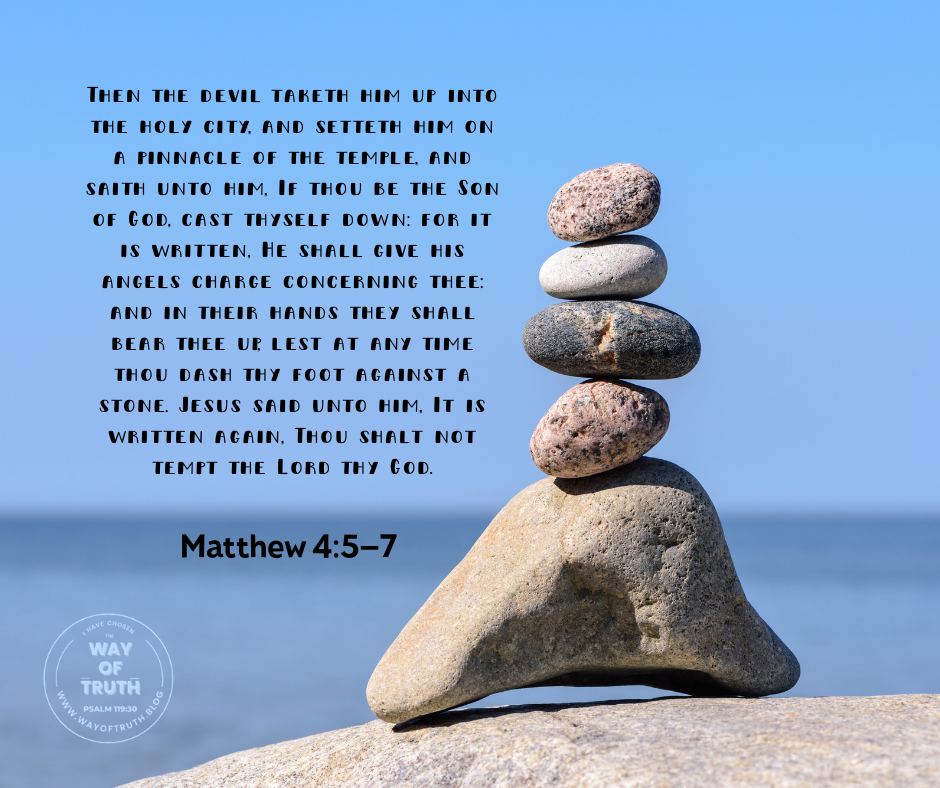
The wilderness temptation now moves to Jerusalem itself. The place that represented the center of Israel’s worship becomes the stage for the next test.
The devil sets Jesus “on a pinnacle of the temple.” The exact architectural feature is debated, but the point is clear: it is high, exposed, and dangerous. One step outward would mean certain death.
Then the adversary repeats his earlier strategy: “If thou be the Son of God.” The question again presses on identity. The Father has already spoken from heaven declaring Jesus His beloved Son. The devil attempts to reopen the issue.
But notice what changes this time.
The devil quotes Scripture.
“For it is written,” he says, citing Psalm 91:11–12: “He shall give his angels charge concerning thee.” The passage promises God’s protection over those who trust Him. The devil’s argument is simple: if Jesus truly trusts the Father, then He should jump. God will rescue Him.
But the devil’s use of Scripture is selective. Psalm 91 speaks about God’s protection in the path of obedience. It doesn’t authorize reckless behavior designed to force God’s intervention.
By isolating a promise from its context, the devil twists the meaning.
Jesus refuses the trap.
The Difference Between Faith and Presumption
Jesus responds the same way He did before: with Scripture.
“It is written again.”
This phrase matters. He doesn’t reject the authority of Psalm 91. Instead, He interprets it in light of the rest of God’s word. He quotes Deuteronomy 6:16: “Thou shalt not tempt the Lord thy God.”
This verse refers back to Israel’s experience at Massah, where the people demanded miraculous proof of God’s presence. They weren’t trusting Him; they were testing Him.
That is exactly what the devil invites Jesus to do.
Jump. Force God to act. Demand a dramatic rescue.
But that wouldn’t be faith. It would be presumption.
Faith trusts God’s promises while walking in obedience. Presumption manufactures danger and expects God to intervene.
Jesus refuses to manipulate the Father. The Son won’t demand signs to validate what the Father has already declared.
There’s also a broader theological point here. Scripture interprets Scripture. No verse stands alone. A promise can’t be used to cancel a command.
The devil quoted Psalm 91. Jesus placed it alongside Deuteronomy 6. When both passages are read together, the distortion collapses.
This exchange demonstrates the reliability and coherence of Scripture. The Bible isn’t a loose collection of isolated sayings. It’s a unified revelation.
Guarding the Heart Against Twisted Truth
This passage exposes a danger that every believer must face.
Misusing Scripture isn’t limited to skeptics or obvious false teachers. Sometimes it appears in subtle spiritual reasoning.
We might justify a questionable decision by appealing to a single promise. We might claim God’s protection while ignoring His commands. We might assume that bold faith means creating situations where God must prove Himself.
Jesus shows a better path.
He refuses to manipulate God for dramatic effect. He refuses to test divine faithfulness through reckless action. Instead, He trusts the Father quietly and obediently.
The church also needs this wisdom. Throughout history, movements have emerged that claim extraordinary spiritual authority while neglecting the full counsel of Scripture. A verse here, a promise there, detached from context.
The result is confusion and sometimes disaster.
True faith doesn’t demand spectacle. It rests in God’s character and obeys His word.
There’s something else worth noticing. The devil takes Jesus to the temple. Temptation sometimes appears in religious settings. The presence of sacred language or sacred places doesn’t automatically guarantee truth.
Discernment requires more than familiarity with Scripture. It requires understanding Scripture.
And that understanding grows through steady exposure to the whole of God’s word.
If You Are Looking for Proof Instead of Trust
Many people approach God the same way the devil tempted Jesus to approach Him.
They want proof first.
“If God is real, let Him show me.”
“If God cares, let Him fix my situation.”
“If God wants me to believe, let Him prove it.”
At first glance, that sounds reasonable. But it places God on trial.
Scripture consistently presents a different invitation. God has already revealed Himself through creation, through His word, and most clearly through His Son.
Jesus Christ didn’t jump from the temple to prove who He was. Instead, He went to the cross.
There, the Son of God bore the penalty for sin. He died in the place of sinners who had repeatedly tested and ignored God. Three days later, He rose again, demonstrating His victory over sin and death.
That’s the proof God has given.
The question now is not whether God will prove Himself again. The question is whether we will trust the proof He has already provided.
If you’ve never turned to Christ, the invitation is simple but serious. Repent of your sin. Trust in Him alone. Believe that His death and resurrection provide forgiveness and new life.
God isn’t waiting to be tested. He’s calling you to trust the Son He has already revealed.
Reflection and Response
- What does this passage teach me about the danger of using Scripture out of context?
- How can I distinguish between genuine faith and spiritual presumption?
- Am I seeking dramatic signs from God instead of trusting His word?
- What habits can help me understand the whole counsel of Scripture more faithfully?
- Have I trusted in Christ, or am I still demanding proof before believing?